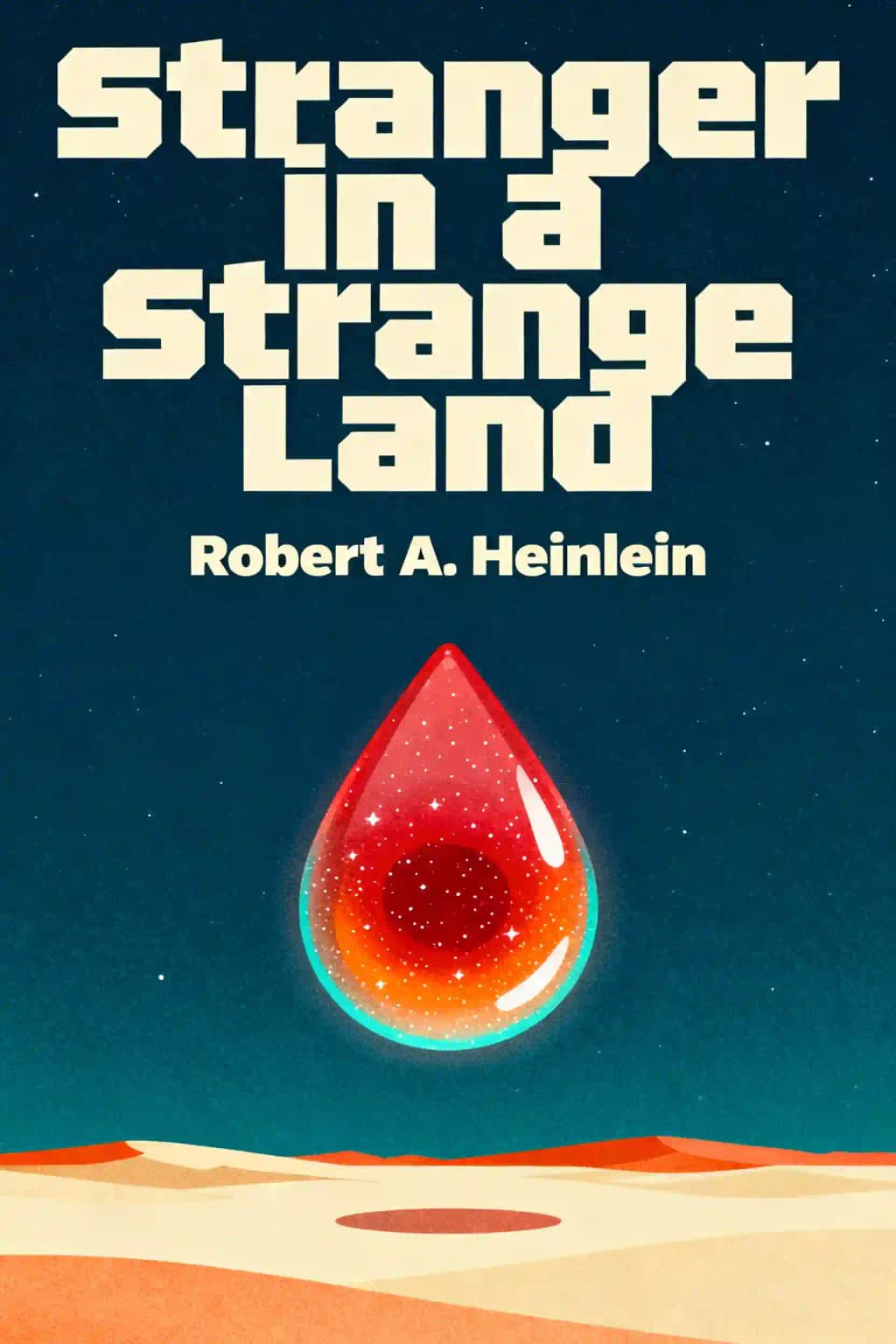
Chapter 1
When Earthly Stranger Met Martian Wisdom
Imagine waking up on a planet where no one understands you-not your language, not your customs, not even your fundamental perception of reality. This is the extraordinary premise of Robert A. Heinlein's "Stranger in a Strange Land," a groundbreaking science fiction novel that transcended its genre to become a cultural phenomenon. First published in 1961 in a heavily edited form, the complete version wasn't released until 1991, revealing Heinlein's full, uncompromising vision. The book became a cornerstone of 1960s counterculture, with its rejection of conventional morality and introduction of concepts like "grokking" (understanding so thoroughly that observer becomes part of observed). Charles Manson claimed it as inspiration (much to Heinlein's horror), while celebrities from Michelle Pfeiffer to Elon Musk have cited it as a favorite. Beyond its cultural impact, the novel won the prestigious Hugo Award and became the first science fiction novel to appear on The New York Times bestseller list, permanently altering how literary critics viewed the genre.
Chapter 2
The Man from Mars: Valentine Michael Smith
Valentine Michael Smith-the sole survivor of the first human expedition to Mars-returns to Earth as a true stranger in a strange land. Born on Mars after his mother's death in childbirth, Smith was raised entirely by Martians, absorbing their language, philosophy, and psychic abilities while having no exposure to human culture. When the second expedition to Mars discovers him twenty-five years later, Smith is physiologically human but mentally Martian-a being with extraordinary powers who views Earth through utterly alien eyes.
Smith's introduction to Earth is traumatic. Kept in isolation at Bethesda Medical Center, he struggles with Earth's gravity, unfamiliar foods, and human customs. His English is rudimentary, and concepts we take for granted-like humor, lying, or clothing-are completely foreign to him. When nurse Gillian Boardman sneaks into his room and offers him water, she unwittingly participates in a sacred Martian ritual of profound significance-the sharing of water that creates an unbreakable bond between "water brothers."
What makes Smith truly remarkable isn't just his cultural differences but his superhuman abilities. Having been raised in Mars' low gravity, his muscles developed differently, giving him extraordinary control over his body. He can enter trance states that slow his metabolism to near-death levels, recall anything he's ever experienced with perfect clarity, and most dramatically, make objects or people vanish completely through a Martian discipline that manipulates matter at a fundamental level. Yet despite these powers, Smith remains childlike in his innocence-a being of immense potential who must learn the most basic aspects of human interaction.
The government's interest in Smith extends beyond scientific curiosity. As the sole survivor of the original expedition, he has inherited enormous wealth from the eight crew members' mutual heir arrangement. More significantly, under the "Larkin Decision" legal precedent, Smith is technically the owner of Mars itself, having maintained continuous occupation of the planet. This makes him both immensely wealthy and politically valuable-a combination that puts his life in danger from those who would control his assets and his claim to Mars.
Chapter 3
Jubal Harshaw: Reluctant Guardian and Philosophical Guide
When Jill Boardman rescues Smith from government custody, she takes him to Jubal Harshaw - a cantankerous polymath who becomes Smith's mentor and father figure. Harshaw embodies Heinlein's ideal of the complete human: doctor, lawyer, writer, philosopher, and curmudgeon who "decided to live forever or die in the attempt." Living in self-imposed semi-retirement with three beautiful secretaries (Anne, Miriam, and Dorcas) and two handymen (Duke and Larry), Jubal has withdrawn from a world he finds increasingly disappointing, creating his own intellectual sanctuary in the Poconos Mountains.
Jubal's household becomes Smith's first real exposure to human society - a microcosm carefully balanced between structure and freedom. Here, Smith learns about art, literature, religion, and human relationships in an environment that accommodates his strangeness while gently introducing him to human customs. The household's daily rhythms, from morning swims to evening discussions, provide Smith with his first model of functional human community. Jubal teaches Smith to question everything, especially authority, while protecting him from government agents who want to control his wealth and power. His method combines Socratic dialogue with practical demonstrations, allowing Smith to learn through both instruction and experience.
What makes Jubal fascinating is his contradictory nature - a complexity that mirrors humanity itself. He rails against humanity's follies yet passionately defends human potential. He claims to care only about himself yet risks his reputation, wealth, and safety to protect Smith. He dismisses organized religion as "pious poppycock" yet shows deep respect for Smith's Martian beliefs and spiritual practices. His library contains everything from classical philosophy to pulp magazines, reflecting his belief that wisdom can be found in both high and low culture. When Smith naively asks if Jubal is God, Jubal vehemently denies it, explaining that humans aren't gods but merely "the local yokels" - yet he ultimately becomes the moral compass that guides Smith's developing understanding of humanity.
Jubal's relationship with Smith reveals his hidden paternal nature, carefully concealed beneath layers of cynicism and wit. Despite his gruff exterior, he comes to love Smith as a son, teaching him not just about human culture but about human values - compassion, justice, and the importance of individual thought. When Smith asks about the meaning of a sculpture - Rodin's "Fallen Caryatid" - Jubal explains it represents the nobility of attempting the impossible, a lesson that foreshadows Smith's own destiny. Through their discussions of art, politics, and human nature, Jubal helps Smith develop critical thinking skills while maintaining his Martian-taught ability to see truth directly. Jubal's greatest gift to Smith isn't protection or knowledge but perspective - helping him integrate his Martian upbringing with his human nature while teaching him to navigate the complexities of human society without losing his essential self.
Chapter 4
Grokking: The Martian Philosophy of Ultimate Understanding
At the heart of Heinlein's novel lies the untranslatable Martian concept of "grok"-perhaps the book's most enduring contribution to language and philosophy. Smith explains that "grok" means "to drink" in its simplest form, but its deeper meaning encompasses total understanding, becoming one with, and loving completely. To grok something is to understand it so thoroughly that the observer becomes part of the observed, eliminating all separation between subject and object.
This concept transforms how Smith perceives reality. When he drinks water with someone, creating the water-brotherhood bond, he doesn't merely form a relationship-he merges with them on a fundamental level. When he studies a subject, he doesn't just learn about it-he becomes it. This perspective makes Smith incapable of hatred or violence toward those he groks, as harming them would be harming himself. It also gives him his extraordinary powers; he can make objects disappear because he groks their essence so completely he can transform their physical reality.
Grokking represents a radical departure from Western dualistic thinking. Where human philosophy often separates mind from body, self from other, and knower from known, Martian philosophy sees these distinctions as illusions. This monistic worldview has profound implications. It eliminates the possibility of misunderstanding once something is truly grokked. It removes the basis for conflict, as one cannot fight what is ultimately part of oneself. And it creates a spiritual framework where all beings are interconnected aspects of a greater whole.
The concept resonated so powerfully with 1960s counterculture because it offered an alternative to what many saw as the alienation of modern life. It suggested a path to authentic connection in a world increasingly dominated by superficial relationships. When hippies and spiritual seekers adopted "I grok you" into their vocabulary, they weren't just using slang-they were expressing yearning for the kind of profound understanding Smith embodied.
Ultimately, grokking serves as both the novel's philosophical core and its narrative engine. Smith's journey involves learning to grok humanity with all its contradictions, while teaching select humans to grok the Martian perspective. This cultural exchange forms the basis for Smith's eventual religious movement, where grokking becomes the central spiritual practice of his followers.
Chapter 5
Water Brotherhood: Creating Family Through Ritual
The Martian concept of water-sharing transcends mere friendship or even blood relation. On a planet where water is precious beyond measure - where every drop means survival - the act of sharing water creates a bond more sacred than any Earth relationship. When Smith shares water with someone, they become "water brothers" - connected by an unbreakable link that makes betrayal literally unthinkable. This ritual becomes Smith's primary means of forming connections on Earth, beginning with Jill in the hospital and expanding to include Jubal and his entire household. The significance of water on Mars, where it exists in such scarcity that wasting even a single drop is considered deeply offensive, gives the ritual its profound weight and meaning.
The water ceremony's power comes from its striking simplicity and absolute sincerity. It requires no elaborate rituals, no institutional approval, no witnesses - just the willing sharing of water and the phrase "May you never thirst." Yet its implications reshape the participants' entire worldview. Water brothers cannot lie to each other, cannot harm each other, and are obligated to share all possessions freely. When Smith makes Jill his water brother, he's not just making a friend - he's creating family in the Martian sense, someone with whom he shares complete trust and unity of purpose. The ceremony permanently alters both participants' neural patterns, creating a psychic bond that makes deception impossible and ensures complete emotional transparency.
As Smith establishes more water brotherhoods on Earth, these relationships form the foundation of his church, expanding from intimate connections to a broader spiritual movement. Unlike human religions that often rely on abstract beliefs, historical traditions, or hierarchical structures, Smith's Church of All Worlds builds its community through direct personal connections and shared experience. Each member is water brother to all others, creating an intricate network of absolute trust and mutual understanding. This structure eliminates the need for rules or commandments - water brothers naturally act in each other's best interests because they truly grok each other's needs, desires, and essential nature. The water-sharing creates a telepathic bond that allows members to understand each other on a fundamental level impossible in traditional human relationships.
The water brotherhood concept particularly appealed to readers in the individualistic 1960s because it offered an alternative model of community - one based on chosen connections rather than accident of birth or institutional membership. It suggested that meaningful relationships could be created through conscious choice and mutual commitment rather than social obligation or traditional structures. When Smith's church members greet each other with "Thou art God," they're acknowledging this sacred connection, recognizing the divine within each person they've accepted as water brother. This radical reimagining of human relationships offered a powerful critique of conventional social structures while presenting an appealing vision of authentic connection based on choice, trust, and shared consciousness rather than obligation or authority.
The practice extends beyond mere symbolic gesture - water brothers share everything, from material possessions to thoughts and memories. This complete openness creates a new type of human relationship that transcends traditional boundaries of friendship, family, and romance, offering a revolutionary model for human connection that challenges conventional social structures while creating deeper, more meaningful bonds.
Chapter 6
Sex and Spirituality: Challenging Earthly Taboos
Perhaps no aspect of Heinlein's novel proved more controversial than its treatment of sexuality. Through Smith's innocent Martian perspective, Heinlein examines human sexual mores as arbitrary cultural constructs rather than universal truths. Smith's inability to understand why nudity is shameful, why sex must be private, or why partners should be exclusive becomes a lens through which readers are invited to question their own assumptions.
In Smith's Church of All Worlds, sex becomes a sacred act of communion rather than a source of shame or possession. The church's inner circles practice ritual nudity and free love, not as hedonistic indulgence but as expressions of their water brotherhood. When Ben Caxton is shocked to see Mike and Jill openly making love in the presence of others, Jubal defends their behavior as "perfect morality" with "invincible innocence," comparing it to early Christian communities and other utopian experiments.
What distinguishes Smith's approach to sexuality from simple promiscuity is its spiritual dimension. For Smith and his followers, physical intimacy is an extension of water-sharing-a way to grok another person completely. Sex becomes a form of worship, acknowledging the divine nature in each participant. This perspective eliminates jealousy and possessiveness, as partners aren't owned but cherished for their unique divine essence. When Smith's followers say "Thou art God" during lovemaking, they're engaging in a profound spiritual practice, recognizing the sacred in their partner.
Heinlein uses this radical sexual philosophy to challenge multiple taboos simultaneously. The novel questions monogamy through its group marriages, challenges gender roles through its strong female characters, and confronts homophobia through its acceptance of all forms of love. For 1961 readers, these ideas were shocking-the original edition was heavily censored, with about 60,000 words cut, much of it dealing with sexuality. When the complete version was finally published in 1991, these passages revealed Heinlein's full vision of sexuality as a path to spiritual transcendence rather than a source of moral corruption.
Chapter 7
Religion Reimagined: The Church of All Worlds
After experiencing Earth's religious diversity and finding it bewildering, Smith creates his own church that synthesizes Martian philosophy with human spiritual needs. The Church of All Worlds represents Heinlein's vision of what religion could be if stripped of dogma, guilt, and institutional control. Its central tenet - "Thou art God" - embodies the radical idea that divinity isn't separate from humanity but inherent within each person. This concept challenges centuries of religious tradition that places divinity as external and unreachable, instead suggesting that every individual possesses divine potential waiting to be awakened.
Smith structures his church in nine concentric circles, with deeper teachings revealed as members progress inward. The outer circles resemble conventional religion, with services, music, and parables accessible to newcomers. These familiar elements - hymns, communal gatherings, shared meals - provide comfort and continuity for those raised in traditional faiths. As members advance, they learn Martian language and philosophy, eventually joining the inner circle where they practice water-sharing, communal living, and develop psychic abilities. This graduated approach allows Smith to introduce radical ideas gradually, helping members shed their cultural conditioning step by step. The nine-circle structure mirrors both ancient mystery schools and modern psychological understanding of gradual transformation.
The church combines elements from multiple Earth religions while transcending them through its Martian foundation. It incorporates Fosterite emotional expressiveness and ecstatic worship, Catholic ritual and symbolism, Eastern meditation practices and mindfulness, and even elements of primitive shamanic traditions. However, unlike traditional religions that emphasize faith in unseen deities, Smith's church offers verifiable experiences and practical benefits: improved health, enhanced telepathic abilities, and profound interpersonal connections. Members demonstrate remarkable physical healing, increased empathy, and the ability to perceive reality more directly. When Ben questions whether the church is truly religious, Jill explains they're not trying to bring people to God ("a contradiction in terms") or save souls, but offering practical truth that can be verified through direct experience.
Smith's religion proves threatening to established institutions precisely because it delivers what they merely promise. When members develop telekinetic abilities, heal their bodies through mental control, or experience genuine spiritual communion, traditional religions appear hollow by comparison. The church's success in producing measurable transformations - from physical healing to enhanced consciousness - poses a direct challenge to religious authorities who maintain power through promised but undelivered salvation. This explains the violent opposition Smith faces from multiple sectors of society. Religious leaders see their authority undermined, government officials fear the implications of widespread psychic abilities, and social institutions resist the radical restructuring of human relationships implied by the church's teachings. His church challenges not just specific beliefs but the entire power structure built on controlling access to spiritual experience, suggesting instead that divine potential is everyone's birthright.
The Church of All Worlds ultimately represents a fusion of mystical insight with practical application, offering a path to human potential that bypasses traditional religious gatekeepers while fulfilling humanity's deep need for meaningful spiritual experience.
Chapter 8
Martyrdom and Transcendence: Smith's Ultimate Sacrifice
Smith's journey culminates in a Christ-like martyrdom that transforms him from teacher to legend - a transformation that resonates deeply with both religious mythology and human psychology. After his church is burned in a coordinated attack and he's arrested on multiple charges, Smith demonstrates extraordinary composure in the face of certain death. Outside the jail, an angry mob of thousands gathers, their faces contorted with hatred and fear of what his teachings represent. In a moment of profound symbolic power, Smith steps forward in his pristine white suit, deliberately choosing to face his adversaries rather than escape - though his Martian powers would have made flight effortless.
The scene that follows becomes the cornerstone of his legacy. As Smith addresses the mob as "beloved brothers," his clothes mysteriously vanish, leaving him exposed - a masterful metaphor for absolute truth and vulnerability. This nakedness serves multiple symbolic purposes: it recalls both the innocence of Eden and the stripped dignity of Christ before crucifixion. Even as the first rocks strike his flesh and shotgun blasts tear through the air, Smith maintains his serenity, speaking words of unity that will echo through generations: "Thou art God and I am God... and all that groks is God."
This sacrificial death represents not defeat but the calculated culmination of Smith's mission. He has grokked a fundamental truth about human nature - that people learn most profoundly through dramatic symbols and emotional narratives. As Jubal Harshaw, his mentor and friend, later reflects, such symbols are "mighty poor building materials for truth" but remain "the only ones we have." Smith's willing martyrdom transforms his philosophical teachings into a powerful mythological narrative, ensuring their survival and spread.
The novel's deeper implications emerge after Smith's physical death, as we discover he has transcended corporeal form to join the Martian Old Ones in a higher plane of existence. In this celestial realm, he assumes the role previously held by Archangel Foster, immediately beginning to implement sweeping reforms to the spiritual order. This transition suggests a multi-layered continuation of his work: while his church grows on Earth, spreading his message of universal brotherhood and spiritual awakening, he continues to influence events from his new position in the cosmic hierarchy.
This carefully constructed ending completes Smith's remarkable arc from innocent stranger to spiritual revolutionary. His evolution from an outsider struggling to comprehend human nature to someone who has fully integrated both his Martian wisdom and human experience represents a unique synthesis of two worlds. In his final earthly moment, when he whispers "Thou art God" to a simple grasshopper, Smith demonstrates the ultimate expression of his teaching - the recognition of divinity in all existence, from the grandest human achievement to the humblest insect. This universal compassion, extending beyond traditional boundaries of species or consciousness, becomes his enduring legacy, challenging humanity to expand its conception of what is sacred and worthy of love.
Chapter 9
Legacy of a Stranger: How Smith Changed Earth
The novel's conclusion leaves us contemplating Smith's lasting impact on Earth. Though his church is persecuted and his physical form destroyed, his ideas have taken root in his followers, who now possess both his teachings and the resources to spread them. Jubal's realization that Smith has made each of them millionaires through his will ensures the movement will continue, while the planned memorial at his martyrdom site will preserve his story.
More significantly, Smith has created a new kind of human-water brothers who combine Martian philosophy with human passion. These followers demonstrate superior abilities in everything from health to interpersonal relationships, suggesting they may eventually outcompete conventional humans through natural selection. As Jubal points out when comforting a doubtful Smith, "superior ability breeds superior ambition," meaning Smith's people may eventually transform human society not through revolution but evolution.
The novel's final cosmic perspective reveals that Mars' Old Ones are still contemplating "the artistic necessity of destroying Earth"-a threat Smith's followers may be humanity's best defense against. By creating humans who can grok the Martian perspective, Smith has potentially saved his mother planet from destruction, building a bridge between two worlds that previously could not understand each other.
Heinlein leaves us with a powerful message about cultural exchange. Smith didn't simply import Martian ways to Earth or abandon them to become fully human-he created something new that transcended both cultures. His Church of All Worlds represents a synthesis of Martian spiritual discipline with human emotional capacity, particularly love. When Smith discovers laughter-something Martians lack-he recognizes it as humanity's unique response to suffering, a way of finding joy even in life's inevitable pain. This appreciation for human resilience becomes part of his teaching, enriching the Martian philosophy he brought to Earth.
Through Valentine Michael Smith, Heinlein challenges us to see our own culture through alien eyes-to question assumptions we take for granted and imagine how we might appear to a true stranger. The novel's enduring appeal lies in this invitation to step outside ourselves, to grok rather than merely understand, and to recognize the divine potential within ordinary human experience.