Chapter 4
The Strangers Among Us: Non-Human Infiltrators
The vampire world's stability is shattered by the appearance of beings who look human but clearly are not. The first sign comes when Derek, imprisoned beneath Budapest by the vampire Roland, is recognized as something extraordinary. "He's not human!" Rhoshamandes exclaims upon seeing him. Roland confirms this, suggesting Derek has existed longer than either vampire - a startling revelation considering vampires measure their ages in centuries and millennia. This discovery sends shockwaves through the vampire community, challenging their long-held belief that they were the planet's apex immortal beings.
These mysterious beings possess remarkable abilities that defy both natural and supernatural laws. When Rhoshamandes severs Derek's arm in torture, the wound miraculously heals, sealing itself completely without leaving even a scar. More astonishingly, the severed limb itself begins to move independently, crawling across the floor toward Derek with fingers propelling it forward, displaying an eerie intelligence and purpose. This limb eventually regenerates into a perfect duplicate of Derek - his "son" Dertu, distinguished only by subtle golden streaks in his hair. The process occurs with frightening speed, taking mere hours rather than the days or weeks that even vampire healing requires.
What makes these beings particularly dangerous is their ability to multiply through dismemberment - each severed part potentially becoming a new individual, effectively making them impossible to destroy through conventional means. This reproductive capability, combined with their apparent immortality and immunity to most forms of harm, presents an existential threat unlike any the vampires have faced before. They can survive decapitation, dismemberment, and even complete immolation, regenerating from the smallest remaining piece. As Fareed warns Lestat telepathically after meeting them: "They are the most dangerous threat to this planet I have ever known." His warning carries special weight given his scientific background and typically measured approach to new phenomena.
Yet despite their alien nature, these beings display recognizably human emotions that add layers of complexity to their characterization. Derek weeps with joy upon meeting his "son," displaying paternal love that mirrors human familial bonds. Kapetria shows unexpected compassion toward vampires despite their predatory nature, often intervening to prevent unnecessary violence. Garekyn expresses deep appreciation for human culture and art, spending hours in museums and concert halls, suggesting these beings aren't simply infiltrators but observers fascinated by humanity's achievements.
Most disturbing for the vampires is these beings' apparent knowledge of Amel. They speak his name with the familiarity of old acquaintances, seek him specifically among all the vampires, and seem to understand aspects of his nature that even he claims to have forgotten. Their presence forces the vampire world to confront uncomfortable questions about their own origins: If Amel isn't simply a spirit as they believed, what is he? And what connection do these non-humans have to the recurring dreams of a falling city that haunt so many vampires? These dreams, previously dismissed as shared memories, take on new significance as possible clues to an ancient history that preceded even vampire kind.
The appearance of these beings represents not just a physical threat but an existential crisis for vampire society, challenging everything they thought they knew about their place in the world's hierarchy and the true nature of their own origins.
Chapter 5
The Court of Prince Lestat: Leadership in Crisis
Lestat's transition from rebellious outcast to reluctant ruler forms a compelling arc throughout the novel. The former "Brat Prince" now finds himself responsible for the entire vampire species, forced to make decisions that will affect all of his kind. This burden weighs heavily on him, as he confesses during a moment of melancholy: "I am alone, I am alone, I am alone. Amel is with me night and day, yet I am alone."
The Court itself represents a dramatic evolution in vampire society. For millennia, these immortals lived in isolation or small covens, distrustful and territorial. Now they gather in the restored Chateau de Lioncourt, forming committees, debating policies, and creating a constitution under Marius's guidance. This unprecedented cooperation stems from necessity-they face threats that no individual vampire, no matter how powerful, could handle alone.
Lestat's leadership style reflects his complex personality. He remains impulsive and passionate, yet shows surprising wisdom in delegating authority to those with specific expertise-Fareed and Seth handle scientific matters, Marius provides historical perspective, and Gregory manages business affairs. When confronted with the mysterious non-humans, Lestat demonstrates remarkable restraint, choosing diplomacy over destruction despite the potential threat they represent.
The Court faces multiple crises simultaneously: the appearance of non-human beings with unknown intentions, Rhoshamandes's rebellion after killing the ancient Maharet, and the growing realization that Amel himself may not be what they thought. These challenges test not only Lestat's leadership but the very foundation of their newly formed society. Can beings who have lived for centuries as predatory individualists truly form a functioning community? Can ancient grudges be set aside for the common good?
Most poignantly, Lestat must navigate his complex relationship with Louis, his former fledgling and eternal love. When Lestat admits simply, "I need Louis," we see the vulnerability beneath the princely facade. Their reconciliation provides emotional stability amid chaos, with Louis promising, "'Wither thou goest, I will go... thy people shall be my people'... you shall be my god." This biblical reference underscores the quasi-religious nature of Lestat's position as Prince-he has become, for better or worse, the focal point of vampire faith and identity.
Chapter 6
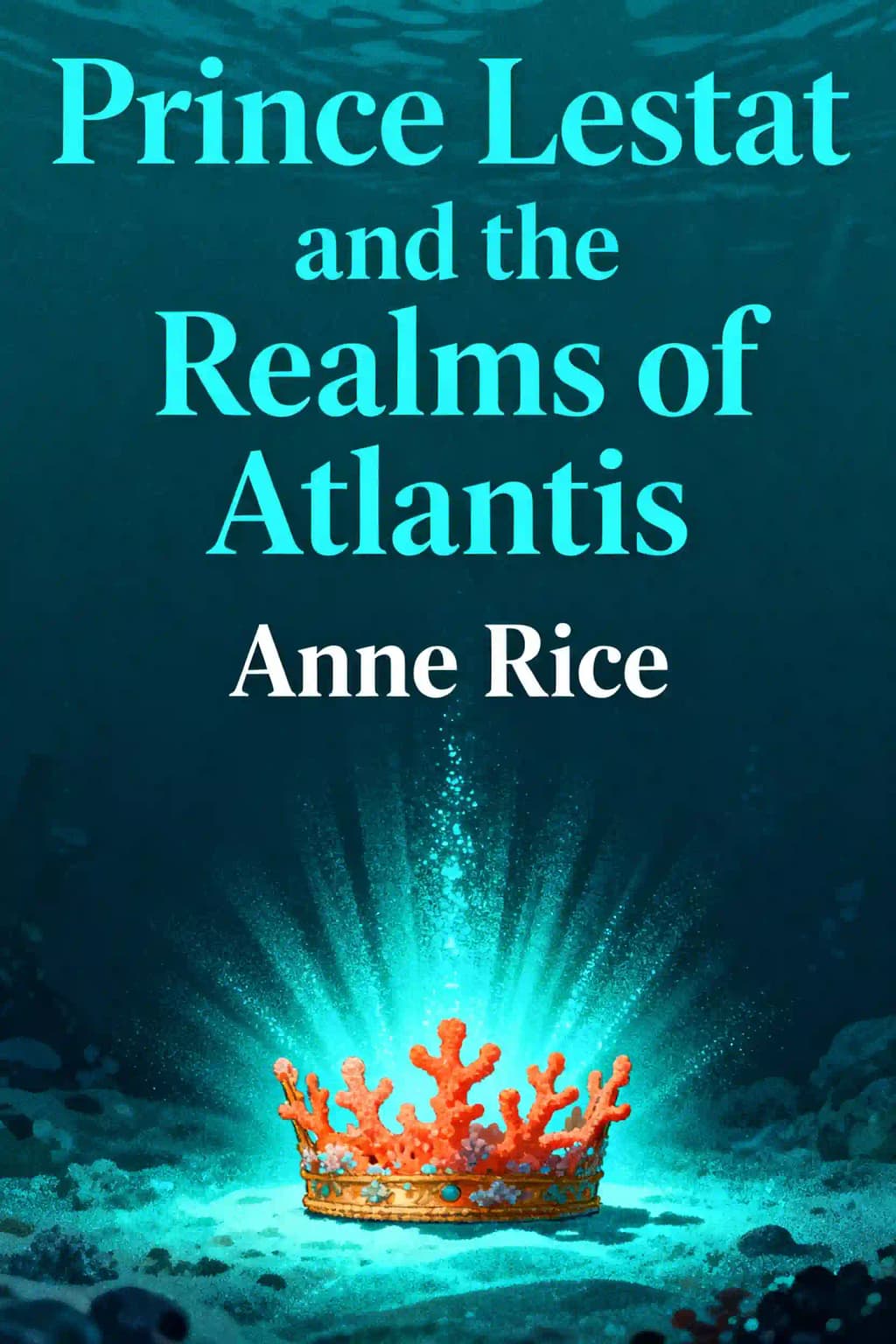
Atlantis Revealed: The Truth Behind the Legend
Kapetria's tale transforms our understanding of both Amel and the legendary Atlantis. Speaking to the assembled vampire court, she reveals that twelve thousand years ago, she and her companions were created as "Replimoids"-organic beings developed from a blend of Earth's life forms to resemble humans but with fundamentally different neural circuitry. Their creators, whom they call "the Parents," were tall, thin beings with white faces, round black eyes, and lipless mouths-clearly extraterrestrial in origin.
The Parents explained that these Replimoids were designed to be unkillable and renewable, created for a specific "Purpose": to infiltrate Earth, where mammals had gained dominance-something the "Realm of Worlds" considered abhorrent. Their mission was to enter Atalantaya, a magnificent domed city rising from the sea, and ultimately trigger a catastrophe that would reset Earth's evolution to favor reptiles and birds over mammals.
Most shockingly, Kapetria reveals Amel's true nature: he was himself a superior Replimoid created by the Parents with vast knowledge and sent to Earth to destroy violent primates with a plague. Designed with pale skin, green eyes, and red hair to be perceived as a god by primitive humans, Amel betrayed his makers. Instead of fulfilling his mission, he destroyed the transmitting stations, never released the plague, and even immunized Earth species against it.
Atalantaya-the true Atlantis-was Amel's creation, a magnificent city of translucent towers where his chosen humans lived in prosperity. The city featured technology far beyond its time: moving sidewalks, electric stairways rising three stories high, self-driving pods, and buildings made of translucent material that could become opaque with a wave of the hand. Most remarkable was Amel's ability to plant tower "seeds" that, when touched by sunlight, grew spectacularly into complete skyscrapers while musicians played and crowds sang.
This revelation transforms our understanding of vampire origins. Amel was not simply a spirit as vampires believed for millennia, but a physical being from another world who became pure consciousness after his physical form was destroyed. The recurring dreams of a falling city were actually Amel's memories of Atalantaya's destruction-the catastrophe engineered by the Parents when their Replimoid agents finally succeeded in their mission.
The truth about Atlantis bridges science fiction with supernatural horror, suggesting that the vampires themselves are the product of alien intervention gone awry. What began as an attempt to destroy humanity instead created a new immortal species that would walk alongside humans throughout history-predators yet preservers of human culture and knowledge.
Chapter 7
The Great Disconnection: Breaking Ancient Bonds
For millennia, all vampires existed in a mystical network, connected through Amel's consciousness. When the ancient Queen Akasha was destroyed, this network nearly collapsed before Amel found a new host in Mekare. Now, with Amel residing in Lestat, the vampires debate a radical experiment: temporarily stopping Lestat's heart to see if they can safely disconnect all vampires from Amel without destroying him.
The theory, articulated by Louis using Theosophical concepts, suggests that each vampire could become a discrete entity with their own etheric body and brain. This would free them from the existential vulnerability of being linked to a single host-if Lestat were destroyed, they wouldn't all perish as was long feared with Akasha. However, it would also fundamentally change what it means to be a vampire, severing the mystical connection that has defined their species since its inception.
The experiment proceeds with Fareed administering an injection to stop Lestat's heart while Louis and Gremt stand by to revive him. As his heart stops, Lestat is transported to a sunlit room with a glass dome where Amel-appearing with red hair brighter than Lestat's and distinct green eyes-welcomes him to Atalantaya. This vision confirms Amel's connection to the lost city and provides Lestat a glimpse of what was lost-a magnificent glass metropolis with buildings changing shape, gardens on rooftops, and children dancing in circles.
When Lestat's heart restarts, they discover the experiment worked-every vampire felt a shock when his heart stopped but recovered within minutes. Despite initial panic throughout the vampire world, no vampire experiences deterioration or loss of powers. The Cloud Gift, Fire Gift, and Mind Gift remain intact across the tribe. A new fledgling is even successfully created in Oxford, proving the species can continue without the central connection.
However, Amel remains bound solely to Lestat, unable to travel into other minds as before. This creates a precarious situation-Amel is now trapped within Lestat alone, making the Prince both uniquely powerful and uniquely vulnerable. If the Replimoids succeed in extracting Amel from Lestat, what would become of the Prince? Could he survive such a procedure, or would he perish like Akasha and Mekare before him?
Chapter 8
Rebirth and Redemption: Amel's New Beginning
The climax comes when Kapetria finally calls Lestat, requesting to meet "out in the open" in front of Notre Dame just before dawn. She admits planning to free Amel but cannot guarantee Lestat won't be harmed. Despite his reluctance, Lestat agrees to meet her, only to be captured by Rhoshamandes who sees this as "reparation" for past wrongs.
Kapetria's plan is revealed: at sunrise, when Lestat is unconscious, she'll replace his blood with Replimoid blood, open his skull, and attempt to remove Amel into another prepared body. Despite rescue attempts by his loyal followers, Lestat surrenders to prevent harm to his friends. When he awakens alone in a hospital room afterward, he discovers himself completely alone-no presence inside him, no voice speaking to him. Amel is gone.
In addressing the vampire court about Amel's absence, Lestat urges them to make their way of life sacred through their own faith, as no outside power can sanctify them. He reminds them that those who survived centuries did so because they cared about something greater than themselves and thirsted for knowledge and beauty despite witnessing everything they cherished fade away. This philosophical reflection marks Lestat's growth from rebellious individualist to thoughtful leader.
The true resolution comes unexpectedly. While in Paris with Louis, Lestat notices someone watching him intently-a young man with suntanned skin, deep-red hair and bright green eyes. It's Amel, reborn in a perfect replica of his original Atlantean body. Their reunion is emotional, with both weeping at the miracle of their meeting. Amel explains how Kapetria created his body from cells in her hands, how he had to learn everything anew-seeing, walking, talking.
Though his Replimoid guardians allow him only brief independence, they share an hour of conversation about history, science, and Amel's plans to explore the world. When they part, Lestat shares his blood with Amel in a final kiss, tasting Amel's innocent blood-"sweet, fresh, powerful"-and feeling a rush of images from his new existence. They promise to meet again, suggesting that despite their separation, their bond transcends physical connection.
Chapter 9
Legacy of Atlantis: Finding Meaning in Immortality
The revelation of Amel's true nature and the existence of Atalantaya fundamentally transforms the vampires' understanding of themselves. What they thought was supernatural in origin-their immortality, their powers, their very existence-turns out to have roots in extraterrestrial science. Yet this scientific explanation doesn't diminish the spiritual questions that have haunted them throughout their long existences.
In a heated argument between Amel and Maxym (theorized to be the entity later known as Memnoch), we see competing philosophical perspectives on existence itself. Maxym believes in a higher Maker and argues that life in Atalantaya was too easy, robbing people of spiritual growth through struggle. Amel counters passionately that all sentient, self-conscious beings with moral sense have souls, regardless of their origin. This debate echoes throughout vampire existence-are they soulless predators or beings capable of moral growth and spiritual development?
Lestat's journey from rebellious fledgling to reluctant prince to separated individual reflects the central theme of finding meaning in immortality. Without Amel's presence inside him, Lestat must redefine himself once again. His observation that "to love even one person truly is the beginning of wisdom" suggests that meaning comes not from power or longevity but from connection and compassion.
The novel ends with a powerful image: Atalantaya with its shimmering towers was evidence of Amel's "fathomless capacity for love." This reframes the entire vampire mythology-what began as violence and blood has evolved into a complex meditation on love, belonging, and purpose. The vampires, once isolated predators, have formed a community. Amel, once a disembodied spirit, has regained physical form. Even Rhoshamandes, consumed by revenge, finds reconciliation possible.
In the end, Rice suggests that immortality's greatest challenge isn't surviving physically but maintaining emotional and spiritual vitality across the centuries. The vampires who endured did so because they "cared about something greater than themselves and thirsted for knowledge and beauty" despite witnessing everything they cherished fade away. This capacity to find meaning and beauty in an endless existence-to love the Savage Garden despite its cruelty-is perhaps the true legacy of Atlantis, a civilization that valued beauty and harmony enough to build translucent towers reaching toward the sky.