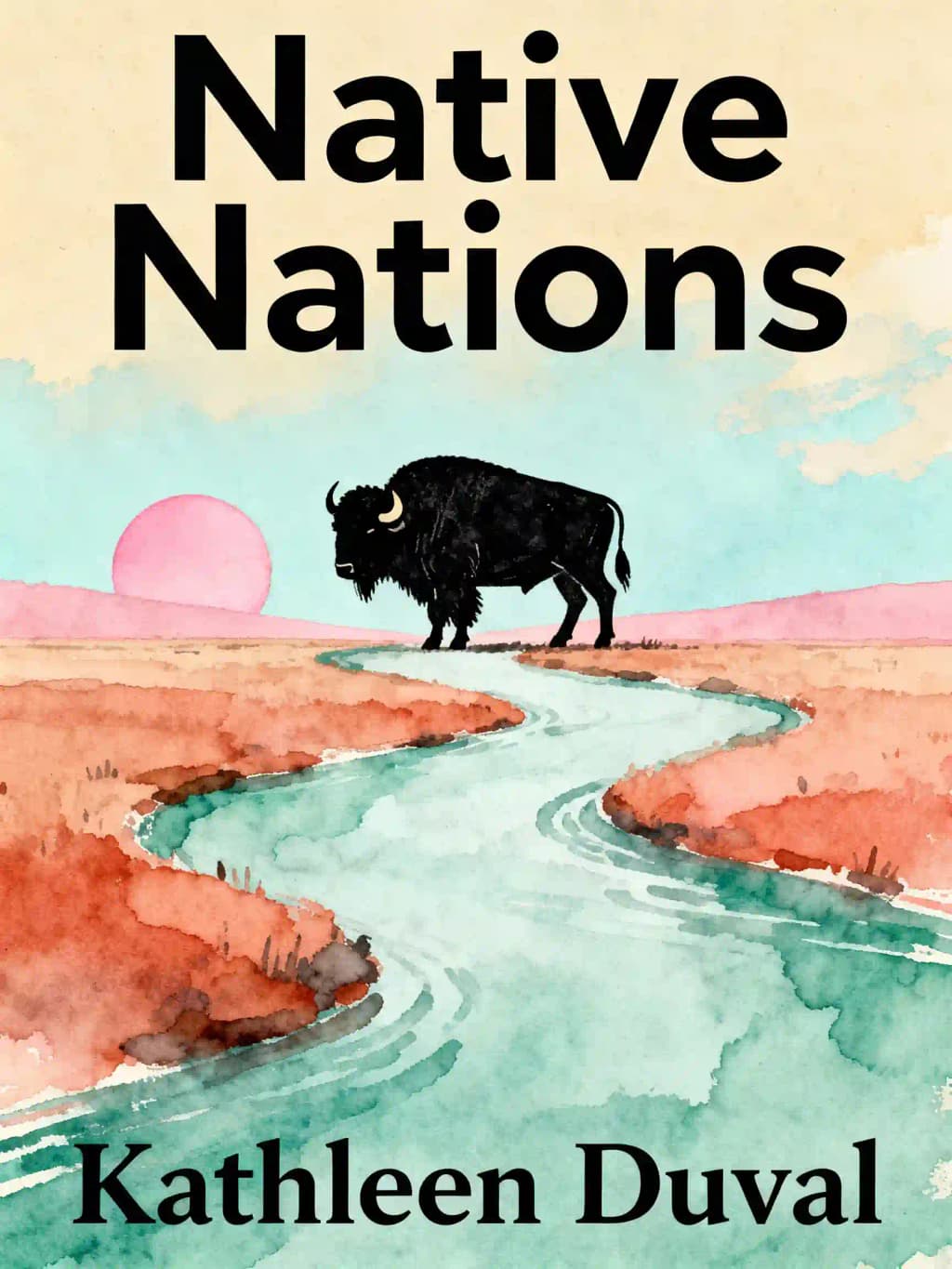
Native Nations book cover

Native Nations by Kathleen Duval Summary

Native Nations
Kathleen Duval
4.43 (694 Reviews)
History
Society
Politics
Overview
Key Takeaways
Author
FAQs

Overview of Native Nations

Rewriting history from Indigenous perspectives, "Native Nations" unveils 1,000 years of sophisticated Native civilizations that shaped America. This Pulitzer Prize winner challenges what you thought you knew - how did Mohawks control Dutch traders while Kiowas regulated settler movement across their lands?

Show more

Key Takeaways from Native Nations

  1. Ancient Native nations built sophisticated urban centers rivaling global cities over a millennium ago.
  2. Indigenous societies shifted toward smaller egalitarian structures following climate instability around 1250 CE.
  3. Native nations maintained diplomatic and economic control over Europeans for centuries after contact.
  4. Mohawks strategically manipulated Dutch trade to control weapon access and influence global markets.
  5. Quapaws tactically maneuvered French colonists to serve their own political objectives.
  6. Shawnee leaders forged intertribal alliances to counter U.S. territorial expansion through cultural redefinition.
  7. Cherokees developed sovereign institutions for global recognition of their political independence.
  8. Kiowas enforced regulations on settler movement through their western territories.
  9. Native nations persistently exercised self-determination despite colonial suppression.
  10. Kathleen DuVal's research reveals Indigenous North American sovereignty spanning ten centuries.
  11. "Native Nations" reframes U.S. history around enduring Indigenous political power.
  12. Resilience defines Native nations' continuous fight for modern sovereignty and rights.

Overview of its author - Kathleen Duval

Kathleen DuVal, Pulitzer Prize-winning historian and professor at the University of North Carolina at Chapel Hill, authored Native Nations: A Millennium in North America, a groundbreaking work in Indigenous history.

Her expertise in North American colonial history stems from decades of archival research and engagement with Native oral traditions, demonstrated in previous acclaimed works like The Native Ground: Indians and Colonists in the Heart of the Continent and Independence Lost: Lives on the Edge of the American Revolution.

DuVal's scholarship reframes historical narratives by centering Indigenous sovereignty, resilience, and political agency across centuries. Her research methodology prioritizes Native perspectives, drawing from tribal records and cultural institutions to challenge Eurocentric views.

The Pulitzer Prize board recognized Native Nations for its transformative examination of Native power dynamics, from ancient urban civilizations to modern sovereignty struggles. This landmark work has been hailed as essential reading for understanding North America’s complex past and present.

Common FAQs of Native Nations

What is Native Nations: A Millennium in North America about?

Native Nations reframes North American history through Indigenous power and sovereignty across 1,000 years. Kathleen DuVal traces the rise of ancient cities rivaling global urban centers, adaptation to climate shifts, and strategic diplomacy with European colonists. The book reveals how nations like the Mohawk controlled trade networks and the Kiowa regulated settler movement, emphasizing Indigenous agency in shaping the continent’s history.

Who should read Native Nations?

This book is essential for history enthusiasts, educators, and anyone seeking a corrective to colonial narratives. It offers profound insights for readers interested in Indigenous resilience, pre-contact civilizations, and sovereignty struggles. DuVal’s accessible scholarship also benefits policymakers addressing contemporary Native rights.

Is Native Nations worth reading?

Absolutely. Winner of the 2025 Pulitzer Prize in History, the book masterfully combines rigorous research with narrative depth. DuVal’s focus on Indigenous perspectives—from ancient urban planning to modern sovereignty fights—provides a groundbreaking, non-Eurocentric view that challenges mainstream history texts.

What ancient Indigenous cities does DuVal highlight?

DuVal examines sophisticated pre-Columbian metropolises like Cahokia and Moundsville, which rivaled contemporary global cities in size and complexity. These centers declined due to climate instability, leading to decentralized yet politically advanced societies that later influenced North American governance structures.

How does the book challenge traditional narratives?

Native Nations counters victimhood tropes by centering Indigenous power: Mohawks dictated Dutch trade terms, Quapaws manipulated French colonists, and Shawnee leaders Tecumseh and Tenskwatawa forged pan-tribal alliances. DuVal argues colonization was neither inevitable nor rapidly decisive.

What role does sovereignty play in the book?

Sovereignty is the core theme—explored through persistent governance models like the egalitarian systems spreading from ancient cities. DuVal documents its evolution: Cherokee global diplomacy, Kiowa territorial control, and modern fights for self-determination, proving Native nations never ceded inherent authority.

How does DuVal address tragedies and resilience?

She contextualizes violence and displacement within millennia of adaptation, noting: "By putting tragedies in a longer perspective, it makes the triumph more amazing." The narrative balances historical trauma with stories of cultural continuity, diplomatic ingenuity, and economic influence.

What awards has Native Nations received?

The book won the 2025 Pulitzer Prize in History, the 2024 Cundill History Prize, the Bancroft Prize, and the Mark Lynton History Prize. These accolades recognize its paradigm-shifting research and narrative excellence.

How does the book connect past and present?

DuVal links pre-colonial urban planning to contemporary sovereignty battles, showing how governance traditions endure. Modern museums and cultural centers preserving oral histories exemplify her thesis: "Native nations are still here," actively reclaiming narratives.

What examples illustrate Indigenous influence?

Key cases include:

  • Mohawks: Dominated fur trade with the Dutch, swaying global markets.
  • Kiowas: Controlled westward settler migration through strategic power.
  • Shawnee brothers: Redefined pan-tribal identity to resist U.S. expansion.
How does DuVal’s background inform her work?

A UNC Chapel Hill history professor, DuVal draws from Arkansas roots and prior books like Independence Lost. Her archival rigor—using tribal records and oral histories—ensures Indigenous perspectives drive the narrative, not European accounts.

Why is Native Nations relevant today?

The book equips readers to understand ongoing legal/cultural sovereignty fights—from land repatriation to language revitalization. By disproving "vanishing Indian" myths, DuVal empowers contemporary Native advocacy and reframes America’s origin story.

Similar books to Native Nations

Start Reading Your Way
Quick Summary

Feel the book through the author's voice

Deep Dive

Turn knowledge into engaging, example-rich insights

Flash Card

Capture key ideas in a flash for fast learning

Fun

Enjoy the book in a fun and engaging way

Explore Your Way of Learning
Native Nations isn't just a book — it's a masterclass in History. To help you absorb its lessons in the way that works best for you, we offer five unique learning modes. Whether you're a deep thinker, a fast learner, or a story lover, there's a mode designed to fit your style.

Quick Summary Mode - Read or listen to Native Nations Summary in 9 Minutes

Quick Summary
Quick Summary
Native Nations Summary in 9 Minutes

Break down key ideas from Native Nations into bite-sized takeaways to understand how innovative teams create, collaborate, and grow.

play
00:00
00:00

Flash Card Mode - Top 10 Insights from Native Nations in a Nutshell

Flash Card
Flash Card
Top 10 Insights from Native Nations in a Nutshell

Distill Native Nations into rapid-fire memory cues that highlight Pixar’s principles of candor, teamwork, and creative resilience.

Flash Mode Swiper

Fun Mode - Native Nations Lessons Told Through 21-Min Stories

Fun
Fun
Native Nations Lessons Told Through 21-Min Stories

Experience Native Nations through vivid storytelling that turns Pixar’s innovation lessons into moments you’ll remember and apply.

play
00:00
00:00

Personalize Mode - Read or listen to Native Nations Summary in 0 Minutes

Personalize
Personalize
Experience Native Nations in your own way.

Ask anything, pick the voice, and co-create insights that truly resonate with you.

Flash Mode Swiper

From Columbia University alumni built in San Francisco

BeFreed Brings Together A Global Community Of 200,000+ Curious Minds

"Instead of endless scrolling, I just hit play on BeFreed. It saves me so much time."

@Moemenn
platform
star
star
star
star
star

"I never knew where to start with nonfiction—BeFreed’s book lists turned into podcasts gave me a clear path."

@Chloe, Solo founder, LA
platform
comments
12
likes
117

"Perfect balance between learning and entertainment. Finished ‘Thinking, Fast and Slow’ on my commute this week."

@Raaaaaachelw
platform
star
star
star
star
star

"Crazy how much I learned while walking the dog. BeFreed = small habits → big gains."

@Matt, YC alum
platform
comments
12
likes
108

"Reading used to feel like a chore. Now it’s just part of my lifestyle."

@Erin, Investment Banking Associate , NYC
platform
comments
254
likes
17

"Feels effortless compared to reading. I’ve finished 6 books this month already."

@djmikemoore
platform
star
star
star
star
star

"BeFreed turned my guilty doomscrolling into something that feels productive and inspiring."

@Pitiful
platform
comments
96
likes
4.5K

"BeFreed turned my commute into learning time. 20-min podcasts are perfect for finishing books I never had time for."

@SofiaP
platform
star
star
star
star
star

"BeFreed replaced my podcast queue. Imagine Spotify for books — that’s it. 🙌"

@Jaded_Falcon
platform
comments
201
thumbsUp
16

"It is great for me to learn something from the book without reading it."

@OojasSalunke
platform
star
star
star
star
star

"The themed book list podcasts help me connect ideas across authors—like a guided audio journey."

@Leo, Law Student, UPenn
platform
comments
37
likes
483

"Makes me feel smarter every time before going to work"

@Cashflowbubu
platform
star
star
star
star
star

"Instead of endless scrolling, I just hit play on BeFreed. It saves me so much time."

@Moemenn
platform
star
star
star
star
star

"I never knew where to start with nonfiction—BeFreed’s book lists turned into podcasts gave me a clear path."

@Chloe, Solo founder, LA
platform
comments
12
likes
117

"Perfect balance between learning and entertainment. Finished ‘Thinking, Fast and Slow’ on my commute this week."

@Raaaaaachelw
platform
star
star
star
star
star

"Crazy how much I learned while walking the dog. BeFreed = small habits → big gains."

@Matt, YC alum
platform
comments
12
likes
108

"Reading used to feel like a chore. Now it’s just part of my lifestyle."

@Erin, Investment Banking Associate , NYC
platform
comments
254
likes
17

"Feels effortless compared to reading. I’ve finished 6 books this month already."

@djmikemoore
platform
star
star
star
star
star

"BeFreed turned my guilty doomscrolling into something that feels productive and inspiring."

@Pitiful
platform
comments
96
likes
4.5K

"BeFreed turned my commute into learning time. 20-min podcasts are perfect for finishing books I never had time for."
@SofiaP
platform
star
star
star
star
star

"BeFreed replaced my podcast queue. Imagine Spotify for books — that’s it. 🙌"

@Jaded_Falcon
platform
comments
201
thumbsUp
16

"It is great for me to learn something from the book without reading it."

@OojasSalunke
platform
star
star
star
star
star

"The themed book list podcasts help me connect ideas across authors—like a guided audio journey."

@Leo, Law Student, UPenn
platform
comments
37
likes
483

"Makes me feel smarter every time before going to work"

@Cashflowbubu
platform
star
star
star
star
star

"Instead of endless scrolling, I just hit play on BeFreed. It saves me so much time."

@Moemenn
platform
star
star
star
star
star

"I never knew where to start with nonfiction—BeFreed’s book lists turned into podcasts gave me a clear path."

@Chloe, Solo founder, LA
platform
comments
12
likes
117

"Perfect balance between learning and entertainment. Finished ‘Thinking, Fast and Slow’ on my commute this week."

@Raaaaaachelw
platform
star
star
star
star
star

"Crazy how much I learned while walking the dog. BeFreed = small habits → big gains."

@Matt, YC alum
platform
comments
12
likes
108

"Reading used to feel like a chore. Now it’s just part of my lifestyle."

@Erin, Investment Banking Associate , NYC
platform
comments
254
likes
17

"Feels effortless compared to reading. I’ve finished 6 books this month already."

@djmikemoore
platform
star
star
star
star
star

"BeFreed turned my guilty doomscrolling into something that feels productive and inspiring."

@Pitiful
platform
comments
96
likes
4.5K

"BeFreed turned my commute into learning time. 20-min podcasts are perfect for finishing books I never had time for."
@SofiaP
platform
star
star
star
star
star

"BeFreed replaced my podcast queue. Imagine Spotify for books — that’s it. 🙌"

@Jaded_Falcon
platform
comments
201
thumbsUp
16

"It is great for me to learn something from the book without reading it."

@OojasSalunke
platform
star
star
star
star
star

"The themed book list podcasts help me connect ideas across authors—like a guided audio journey."

@Leo, Law Student, UPenn
platform
comments
37
likes
483

"Makes me feel smarter every time before going to work"

@Cashflowbubu
platform
star
star
star
star
star
Start your learning journey, now
Download This Summary

Get the Native Nations summary as a free PDF or EPUB. Print it or read offline anytime.