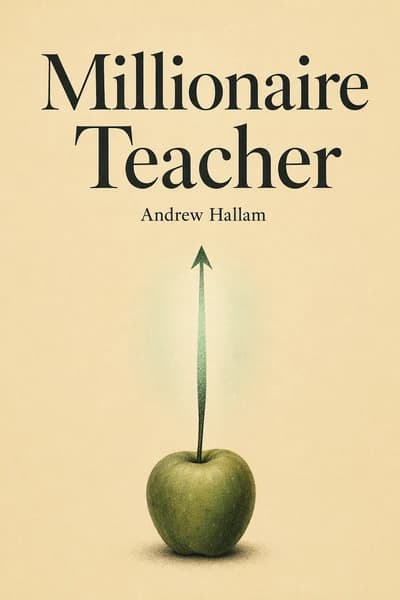
Discover how a schoolteacher built a million-dollar portfolio on a modest salary. Rated 4.32/5 by finance experts, this global bestseller reveals nine wealth rules schools never taught you - transforming everyday investors into savvy millionaires without Wall Street wizardry.
Andrew Hallam is the bestselling author of Millionaire Teacher: The Nine Rules of Wealth You Should Have Learned in School. He is a Canadian personal finance authority renowned for empowering middle-income earners and expatriates to build wealth through disciplined saving and low-cost investing.
A former high school teacher at Singapore American School, Hallam transformed his modest salary into a million-dollar portfolio using index funds, a strategy he outlines in his debut book.
His expertise extends to expat finance with follow-up works like The Global Expatriate’s Guide to Investing and Millionaire Expat, which critique high-fee financial products and offer alternatives for international audiences. Hallam’s actionable advice has been featured in Canadian Business and The Globe and Mail, and is bolstered by his blog (andrewhallam.com) and global speaking engagements.
Millionaire Teacher, a perennial personal finance classic, has become a roadmap for educators and frugal investors alike, cementing Hallam’s reputation as a trusted voice in financial literacy.
Millionaire Teacher outlines a proven path to financial independence through low-cost index fund investing, frugal living, and avoiding costly financial advisors. Andrew Hallam, a former high school teacher, shares nine rules for building wealth on an average salary, emphasizing simplicity, discipline, and long-term strategies over get-rich-quick schemes.
This book is ideal for beginners and intermediate investors seeking actionable advice on wealth-building. It’s particularly valuable for teachers, expatriates, or anyone with a modest income aiming to achieve financial freedom without complex strategies.
Yes—readers consistently praise its clarity, practicality, and empowering approach. Over 670 Goodreads reviewers highlight its timeless relevance, with many crediting it for transforming their financial habits and retirement planning.
Hallam advocates for passive investing in globally diversified index funds, dollar-cost averaging, and minimizing fees. He demonstrates how these strategies outperform most actively managed funds while requiring minimal effort.
The book stresses living below your means, avoiding lifestyle inflation, and prioritizing debt elimination. Hallam’s own journey to becoming a debt-free millionaire on a teacher’s salary serves as a foundational case study.
Hallam criticizes commission-based advisors for high fees and conflicts of interest. He recommends low-cost robo-advisors or self-directed index fund portfolios to maximize returns.
Yes—Hallam tailors advice for expats, covering currency risks, tax-efficient strategies, and country-specific retirement plans. His later book, Millionaire Expat, expands on these themes.
Some argue its focus on index funds oversimplifies market dynamics. Others note its U.S.-centric examples, though later editions add guidance for Canadian, Australian, and European investors.
Both emphasize index fund investing, but Hallam’s approach is more globally oriented and includes expat-specific strategies. The Simple Path to Wealth by JL Collins focuses heavily on U.S. markets.
“Intelligent investing allows people to buy the only non-renewable resource they’ll ever have: time.” Another standout: “Spend like you want to grow rich, not like you already are”
It provides frameworks for calculating savings rates, selecting low-fee funds, and leveraging tax-advantaged accounts. Readers learn to build portfolios that compound steadily over decades.
Its core principles—low fees, diversification, and behavioral discipline—remain foundational amid market volatility. Updated editions now include robo-advisor comparisons and cryptocurrency cautions.
Feel the book through the author's voice
Turn knowledge into engaging, example-rich insights
Capture key ideas in a flash for fast learning
Enjoy the book in a fun and engaging way
True wealth isn't about appearing rich with flashy cars.
Credit card debt elimination should be prioritized as an "investment" in itself.
Most financial advisers are salespeople who prioritize their own profits over clients' interests.
Beating indexes is "just not going to happen."
Break down key ideas from Millionaire Teacher into bite-sized takeaways to understand how innovative teams create, collaborate, and grow.
Experience Millionaire Teacher through vivid storytelling that turns innovation lessons into moments you'll remember and apply.
Ask anything, choose your learning style, and co-create insights that truly resonate with you.

From Columbia University alumni built in San Francisco
"Instead of endless scrolling, I just hit play on BeFreed. It saves me so much time."
"I never knew where to start with nonfiction—BeFreed’s book lists turned into podcasts gave me a clear path."
"Perfect balance between learning and entertainment. Finished ‘Thinking, Fast and Slow’ on my commute this week."
"Crazy how much I learned while walking the dog. BeFreed = small habits → big gains."
"Reading used to feel like a chore. Now it’s just part of my lifestyle."
"Feels effortless compared to reading. I’ve finished 6 books this month already."
"BeFreed turned my guilty doomscrolling into something that feels productive and inspiring."
"BeFreed turned my commute into learning time. 20-min podcasts are perfect for finishing books I never had time for."
"BeFreed replaced my podcast queue. Imagine Spotify for books — that’s it. 🙌"
"It is great for me to learn something from the book without reading it."
"The themed book list podcasts help me connect ideas across authors—like a guided audio journey."
"Makes me feel smarter every time before going to work"
From Columbia University alumni built in San Francisco

Get the Millionaire Teacher summary as a free PDF or EPUB. Print it or read offline anytime.
When a middle-school English teacher became a millionaire in his 30s without inheritance or risky schemes, people naturally wanted to know how. The secret wasn't market timing wizardry or get-rich-quick strategies, but nine straightforward rules that should be taught in every school but rarely are. This book has developed a cult following among financial experts and educators, with Warren Buffett reportedly keeping copies to give away. What makes these insights so powerful is how they transform complex financial concepts into straightforward advice anyone can follow, regardless of income or background. The path to wealth isn't about financial genius - it's about understanding fundamentals that most schools never teach.
True wealth isn't about flashy possessions funded by debt. Many seemingly wealthy people actually survive on loans and credit cards. Most million-dollar homes aren't owned by millionaires but by non-millionaires with large mortgages, while 90% of actual millionaires live in homes valued under a million dollars. Genuine wealth means having investments that generate twice your country's median household income without working. Your spending habits are heavily influenced by your environment, which explains why American millionaires spend a median of just $31,367 on cars, with Toyota being their most popular brand. Even Warren Buffett only spent $55,000 on his most expensive car. For vehicles, follow millionaire mechanic Russ Perry's advice: never buy new, purchase after someone else has absorbed the depreciation, and target low-mileage Japanese cars in the $3,000-$5,000 range. For homes, apply this test: if you can't afford mortgage payments at double the current interest rate, you can't truly afford the home - a guideline that would have protected many families during the 2008 housing crisis.
While schools teach abstract math, compound interest-Einstein's alleged "eighth wonder of the world"-is truly life-changing. Just $100 growing at 10% annually becomes $161 after 5 years, $673 after 20 years, and $1.3 million after 100 years. This exponential growth occurs because you earn returns on both your initial investment and accumulated returns. Consider Star, who invests $1.45 daily from age five. By 65, her modest $32,400 total investment grows to over $1 million. Meanwhile, her friend Lucy, investing $800 monthly starting at 40, ends with $237,052 less despite investing nearly eight times more. The crucial difference is time in the market. Before investing, eliminate high-interest credit card debt. Paying off a card with 18% interest equals a guaranteed, tax-free 18% return-far better than typical stock market expectations. Historical market performance supports long-term investing, averaging nearly 10% annually from 1920-2010, with $1,000 potentially growing to over $44,600 in 40 years through dividends and appreciation.
Most financial advisers are essentially salespeople prioritizing their profits by selling actively managed funds over superior index funds. With just three index funds-a home country stock index, an international stock index, and a government bond index-investors can outperform most professionals at a fraction of the cost. The evidence supporting index investing is overwhelming. Warren Buffett recommends them for average investors, and Nobel Prize-winning economists endorse them. Research shows 96% of active funds underperform indexes after accounting for fees, taxes, and survivorship bias. Active funds suffer from five major disadvantages: expense ratios, marketing costs, trading costs, sales commissions, and tax inefficiency. Even legendary manager Peter Lynch, who averaged 29% annual returns with Fidelity Magellan, admits "the public would be better off in an index fund." Ted Aronson, managing $7 billion professionally, invests all his personal taxable money in Vanguard index funds, stating "after tax, active management just can't win." The impact of fees is staggering. With $100,000 invested for 25 years at 8% market returns, an actively managed fund charging 2.2% leaves you with $422,598, while an index fund charging 0.2% grows to $730,013-a $307,415 difference from just a 2% fee gap.
Most investors underperform their own funds because they buy high and sell low, driven by fear and greed. While funds might average 10% annual returns over decades, the average investor earns only about 7.3% - a difference that compounds to over $250,000 on a $50,000 investment over 25 years. Market timing is virtually impossible. John Bogle couldn't name anyone who consistently succeeded at it after 50 years in the industry. Market movements are largely unpredictable, with research showing major historical market moves often had no logical connection to world events. Stock markets resemble dogs on leashes - prices may temporarily race ahead of business earnings but eventually must align with underlying performance. The late 1990s tech bubble exemplified this disconnect, with unprofitable companies seeing soaring valuations until the inevitable crash. Disciplined investors capitalize on market downturns by selling bonds to buy discounted stocks. During the 2008-2009 financial crisis, while most investors were selling $228 billion of stock mutual funds, smart investors were buying at 50% discounts, following Warren Buffett's philosophy of seizing bargains during market drops.
A balanced portfolio requires more than stock index funds. Like a healthy diet needs variety, responsible investing needs bonds for stability. Bonds act as parachutes during market crashes, protecting your investments from steep declines. Consider allocating a percentage to bonds roughly equivalent to your age, adjusted for risk tolerance. During downturns, maintain your desired stock/bond ratio by buying stocks with new contributions and eventually selling bonds to purchase stocks at lower prices. Reverse this when markets recover. Include international exposure since U.S. markets represent only 45% of global markets. A total international stock market index provides diversification across developed and emerging economies. The "Couch Potato Portfolio" - equal parts total stock market index and total bond market index - demonstrates effective simplicity, averaging nearly 11% annually from 1986-2001 while providing significant protection during crashes. If you must pick individual stocks, limit them to 10% of your portfolio. When selecting stocks, focus on businesses with long-term competitive advantages, consistent growth, low debt, high return on capital, and honest management.
Financial advisers use sophisticated arguments against index funds to sell expensive products-claiming they underperform in downturns, deliver only "average" returns, highlighting temporary outperformers, and boasting about market timing abilities-all contradicting extensive research. Most advisers are primarily salespeople with minimal investment training (just 6-8 weeks for licensing exams). Their compensation creates inherent conflicts of interest, with significant commissions from selling actively managed products. Even institutional professionals with advanced degrees consistently fail to outperform simple index portfolios long-term. Major pension funds recognize this reality: Washington state indexes 100% of its stock assets, California 86%, New York 75%, and Connecticut 84%. Financial freedom comes from following principles wealthy people have practiced for generations: living below your means, leveraging compound interest, minimizing costs, controlling emotions, and building a balanced portfolio of low-cost index funds. True wealth isn't about flashy possessions-it's about freedom to make unconstrained choices. Every dollar saved today purchases future freedom. The path requires patience in an instant-gratification world, discipline in a consumption-driven culture, and independent thinking amid financial noise. The rewards-security, freedom, and peace of mind-are immeasurable.