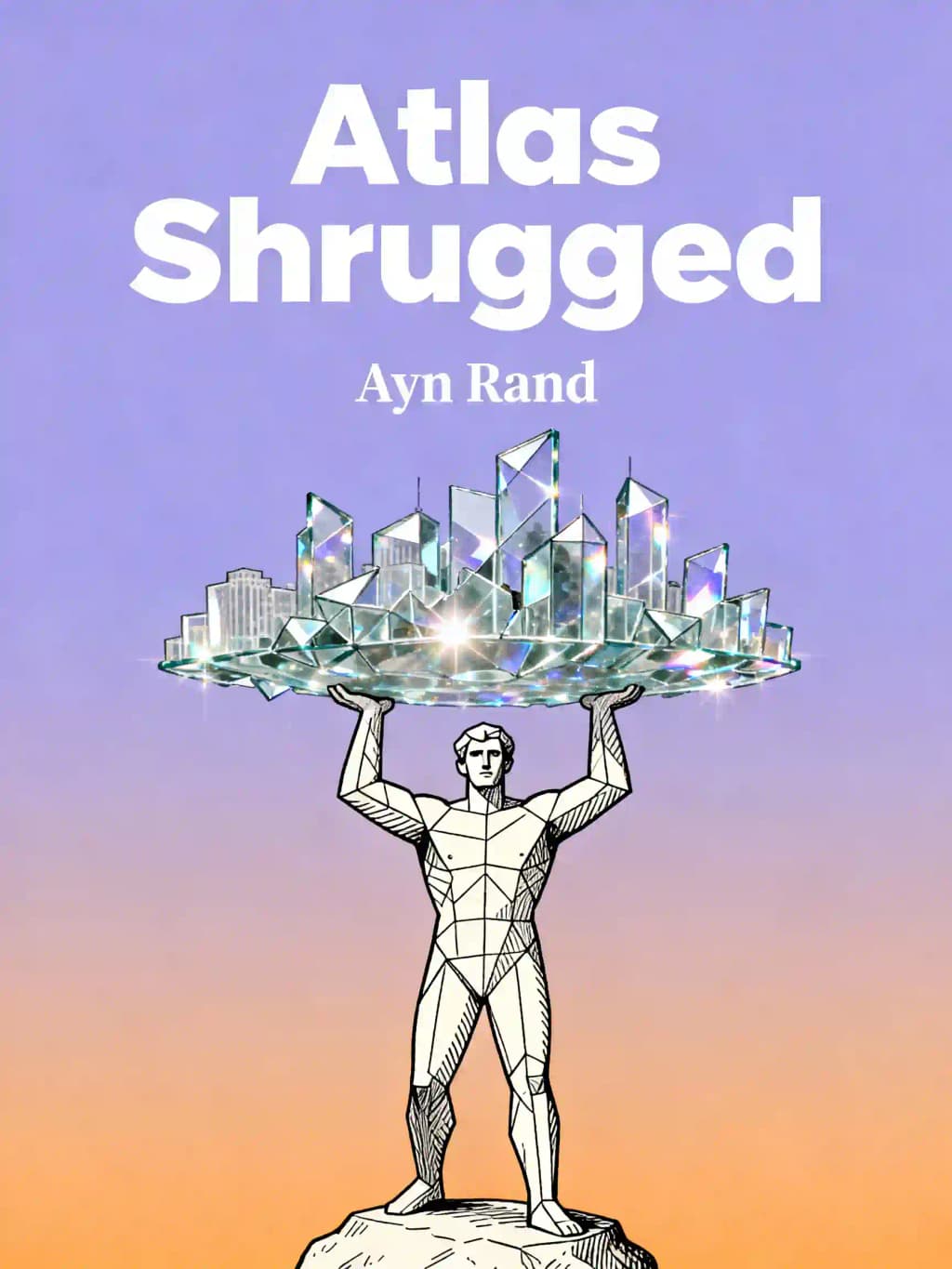
Book
Atlas Shrugged
Ayn Rand
A philosophical novel championing individualism and capitalism, following industrialists fighting against collectivism in a dystopian America.
Explore Ayn Rand's philosophy of Objectivism, her major works like Atlas Shrugged and The Fountainhead, and where to start reading.

Ayn Rand was a Russian-American author and philosopher who created the philosophical system known as Objectivism, which champions rational self-interest and laissez-faire capitalism. Born Alisa Rosenbaum in 1905 in St. Petersburg, Russia, she witnessed the rise of the Soviet Union before fleeing to the United States in 1926 and eventually becoming an American citizen. Through sweeping novels and dense nonfiction, Rand argued for the supreme value of the individual mind and rejected collective conformity. Her major works have sold tens of millions of copies worldwide, deeply influencing political, economic, and libertarian thought. Though she died in New York in 1982, Rand's intellectual legacy endures today, continuing to spark fierce debate about the role of government, the morality of capitalism, and the nature of human freedom.
With BeFreed's AI-powered book summaries, you can explore the key ideas behind Rand's most influential works in minutes — no need to tackle 1,168 pages first.
Objectivism is a philosophical system developed by Ayn Rand that advocates for reason as the only means of acquiring knowledge and rational self-interest as the guiding moral principle of life. Rand famously described her philosophy as a concept of man as a heroic being, with his own happiness as the moral purpose of his life.
The philosophy rests on four core pillars. First is metaphysics, which dictates that objective reality exists entirely independent of human feelings, wishes, or fears. Second is epistemology, the belief that reason is the only valid way for humans to understand the world and survive. Third is ethics, which positions rational self-interest as the highest moral purpose, rejecting the idea that self-sacrifice is a virtue. Finally, the political pillar argues that laissez-faire capitalism is the only moral social system because it is the only system that fully respects individual rights.
Objectivism differs sharply from many traditional philosophies and religions because it completely rejects altruism as a moral duty. Instead of viewing selfishness as a vice, Rand argued that rational selfishness is essential for human flourishing.
This uncompromising stance is exactly why Objectivism remains deeply controversial yet highly influential. Many readers find her message of individualism deeply empowering, while others find her rejection of collective responsibility extreme. Regardless of where readers stand, her framework continues to shape modern discussions around free markets and personal liberty.
| Book | Year | Genre | Core Idea | Notable Fact |
|---|---|---|---|---|
| Atlas Shrugged | 1957 | Fiction | Rational self-interest and the role of the mind | Over 10 million copies sold |
| The Fountainhead | 1943 | Fiction | Individualism vs. collective conformity | Over 6.5 million copies sold |
| Anthem | 1938 | Fiction | The danger of total collectivism | Short novella, ideal entry point |
| The Virtue of Selfishness | 1964 | Nonfiction | Selfishness as a moral foundation | Over 1 million copies sold |
| Why Businessmen Need Philosophy | 1999 | Nonfiction | Capitalism's moral defense | Endorsed by BB&T CEO John Allison |
Published in 1957, Atlas Shrugged is Ayn Rand's 1,168-page masterpiece that asks a profound question: What happens when society's creators disappear? The plot follows a dystopian America where collectivism takes over, prompting the nation's top industrialists, scientists, and creators to go on strike and retreat from society.
A philosophical novel championing individualism and capitalism, following industrialists fighting against collectivism in a dystopian America.
The core ideas of the novel revolve around rational self-interest and the indispensable role of the human mind in existence. Rand argues that industrial creators embody heroism through their innovation, and that government coercion ultimately crushes human potential. The philosophical centerpiece of the novel is John Galt's speech, a lengthy broadcast that lays out the entire framework of Objectivism.
The book's impact has been monumental. It has sold over 10 million copies as of 2022 and saw a massive surge of over 500,000 copies sold in 2009 during the financial crisis. In a 1991 Library of Congress survey, it was ranked the second most life-changing book after the Bible, and it was voted the number one novel of the 20th century in a 1998 Modern Library reader poll.
Published in 1943, The Fountainhead sparked a literary phenomenon and established Rand as a major intellectual force. The novel follows rebellious architect Howard Roark, who absolutely refuses to compromise his creative vision to satisfy public taste or conventional standards.

Visionary architect battles conformity in timeless fight for creative freedom.
The story serves as a vehicle for Rand's views on integrity and creative independence. It draws a sharp contrast between "creators," who think independently and produce original value, and "second-handers," who live through others and seek collective approval. Roark embodies the idea that individualism must always triumph over collective conformity.
Translated into more than 16 languages, the book has sold over 6.5 million copies in English alone. It remains a definitive text for those exploring the tension between personal integrity and societal expectations.
Published in 1938, Anthem is a gripping novella set in a dark, collectivist future where individuality has been completely erased. In this society, even the word "I" is strictly forbidden, replaced entirely by "we."
The core ideas of the novella focus on the necessity of individual identity and the severe danger of total collectivism. The protagonist must rediscover the concept of the self in order to reclaim his humanity and freedom.
Because of its brevity, Anthem serves as a short but powerful entry point into Rand's thinking. It distills her warnings about the loss of the individual into a highly accessible narrative.
While Rand's novels dramatized her philosophy, her nonfiction essays explicitly codified it. The Virtue of Selfishness is a million-selling manifesto that challenges conventional morality. It argues that rational self-interest is the moral foundation for human flourishing, rejecting altruism and asserting that reason is the only absolute guide to knowledge and ethics.
A provocative philosophical treatise arguing that rational self-interest is moral and necessary for human flourishing and societal progress.
In Why Businessmen Need Philosophy, Rand provides a robust moral defense of capitalism. She argues that production is a virtue and that rational self-interest is the ethical foundation of business success. The book underscores how philosophy determines profit and serves as a strategic advantage for business leaders.
A collection of essays arguing that philosophical principles are crucial for business success and defending capitalism's moral foundations.
Rand also applied her philosophy to the craft of writing. The Art of Nonfiction, distilled from her 1969 lectures, demystifies the writing process. It advocates for a clarity-first method, teaching writers to build bulletproof outlines and edit with ruthless objectivity to transform vague ideas into persuasive prose.
A guide to mastering nonfiction writing, offering invaluable insights on the creative process from a renowned philosopher and author.
For readers new to Ayn Rand, deciding where to start depends largely on your goals. A common and highly recommended entry point is Anthem, as its short length provides a quick introduction to her themes of individualism. From there, The Fountainhead offers a compelling, character-driven story that is less overtly political than her later work. Finally, Atlas Shrugged stands as the definitive, comprehensive presentation of her entire philosophy in fiction form.

Tackling a 1,168-page novel can be a massive commitment. If you want to understand Rand's polarizing and influential ideas without spending weeks reading, BeFreed offers AI-powered summaries of her major works. You can quickly grasp the core concepts of Objectivism, explore the key takeaways of her novels, and decide which full texts you want to dive into next.

Ayn Rand remains one of the most debated intellectual figures of the modern era. By framing rational self-interest as a moral virtue and capitalism as the only ethical economic system, she challenged the foundational assumptions of traditional morality. Whether you agree with her or not, her influence on business, politics, and literature is undeniable. Exploring her books offers a vital perspective on the ongoing cultural conversation about the rights of the individual versus the demands of the collective.

Philosophy for the Modern Chaos
In an era of information overload and existential uncertainty, this plan provides the mental tools needed to regain agency. It is designed for thinkers and professionals seeking to bridge the gap between abstract philosophy and practical, ethical living.

The Age of Reason
This plan is essential for anyone seeking to understand the intellectual foundations of the modern world. It is ideal for history buffs, philosophy students, and curious minds interested in how reason reshaped science, psychology, and governance.

Understand Nietzsche's Core Ideas
Friedrich Nietzsche's revolutionary philosophy challenged fundamental Western assumptions about truth, morality, and human potential. This learning plan provides essential insights for anyone interested in philosophy, critical thinking, or personal development, offering a structured approach to understanding one of history's most misunderstood and influential thinkers.

Philosophy
This learning plan offers a structured journey through Western philosophy's most transformative ideas, from ancient Greece to modern existentialism. It's ideal for curious minds seeking to develop rigorous critical thinking skills, anyone grappling with life's big questions about meaning and morality, or professionals wanting to enhance their analytical reasoning and ethical decision-making capabilities. Whether you're new to philosophy or looking to deepen your understanding, this path provides both timeless wisdom and practical frameworks for examining the fundamental questions that shape how we live and think.

Existentialism
This plan provides a roadmap for navigating the complexities of modern existence by engaging with the world's most influential thinkers. It is ideal for anyone seeking to build a resilient personal philosophy and find clarity in their own freedom and ethical choices.

The Birth of Wisdom
This plan bridges the gap between ancient logic and modern existential critique, offering a powerful toolkit for independent thought. It is ideal for students of philosophy, debaters, or anyone seeking to liberate their mind from conventional biases.

Podcast: 500 Philosophy Books Audio Summary
This curated audio summary distills centuries of wisdom into actionable insights for the modern thinker. It is ideal for lifelong learners and professionals seeking to enhance their critical reasoning and ethical decision-making through the lens of history's greatest minds.

The Existentialist Roadmap to Freedom
This plan is essential for individuals feeling trapped by societal expectations or existential dread, offering a path to radical self-ownership. It is designed for deep thinkers and aspiring leaders who want to build a life of authenticity and purpose beyond conventional norms.