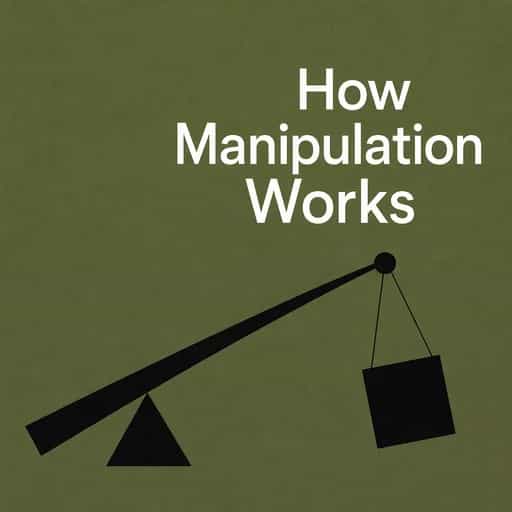
The Subtle Shift From Connection to Control
Lena: You know, I was thinking about how we all have this deep, quiet need for control in our lives. It’s almost like an instinct—like how a toddler insists on picking out their own socks or deciding which way the stroller should face . We all want to feel like we’re in the driver’s seat of our own lives. But what happens when that natural desire starts to bleed into our relationships? When does wanting to feel safe and secure cross the line into actually manipulating the people around us?
Miles: It’s a thin line, isn’t it? And what’s really wild is that most of the time, the person doing the manipulating doesn’t even realize they’re doing it. They think they’re just being helpful or protective . And on the other side, the person being controlled often just feels a vague sense of confusion or guilt without knowing why. It’s why experts call this “dark psychology”—not because it’s some mysterious magic, but because it exploits the very systems that make us human, like empathy and our need for social harmony .
Lena: That’s a powerful way to put it. It’s not necessarily about being a “bad person,” but about these patterns that weaponize our best traits against us. I’ve seen statistics that as of 2023, with over five billion people online, the risks for tech-enabled manipulation have just exploded . It’s everywhere—from our dinner tables to our phone screens.
Miles: Exactly. It’s pervasive. Research shows that roughly 0.5 to 1 percent of the population has Narcissistic Personality Disorder, but the actual use of manipulative tactics is way more common than that . In fact, one study found that between 1 and 11 percent of people experience some form of emotional manipulation at work at least once a week . It’s a widespread human struggle.
Lena: It really makes you realize why we need to talk about this. Today, we’re going to pull back the curtain on how these tactics actually work. We’re going to look at the “why” behind the need for control and help everyone listening start to recognize these patterns in their own lives—not to point fingers, but to find a path toward more authentic, healthy connections.
Miles: And that’s the goal—moving from a place of confusion to one of clarity. Because once you can name the tactic, it loses its power over you. So, let’s start by looking at the specific ways people create that “fog” of manipulation.