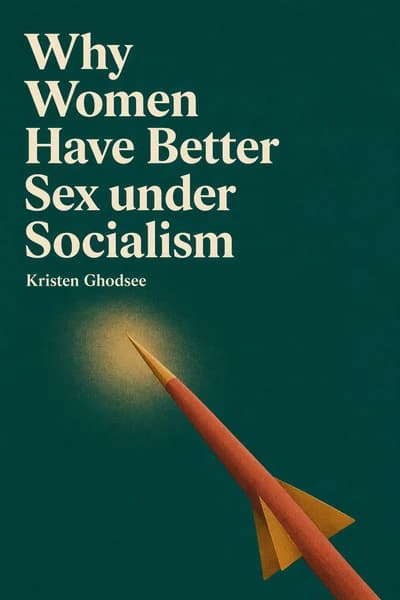
Kristen Ghodsee's provocative exploration reveals why socialist economies foster women's sexual satisfaction through economic independence. Endorsed by Oprah Winfrey and rated 3.99/5 by thousands, this controversial bestseller challenges capitalism with a question: can restructuring economics transform your bedroom satisfaction?
Kristen Rogheh Ghodsee is the critically acclaimed author of Why Women Have Better Sex Under Socialism: And Other Arguments for Economic Independence, a groundbreaking exploration of gender equality and economic systems. A professor and chair of Russian and East European Studies at the University of Pennsylvania, Ghodsee brings decades of expertise in postsocialist societies and feminist economics to this politically charged work.
Her ethnographic research, spanning titles like The Red Riviera and Lost in Transition, informs her analysis of how socialist policies historically advanced women’s autonomy—a theme further expanded in her later book Everyday Utopia.
Ghodsee’s writing regularly appears in The New York Times, The Washington Post, and Jacobin, and she’s been featured on PBS NewsHour, NPR’s Throughline, and France 24. A Guggenheim Fellow and award-winning scholar, her work bridges academic rigor and public discourse.
Why Women Have Better Sex Under Socialism has been translated into 15 languages, cementing its status as a provocative manifesto for reimagining gender politics. Ghodsee continues to challenge conventional narratives through her research and commentary from her base in Philadelphia.
Why Women Have Better Sex Under Socialism argues that capitalism exacerbates gender inequality, while socialist policies—like state-funded childcare, equal pay, and reduced work hours—empower women economically and socially. Kristen Ghodsee uses historical examples from socialist states to show how economic independence improves women’s labor conditions, work-life balance, and sexual autonomy.
This book is ideal for feminists, policymakers, and readers interested in gender studies, socialist theory, or critiques of capitalism. It’s particularly relevant for those exploring how economic systems shape personal relationships, workplace dynamics, and societal equality.
Yes, it’s a provocative, well-researched analysis that links economic policy to gender liberation. Translated into 15 languages and praised for its accessibility, it’s a compelling entry point into discussions about socialism’s potential to address systemic inequalities.
Ghodsee argues that socialist policies reduce financial dependence on partners, freeing women to make authentic sexual choices. State-supported childcare and equitable wages alleviate stressors that hinder intimacy, fostering relationships based on mutual desire rather than economic necessity.
Ghodsee acknowledges historical flaws in socialist regimes but emphasizes adaptable lessons, like prioritizing collective welfare over profit. She distinguishes authoritarian governments from socialist principles focused on reducing inequality.
The book draws on mid-20th-century Eastern Bloc policies, such as East Germany’s subsidized childcare and Bulgaria’s gender-equal labor laws, to demonstrate how socialism improved women’s autonomy compared to capitalist counterparts.
Unlike individual empowerment-focused feminism, Ghodsee’s work critiques systemic economic structures. It aligns with materialist feminism, emphasizing how policy changes—not just cultural shifts—are essential for equality.
This chapter critiques the gender wage gap under capitalism, highlighting how women’s labor is systematically undervalued. Ghodsee contrasts this with socialist models where equal pay laws and unionization narrowed income disparities.
With rising interest in democratic socialism post-2016, Ghodsee’s analysis offers a blueprint for integrating socialist policies (e.g., universal healthcare) into modern economies to address gender and class inequality.
Some scholars argue Ghodsee oversimplifies socialist history, overlooking political repression. Others contend her focus on economic structures downplays cultural factors shaping gender roles.
It’s sparked debates about integrating socialist principles into feminist activism, inspiring policy proposals like paid family leave and universal childcare in progressive political platforms.
Ghodsee divorces socialism from Cold War stereotypes, framing it as a system prioritizing public goods over profit, with policies like free education and healthcare as tools for gender equity.
She advocates hybrid models: incorporating socialist policies (e.g., universal basic income, affordable housing) within democratic frameworks to reduce inequality and empower women.
通过作者的声音感受这本书
将知识转化为引人入胜、富含实例的见解
快速捕捉核心观点,高效学习
以有趣互动的方式享受这本书
Capitalism benefits from women's unpaid domestic labor.
The gender wage gap...is about freedom, safety, and basic human dignity.
These aren't just personal choices-they're predictable outcomes.
Without it, many find themselves trapped.
将《Why Women Have Better Sex under Socialism》的核心观点拆解为易于理解的要点,了解创新团队如何创造、协作和成长。
将《Why Women Have Better Sex under Socialism》提炼为快速记忆要点,突出坦诚、团队合作和创造力的关键原则。

通过生动的故事体验《Why Women Have Better Sex under Socialism》,将创新经验转化为令人难忘且可应用的精彩时刻。
随心提问,选择声音,共同创造真正与你产生共鸣的见解。

"Instead of endless scrolling, I just hit play on BeFreed. It saves me so much time."
"I never knew where to start with nonfiction—BeFreed’s book lists turned into podcasts gave me a clear path."
"Perfect balance between learning and entertainment. Finished ‘Thinking, Fast and Slow’ on my commute this week."
"Crazy how much I learned while walking the dog. BeFreed = small habits → big gains."
"Reading used to feel like a chore. Now it’s just part of my lifestyle."
"Feels effortless compared to reading. I’ve finished 6 books this month already."
"BeFreed turned my guilty doomscrolling into something that feels productive and inspiring."
"BeFreed turned my commute into learning time. 20-min podcasts are perfect for finishing books I never had time for."
"BeFreed replaced my podcast queue. Imagine Spotify for books — that’s it. 🙌"
"It is great for me to learn something from the book without reading it."
"The themed book list podcasts help me connect ideas across authors—like a guided audio journey."
"Makes me feel smarter every time before going to work"

免费获取《Why Women Have Better Sex under Socialism》摘要的 PDF 或 EPUB 版本。可打印或随时离线阅读。
What if I told you that the quality of your sex life might have less to do with chemistry and more to do with your paycheck? In 2017, an explosive op-ed claimed that women had better sex under socialism, igniting a firestorm of debate that refused to die down. The assertion seemed absurd to some, revelatory to others. Yet beneath the provocative headline lay a serious question: how do economic systems shape our most intimate moments? When we think about capitalism versus socialism, we imagine factories and welfare programs, not bedrooms and desire. But what happens between two people behind closed doors is never entirely private-it's shaped by who has money, who has power, and who depends on whom for survival. This isn't just about politics or economics. It's about whether your relationship is a partnership or a transaction, whether you stay because you want to or because you can't afford to leave.