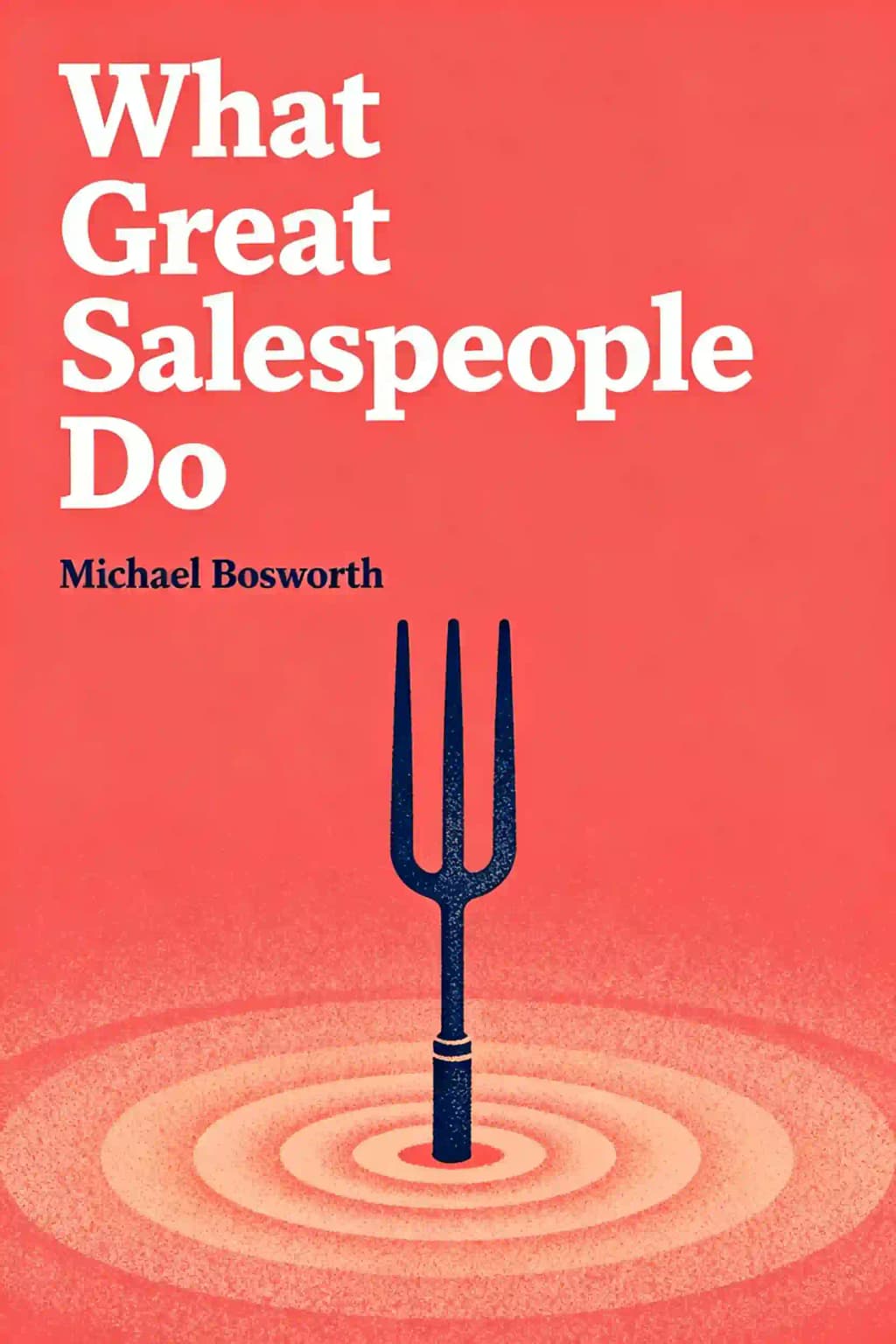
Forget pushy sales tactics. "What Great Salespeople Do" reveals how emotional storytelling trumps logic in closing deals. Featured in Gong's "58 best sales books," it's reshaping business communication by applying neuroscience insights that prove vulnerability creates deeper customer connections than perfect pitches.
Michael Bosworth, bestselling author of What Great Salespeople Do: The Science of Selling Through Emotional Connection and the Power of Story, is a globally recognized sales philosopher and pioneer of customer-centric methodologies. A veteran of Xerox’s top-performing sales teams and founder of the influential Solution Selling® framework, Bosworth combines decades of field experience with groundbreaking research on human connection. His work explores the intersection of neuroscience, storytelling, and sales strategy, helping professionals build trust and influence in competitive markets.
Alongside What Great Salespeople Do, Bosworth authored the sales classics Solution Selling and Customer Centric Selling, which remain required reading in Fortune 500 training programs. A sought-after keynote speaker, he hosts workshops and appears on leading sales podcasts, sharing actionable insights drawn from his California State Polytechnic University business education and 50+ years in tech sales.
His storytelling framework has been adopted by organizations worldwide, from startups to enterprise teams. What Great Salespeople Do continues to rank among Amazon’s top business books, with translations available in 12 languages and adaptations used in university sales curricula.
What Great Salespeople Do by Michael Bosworth and Ben Zoldan teaches sales professionals to prioritize emotional storytelling over logical persuasion. The book argues that breakthrough sales come from forging authentic connections, using neuroscience-backed frameworks to craft narratives that align with buyers’ values and challenges. It shifts focus from traditional "problem-solving" tactics to vulnerability-driven engagement.
Salespeople, managers, and entrepreneurs seeking to influence decisions through empathy will benefit most. The book is particularly valuable for those tired of transactional interactions and aiming to build trust-driven relationships. Leaders in consultative or complex sales environments will find its storytelling methods transformative.
Yes—endorsed by executives at Oracle and Selling Power, the book provides actionable strategies to humanize sales. Its blend of psychology, case studies, and the “STORY” framework (Setting, Complication, Turning Point, Resolution) offers a fresh alternative to outdated techniques.
Key ideas include:
Stories bypass logical resistance by activating emotional brain regions. For example, Apple’s “Think Different” campaign tripled stock prices by linking products to aspirational narratives—not specs. The book teaches salespeople to craft similar purpose-driven stories that align with buyer identity.
The authors merge Bosworth’s CustomerCentric Selling with narrative psychology:
Yes—it critiques overreliance on diagnostic questions and ROI studies, which often trigger skepticism. Instead, it advocates for “story listening” to uncover emotional drivers, then aligning solutions through collaborative storytelling.
Admitting limitations (e.g., “Our solution isn’t perfect for everyone”) disarms buyers by contrasting with typical sales bravado. This authenticity fosters psychological safety, making prospects 34% more likely to share true objections.
Unlike SPIN Selling (question-based) or Challenger Sale (teaching-focused), this book prioritizes emotional narrative. It complements To Sell Is Human by adding neurological frameworks for story crafting.
Yes—it trains sellers to preempt objections by embedding counterpoints into stories. For example, a tale about a client who initially doubted ROI, then achieved 200% returns, addresses cost concerns implicitly.
Some argue it underemphasizes data-backed negotiation—though the authors counter that stories make metrics more relatable. Others note its methods require more practice than scripted tactics.
通过作者的声音感受这本书
将知识转化为引人入胜、富含实例的见解
快速捕捉核心观点,高效学习
以有趣互动的方式享受这本书
Emotion drives decisions, while logic merely justifies them afterward.
We are 'feeling machines that think,' not 'thinking machines that feel.'
We were studying what great salespeople did, but not how they made buyers feel.
Most salespeople are trained to engage only the buyer's left brain.
We don't connect with perfection.
将《What Great Salespeople Do (PB)》的核心观点拆解为易于理解的要点,了解创新团队如何创造、协作和成长。
将《What Great Salespeople Do (PB)》提炼为快速记忆要点,突出坦诚、团队合作和创造力的关键原则。

通过生动的故事体验《What Great Salespeople Do (PB)》,将创新经验转化为令人难忘且可应用的精彩时刻。
随心提问,选择声音,共同创造真正与你产生共鸣的见解。

"Instead of endless scrolling, I just hit play on BeFreed. It saves me so much time."
"I never knew where to start with nonfiction—BeFreed’s book lists turned into podcasts gave me a clear path."
"Perfect balance between learning and entertainment. Finished ‘Thinking, Fast and Slow’ on my commute this week."
"Crazy how much I learned while walking the dog. BeFreed = small habits → big gains."
"Reading used to feel like a chore. Now it’s just part of my lifestyle."
"Feels effortless compared to reading. I’ve finished 6 books this month already."
"BeFreed turned my guilty doomscrolling into something that feels productive and inspiring."
"BeFreed turned my commute into learning time. 20-min podcasts are perfect for finishing books I never had time for."
"BeFreed replaced my podcast queue. Imagine Spotify for books — that’s it. 🙌"
"It is great for me to learn something from the book without reading it."
"The themed book list podcasts help me connect ideas across authors—like a guided audio journey."
"Makes me feel smarter every time before going to work"

免费获取《What Great Salespeople Do (PB)》摘要的 PDF 或 EPUB 版本。可打印或随时离线阅读。
Have you ever noticed how some salespeople seem to effortlessly connect with buyers, while others struggle despite knowing every product detail? This disparity haunted sales experts Michael Bosworth and Ben Zoldan as they watched the traditional 80/20 rule evolve into a staggering 87/13 split - where just 13% of salespeople generate 87% of revenue. Their groundbreaking discovery? The conventional wisdom about sales-focused on logic, questioning techniques, and problem-solving-is fundamentally flawed. Buying decisions are primarily emotional rather than logical, and the most successful salespeople intuitively understand this hidden truth. What if everything we've been taught about sales is backward? Recent neuroscience reveals we're "feeling machines that think," not "thinking machines that feel." When traditional sales training focuses exclusively on left-brain analytical approaches-diagnosing problems, asking questions, presenting solutions-it addresses only a small part of how people actually decide to buy. This explains why the performance gap between top performers and average sellers persists despite decades of training. The most successful salespeople build trust and emotional connection first, then engage the rational mind-not the other way around.
