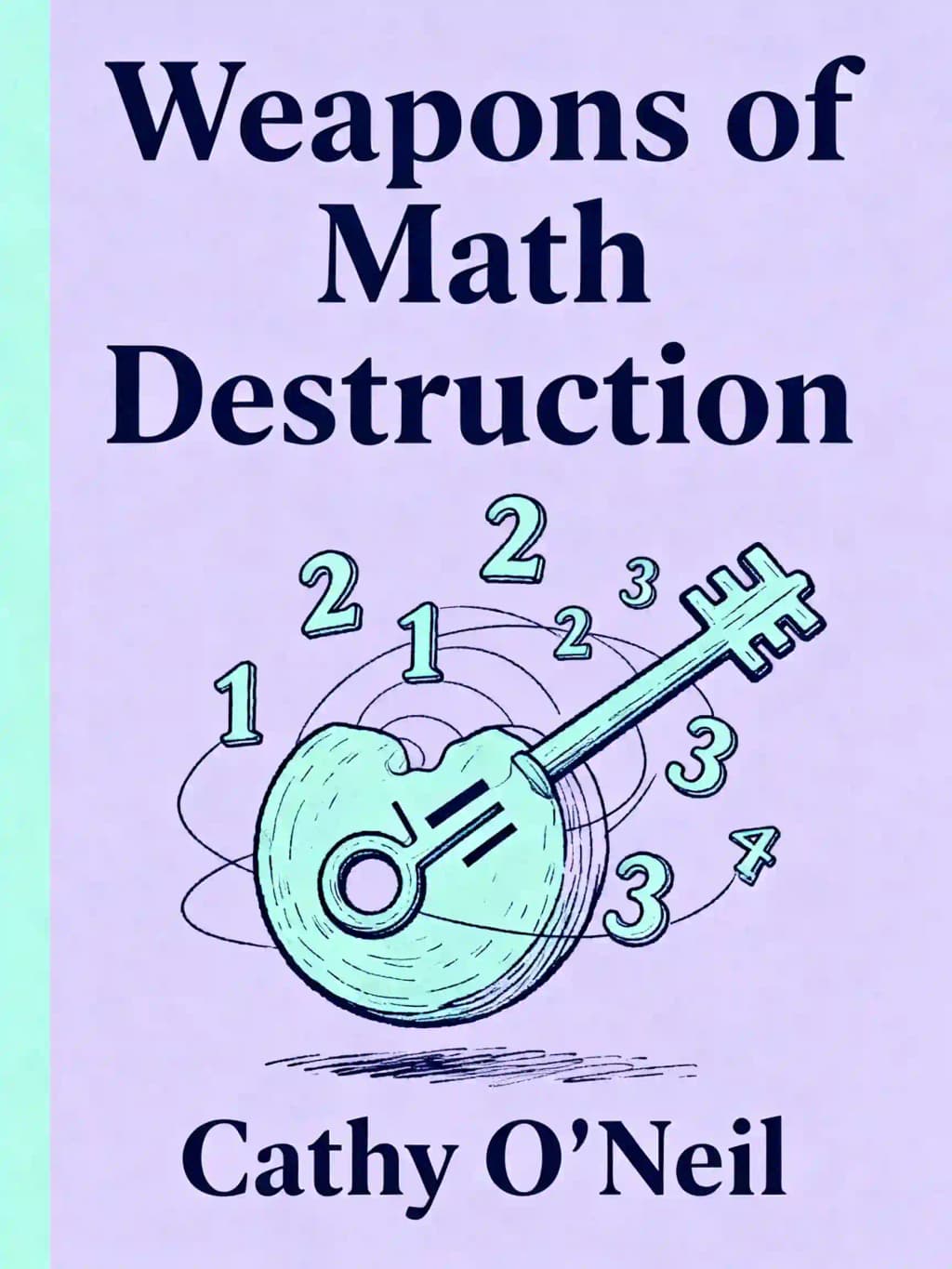
In "Weapons of Math Destruction," former Wall Street quant Cathy O'Neil exposes how algorithms silently shape our lives - sometimes ruining them. This New York Times bestseller, longlisted for the National Book Award, reveals why elite-built models are quietly perpetuating inequality across society.
Catherine Helen O'Neil, author of the New York Times bestselling book Weapons of Math Destruction: How Big Data Increases Inequality and Threatens Democracy, is a mathematician and data scientist renowned for exposing algorithmic bias.
With a PhD in mathematics from Harvard University and experience as a hedge fund quant at D.E. Shaw, O'Neil combines academic rigor with insider knowledge to critique automated decision-making systems that shape education, finance, and criminal justice. Her work bridges mathematics, ethics, and social justice, informed by her activism in Occupy Wall Street’s Alternative Banking Group.
O'Neil founded ORCAA, a pioneering algorithmic auditing company, and contributes regularly to Bloomberg Opinion. She authored Doing Data Science, a foundational text in the field, and The Shame Machine, which examines technology’s role in perpetuating societal humiliation. Through her blog mathbabe.org and Columbia University’s Lede Program in Data Journalism, which she created, O’Neil trains journalists to investigate data-driven systems.
Weapons of Math Destruction has sold over 500,000 copies, was longlisted for the National Book Award, and received the Euler Book Prize, cementing its status as essential reading in technology ethics.
Weapons of Math Destruction exposes how opaque algorithms amplify societal inequality, profiling systems like predatory lending models, biased recidivism risk assessments, and exploitative workplace scheduling tools. O’Neil defines these harmful systems as “WMDs”—mathematical models marked by opacity, scale, and damage that evade accountability while disproportionately harming marginalized groups.
This book is essential for policymakers, data scientists, and socially conscious readers seeking to understand algorithmic bias. O’Neil’s analysis of credit scoring, college rankings, and policing algorithms provides actionable insights for anyone advocating for ethical AI or regulatory reforms.
Yes—ranked among The Guardian’s top 10 books about democracy, it remains critically relevant in 2025 as AI regulation debates intensify. O’Neil’s Wall Street and tech industry expertise makes complex concepts accessible, blending data journalism with real-world case studies.
O’Neil argues fairness requires transparency (publicly auditable models) and accountability (mechanisms to challenge harmful outputs). She contrasts this with “weaponized” systems that prioritize corporate profits over ethical outcomes.
O’Neil dismantles the myth that algorithms are neutral, showing how human biases in data collection (e.g., over-policing Black neighborhoods) get codified as “objective” risk scores. She warns this creates self-fulfilling prophecies that worsen inequality.
While both critique tech’s societal harms, O’Neil focuses on structural solutions (policy changes, auditing standards) rather than individual behavior fixes. Her Wall Street experience provides unique insights into financial sector algorithms absent from the film.
Some economists argue O’Neil oversimplifies trade-offs between innovation and regulation. However, her 2022 follow-up The Shame Machine addresses these concerns by detailing successful corporate audits and policy wins.
O’Neil’s work spurred Fortune 500 firms like Microsoft and IBM to adopt ethical AI review boards. Her “WMD” framework is now taught in 300+ university courses on algorithmic accountability.
“All models are wrong, but some are dangerous. The latter are weapons of math destruction, and they’re undermining democracy in ways both subtle and stark." This emphasizes how unchecked algorithms erode civil liberties under the guise of technological progress.
通过作者的声音感受这本书
将知识转化为引人入胜、富含实例的见解
快速捕捉核心观点,高效学习
以有趣互动的方式享受这本书
Models are simplifications of reality-necessary yet inherently flawed.
The numbers don't lie.
Opacity means the inner workings of the model remain hidden.
The 2008 financial crisis wasn't just a failure of regulation-it was a failure of modeling.
When a WMD fails, those harmed rarely have recourse.
将《Weapons of Math Destruction》的核心观点拆解为易于理解的要点,了解创新团队如何创造、协作和成长。
将《Weapons of Math Destruction》提炼为快速记忆要点,突出坦诚、团队合作和创造力的关键原则。

通过生动的故事体验《Weapons of Math Destruction》,将创新经验转化为令人难忘且可应用的精彩时刻。
随心提问,选择声音,共同创造真正与你产生共鸣的见解。

"Instead of endless scrolling, I just hit play on BeFreed. It saves me so much time."
"I never knew where to start with nonfiction—BeFreed’s book lists turned into podcasts gave me a clear path."
"Perfect balance between learning and entertainment. Finished ‘Thinking, Fast and Slow’ on my commute this week."
"Crazy how much I learned while walking the dog. BeFreed = small habits → big gains."
"Reading used to feel like a chore. Now it’s just part of my lifestyle."
"Feels effortless compared to reading. I’ve finished 6 books this month already."
"BeFreed turned my guilty doomscrolling into something that feels productive and inspiring."
"BeFreed turned my commute into learning time. 20-min podcasts are perfect for finishing books I never had time for."
"BeFreed replaced my podcast queue. Imagine Spotify for books — that’s it. 🙌"
"It is great for me to learn something from the book without reading it."
"The themed book list podcasts help me connect ideas across authors—like a guided audio journey."
"Makes me feel smarter every time before going to work"

免费获取《Weapons of Math Destruction》摘要的 PDF 或 EPUB 版本。可打印或随时离线阅读。
Imagine waking up tomorrow to discover an algorithm has determined you're unfit for your job, denied your loan application, or marked you as a criminal risk-all without explanation or appeal. This isn't science fiction; it's the reality exposed in "Weapons of Math Destruction." These mathematical models wield extraordinary power while remaining largely unaccountable, affecting everything from who gets hired to who goes to jail. Consider Sarah Wysocki, a dedicated teacher fired because an algorithm deemed her ineffective. Despite glowing reviews from parents and her principal, she was terminated when the model detected a decline in test scores-failing to account for the fact that her students' previous scores had been artificially inflated through cheating. When Sarah asked how the algorithm reached its conclusion, she was essentially told, "The numbers don't lie." But numbers, divorced from context and human judgment, often tell incomplete stories. This pattern repeats across institutions. In criminal justice, recidivism models transform complex human histories into risk scores that determine sentencing. These models often incorporate factors like zip code and family criminal history-variables that correlate strongly with race and socioeconomic status. The result? A veneer of mathematical objectivity masking the same biases we've struggled with for generations.