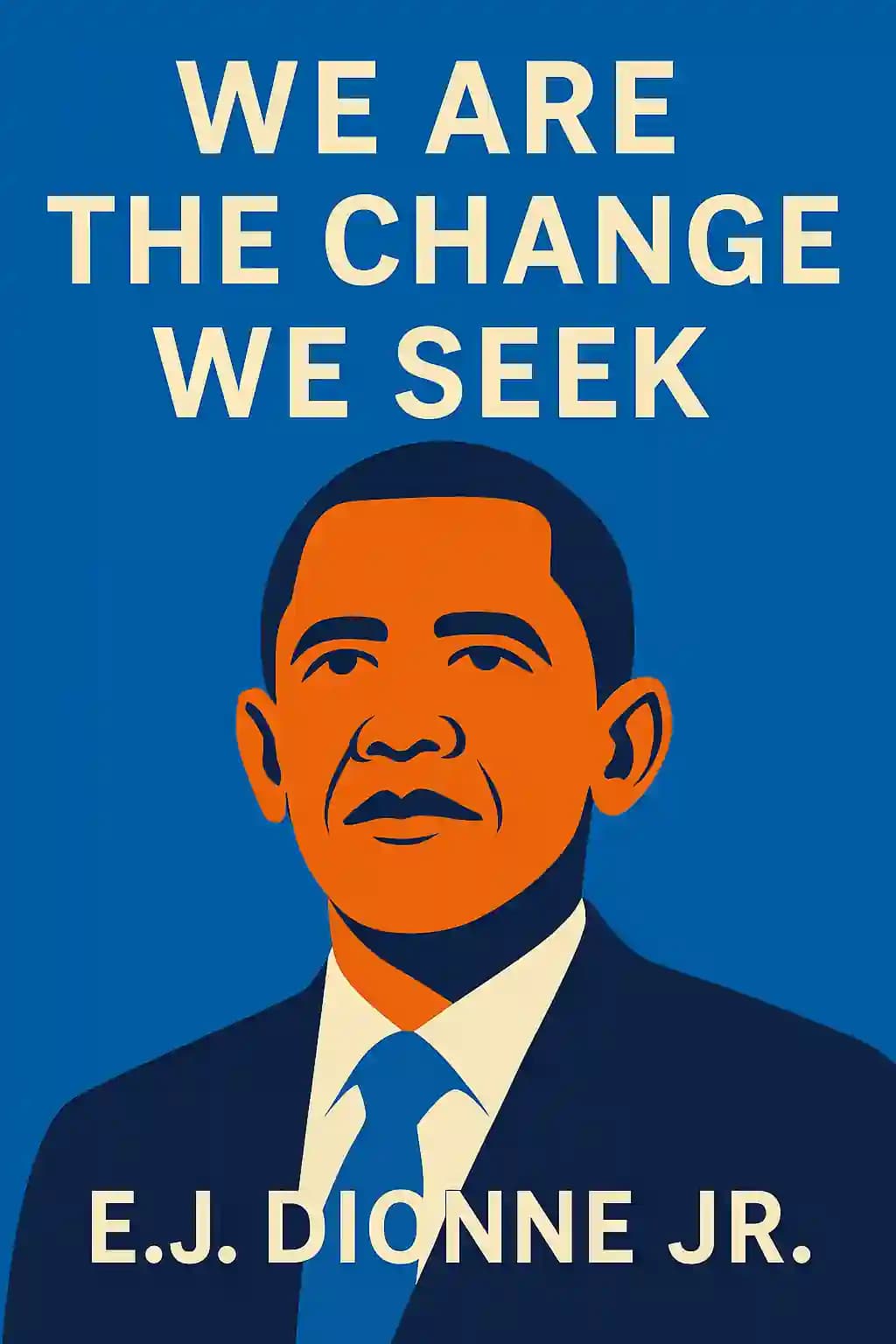
Experience Obama's America through 27 of his most powerful speeches, from his Iraq War opposition to his farewell address. Praised for capturing his vision of hope and change, this collection reveals why his oratory moved a nation and defined a presidency.
E.J. Dionne Jr., author of We Are the Change We Seek, is a Pulitzer Prize-winning political commentator, bestselling author, and Georgetown University professor renowned for his incisive analysis of American democracy and progressive politics. A Harvard graduate and Rhodes Scholar, Dionne brings decades of expertise as a Washington Post columnist and Brookings Institution senior fellow to this exploration of civic renewal and collective action.
His career spans journalism, with 14 years at The New York Times, academia, and media commentary, with regular appearances on NPR, Meet the Press, and CNN.
Dionne’s authoritative works, including the National Book Award-nominated Why Americans Hate Politics and Code Red: How Progressives and Moderates Can Unite to Save Our Country, establish him as a leading voice on political polarization and democratic reform. His forthcoming book, 100% Democracy: The Case for Universal Voting (coauthored with Miles Rapoport), further examines participatory governance.
Recognized among Washington’s 25 most influential journalists by the National Journal, Dionne’s writing has shaped national discourse for over three decades, with Why Americans Hate Politics hailed as “a classic in American political history” by Newsday.
We Are the Change We Seek compiles 26 pivotal speeches by Barack Obama, spanning his 2002 anti-Iraq War address to his 2016 UN farewell. The collection highlights his rhetorical mastery in addressing critical issues like racial justice, gun violence, and global diplomacy, framed by an introductory essay analyzing his oratory’s historical significance.
This book appeals to political historians, public speaking enthusiasts, and readers interested in progressive leadership. Its curated speeches and context from editors E.J. Dionne Jr. and Joy Reid make it valuable for studying Obama’s fusion of idealism and pragmatic governance.
Yes, for its insights into Obama’s ability to reframe national conversations. Reviewers praise it as a “political partisan’s dream” (Washington Post) and note its enduring relevance to American civic discourse. The speeches showcase his signature themes of hope and collective responsibility.
Key themes include:
Speeches are organized chronologically (2002–2016), with contextual commentary on their impact. This timeline reveals Obama’s evolving rhetoric from state politics to global leadership, emphasizing consistency in addressing inequality and human rights.
The title captures Obama’s core message: societal progress requires personal accountability. As he stated, “Change will not come if we wait for some other person... We are the ones we’ve been waiting for”.
Their introductory essay analyzes Obama’s oratory within American political traditions, comparing him to leaders like Lincoln and King. They argue his speeches uniquely bridged partisan divides while advancing progressive ideals.
The book highlights his blend of:
Speeches like his 2008 “A More Perfect Union” address showcase his nuanced approach—acknowledging systemic racism while advocating shared responsibility for solutions. The collection underscores race as a recurring theme in his governance.
Yes. Analysts note Obama’s techniques—storytelling, rhythmic repetition, and audience adaptation—make it a practical study tool. The Guardian calls it “a masterclass in political rhetoric”.
By curating speeches on climate action, healthcare, and international relations, the editors present his presidency as a blueprint for progressive leadership grounded in civic engagement.
While celebratory, the essays acknowledge critiques that his idealism occasionally clashed with political realities. However, they argue his speeches consistently pushed boundaries of achievable change.
通过作者的声音感受这本书
将知识转化为引人入胜、富含实例的见解
快速捕捉核心观点,高效学习
以有趣互动的方式享受这本书
You want a fight? Let's finish the fight with bin Laden and al Qaeda.
There's not a liberal America and a conservative America; there's the United States of America.
We coach Little League in the blue states and have gay friends in the red states.
Obama's words continue to resonate as a testament to the power of rhetoric in American politics.
将《We Are the Change We Seek》的核心观点拆解为易于理解的要点,了解创新团队如何创造、协作和成长。
将《We Are the Change We Seek》提炼为快速记忆要点,突出坦诚、团队合作和创造力的关键原则。

通过生动的故事体验《We Are the Change We Seek》,将创新经验转化为令人难忘且可应用的精彩时刻。
随心提问,选择声音,共同创造真正与你产生共鸣的见解。

"Instead of endless scrolling, I just hit play on BeFreed. It saves me so much time."
"I never knew where to start with nonfiction—BeFreed’s book lists turned into podcasts gave me a clear path."
"Perfect balance between learning and entertainment. Finished ‘Thinking, Fast and Slow’ on my commute this week."
"Crazy how much I learned while walking the dog. BeFreed = small habits → big gains."
"Reading used to feel like a chore. Now it’s just part of my lifestyle."
"Feels effortless compared to reading. I’ve finished 6 books this month already."
"BeFreed turned my guilty doomscrolling into something that feels productive and inspiring."
"BeFreed turned my commute into learning time. 20-min podcasts are perfect for finishing books I never had time for."
"BeFreed replaced my podcast queue. Imagine Spotify for books — that’s it. 🙌"
"It is great for me to learn something from the book without reading it."
"The themed book list podcasts help me connect ideas across authors—like a guided audio journey."
"Makes me feel smarter every time before going to work"

免费获取《We Are the Change We Seek》摘要的 PDF 或 EPUB 版本。可打印或随时离线阅读。
Barack Obama's words transcend typical political rhetoric, offering a blueprint for how language can bridge divides in fractured times. His speeches-from state senator to two-term president-reveal a rare rhetorical genius that places him alongside FDR, JFK, and Reagan in the pantheon of presidential orators. What makes Obama's language particularly powerful is how it weaves personal narrative with national identity, creating a vision of America as an unfinished project requiring collective effort. His words don't just inform-they inspire action. When Lin-Manuel Miranda cited Obama's speeches as inspiration for "Hamilton," he recognized what makes this rhetoric distinctive: the ability to make complex ideas accessible while maintaining intellectual depth. In our increasingly polarized landscape, these speeches offer more than historical artifacts-they provide a pathway to reconnect with our shared humanity and democratic values.