第 1 章
Dreams of a Nation, Words of a Leader
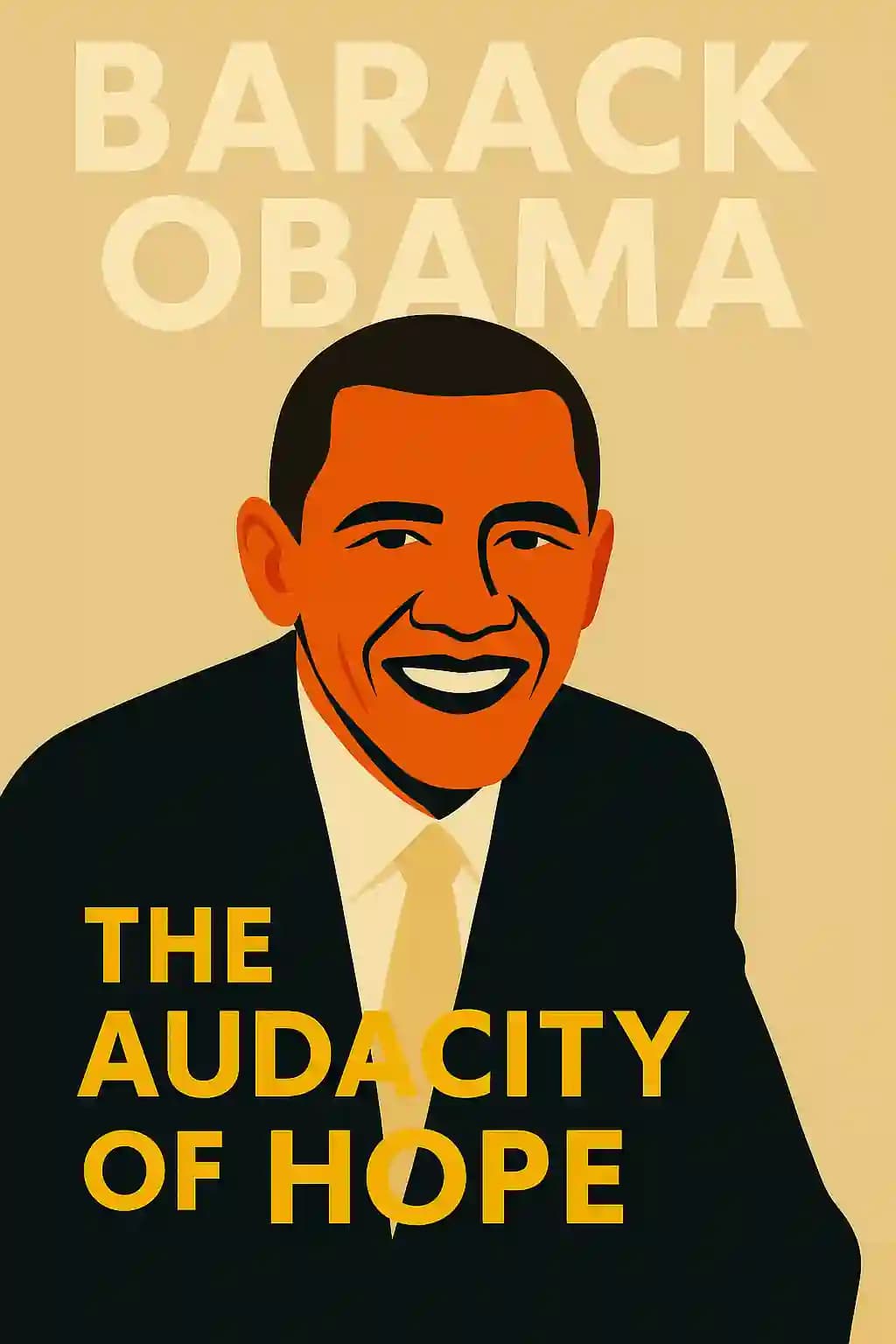
Barack Obama's "The Audacity of Hope" arrived at a pivotal moment in American history. Published in 2006, a year before he announced his presidential candidacy, the book became an instant bestseller and cultural touchstone, selling over 4.5 million copies worldwide. Celebrities from Oprah Winfrey to Warren Buffett praised its thoughtful analysis and personal reflections. The title itself, borrowed from a sermon by Obama's former pastor Reverend Jeremiah Wright, captured the imagination of a nation hungry for a new kind of politics. More than just a political memoir, the book offers a window into the mind of a man standing at the crossroads of American history, contemplating both his personal journey and the collective path forward for a deeply divided nation. What makes this work particularly fascinating is how it foreshadows the themes that would later define Obama's presidency-the search for common ground, the belief in America's capacity for positive change, and the recognition that democracy requires both idealism and pragmatism.
第 2 章
Politics Beyond the Partisan Divide
Entering the Senate chamber through the Capitol basement, Obama is immediately struck by its imposing grandeur-marble columns, blue damask walls, and the American eagle etched into the creamy white ceiling. The chamber holds one hundred mahogany desks dating back to 1819, each bearing the scratched names of senators past-Taft, Long, Kennedy, Stennis. These romantic moments fade quickly, though, as Obama discovers the reality of the Senate: members spend little time on the floor, most decisions are worked out in advance, and during roll calls, the chamber is nearly empty. In the world's greatest deliberative body, no one is listening.
Obama's swearing-in day was a beautiful blur, but beneath the pageantry lay an awareness that Washington's brief unity wouldn't last. The country was more politically divided than at any time since before World War II, with Americans disagreeing vehemently on everything from Iraq to taxes, abortion to immigration. What's troubling isn't the gap between our ideals and reality-that's existed since America's birth. What's concerning is the gap between our massive challenges and our petty politics, our chronic avoidance of tough decisions, our inability to build consensus for solving big problems.
The political divide we experience today has deep historical roots. American politics was once less ideological, with party affiliation more amorphous. The Democratic coalition controlling Congress combined Northern liberals with conservative Southern Democrats and big-city machine loyalists. The Republican Party also tolerated philosophical divisions-between Barry Goldwater's Western libertarianism and Nelson Rockefeller's Eastern paternalism. But the sixties upended these alignments, beginning with the civil rights movement and continuing through the Vietnam War protests. Politics became less about economics and more about moral absolutes, affecting every interaction between groups.
What's remarkable is how durable Reagan's political narrative has proven. The sixties' conflicts continue driving our discourse forty years later, with every issue reduced to either-or choices-tax cuts or tax hikes, small government or big government-with simplicity becoming a political virtue. Bill Clinton's singular contribution was trying to transcend this ideological deadlock by recognizing the inadequacy of "conservative" and "liberal" labels. He understood that properly designed government spending could serve as an ingredient to economic growth, while markets could promote social justice.
For those who believe government has a role in promoting opportunity, a polarized electorate isn't enough. We need a broad majority of Americans-Democrats, Republicans, and independents-reengaged in national renewal, seeing their interests linked to others'. Building this working majority won't be easy, but it's necessary because solving America's problems requires tough choices and sacrifice.
第 3 章
Values That Bind Us Together
Despite my disagreements with President Bush's policies, I find it possible to understand the motives of those in Washington and recognize shared values. This isn't easy in a capital where high stakes, party loyalty, campaign imperatives, and media amplification create suspicion. But outside Washington, America feels less divided. During my travels through Illinois-from Chicago's sophistication to southern counties that culturally resemble the South-I've discovered that beneath surface differences, Americans are becoming more alike.
The Declaration's fundamental idea-that we're born free with inalienable rights-orients every American daily, though we often take individual freedom for granted. My appreciation for these rights deepened from childhood experiences in Indonesia and family connections in Kenya, where individual rights depend on generals' self-restraint or bureaucrats' whims. Americans understand liberty both negatively (the right to be left alone) and positively (opportunity and the virtues that realize it)-self-reliance, discipline, hard work, and personal responsibility.
Though individualistic, Americans are bound by communal values-family obligations, neighborliness, patriotism, faith in something larger than ourselves, and mutual regard expressed through honesty, fairness, humility, and compassion. These twin strands-individualism and community-create tension in every society, but America has negotiated them better than most. Still, our values can collide when distorted: self-reliance becomes selfishness, patriotism slides into jingoism, faith calcifies into self-righteousness.
Finding balance between competing values is difficult not because we've steered wrong but because our world is complex. Since 9/11, we've compromised constitutional principles fighting terrorism, yet security and civil liberties must be balanced. Too often, our national debates exaggerate threats to our values or ignore conflicts between them-conservatives defend market freedom but accept government surveillance; liberals champion press freedom but overlook regulatory burdens on small businesses.
Much confusion in values debates stems from equating politics with government. Some values shouldn't be legislated but remain worthy of public discussion-good manners, competence, work ethic. Progressives often miss this, fearing to appear judgmental about cultural issues, while conservatives overlook ethical problems like excessive CEO pay. This belief that our communal values should express through government makes me a Democrat. I acknowledge culture's power but believe government can shape it for better or worse.
We long for authenticity in our leaders-that quality of being who you say you are, possessing a truthfulness beyond words. Empathy-standing in someone else's shoes-forms the core of my moral code and my understanding of the Golden Rule. This simple principle-considering how others feel-guides my politics and reveals America's empathy deficit in how we treat struggling schools, workers, and those in harm's way.
第 4 章
The Constitution as Conversation
Arriving in the Senate feels like "drinking from a fire hose"-hiring staff, setting up offices, negotiating committee assignments, responding to thousands of constituent letters and hundreds of speaking invitations each week. My colleagues advised me to meet with Senator Robert Byrd as soon as possible. At eighty-seven, Byrd embodied the Senate itself-a self-educated man from West Virginia coal country who had served for forty-seven years, written a four-volume Senate history, and carried a pocket Constitution everywhere.
My eight-year-old might say I make laws, but Washington spends surprising time arguing not what the law should be, but what it is. The simplest statute becomes subject to wildly different interpretations depending on who's talking. This complexity stems partly from our system of checks and balances, where no law is ever truly final, and partly from the nature of law itself. Post-9/11, the White House resisted any suggestion it was answerable to Congress or courts on national security matters, claiming Fourth Amendment protections didn't extend to U.S. citizens labeled as "enemy combatants."
Ironically, disregarding rules and manipulating language to achieve particular outcomes was precisely what conservatives had long accused liberals of doing. For a generation of conservative activists, controlling the courts was the holy grail-not just because they viewed them as bastions of liberalism, but because they claimed liberal judges placed themselves above the law, finding rights that didn't exist in the text and subverting democracy.
These procedural fights matter more than many realize. Not only because they determine outcomes on everything from environmental regulation to government surveillance, but because they define our democracy as much as elections do. What I appreciated most about teaching constitutional law was how accessible our founding documents remain after two centuries. Unlike religious texts, the Declaration of Independence, Federalist Papers, and Constitution present themselves as products of men whose intentions and debates we can examine.
A careful reading of our founding documents reveals how profoundly they've shaped our attitudes. Despite our many disagreements, virtually all Americans subscribe to the basic liberties enshrined in our Constitution: free speech, religious freedom, peaceful assembly, property rights, protection from unreasonable searches, due process, fair trials, and family autonomy. The Founders understood that individual freedom contains seeds of anarchy-if everyone's notion of truth is equally valid, how can society cohere? Building on Enlightenment thinkers like Hobbes and Locke, they recognized that free people form governments as a bargain, sacrificing some individual license to preserve broader liberty.
The real argument between conservatives and liberals isn't about whether we believe in individual liberty or democratic rules-it's often about results. Some, like Justice Scalia, believe we must strictly follow the original understanding of the Constitution. Others, like Justice Breyer, believe original meaning matters but can only take us so far-context, history and practical outcomes must be considered in hard cases. While I appreciate the strict constructionist view, ultimately I side with seeing the Constitution as a living document that must be read in the context of an ever-changing world.
I see the Constitution not as a fixed blueprint but as a framework for conversation. Its elaborate machinery-separation of powers, checks and balances, federalism, Bill of Rights-forces us into a "deliberative democracy" where citizens must test ideas against reality and build shifting alliances of consent. This diffusion of power compels us to entertain the possibility we're not always right and sometimes change our minds. The Founders shared one impulse above all: rejection of absolute authority in any form.
第 5 章
The Politics of Fear and Money
One of my favorite senatorial tasks is hosting town hall meetings-thirty-nine in my first year across Illinois, from tiny rural towns to prosperous suburbs, black churches to college campuses. These simple events bring me face-to-face with the people who sent me to Washington. Looking out at these crowds, I see hard work in their bearing and hope in how they handle their children. Afterward, as people approach for handshakes and photos, someone inevitably grabs my hand with a plea: "Please stay who you are. Please don't disappoint us."
It's an American tradition to blame political problems on politicians' quality. Most voters conclude everyone in Washington is "just playing politics"-taking positions contrary to conscience based on donations, polls, or party loyalty. Yet year after year, we keep the same representatives, with House reelection rates hovering around 96 percent. Political scientists explain this through several factors: the difficulty of penetrating voters' consciousness in our busy world; the power of name recognition that incumbents cultivate; the fundraising advantages incumbents enjoy; and political gerrymandering that insulates House members from challenge.
Another factor rarely mentioned: most politicians are actually likable people. My Senate colleagues made wonderful company-Ted Kennedy and Trent Lott were great storytellers, Kent Conrad and Richard Shelby had sharp wits, Debbie Stabenow and Mel Martinez were genuinely warm individuals. Few become senators by accident. It requires a certain megalomania-believing that of all gifted people in your state, you're uniquely qualified to speak for them. This belief must be strong enough to endure the uplifting, harrowing, and slightly ridiculous campaign process.
Beyond ambition and single-mindedness lies a more pervasive, destructive emotion gripping candidates after announcement until Election Day: fear. Not just fear of losing, but of total, complete humiliation. Politicians' losses uniquely occur on public display-the cheerful concession speech to a half-empty ballroom, comforting staff while maintaining a brave face, making thank-you calls and awkward debt-retirement requests. Despite rationalizing about timing or money, it feels like personal repudiation by the entire community.
Most political sins derive from the need to win and fear of losing. The money chase isn't primarily about getting rich-most senators are already wealthy. It's about maintaining status and power, scaring off challengers. The amounts required are breathtaking, particularly in large states with multiple media markets. Without personal wealth, raising such sums means one thing: asking rich people for money.
The fundraising process changed me. I lost my shame in asking strangers for money, but I also found myself spending time almost exclusively with the wealthy-law firm partners, investment bankers, hedge fund managers. Though smart and liberal, they uniformly reflected their class perspective-the top 1% who could afford $2,000 checks. I found myself avoiding certain topics with them, anticipating their expectations, becoming more like them. I spent less time experiencing the immediate hardships of the 99% I'd entered public life to serve-a narrowing of perspective that affects every senator.
Beyond donors and interest groups, a third force shapes politicians' behavior: the media. While party bosses once defined political careers, today it's the press. The most corrosive aspect of modern media is how narratives, repeated endlessly and amplified through cyberspace, become hardened reality. Political caricatures lodge in our brains without examination: Democrats are "weak," Republicans are "strong," Bush is "decisive," Hillary Clinton is "calculating," McCain is a "maverick." We've lost our authoritative figures like Walter Cronkite who could sort contradictory claims. Instead, media has splintered into fragments, each with its own reality.
第 6 章
Creating Economic Opportunity for All
One benefit of being a U.S. senator is frequent flying-weekly trips between Washington and your state, plus speaking engagements nationwide. On one such flight heading west for fundraising events, I watched America unfold beneath me from 40,000 feet-Illinois farmland, the Mississippi River, ranch land, and the Rockies-understanding how people could grow accustomed to such luxury.
The most memorable part of my West Coast trip was visiting Google's headquarters in Mountain View, California. Larry Page showed me Google's ambitious mission to organize all the world's information. He demonstrated a mesmerizing 3D visualization showing global search activity in real-time-different colors representing different languages, creating an organic image of a world connected through light. But I noticed troubling dark swaths across Africa, parts of South Asia, and even portions of the United States where digital connectivity was sparse.
Around the same time, I drove to Galesburg, Illinois, a historic college town founded in 1836 that was facing economic devastation. The Maytag plant was closing, laying off 1,600 employees as operations moved to Mexico. At the machinists' union hall, workers like Dave Bevard explained their frustration-despite productivity, quality workmanship, and previous wage concessions, Maytag was leaving for cheaper labor. Most heartbreaking was Tim Wheeler, formerly from the Butler steel plant, whose son needed a liver transplant just as his health benefits were expiring.
Both political parties acknowledge we're undergoing fundamental economic transformation. Our market economy has created unmatched prosperity, but contrary to laissez-faire assumptions, our free-market system wasn't inevitable-it emerged through difficult choices between efficiency and fairness. Throughout history, government has played three crucial roles: building infrastructure and foundations for growth; addressing market failures; and structuring the social compact between business and workers. This model worked brilliantly during America's post-war dominance, allowing both corporate profits and middle-class prosperity to flourish.
What might a new economic consensus look like? We need investments that make America competitive globally: in education, science and technology, and energy independence. Education has always been central to America's promise of opportunity, but our schools are failing to prepare students for global competition. In our knowledge economy, most workers need higher education, as eight of nine fastest-growing occupations require scientific or technological skills.
Our addiction to oil severely undermines America's future. Without policy changes, U.S. demand will jump 40% over twenty years, while global demand increases 30% as countries like China and India expand. This dependence threatens national security, sending $800 million daily to volatile regimes like Saudi Arabia and Venezuela. Unlike the Bush Administration's focus on drilling and oil subsidies, America needs renewable energy sources.
Today's families face dramatically different economic realities than previous generations. While 70% of families in the sixties had stay-at-home mothers, now 70% have two working parents or a single working parent. This creates what policy expert Karen Kornbluh calls "the juggler family," where parents struggle to balance work and family responsibilities. Americans now have 22 fewer hours weekly to spend with children than in 1969, with employed mothers losing almost an hour of sleep daily trying to manage it all.
第 7 章
Faith in the Public Square
Two days after winning my Democratic Senate nomination, I received an email from a Christian doctor who, while congratulating me, expressed concerns about language on my website describing abortion opponents as "right-wing ideologues." Though he strongly opposed abortion from his Christian faith, he asked only that I speak about the issue in "fair-minded words." Reading his thoughtful letter, I felt ashamed. While some anti-abortion protesters were aggressive, those I encountered at my rallies were often quiet, dignified families standing in silent vigil.
It's a truism that Americans are religious-95% believe in God, over two-thirds belong to churches, and 37% call themselves committed Christians. Religion permeates our culture through bestselling apocalyptic books, Christian music charts, and proliferating megachurches. This religiosity isn't new-from the Pilgrims to abolitionists to civil rights activists, faith has shaped American life. Yet fifty years ago, cultural commentators predicted religion's decline, assuming science and education would render traditional faith obsolete.
Evangelicals might have remained politically disengaged indefinitely if not for the social upheavals of the 1960s. For Southern Christians, court-ordered desegregation seemed connected to decisions eliminating school prayer. The women's movement, sexual revolution, gay rights, and especially Roe v. Wade directly challenged church teachings about gender roles and sexuality. Though Jimmy Carter first brought evangelical language into national politics, Republicans better positioned themselves to mobilize these newly politicized believers against liberal orthodoxy.
I wasn't raised in a religious household. My maternal grandparents had religious childhoods in Kansas but faith never took root in their hearts. My grandmother was too rational and stubborn to accept the unseen; my grandfather, though a dreamer who might have found refuge in faith, possessed a rebellious nature and tolerance for human weakness that prevented serious religious commitment. Despite her secularism, my mother was deeply spiritual. She possessed an instinct for kindness and love, working to instill values many learn in Sunday school: honesty, empathy, discipline, and hard work.
My Chicago experiences forced me to confront a dilemma my mother never resolved: I had no community to ground my beliefs. The Christians I worked with recognized I knew their Book and shared their values, but sensed part of me remained detached. I realized without commitment to a faith community, I'd remain apart-free as my mother was free, but also alone as she was alone. I was drawn to the black church's power to spur social change and its understanding that faith doesn't mean abandoning doubt. Eventually, I walked down the aisle of Trinity United Church and was baptized-not through epiphany but choice, dedicating myself to discovering God's truth.
When progressives abandon religious discourse or discuss religion only negatively, others-often those with insular views or cynical partisan motives-fill the vacuum. More fundamentally, progressive discomfort with religiosity inhibits addressing issues in moral terms. Without religious language, we forfeit imagery through which millions understand morality and justice-imagine Lincoln's Second Inaugural or King's "Dream" speech without divine references.
Secularists err when asking believers to leave religion at the door before entering public debate. Most great American reformers were motivated by faith and used religious language. However, pluralistic democracy demands that religious concerns be translated into universal values subject to reason. If opposing abortion on religious grounds, I cannot simply invoke God's will but must explain why it violates principles accessible to all faiths or none.
第 8 章
Race: Progress and Challenges
At Rosa Parks' funeral in a magnificent $35 million church, four thousand mourners gathered-African American professionals, political leaders, and thousands more waiting outside to pay respects. The scene-a former president acknowledging his debt to a black seamstress, the prosperity evident among attendees, my own presence as a senator-all traced back to Parks' quiet refusal to surrender her bus seat in 1955. Yet my mind kept returning to Hurricane Katrina's devastation just two months earlier-images of desperate mothers, abandoned elderly, and young men wading through floodwaters.
People often quote back to me my 2004 convention line about "not a black America and white America...but the United States of America." As someone of mixed heritage with a diverse family resembling a "UN General Assembly," I've never had the option of tribal loyalty. I believe America's genius lies in absorbing newcomers and forging a national identity from our disparate origins, aided by our Constitution's core principle of equal citizenship. This vision aligns with demographic reality-several states are already majority-minority, with America projected to follow by 2050. But this doesn't mean we live in a "post-racial" society.
My Senate campaign demonstrated the changes in Illinois's racial landscape over twenty-five years. Following predecessors like Roland Burris and Carol Moseley Braun, my candidacy wasn't a novelty. Surprisingly, my early supporters weren't just "Lakefront Liberals" but working-class white state senators like Terry Link, Denny Jacobs, and Larry Walsh who represented predominantly white districts. Beyond our personal relationships (itself evidence of evolving race relations), these experienced politicians believed I could "sell" in their districts once constituents met me.
My election wasn't just aided by evolving white attitudes but reflected changes in Illinois's African American community. Nearly half my first $500,000 came from black businesses and professionals. Black-owned media first promoted my campaign. This capacity didn't exist a generation ago when only a handful of self-made men like John Johnson of Ebony would've been considered wealthy by white standards. Today, Chicago teems with black professionals occupying high corporate positions and owning investment banks, restaurant chains, and architectural firms.
Despite four decades of progress, stubborn gaps remain-black wages average 75% of white wages, Latino wages 71%. Median net worth shows even starker disparities: $6,000 for blacks and $8,000 for Latinos compared to $88,000 for whites. Closing this gap requires completing civil rights unfinished business-enforcing nondiscrimination laws in employment, housing, and education. Ultimately, what ails minority workers mirrors what troubles their white counterparts: outsourcing, wage stagnation, dismantled benefits, and inadequate schools. The most effective remedies are universal: living wages, education and training, balanced labor laws, and reliable healthcare and retirement systems.
While inner-city poverty connects to our tragic past, immigration sparks fears about an uncertain future. America's demographics are changing at lightning speed, with new immigrants arriving unburdened by historical racial dynamics. During my campaign, I witnessed this new America-in Indian markets, new mosques, ethnic weddings and professional associations. Everywhere, immigrants anchor themselves to whatever work they can find, save money, build businesses, revitalize neighborhoods, and raise American children.
第 9 章
Family: The Foundation of Society
By my second Senate year, I'd established a workable rhythm-flying to Washington Tuesday mornings for committee meetings, votes, speeches, and constituent work, then returning Thursday nights to Chicago. Despite being in the minority party with most of my major initiatives languishing in committee, I found satisfaction in passing amendments that helped veterans, promoted alternative fuels, prepared for pandemic threats, and eliminated post-Katrina no-bid contracts.
I met Michelle in summer 1988 while working as a summer associate at Sidley & Austin in Chicago. She was already practicing law after Harvard, while I harbored doubts about abandoning community organizing for corporate law. As my assigned advisor, she impressed me with her professional manner, intelligence and beauty. Though initially reluctant to date me citing professional boundaries, I eventually wore her down. Meeting Michelle's family revealed the source of her character-her father Frasier who never missed work despite multiple sclerosis, her practical mother Marian who maintained order, her basketball-star brother Craig, and a house full of extended family and laughter.
Today, many discuss the decline of the American family. Social conservatives claim traditional families face assault from cultural forces, while liberals point to economic pressures like stagnant wages and inadequate childcare. Despite concerns, marriage remains prevalent-89% of women and 83% of men marry by age 45, with married couples heading 67% of American families. Still, family structures have changed dramatically: divorce affects half of first marriages, out-of-wedlock births have increased, and only 66% of children live with their biological fathers.
Growing up without a father in the house, I was raised by strong women-my grandmother with her practicality and my mother with her love and clarity of spirit. While they provided everything important, I recognized how hard it was for them and saw the mark a father's absence leaves. I determined my children would have a father they could count on.
In the most basic sense, I've succeeded-my marriage is intact, my family provided for, and my daughters bask in my adoration. Yet it's where I entertain the most doubt. Like many modern fathers, I navigate changing economic realities and social norms. The 1950s breadwinner father remains a powerful cultural image even as it becomes less attainable, causing frustration for many men.
Today's fathers face longer work hours precisely when they're expected-and often want-to be more involved with their children than their own fathers were. I struggle with my "ridiculous schedule" that keeps me from Michelle and the girls. Though I tell myself I'm in politics for their future, such rationalizations feel feeble when I'm missing school events or postponing vacations.
When home, I try to be present-having dinner with the family, reading bedtime stories, limiting TV and junk food, taking the girls to museums or the pool on Sundays. Michelle encourages this, though sometimes I sense I'm encroaching on her space-that my absences have forfeited certain rights in the world she's built. The girls thrive despite my disappearances, testament to Michelle's perfect parenting touch.