第 1 章
When Technology Meets Strategy: Bridging the IT-Business Divide
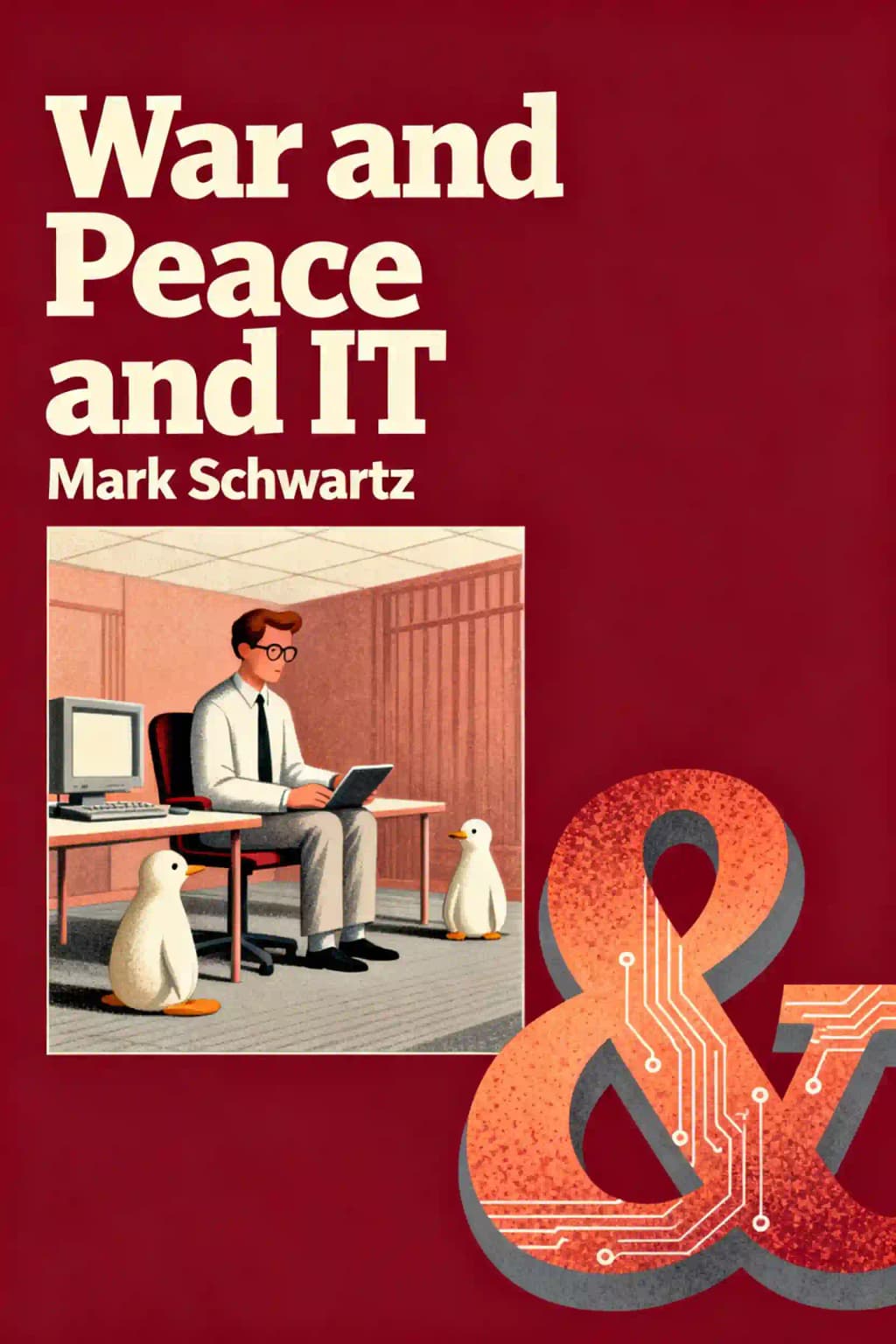
Have you ever wondered why some companies thrive in the digital age while others falter despite massive technology investments? Mark Schwartz's "War and Peace and IT" might hold the answer. This provocative book has become required reading in boardrooms across Silicon Valley, with tech luminaries like Jeff Bezos reportedly keeping copies on their nightstands. The book's cultural impact extends beyond business circles-it was featured in Bill Gates' 2020 summer reading list and has influenced how governments worldwide approach digital transformation.
Schwartz, a Harvard-educated former CIO who now serves as an Enterprise Strategist at Amazon Web Services, brings a unique perspective that bridges the worlds of technology and business leadership. His work has fundamentally challenged how organizations view the relationship between IT and business strategy, making this one of the most influential business technology books of the past decade. With over 100,000 copies sold and translations in 15 languages, it's reshaping how enterprises approach digital transformation globally.
第 2 章
The Great Divide: Why Business and IT Don't Understand Each Other
Imagine it's 1975. Your company's first computer sits in its own frigid room, visible through a window as you pass by. Inside, technicians in white lab coats tend to spinning tape drives and punched card readers. One of them is Gerald, the brilliant but eccentric programmer you once found sleeping under his desk when the payroll system crashed. While employees weren't getting paid-a genuine emergency-Gerald seemed more fascinated by his "emphatic byte munger" algorithm than fixing the problem.
This disconnect created a fundamental challenge: how could businesses hold accountable these essential but peculiar specialists who spoke an alien language and seemed more interested in technology than business outcomes? Companies responded by hiring IT managers and CIOs who could translate between worlds. A relationship evolved where "The Business" specified requirements through formal processes, while IT prepared Gantt charts and status reports to demonstrate accountability.
The result was an arms-length, contractor-like relationship that separated rather than integrated these groups. "The Business and IT" became distinct entities-one focused on shareholder value, the other on algorithms and routers. Some organizations even implemented chargeback models where IT billed internal departments like an external vendor.
Today, these stereotypes no longer hold. Modern IT professionals are typically business-focused problem solvers who, as Menlo Engineering describes, have "the heart of the engineer, which is to serve others." Yet many organizations remain trapped in outdated relationship models that prevent true digital transformation.
The traditional waterfall approach-where requirements are specified upfront, signed off on, and then delivered through sequential phases-creates numerous problems. It maximizes "feature bloat" by forcing stakeholders to include every possible need they might have in the future. Studies show more than half of features in IT systems are rarely or never used, representing billions in wasted spending.
What businesses truly want isn't delivery on schedule but delivery as soon as possible-urgency and the shortest possible lead time. This requires eliminating waste throughout the delivery process, including waste in the interactions between IT and the rest of the business.
第 3 章
Navigating Complexity and Uncertainty in the Digital Battlefield
Tolstoy's account of Napoleon at the battle of Borodino illustrates the futility of command-and-control in complex environments. Despite Napoleon's military genius, his orders were often ignored or rendered obsolete by rapidly changing conditions. The battlefield's complexity, uncertainty, and rapid changes meant that neither following preset plans nor giving direct orders from a distance proved effective.
In environments where circumstances change more rapidly than decision lead times, control becomes an illusion. As Clausewitz noted, "War is the realm of uncertainty; three quarters of the factors on which action is based are wrapped in a fog of greater or lesser uncertainty." The troops who could rapidly decide and act were the only ones who could respond at the necessary tempo.
The business enterprise functions as a complex adaptive system where individuals pursue objectives and interact in complex ways. Such systems aren't deterministic but continuously reorganize unexpectedly. Information flows imperfectly through organizations-upper management doesn't know ground realities, and line employees don't know boardroom conversations. Even as CIO at US Citizenship and Immigration Services, Schwartz discovered his requests were transformed as they descended through management layers, often becoming unrecognizable to technologists who wisely ignored them.
The complexity intensifies when considering market contexts. Unpredictable events-competitors, discoveries, social movements-inevitably disrupt our carefully calculated plans. Our business school management models assume predictability and equilibrium, but uncertainty undermines this. Honest business cases would include enormous uncertainty ranges, making traditional ROI calculations nearly meaningless.
The task of leaders in complex adaptive systems isn't issuing orders but creating conditions that guide independent actors toward desired outcomes. The enterprise leadership team sets the vision that defines what delivering business value means.
The military has recognized this reality. The Marine Corps puts agility at its doctrine's center, operating in small teams making ground-level decisions while sharing principles, values, and understanding of the "commander's intent"-their goal and decision-making parameters.
No matter how much data we collect, we cannot know the future. The myth of visionary business leaders who predict the future is just that-a myth. As Prince Andrei says in War and Peace about skilled commanders who foresee all possibilities: "That's impossible." Truly great leaders adapt nimbly to whatever happens rather than simply guessing correctly under uncertainty.
第 4 章
The Agile Revolution: Embracing Speed and Flexibility
In 2001, software development experts created the Manifesto for Agile Software Development, undermining the contractor-control, plan-above-all model ingrained in corporate IT. Agile manages complexity through continuous learning and adaptation, working in short cycles to gather feedback and improve incrementally.
Like military theory that decentralizes command to cope with uncertainty, Agile uses small teams with joint accountability who communicate daily and periodically assess their process. Decisions are decentralized but controlled through shared understanding of objectives and continuous leadership oversight.
Unlike waterfall's rigid upfront planning, Agile establishes goals and creates tentative feature lists that developers and users refine together as they're delivered. Each feature is developed independently from start to finish, allowing immediate delivery and the flexibility to modify priorities at any time.
Since Agile focuses on completing work quickly, applying Lean manufacturing principles to IT delivery is logical. Waste in IT includes any activity that doesn't add enough value to justify its cost or additional lead time. Large batch sizes (processing many requirements as a single deliverable) create significant waste. Lean IT teams limit work-in-process to reduce cycle time, variability, risk, overhead, and costs while accelerating feedback and improving efficiency.
DevOps combines Agile and Lean IT principles through cross-functional teams and extensive automation, eliminating the traditional tradeoff between speed and control. Research by DevOps Research and Assessment (DORA) shows organizations using DevOps practices are 1.53 times more likely to meet business goals and create workplaces where employees are 2.2 times more likely to recommend working there.
DevOps teams are small (5-9 people), cross-functional, and staffed with "T-shaped" people who have broad skills but deep expertise in one area. They automate testing, infrastructure setup, security controls, and code integration. Most remarkably, they deploy code frequently-from Amazon's fifty million deployments per year to smaller organizations' daily or weekly releases.
Elite DevOps performers deploy 46 times more frequently than low performers, with 2,555 times faster lead times, 2,604 times faster recovery from problems, and 7 times fewer change failures. This approach reduces security risks, cuts costs by eliminating unneeded features, decreases defects, and allows continuous business involvement rather than periodic reviews.
第 5 章
The Hidden Assets: Technology as Strategic Advantage
Enterprises face transformation challenges that startups don't have-they're burdened with legacy systems optimized for yesterday's business needs. A successful enterprise has perfected delivering yesterday's value with yesterday's processes and people, making it inherently unprepared for tomorrow's demands. Digital transformation requires embracing nimbleness while untangling from a complex network of interrelated processes.
Despite these challenges, large enterprises possess advantages in the digital world: global distribution, support systems, brand recognition, ecosystems, and strong finances. If they can free themselves from legacy constraints while leveraging these assets, they can compete effectively-but this means abandoning what made them successful.
The total IT capabilities of an enterprise form an economic asset whose value lies not just in current functionality but in its adaptability to future needs. This "IT asset" includes software, infrastructure, and devices that enable business operations. Its agility determines costs and lead times when adapting to change, yet governance processes rarely justify investments purely to increase this agility. In a digital world, the quality of this off-balance sheet asset becomes crucial to success.
The IT asset's quality depends on technical considerations like design, architecture, code style, and resilience. Even well-written code degrades through technical debt, which can be reversed through refactoring. In uncertain environments, quality improvements become crucial for future cash flows.
Beyond technical factors, organizational agility comes from nontechnical resources like investment management, governance processes, and people. Outsourcing has impaired this asset-while companies believed it would make them more agile by flexibly adding technical talent, the contracting overhead actually impedes innovation and lengthens lead times.
The third intangible asset is the company's ability to use its data. While traditionally organized for transactions, data increasingly has informational value. Rather than limiting access through pre-prepared reports, making data more agile means implementing flexible analytics systems where employees can conduct ad hoc analyses using visualization tools or AI.
These three assets-technical, organizational, and data-work together to provide nimbleness for seizing opportunities. They reduce lead times: the organizational asset determines planning time, the technical asset determines deployment speed, and the data asset determines data accessibility.
第 6 章
Reframing Risk and Opportunity in the Digital Age
Risk represents the possible negative consequences of an uncertain future, while opportunity represents the positive possibilities. Agility determines which outcome materializes. Today's business environment is filled with unprecedented disruption-from nimble startups fundamentally upending traditional industries, increasingly unpredictable customer preferences, growing political instability across markets, and exponentially evolving technology. Yet this uncertainty doesn't automatically spell disaster; it creates unprecedented opportunities for organizations prepared to seize them. The key differentiator between hazard and opportunity is agility. Extensive research from McKinsey and BCG shows highly adaptive companies consistently outperform less adaptive ones by 50-150% during economic turmoil and market transitions.
Agility directly reduces risk in uncertain environments by enabling rapid response to change. When market conditions shift suddenly-like Newton bobbleheads becoming obsolete when Einstein's theory emerges-an agile factory can quickly retool production lines for Einstein dolls and capture first-mover advantage. This principle extends beyond manufacturing: software companies with microservice architectures can rapidly reconfigure capabilities, retailers with flexible supply chains can quickly adjust inventory, and organizations with cross-trained workforce can reallocate talent. The fundamental principle remains: anything increasing your cost of change increases risk exposure, while anything decreasing it reduces risk. Risk, therefore, is fundamentally about lack of agility.
We demonstrate consistent cognitive biases that lead us to irrationally fear the new while dangerously underestimating risks of maintaining the status quo. Organizations frequently hesitate to adopt proven risk-reducing technologies like cloud infrastructure, DevOps practices, and digital transformation initiatives. Security specialists routinely complain about on-premise datacenter vulnerabilities yet resist cloud migration as "too risky" despite superior security capabilities. This status quo bias, extensively documented by Samuelson and Zeckhauser across multiple industries, shows people disproportionately stick with current situations even when better alternatives exist. The endowment effect makes us overvalue what we already possess, especially things we've had longer-like legacy COBOL systems that cost millions to maintain. In today's rapidly evolving environment, maintaining the status quo is often significantly riskier than embracing strategic change.
Digital transformation fundamentally isn't about increasing risk tolerance but rather reducing risk through systematic experimentation and learning. "Failing fast" means making small, reversible investments to gather real-world information before larger commitments. Well-designed experiments let organizations test multiple approaches inexpensively, avoiding analysis paralysis and the often-overlooked cost of delay. This approach closely resembles optimal betting strategies in games like blackjack-placing small initial bets across a portfolio of opportunities, then increasing investment in proven winners while cutting losses on failures. In an uncertain world, blindly following rigid plans based on yesterday's knowledge is incredibly risky; agile experimentation with rapid feedback loops is actually the truly risk-averse approach. Companies like Amazon, Netflix, and Google have demonstrated how continuous experimentation reduces risk while accelerating innovation.
第 7 章
Transforming IT Governance for the Digital Era
An enterprise must direct resources toward investments delivering maximum value. Traditional IT investment management weighs proposed initiatives through business cases and go/no-go decisions, but this approach is unnecessarily risky and slow in the digital age. Speed can improve decision-making and extract more value from each investment.
In the traditional model, business proposes initiatives while IT executes with limited capacity. Demand always exceeds supply, creating a growing backlog of IT requests. Small requests go through low-overhead prioritization, while larger projects undergo capital budgeting processes with formal governance oversight. This process requires formal proposals with estimated benefits, risks, and resource requirements submitted to decision-makers who select "winning proposals."
The Star Chamber (governance body) has fiduciary duty to deploy resources for good returns and oversee initiatives, but this approach falters in environments of uncertainty and complexity. It places excessive reliance on business cases and plans prepared in advance, which rarely survive first contact with reality. Since the Star Chamber invests in specific plans and business cases, these shouldn't change during execution-directly conflicting with Agile adaptation.
Traditional governance evaluates business cases for initiatives as monolithic wholes-coarse-grained decisions assuming value comes from the sum of all parts. While some functionality combinations are necessary, surprisingly minimal products can remain viable. Coarse-grained governance sacrifices the advantages of Agile techniques: deploying individual capabilities as they're ready, working on individual requirements rather than large batches, maintaining flexibility, and properly prioritizing work items with different business values.
Three models enable decentralized decision-making with centralized direction. In the product model, technologists work as part of product groups managing roadmaps based on market feedback and company strategy. The budget model treats IT work as everyday production rather than projects-IT staff simply produce what's needed daily. The objective model charters cross-functional teams with specific business objectives cascaded from company priorities. These teams own the objectives rather than requirements, testing hypotheses and implementing both IT and business process changes to achieve them.
Schwartz implemented the objective model at USCIS with their E-Verify modernization project. After four years of traditional waterfall approach produced only binders of documentation, they reclassified those binders as trash and reduced the project to five business objectives. Cross-functional teams of technologists and business staff were empowered to do whatever necessary to meet their objectives. The two-and-a-half-year project achieved maximum outcomes while minimizing output, demonstrating DevOps' power when paired with appropriate investment management.
第 8 章
Unleashing Innovation Through Cultural Transformation
Innovation drives change in capitalist economies through creative destruction-enterprises must both create future success conditions while undoing previous ones. This transformation requires unlearning old behaviors, making innovation appear "in the guise of a miracle." Hindu mythology illustrates this through Shiva, who embodies both destruction and creation in an eternal cycle of transformation.
At USCIS, Schwartz discovered the true obstacle to innovation wasn't lack of ideas but organizational resistance. When taking over the troubled USCIS Transformation program, he met with key participants who each offered excellent improvement suggestions. When asked why they hadn't implemented these ideas, they revealed the real problem: excessive approval requirements, multiple veto points, and leadership's rigid commitment to existing approaches. They had developed learned helplessness and no longer bothered promoting their innovations.
Many enterprises try solving innovation through specialized "innovation teams" with special rule-bypassing powers or through "innovation boards" staffed by the very executives who created the status quo. Both approaches fail: the former tells regular employees "don't bother innovating" while the latter subjects ideas to judgment by those least likely to embrace change. The key isn't distinguishing between sources of innovation but creating systems where good ideas naturally find paths to execution.
The traditional approach to innovation focuses on risk avoidance, but the digital age changes this calculus dramatically. Trying new ideas has become less risky thanks to DevOps, cloud computing, and open-source frameworks that enable quick, inexpensive experiments. Meanwhile, maintaining the status quo has become riskier as competitors leverage these same tools.
Automated controls-guardrails-enable innovation while maintaining compliance. Instead of manual gatekeeping that interrupts work, automated controls run continuously while work flows. These constraints actually enhance creativity, as Stravinsky noted: "The more constraints one imposes, the more one frees one's self." Constraints direct innovation toward appropriate objectives while giving engineers confidence to create freely within safe boundaries.
第 9 章
The Digital Action Plan: Practical Steps for Transformation
Digital transformation requires immediate action rather than planning. The Agile approach means moving quickly, learning constantly, and delivering incremental successes. Starting immediately means getting results within two weeks, not just holding meetings or drafting plans. The key is to think big but execute small, mitigating risk through small steps that produce results rather than through extensive planning.
IT initiatives should focus on intended outcomes rather than fixed requirements. Requirements should be flexible, used only if they help achieve the outcome in better, simpler, or faster ways. Start by chartering a small, self-contained team with all necessary skills and authority to accomplish a specific business objective. Management's role is to remove impediments.
Focus relentlessly on reducing lead time-the period from when an objective is conceived to when it's met. Start by mapping out process steps and questioning each one. Many delays aren't technical but bureaucratic: governance processes, meetings with hard-to-coordinate schedules, or waiting for approvals.
In the digital world, progress is measured only by finishing things that add business value. Nothing should be "47% complete" or merely "on schedule." The mantra is "Always be shipping"-continuously finishing work and delivering it to users. If a task can't be finished quickly, it's too big.
Treat business ideas not as requirements for IT, but as hypotheses to be tested and refined. The first step is identifying hidden hypotheses-for example, a requirement to "display data from database x" might really be a hypothesis that "users with this data could make better credit decisions." Once explicit, define how to measure outcomes. Then design the smallest possible experiment to test if building the capability will achieve the goal.
In the digital world of uncertainty, complexity, and rapid change, agility has high business value. It transforms unexpected events from hazards into opportunities and gives enterprises freedom to innovate or respond to competitors. IT is a crucial source of agility-software changes more easily than physical assets, and cloud infrastructure offers flexibility hardware cannot.
Security must be everyone's responsibility, not just IT's concern. Sales and marketing owe data privacy to customers and have stakes in product availability. The CFO owes security risk management to stakeholders. Every employee should consider security essential to their job.
Data is an underexploited asset often trapped in databases structured for anticipated uses, making it unavailable for ad hoc analysis or innovation. Modern approaches leverage cloud-based data lakes that combine data from across company databases regardless of format.
第 10 章
Redefining Leadership for the Digital Enterprise
The transformation to the digital world demands reconsideration of how functional areas work together, particularly at the leadership level. While C-suite executives represent different functional specialties, they often operate in silos rather than as a true team with shared accountability. By applying DevOps team concepts to executive leadership, enterprises could achieve greater agility and flexibility needed in the digital world.
In the digital world, the CFO's role becomes strategically critical. Rather than simply controlling costs, the modern CFO steers resources toward strategic opportunities, manages investments as options, and targets waste elimination. The role has evolved from backward-looking financial reporting to forward-focused opportunity identification.
The digital world demands deeper customer relationships, creating both challenges and opportunities for the CMO. Frequent digital customer interactions enable rapid testing, feedback collection, and problem resolution. As the voice of the customer, the CMO brings market surprises to the leadership team, sensing changes in customer buying patterns that impact company strategy.
CEOs must grow the business while sustaining core operations, but growth and stability can actually complement each other. By making processes lean and removing innovation impediments, enterprises can unlock growth opportunities at minimal cost and risk. The CEO's role isn't just quarterly growth but setting up for sustained growth and future adaptability.
The CIO brings IT expertise to leadership but most enterprises aren't taking enough advantage of their CIOs. They should be held to a higher standard beyond project delivery and budget management. The CIO should continuously deliver valuable IT capabilities incrementally while contributing digital expertise to support other executives. As a driver of business outcomes and strategy, the CIO should be responsible for revenues, costs, competitive strategy, and maintaining an agile, cost-effective, secure IT asset. For an enterprise to succeed in the digital age, IT must not just serve the business but BE the business.
The digital mindset requires overcoming traditional dualities: IT versus business, control versus speed, agility versus planning, legacy versus innovation. Like Shiva's dance of destruction and recreation, we must move forward with both confidence and humility. Despite Napoleon's hubris, "the only emperor is the emperor of ice cream"-a reminder that even the mightiest leaders are temporary.