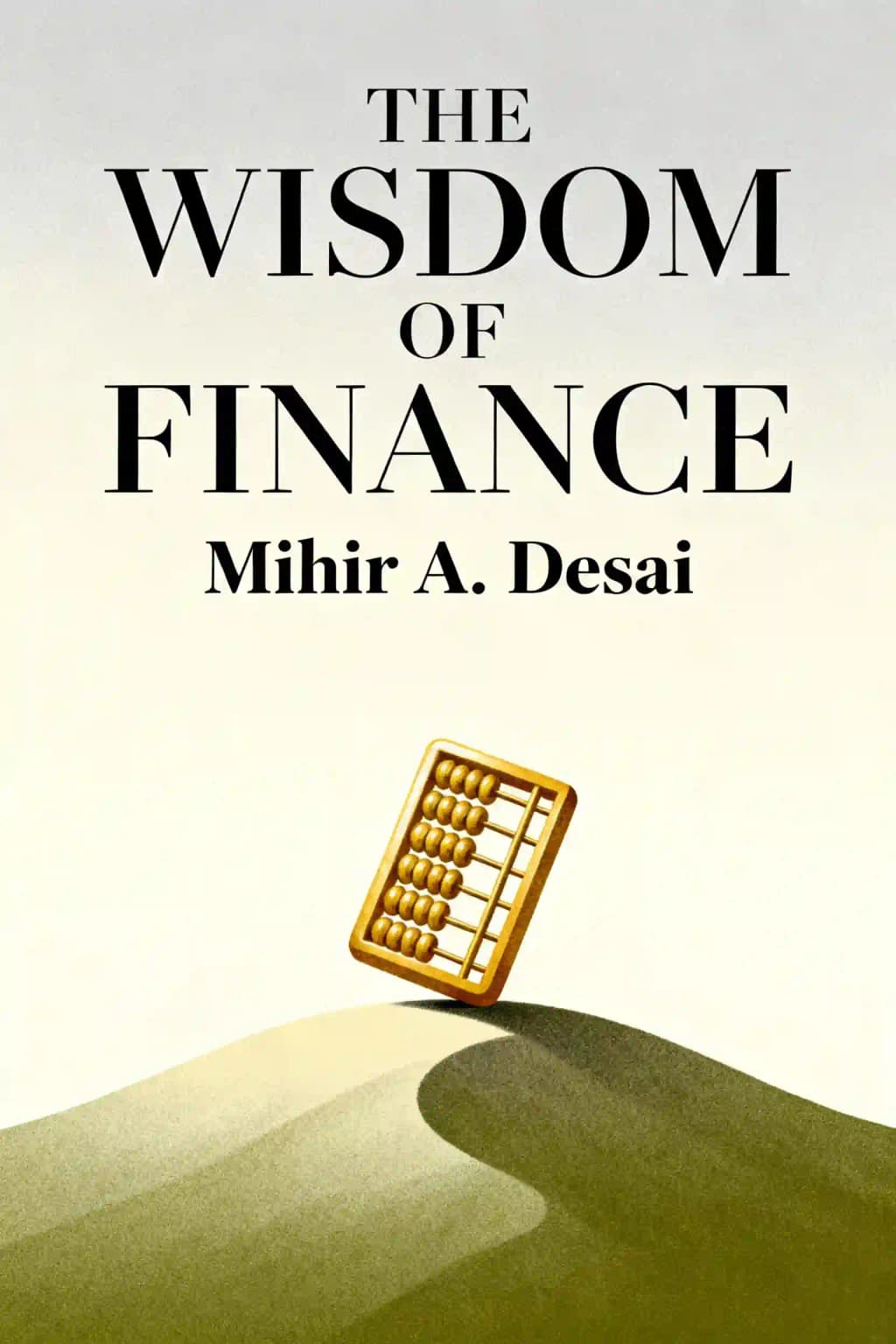
Wisdom of Finance
Discovering Humanity in the World of Risk and Return
《Wisdom of Finance》概述
Discover how finance is deeply human in Harvard professor Desai's award-winning exploration, where Jane Austen explains risk and Mel Brooks illustrates fiduciary duty. Nobel Laureate Oliver Hart calls it "a fascinating new perspective" that restores nobility to an often misunderstood profession.

《Wisdom of Finance》核心主题
- humanistic finance
- risk management philosophy
- optionality and diversification
- probabilistic thinking
- value creation ethics
《Wisdom of Finance》经典语录
Finance isn't just about making money-it's about finding purpose.
Chance is everywhere yet manageable through patterns.
We should see ourselves as insurance companies.
Experience-gathering demands empathy.
Happiness in marriage is entirely a matter of chance.
《Wisdom of Finance》主要人物
- Mihir A. DesaiAuthor and Harvard professor of business and law
- Charles Sanders PeircePhilosopher who explored randomness and patterns
- Wallace StevensPoet and insurance executive
- Fred SmithFounder of FedEx used as a case study in risk
- Elizabeth BennetLiterary protagonist used to illustrate risk
关于作者
《Wisdom of Finance》作者介绍
Mihir A. Desai, author of The Wisdom of Finance: Discovering Humanity in the World of Risk and Return, is a renowned finance scholar and Mizuho Financial Group Professor of Finance at Harvard Business School, with a joint appointment at Harvard Law School. A leading authority on corporate finance, taxation, and globalization, Desai bridges academic rigor and real-world relevance in his exploration of finance’s humanistic dimensions. The book, longlisted for the 2017 FT/McKinsey Best Business Book of the Year, reimagines finance through literary and historical lenses, linking concepts like risk and return to universal themes of decision-making and ethics.
Desai, a Baker Scholar and Fulbright recipient, also wrote How Finance Works: The HBR Guide to Thinking Smart about the Numbers and co-hosts Harvard Business Review’s After Hours podcast.
His insights, shaped by roles at McKinsey & Co. and advisory positions for governments and Fortune 500 firms, are widely cited in major publications like The Economist and The New York Times. A sought-after speaker, he developed Harvard’s popular online course Leading with Finance. His work has informed policy testimonies before the U.S. Senate and House committees, cementing his status as a trusted voice in global finance.
下载《Wisdom of Finance》摘要
免费获取《Wisdom of Finance》摘要的 PDF 或 EPUB 版本。可打印或随时离线阅读。
关于本书的常见问题
The Wisdom of Finance reframes finance through literature, history, and philosophy, revealing how concepts like risk, insurance, and value creation mirror universal human experiences. Desai bridges financial theory with life lessons, using stories from Jane Eyre to Dutch shipping to show how financial principles inform resilience, decision-making, and moral responsibility.
Finance professionals, students, and general readers seeking a humanistic perspective on finance will gain value. Desai’s interdisciplinary approach appeals to those interested in philosophy, literature, or ethical decision-making, offering fresh insights into risk management, personal growth, and societal contribution.
Yes—it’s a concise, thought-provoking exploration of finance’s deeper connections to everyday life. Desai’s storytelling demystifies complex topics like derivatives and mergers while challenging readers to reflect on resilience, uncertainty, and creating lasting value.
Risk is framed as an inherent part of life, managed through strategies like diversification (e.g., Dutch traders spreading shipping risks) and insurance. Desai argues that embracing uncertainty, rather than avoiding it, fosters resilience in finance and personal challenges.
Desai uses narratives from Pride and Prejudice to Charles Sanders Peirce’s philosophy to illustrate financial concepts. These stories make abstract ideas relatable, showing how insurance parallels trust in relationships or how mergers mirror romantic unions.
True value arises from exceeding expectations ethically, whether in investing or personal endeavors. Desai emphasizes long-term growth and serving others, critiquing short-term profit motives while highlighting parallels between corporate mergers and collaborative partnerships.
The book applies financial principles to life choices, like viewing insurance as a tool to manage life’s randomness or diversification as a strategy for balancing career risks. Desai encourages aligning financial decisions with personal values and moral goals.
Desai ties finance to existential themes: embracing uncertainty (via Peirce), finding meaning in risk-taking, and reconciling self-interest with societal good. He argues finance, like life, requires balancing fragility and ambition.
Desai challenges finance’s reputation for greed, advocating for its nobler purpose: enabling growth, managing fragility, and fostering trust. He contrasts transactional mindsets with frameworks that prioritize sustainability and ethical impact.
- Risk and resilience: Uncertainty is inevitable—manage it through preparation and adaptability.
- Value beyond profit: Create lasting impact by serving others.
- Interdisciplinary learning: Finance gains depth when connected to humanities.
Unlike technical guides, Desai’s work focuses on finance’s human side, pairing quantitative concepts with qualitative stories. It complements classics like The Intelligent Investor by adding philosophical and historical context.
Some reviewers note its abstract approach may overwhelm readers seeking practical steps. However, its strength lies in redefining finance’s role in society rather than offering prescriptive advice.