第 1 章
When Life Throws You Curveballs: A Philosophy of Resilience
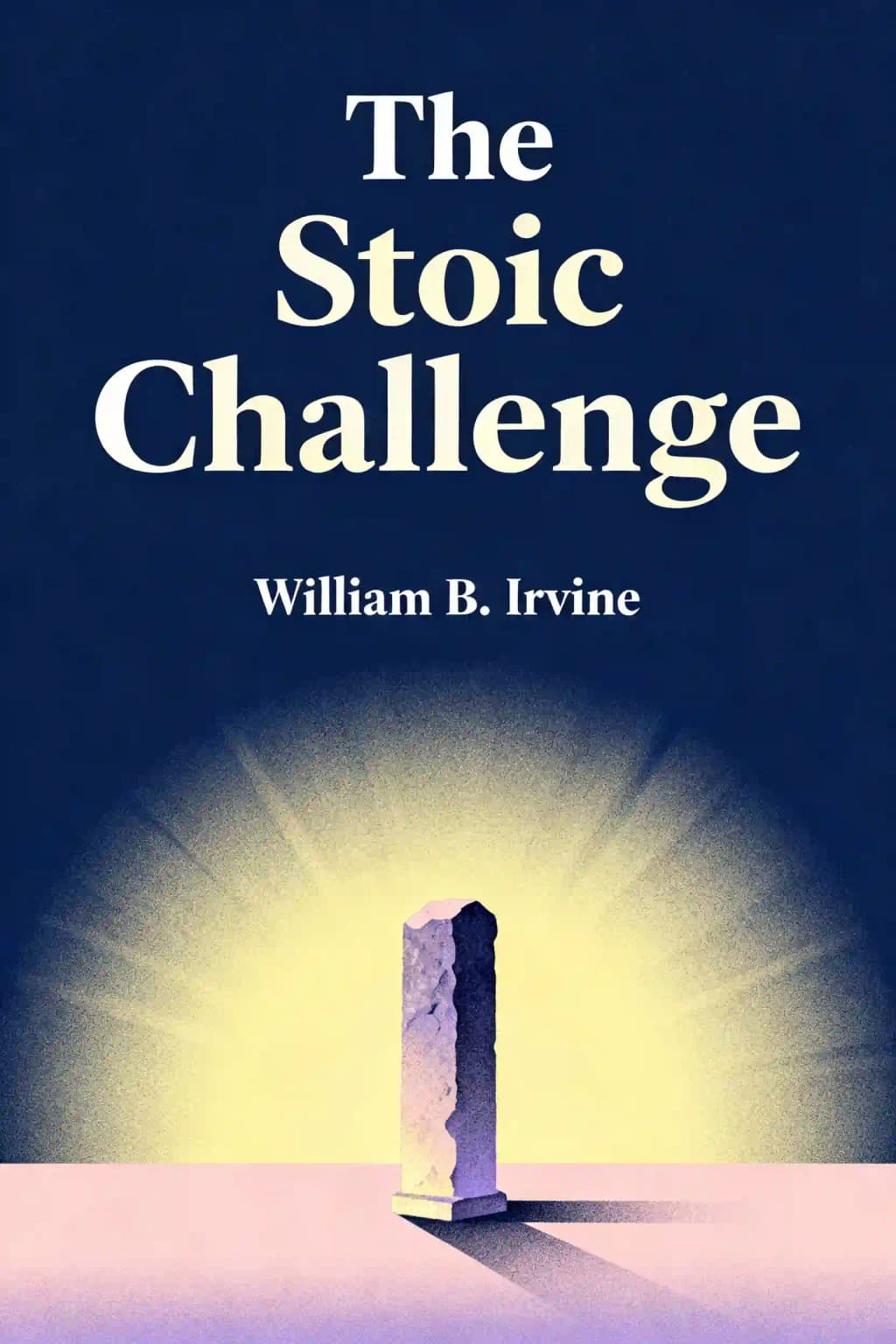
Have you ever found yourself stranded at an airport, watching fellow travelers descend into rage while you somehow maintain your cool? This is precisely what happened to William B. Irvine during a cascade of travel disruptions that would test anyone's patience. Rather than succumbing to frustration, he reframed the experience as a test of character-a challenge from what he playfully calls the "Stoic gods." This perspective transformed what could have been a miserable day into a personal victory.
"The Stoic Challenge" has become a favorite among Silicon Valley executives and professional athletes for its practical approach to resilience. Even celebrities like Tim Ferriss and Maria Sharapova have praised its wisdom. Unlike many self-help books that offer superficial solutions, Irvine's work revives ancient Stoic wisdom while backing it with modern psychological research on framing effects. The result is a surprisingly optimistic philosophy that doesn't ask us to suppress emotions but rather to transform how we experience life's inevitable obstacles.
第 2 章
The Spectrum of Setbacks: From Burnt Toast to Terminal Illness
Life flows smoothly until it doesn't. Setbacks range dramatically in severity-from minor inconveniences like burnt toast to profound disruptions like terminal illness or wrongful imprisonment. Most obstacles come not from nature but from other people, sometimes unintentionally, sometimes deliberately. And let's be honest: we're often responsible for many of our own setbacks through poor planning or bad choices.
What's fascinating is how the same event might devastate one person while barely affecting another. This happens because setbacks connect directly to our desires-the more we want something, the more painful it is when obstacles appear in our path. Even the most careful planners can't prevent all obstacles, which is why developing strategies for managing our emotional responses becomes crucial.
Our fascination with setbacks explains their prevalence in sports, literature, and even our dreams. We share setback stories for various reasons: as warnings to others, to seek help, to impress others with our resilience, or simply to gain sympathy. These stories form the backbone of human experience-they reveal character and shape our identities in ways that smooth sailing never could.
Consider how differently we respond to challenges. Some become emotionally devastated by minor obstacles, while others demonstrate remarkable resilience. The difference lies not in what happens to us, but in how we choose to respond. This choice-between frustration and equanimity-forms the cornerstone of Stoic philosophy.
第 3 章
The Poison of Anger: Why Getting Mad Never Helps
When faced with obstacles, most people respond with frustration that quickly transforms into anger. But anger is fundamentally incompatible with happiness and tends to be contagious. We either direct it at those who caused our setback or share it with innocent bystanders, seeking validation and commiseration. When we want others to join our anger, we're essentially asking them to share our wretchedness, multiplying the foolishness of our emotional response.
Once anger takes hold, we have two options: express it or suppress it. Neither works well. Suppressed anger might become dormant only to spring back to life later-anger flashbacks can continue for decades. Expressing anger in socially unacceptable ways might lead to imprisonment, while even socially acceptable expressions negatively impact ourselves. As Seneca noted, "No plague has cost the human race more" than anger, leading to insults, lawsuits, divorces, violence, wars, and fallen civilizations.
The Stoic approach offers a third option: avoid getting angry in the first place. Through studying Stoic philosophy, we can learn to think our way out of becoming angry. By investigating our anger patterns-yelling at other drivers in traffic jams, shouting at politicians on television, or dwelling on past wrongs-we recognize the harm we do to ourselves and begin addressing our anger issues.
Imagine two drivers stuck in the same traffic jam. One fumes with rage, honking uselessly and carrying that negative energy home to family and coworkers. The other uses the delay productively by listening to a podcast or catching up on phone calls. Same situation, dramatically different outcomes-all because of how they framed the experience.
第 4 章
Profiles in Resilience: Ordinary People, Extraordinary Responses
While we might pity those broken by life's setbacks or sympathize with those who respond with frustration, there exist individuals who quickly bounce back or don't get upset to begin with. These resilient individuals appear strong and heroic-not because they avoid suffering but because they transform it.
Consider astronaut Neil Armstrong, who after narrowly ejecting from a crashing lunar lander trainer that burst into flames, calmly returned to his office to do paperwork. When fellow astronaut Alan Bean discovered what happened and asked about it, Armstrong simply acknowledged the crash without dramatizing it. Bean later remarked that most astronauts would have boasted about their survival skills, noting how Armstrong's unusual composure colored his opinion of him ever since.
Or thirteen-year-old surfer Bethany Hamilton, who lost her left arm to a shark attack while surfing in Hawaii. Despite losing 60% of her blood and nearly dying, she quickly considered her options during recovery. Just 26 days after the attack, she successfully rode waves again. Less than two years later, she won the National Scholastic Surfing Association National Championship before turning professional.
Even more remarkable is Alison Botha, who survived a horrific attack by two men who abducted, raped, and brutally stabbed her multiple times before leaving her for dead. During her long, painful recovery, she initially became depressed but found purpose as an inspirational speaker. She embraced a philosophy that Stoic Epictetus would have applauded: "We cannot always control what happens in our life..., but we can always control what we do with what happens."
Film critic Roger Ebert faced devastating health challenges when diagnosed with salivary cancer, eventually losing his ability to speak and being left with a permanently disfigured jaw. Yet in 2011, he gave a remarkable TED Talk using a speech synthesizer and friends to read his words while he used gestures to make self-deprecating jokes. Despite his inability to speak, Ebert maintained his sense of humor, earning a standing ovation from the initially uncertain audience.
These stories evoke mixed emotions-tears for others' suffering, shame for taking our own abilities for granted, and ultimately inspiration. They show ordinary people transforming potential tragedies into personal triumphs by responding to enormous challenges with courage and intelligence rather than self-pity.
第 5 章
The Declining Art of Resilience: Can We Recover It?
Resilience varies not just among individuals but across generations, with compelling evidence suggesting a marked decline in recent decades. The author argues that resilience is not an innate trait like eye color but an acquired ability that modern society has systematically undermined. He illustrates this through vivid historical examples, contrasting the remarkable resilience shown by Londoners during WWII bombings - who maintained daily routines and even humor despite nightly raids - with the decreased resilience of their descendants who often struggle with far lesser challenges.
Several interconnected factors have contributed to this decline. The popularization of Elisabeth Kubler-Ross's grief stages, while valuable for understanding loss, inadvertently normalized extended periods of negative emotions and created an expectation that recovery should follow a lengthy, prescribed path. The exponential rise of psychological counseling, while beneficial in many ways, has sometimes reinforced victim mentalities by encouraging people to attribute their struggles to past traumas rather than focusing on forward-looking solutions. Politicians increasingly leverage victimhood narratives for political gain, creating a culture where victim status confers social benefits. Meanwhile, helicopter parents, driven by good intentions but misguided strategies, create artificially setback-free childhoods that leave children ill-equipped for real-world challenges.
Modern parenting practices deserve particular scrutiny in this decline. In attempting to protect children from all discomfort, many parents intervene in everything from playground disputes to academic challenges, creating emotionally brittle adults. Children need to experience appropriate challenges and minor setbacks - whether it's losing at sports, receiving criticism, or solving their own social conflicts - to develop resilience. Without this crucial practice, they enter adulthood unprepared for life's inevitable difficulties. Research shows that children who face and overcome manageable challenges develop better coping mechanisms and higher self-confidence than those sheltered from all adversity.
The encouraging conclusion is that resilience can be developed through conscious effort at any age. It's not a fixed personality trait but a skill that improves with practice, much like building physical strength through exercise. By understanding the psychology behind our responses to setbacks - including how our thoughts influence our emotional reactions - we can transform our relationship with life's challenges. Simple practices like reframing negative events, maintaining perspective during difficulties, and deliberately taking on challenging tasks can build resilience over time. Studies of successful people across various fields consistently show that their resilience often came not from natural immunity to setbacks but from deliberately cultivating a growth mindset and practicing recovery from failure. This insight potentially revolutionizes our approach to personal development and quality of life improvement.
第 6 章
The Battle of Two Minds: Conscious vs. Subconscious
We humans possess both conscious and subconscious minds that often work at cross-purposes when facing setbacks. While the subconscious mind has valuable functions-reading body language, providing moral instincts for quick decisions, and generating creative insights-it can also interfere with effective responses to challenges.
The Stoics weren't anti-emotion as they're often mischaracterized; they valued positive emotions like joy and delight while seeking to minimize negative ones like anger and frustration. Their "Stoic test strategy" bypasses the subconscious mind's tendency to blame others for setbacks, preventing negative emotional cascades before they begin.
By reframing setbacks as tests of resilience rather than undeserved tribulations, we can avoid emotional disruption and even transform challenges into opportunities for positive emotions like pride and satisfaction. It's like turning "setback lemons" into "lemonade" through a simple shift in perspective.
Our emotional responses evolved over millions of years. Early ancestors had simple brains with reflexive responses, later developing a limbic system that made certain experiences feel good or bad. This evolutionary wiring incentivized survival behaviors. While our brains have gained tremendous processing power, this ancient emotional wiring remains largely unchanged, leaving us with "a computer with lots of processing power but an archaic operating system" responding to modern challenges with primitive emotional programming.
The Stoics discovered a way to hack this computer-by quickly framing setbacks as tests of resilience and ingenuity, we can short-circuit negative emotions and transform unpleasant incidents into enjoyable challenges. This isn't suppressing emotions; it's redirecting our emotional energy in more productive directions.
第 7 章
The Power of Perspective: Anchors and Frames
Two psychological phenomena shape how we experience setbacks: anchoring and framing. Anchoring occurs when initial reference points unconsciously influence our judgments. Experiments by Tversky, Kahneman, and others demonstrate how arbitrary numbers affect people's estimates on unrelated topics. While modern businesses exploit this effect through pricing strategies, the ancient Stoics harnessed it through "negative visualization"-periodically imagining how life could be worse.
Unlike dwelling on misfortune, these brief mental exercises involve "flickering thoughts" about potential losses, like visualizing a friend's funeral or temporary blindness. When returning to reality, one experiences renewed appreciation for what might otherwise be taken for granted. This powerful technique requires no special training, costs nothing, and can be practiced anywhere in seconds.
Framing, meanwhile, determines how we interpret events. While anchoring helps us appreciate life, framing can prevent setbacks from disrupting our tranquility. The Stoics recognized that our judgments about events, not the events themselves, determine our emotional responses. Using an art gallery metaphor, optimists place life's "paintings" (events) in beautiful frames, while pessimists choose ugly ones.
Several reframing strategies can help us navigate challenges: the competing obligations frame (recognizing others' conflicting duties), the incompetence frame (attributing problems to incompetence rather than malice), the storytelling frame (focusing on creating an interesting narrative), the comedic frame (responding with humor like Socrates did), and the game frame (treating challenges as part of play). The final strategy is the Stoic test frame, where setbacks are viewed as challenges from imaginary "Stoic gods" testing our resilience.
第 8 章
The Five-Second Rule: Winning the Race Against Emotions
When experiencing setbacks, our first priority should be preventing negative emotional flooding, just as we'd immediately turn off water from a burst pipe. This immediate response is crucial because emotional reactions, once triggered, can be incredibly difficult to contain and manage. The key to the Stoic test strategy is speed-we have about five seconds to frame a setback as a test before our subconscious triggers negative emotions. This brief window represents the critical moment between an event occurring and our emotional response becoming fixed.
Even after years of practice, reflexive profanity might still occur, but this doesn't prevent successfully employing the strategy if done promptly. Many experienced practitioners report that their initial reaction might still be negative, but they've developed the ability to pivot quickly into the test mindset. Unlike Jefferson's "count to ten" rule for anger management, the Stoic five-second rule aims at anger prevention rather than damage control. This distinction is crucial - prevention is far more effective than trying to manage emotions once they've taken hold.
According to Seneca, setbacks are tests from "God" (Jupiter in Roman context), who tests those with potential for excellence. These divine tests aren't punishment but opportunities to develop courage and self-knowledge. The Stoics viewed challenges as carefully calibrated exercises designed to strengthen character, much like a skilled trainer adjusts weights to build specific muscles. For those uncomfortable with religious beliefs, the Stoic test strategy can still work with imaginary gods as a "convenient fiction" that shapes our subconscious responses. This approach allows practitioners to maintain the psychological benefits of the framework without requiring literal belief in divine intervention.
The Stoic gods don't grade tests-we must grade ourselves based on our workaround solution and emotional response, with the latter being more important. The optimal response isn't just staying calm (a B grade) but welcoming setbacks enthusiastically (an A grade), like a firefighter eager to demonstrate their training. This highest level of response transforms challenges from sources of stress into opportunities for growth and self-improvement. Expert practitioners often report feeling genuine excitement when facing obstacles, viewing them as chances to demonstrate their philosophical progress and resilience.
The five-second rule requires consistent practice and can be strengthened through daily preparation. Many successful practitioners recommend morning meditation or visualization exercises where they imagine potential setbacks and rehearse their rapid reframing response. This preparation helps build the mental pathways necessary for quick implementation when real challenges arise.
第 9 章
Training for Life's Tests: Stoic Adventures and Toughness Training
Once we reframe setbacks as Stoic tests, we may look forward to them as opportunities to develop and display our skills. While we can't create genuine setbacks (which require surprise), we can put ourselves in situations where challenging surprises are likely to occur. This is "studying for" Stoic tests through what Irvine calls "Stoic adventures"-deliberately placing ourselves in challenging circumstances.
What constitutes a challenge varies by person: for some, making breakfast; for Michael Jordan, becoming a minor-league baseball player; for Irvine, learning to row. These adventures help us confront our "Lazy Bill"-the inner voice urging us to quit when things get difficult. By embarking on Stoic adventures, we transform our response to setbacks from frustration to a burst of delight: "Ahhh! A setback to work on!"
Beyond Stoic adventures, we can also engage in "toughness training" by deliberately creating discomfort to expand our comfort zones. This practice addresses both physical and emotional dimensions. Emotionally, we can systematically expose ourselves to fears in measured doses. Physically, we might intentionally experience discomfort by underdressing in cold weather or spending time in heat when air conditioning is available.
Dietary toughness training involves exploring hunger by reducing portion sizes and eliminating snacks, often revealing that what we thought was hunger was actually boredom or discontent. As we advance in our training, we can intensify it through fasting, exercise progression, and even practicing periods of simple living as Seneca did with his "poverty practice."
The Stoics knew that this systematic exposure to discomfort would ultimately reduce total discomfort in daily living-a worthwhile investment that builds resilience and self-confidence while potentially yielding benefits like weight loss, greater meal satisfaction, and the capacity to find delight in simple things.
第 10 章
Embracing "Failure" as the Path to Success
People habitually conceal failures not only from others but from themselves, creating a dangerous blind spot that prevents valuable learning opportunities. While anticipating obstacles is one strategic way to avoid failure, many choose the safer path of pursuing only easily attainable goals-a choice that makes remarkable success virtually impossible. When examining highly accomplished individuals across various fields, a common pattern emerges: they consistently pursued challenging goals, experienced numerous setbacks, yet demonstrated unwavering persistence.
James Dyson's journey exemplifies this principle perfectly. He meticulously developed and rejected over 5,000 vacuum designs before finally perfecting his revolutionary bagless cleaner. Each "failed" prototype provided crucial insights that ultimately led to his breakthrough innovation. The literary world offers equally compelling examples. Margaret Mitchell's "Gone with the Wind" faced 38 rejections before becoming a bestseller and classic film. Robert Pirsig's "Zen and the Art of Motorcycle Maintenance" was rejected an astounding 121 times before finding a publisher and going on to sell millions of copies. Vincent Van Gogh's story is perhaps even more dramatic-despite creating 860 canvases during his lifetime, he sold only one, yet his persistence transformed modern art.
The entrepreneurial landscape is particularly rich with examples of triumph through persistence. Howard Schultz, while building Starbucks into a global phenomenon, faced 242 rejections from investors-a number that would have deterred most people. Kathryn Minshew, founder of career platform The Muse, encountered 148 "noes" from investors before securing funding. Her experience demonstrates how rejection often reflects market timing rather than idea quality. Abby Falik of Global Citizen Year developed an innovative perspective, viewing rejections as "gifts" that provide valuable clues about how to refine and improve her approach.
In the technology sector, this philosophy has evolved into a formal strategy. Mark Zuckerberg's famous advice to Facebook employees isn't to avoid failure but to "Fail faster"-making mistakes quickly and learning from them to accelerate the development of successful products. This approach has become standard practice in Silicon Valley, where rapid prototyping and iterative development are fundamental to innovation. Even traditionally conservative pharmaceutical companies have embraced this mindset. Roche CEO Severin Schwan notably celebrates research teams whose drug development efforts fail with champagne lunches, recognizing that each "failure" advances scientific understanding and brings them closer to breakthrough treatments.
The transformative insight lies in reframing failures not as terminal setbacks but as necessary obstacles on the path to success. By deconstructing seemingly impossible goals into smaller, achievable micro-goals, daunting challenges become manageable through sustained effort rather than requiring extraordinary genius. This approach transforms failure from something to fear into a valuable tool for growth and innovation. Successful people don't necessarily fail less; they simply learn more from each setback and persist longer than others might.
第 11 章
The Final Test: Facing Death with Stoic Courage
Like it or not, you are going to die. The Stoics advise framing death as both a test and an adventure. When you die, your life should be as complete as humanly possible-those who helped you will have been thanked, and people you love will know of your love. There should be few things about your life's plot you'd want to change, partly because of your choices but mainly because you embraced whatever life you found yourself living.
Julius Canus exemplified the Stoic approach to death when condemned by Emperor Caligula. When taken to his execution while playing a board game, he complained not about dying but about being prevented from finishing the game. Before his execution, he treated death as an adventure, curious whether his spirit could witness its departure from his body.
Seneca's own death demonstrates Stoic principles in practice. After being condemned by Emperor Nero, he chose suicide over execution. When friends and family wept at his final moments, he chastised them for abandoning their Stoicism when it would have been most useful. Despite difficulties in dying-his old age made him slow to bleed from cut veins, poison failed to work, and he finally died in a steam bath-he remained true to his principles throughout, demonstrating a magnificent Stoic exit from life.
The Stoic approach to death isn't morbid but liberating. By contemplating our mortality regularly, we appreciate life more fully and prepare ourselves for its inevitable conclusion. As poet Mary Oliver expressed, we can enter death's "cottage of darkness" full of curiosity, as "a bride married to amazement."
第 12 章
From Victim to Victor: The Transformative Power of Stoicism
Irvine concludes his book with another airport story. While traveling to Paris for an exhibition at the Louvre, he discovered his passport missing-likely stolen between the jetway and his seat in Atlanta. This triggered a cascade of challenges: questioning by intimidating French police, signing documents in a language he couldn't read, and discovering the US embassy closed for President's Day when he needed a replacement passport.
Throughout this ordeal, he recognized the handiwork of the "Stoic gods"-it was a test! Because he approached the situation in a test-taker frame of mind, he experienced fascination rather than frustration, amusement rather than anger. He studied how others in the embassy line handled their own passport setbacks, noticing how some remained angry while others rebounded well.
This experience revealed that he had transformed into a "setback connoisseur"-someone who not only studies setbacks but appreciates them. He mentally tipped his hat to the Stoic gods for their ingenuity in devising such an elaborate test, complete with clever touches like having the pilot come back to help search and the embassy being closed when needed.
The beauty of the Stoic approach is that it doesn't require us to deny reality or suppress emotions. Instead, it offers a practical framework for transforming our relationship with life's inevitable challenges. By reframing setbacks as tests of character rather than personal affronts, we can move from being victims of circumstance to victors over our own responses.
In a world increasingly characterized by outrage and victimhood, the ancient wisdom of Stoicism offers a refreshing alternative-one that empowers us to take responsibility for our emotional lives while building resilience in the face of adversity. The question isn't whether life will test you-it will-but whether you'll be ready to pass those tests with flying colors.