第 1 章
The Entrepreneur's Blueprint: Navigating the Startup Wilderness
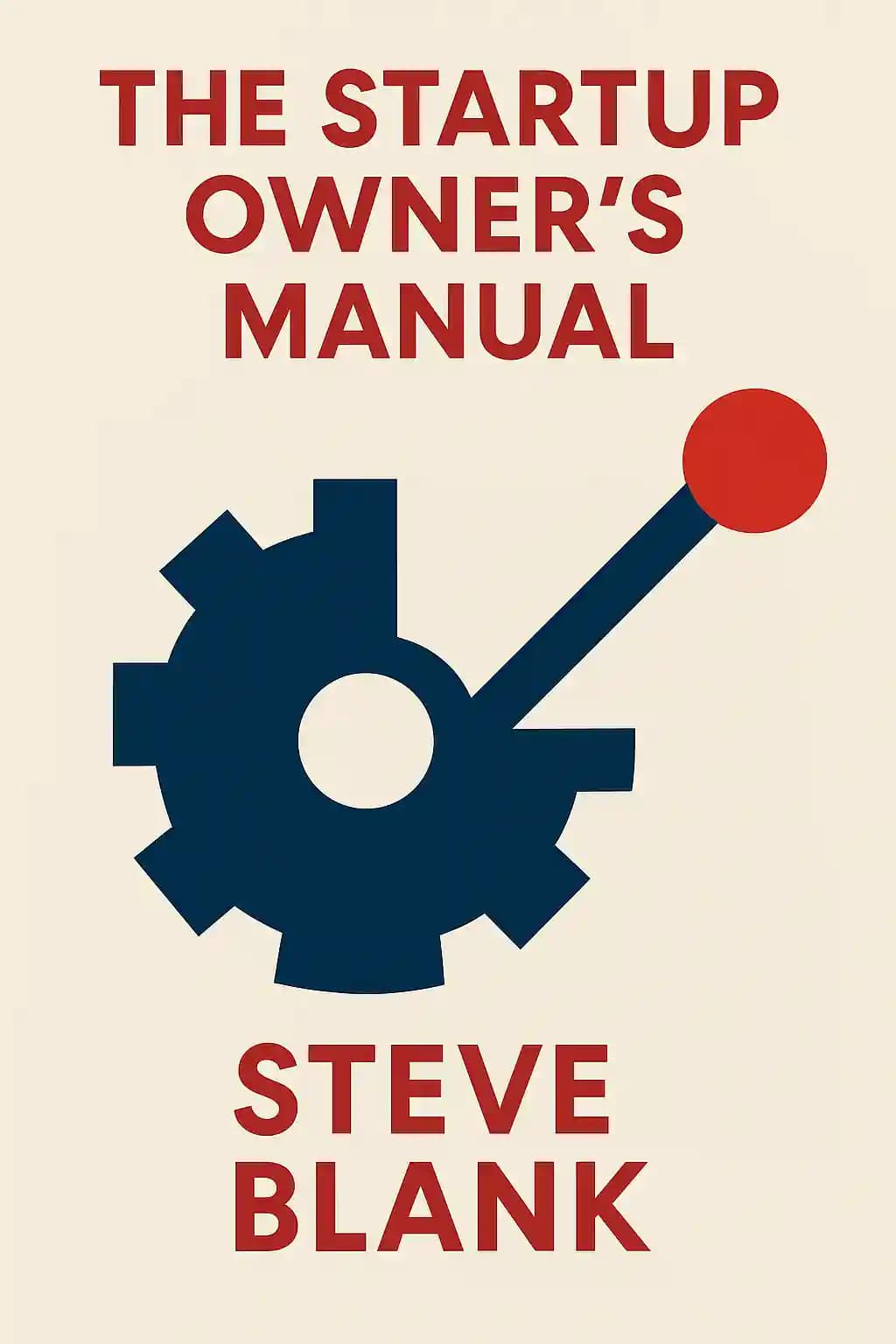
In a world where 9 out of 10 startups fail, Steve Blank's "The Startup Owner's Manual" stands as the definitive survival guide for entrepreneurs venturing into the business wilderness. This isn't just another business book-it's the culmination of decades of entrepreneurial battle scars transformed into actionable wisdom. Since its publication, it has become required reading in entrepreneurship programs at Stanford, Berkeley, Columbia, and beyond. Elon Musk reportedly keeps a copy on his nightstand, and the methodology has been adopted by the National Science Foundation to help scientists commercialize their research. The book's core philosophy-that startups are not smaller versions of large companies but temporary organizations searching for scalable business models-has revolutionized how we think about entrepreneurship, spawning the entire Lean Startup movement that has transformed how innovation happens worldwide.
第 2 章
The Startup Revolution: Why Traditional Methods Fail
The cautionary tale of Webvan illustrates perfectly why traditional business approaches destroy startups. Despite raising over $800 million and assembling an all-star team of executives from companies like Andersen Consulting and Goldman Sachs, Webvan went bankrupt within 24 months of its IPO, burning through $1.2 billion in capital. Why? They followed the traditional product introduction playbook designed for established companies with known customers and markets - a fatal mistake for a startup entering uncharted territory.
This traditional model follows a linear progression: concept development, product building, alpha/beta testing, and launch. It assumes you know exactly what customers want before you've spoken to a single one - a dangerous premise in uncertain markets. Webvan exemplified this flawed thinking by building massive $40 million automated warehouses in multiple cities, developing complex custom software systems, and purchasing a fleet of refrigerated delivery trucks before shipping a single item. They operated purely on assumptions rather than customer validation, believing their extensive market research could substitute for real-world testing.
"Nine out of ten startups fail, and it's not because they can't build the product. Most die because they can't find enough customers," Blank explains. Through studying hundreds of startup failures, he identified nine deadly flaws in the traditional model that consistently doom startups:
First, founders assume they understand customer needs without validation, often projecting their own preferences onto the market. Second, they believe they know what features to build without customer input, leading to over-engineered products that miss crucial market needs. Third, they fixate on rigid launch dates rather than learning cycles, rushing to market before understanding their customers. Fourth, they emphasize blind execution over hypothesis testing and iteration, treating untested assumptions as facts. Fifth, business plans assume flawless execution with no room for pivots, ignoring the reality that most startups significantly evolve their business model. Sixth, they confuse traditional job titles with startup needs, hiring for execution before validation. Seventh, sales and marketing execute against fantasy plans rather than customer understanding, wasting resources on ineffective campaigns. Eighth, they scale prematurely before finding product-market fit, building infrastructure for thousands of customers before securing their first hundred. Finally, when sales inevitably miss targets, the death spiral begins - replacing executives, changing strategies, and burning through cash until nothing remains.
Webvan's fatal flaw wasn't execution - they executed their plan brilliantly, with state-of-the-art warehouses and sophisticated logistics systems. The problem was that they never asked the fundamental question: "Where are the customers?" They assumed that if they built an impressive infrastructure, customers would naturally follow. Meanwhile, competitors like Peapod succeeded by starting smaller with manual processes, avoiding rigid plans, and learning what customers actually wanted through direct interaction. Peapod began by manually shopping at local grocery stores and focused on understanding customer behavior before scaling, ultimately surviving while Webvan collapsed.
The contrast between Webvan and Peapod demonstrates a crucial lesson: successful startups begin with customer discovery and validation, not with elaborate business plans and infrastructure. They embrace uncertainty, test assumptions, and adapt based on real market feedback rather than theoretical projections.
第 3 章
Customer Development: A New Path to Startup Success
The Customer Development model emerged as the antidote to the traditional approach's failures. It recognizes that startups are fundamentally different from established companies-they're temporary organizations designed to search for repeatable, scalable business models, not execute known ones.
This methodology was first implemented at IMVU, where founders Will Harvey and Eric Ries combined Customer Development with agile engineering. While other virtual world startups built elaborate products in isolation for years, IMVU continuously tested minimum viable products with customers, pivoting repeatedly based on feedback. The result? While competitors burned through millions before launching products nobody wanted, IMVU built a profitable company by discovering what customers would actually pay for.
The Customer Development model consists of four steps, with the first two focused on "searching" and the last two on "executing":
1. Customer Discovery: Translates the founder's vision into testable business model hypotheses, then tests those hypotheses with customers to see if the problem is real and the solution compelling.
2. Customer Validation: Tests whether the resulting business model is repeatable and scalable. Can you actually sell the product repeatedly to real customers?
3. Customer Creation: Builds end-user demand and drives it into the sales channel to scale the business.
4. Company Building: Transitions the organization from a startup searching for a business model to a company executing one.
Unlike traditional business plans that move in only one direction, Customer Development is represented as circular tracks with recursive arrows, acknowledging that startups will fail and iterate multiple times before getting it right. Each step has a "stop sign" where founders assess whether they've learned enough to move forward.
"In a startup, no business plan survives first contact with customers," Blank notes. The process embraces failure as an integral part of discovery, with pivots (substantive changes to the business model) and iterations (minor refinements) expected along the way.
第 4 章
The Customer Development Manifesto: 14 Rules for Startup Success
The Customer Development Manifesto consists of 14 essential rules that form the foundation of successful startups:
Rule 1: There Are No Facts Inside Your Building, So Get Outside. On day one, startups are faith-based enterprises built on hypotheses, not facts. Founders must transform these hypotheses into facts by meeting potential customers face-to-face. This work cannot be delegated-only founders can properly absorb feedback and make necessary pivots.
Rule 2: Pair Customer Development with Agile Development. Traditional waterfall development makes teams unresponsive to customer feedback. Agile methodologies enable continuous incorporation of customer insights through rapid iteration.
Rule 3: Failure is an Integral Part of the Search. Unlike established companies where failures are exceptions, startups naturally go from failure to failure as part of finding the right path. These aren't failures but learning opportunities.
Rule 4: Make Continuous Iterations and Pivots. The strategy of embracing failure demands frequent adjustments. Groupon exemplifies this, pivoting from a struggling social platform (The Point) to a daily deals powerhouse worth $12 billion.
Rule 5: No Business Plan Survives First Contact with Customers. Instead of rigid business plans, use a Business Model Canvas to visualize nine key components: value proposition, customer segments, channels, customer relationships, revenue streams, resources, activities, partners, and cost structure.
Rule 6: Design Experiments to Validate Your Hypotheses. Create simple, objective pass/fail tests to turn guesses into facts. The goal is finding strong signals amid market noise.
Rule 7: Agree on Market Type. Different market types (existing, new, resegmented, or clone) require dramatically different strategies. This choice affects everything from customer acquisition to product features to launch approaches.
Rule 8: Startup Metrics Differ from Those in Existing Companies. Traditional financial metrics don't work for startups. Focus on metrics that track progress converting hypotheses into facts, plus cash-burn rate and runway remaining.
Rule 9: Fast Decision-Making, Cycle Time, Speed and Tempo. Speed is critical when cash depletes daily. Make reversible decisions immediately, while giving irreversible ones more consideration.
Rule 10: It's All About Passion. Successful startup founders are wired differently-thriving in chaos, maintaining irrational focus on customer needs, and treating work as a 24/7 commitment.
Rule 11: Startup Job Titles Are Different from Large Companies'. Startups need executives comfortable with uncertainty and constant change, not those who excel at executing fixed tasks.
Rule 12: Preserve Cash Until Needed, Then Spend. Conserve resources while searching for a repeatable, scalable business model-then invest aggressively once found.
Rule 13: Communicate and Share Learning. Everything learned outside the building must be shared with employees, co-founders, and investors.
Rule 14: Customer Development Success Begins with Buy-In. Everyone-investors, engineers, marketers, and founders-must understand and commit to this fundamentally different approach.
第 5 章
Customer Discovery: Transforming Vision into Testable Hypotheses
Customer Discovery begins with a sobering truth: no startup business plan survives first contact with customers. The goal is turning founders' hypotheses into facts by "getting out of the building" to meet real customers.
The process starts by breaking down the founder's vision into nine testable business model components, each documented in brief one-page summaries. These components include:
Market Size Hypothesis: Estimating the total addressable market (TAM), served available market (SAM), and target market to determine if the opportunity is worth pursuing.
Value Proposition: Defining the product vision, features, benefits, and minimum viable product (MVP)-the smallest possible feature set that solves the core customer problem.
Customer Segments: Identifying who your customers are, what problems they have, and creating detailed customer archetypes that visualize their daily lives and workflows.
Channels: Determining how products will move from your company to customers, whether through direct sales, distributors, retailers, or digital channels.
Customer Relationships: Planning how to get, keep, and grow customers through the sales funnel.
Revenue Model: Deciding how much to charge and which pricing model to use (value-based, competitive, subscription, etc.).
Key Resources: Identifying critical external resources needed for success, including physical assets, financial resources, human talent, and intellectual property.
Key Partners: Determining which capabilities should be outsourced rather than built internally.
After documenting these hypotheses, founders must "get out of the building" to test whether customers truly care about the problem being solved. This involves designing simple pass/fail experiments, meeting potential customers face-to-face, and asking questions that reveal the severity of their problems.
"The goal isn't to collect feature requests but to understand if you've identified a problem customers will pay to solve," Blank emphasizes. You're searching for evidence that the problem is urgent, recognized, and actively being addressed with makeshift solutions-signs of a true "hair-on-fire" issue rather than a "nice-to-have" improvement.
第 6 章
Testing the Solution: From Problem Validation to Product Fit
Once you've validated that customers care about the problem, the next phase tests whether your proposed solution gets them excited enough to buy or use your product. This involves creating a product "solution" presentation that demonstrates how your offering solves their specific problems. The presentation should include mockups, prototypes, or detailed descriptions that bring your solution to life, making it tangible for potential customers.
During these meetings, founders should watch for signs of genuine enthusiasm-customers leaning forward, asking when they can get the product, or offering to pay immediately. Key indicators include customers interrupting to share use cases, taking detailed notes, or requesting follow-up meetings with decision-makers. Body language and engagement level are crucial metrics - observe if they're checking their phones or fully focused on your presentation. The goal isn't selling yet but learning if the product is salable and understanding the specific features that resonate most strongly.
Solution interviews should follow a structured format: begin with problem confirmation, present the solution, gather feedback, and discuss potential pricing and implementation. Document specific quotes, objections, and feature requests. Pay particular attention to whether customers describe how they would use the product in their daily operations - this indicates they're mentally implementing the solution.
After completing solution interviews, it's time to update the business model based on customer feedback. Customer reactions typically fall into four categories:
1. Unequivocal love with no changes needed - These customers immediately grasp the value proposition and want to purchase or implement the solution as-is
2. General approval but requests for specific additional features - They see the core value but need certain modifications to make it work in their environment
3. Understanding after lengthy explanation but no urgency to buy - They comprehend the solution but don't prioritize solving this problem
4. Little perceived need for the product - Either the problem isn't significant enough or the solution doesn't adequately address their needs
Only Category 1 responses justify proceeding to customer validation. Categories 3 and 4 typically require pivoting and restarting the process, as lukewarm response indicates poor product-market fit. Category 2 responses warrant careful analysis - if requested features align with your vision and are technically feasible, they might be worth incorporating.
"Startups don't fail because they lack a product; they fail because they lack customers and a profitable business model," Blank notes. This phase helps identify whether you've found a solution compelling enough to build a business around. Success requires not just solving a problem, but solving it in a way that creates enough value for customers to change their current behavior and adopt your solution.
The solution testing phase should also uncover initial insights about pricing sensitivity, implementation requirements, and potential obstacles to adoption. These learnings become crucial inputs for the next stages of customer development and help shape the go-to-market strategy.
第 7 章
Customer Validation: Proving the Business Model
Customer Validation is where hypotheses transform into a repeatable, scalable business model through real-world testing. The process begins by preparing to sell-developing positioning statements, creating sales materials, and building a sales roadmap that documents every step from first contact to closed deal.
The critical test comes when founders attempt to sell the product to real customers. Unlike traditional approaches where any sale is celebrated, Customer Validation specifically targets "earlyvangelists"-visionary customers willing to buy incomplete products because they desperately need a solution. These customers should be so enthusiastic they almost leap across the table to get your product.
Through dozens or hundreds of sales meetings, patterns emerge that help refine the sales roadmap into a repeatable process. Founders learn who influences purchasing decisions, how long the sales cycle takes, what objections arise, and which features matter most. This becomes the playbook that will eventually guide a professional sales organization.
After securing initial orders, the team develops formal positioning for both product and company. Product positioning articulates why customers should buy your solution, while company positioning explains why your organization exists and how it's different from competitors. This positioning must align with your market type-whether you're entering an existing market, creating a new one, or re-segmenting an established market.
The final phase involves the gut-wrenching "pivot or proceed" decision: is there enough evidence to justify scaling the business? This requires honest assessment of all data gathered during discovery and validation. Key questions include: Have we found product-market fit? Do we understand our customers and how to reach them? Can we make money and grow the company?
Rather than complex spreadsheets, this analysis focuses on "metrics that matter"-a handful of key numbers that determine success or failure. For physical products, these include market size, customer acquisition costs, conversion rates, lifetime value, channel costs, and burn rate. For web/mobile products, they include per-user costs, retention rates, viral coefficients, and revenue metrics.
第 8 章
The Entrepreneur's Moment of Truth: Pivot or Proceed?
The pivot-or-proceed decision represents the ultimate moment of truth for a startup, serving as a critical junction that can determine the venture's entire trajectory. Despite completing extensive customer discovery and validation, most companies need at least one more pivot before moving forward - studies suggest that successful startups pivot an average of 2-3 times before finding their optimal path. The key question remains deceptively simple but profound: Is there a big enough market hungry for this product to support a repeatable, scalable, profitable business?
This decision requires brutal honesty and rigorous data analysis. Self-confident entrepreneurs must avoid confusing hubris with passion or facts, a common pitfall that has led many promising startups astray. The next step dramatically increases cash burn - often by 3-5x the current rate - so validation must truly convert opinions to facts, not just move goalposts. Key indicators must be scrutinized: Did the product sell easily without excessive discounting or lengthy negotiations? Is it absolutely clear that additional spending will acquire customers at a steady, profitable pace? Are customer acquisition costs sustainable relative to lifetime value?
"This question alone sends 90% of startups back into Customer Development for refinement," Blank observes, highlighting how rare it is to get it right the first time. The validation process must answer specific questions: Can sales cycles be predicted? Are customer acquisition costs decreasing? Is the value proposition resonating consistently across different customer segments? If everything checks out (rare on first attempt), you've reached a major milestone-with proven customer problems, earlyvangelists, a product customers want, a repeatable sales process, and a profitable business model.
Successful pivots often involve maintaining core strengths while adjusting the business model, target market, or product features. For example, Slack pivoted from a gaming company to enterprise communication, while Instagram transformed from a location-based service to a photo-sharing app. The key is recognizing when market feedback suggests a change in direction while maintaining enough conviction to persist through normal startup challenges.
The proceed decision should only be made when there's concrete evidence of product-market fit, including consistent sales metrics, predictable customer acquisition costs, and clear scaling potential. This might manifest as increasing referral rates, declining sales cycles, or growing average deal sizes - all indicators that the market is pulling the product rather than the startup pushing it.
第 9 章
Beyond Validation: Building a Lasting Company
The Customer Development process doesn't end with validation - it evolves into a critical phase of growth and formalization. Once a startup discovers a repeatable, scalable business model through rigorous testing and iteration, it transitions from searching to executing through two vital stages: Customer Creation and Company Building.
Customer Creation builds on initial sales success by implementing systematic demand-generation activities. The specific approach varies dramatically by market type, requiring distinctly different strategies. In existing markets, companies must focus on competitive positioning and differentiation from established players, often emphasizing superior features or value. New markets demand extensive customer education and evangelism to explain the novel solution's benefits and use cases. For re-segmented markets, whether low-end or niche, the focus lies on clearly communicating the unique value proposition and differentiation that serves the specific segment better than existing solutions.
Company Building marks the transformation from a temporary, search-oriented organization into a formal company structured to execute its validated business model. This phase involves replacing informal learning-oriented teams with traditional departments led by experienced executives. Sales shifts from visionary early adopters to mainstream customers, requiring more structured processes and metrics. Marketing evolves from learning to building repeatable programs. Product development transitions from agile iteration to disciplined execution.
This transition often necessitates leadership changes as the company's needs evolve. The skills required for searching and learning (creativity, adaptability, comfort with uncertainty) differ from those needed for execution and scaling (process orientation, operational excellence, predictable delivery). Founders must honestly assess whether they can adapt their leadership style or if new executives are needed.
Throughout this journey, the Business Model Canvas serves as a dynamic scorecard and historical record. It tracks how initial hypotheses transform into validated facts through customer interaction and market learning. Each pivot creates a new canvas, forming a visual history of the entrepreneurial process. These canvases become valuable artifacts showing the evolution of thinking and helping maintain organizational memory as the company grows. Teams can refer back to why certain decisions were made and how the business model evolved to its current state.
The successful transition beyond validation requires carefully balancing the entrepreneurial spirit that drove initial success with the operational discipline needed for scaling. Companies must maintain their customer-centric approach and ability to adapt while building the infrastructure and processes required for sustained growth.
第 10 章
The Startup Revolution's Lasting Impact
The Customer Development methodology has fundamentally transformed how startups are built and scaled in the modern business landscape. By recognizing that startups are not smaller versions of large companies but temporary organizations searching for scalable and repeatable business models, Blank created a framework that dramatically increases success odds while reducing wasted time, money, and effort. This distinction has proven crucial, as it shifts focus from premature scaling to methodical validation.
This approach has spawned the Lean Startup movement, been adopted by thousands of entrepreneurs worldwide, and become standard curriculum in leading universities and accelerator programs like Y Combinator, TechStars, and 500 Startups. The methodology has been particularly impactful in technology hubs like Silicon Valley, where it has influenced how venture capitalists evaluate potential investments and how founders structure their early-stage companies. Even large corporations like GE, Intuit, and Toyota now use these principles to drive innovation within established organizations, creating internal startup teams that operate with the same customer-centric approach.
The core insight remains powerful in its simplicity: get out of the building, talk to customers, test your hypotheses, and be willing to pivot when the facts don't match your assumptions. This approach has proven especially valuable in diverse industries, from software and healthcare to manufacturing and retail. As Blank frequently emphasizes, "In a startup, the facts are all outside the building. Inside, there are only opinions." This mantra has helped countless entrepreneurs avoid the common trap of building products based on untested assumptions.
The methodology's impact extends beyond individual startups to the entire entrepreneurial ecosystem. Accelerators have restructured their programs around customer development principles, investors have adjusted their due diligence processes to evaluate customer discovery efforts, and entrepreneurship education has shifted from traditional business planning to experiential learning and customer validation. The framework has also proven adaptable to different types of startups, from B2B enterprise solutions to consumer products and social enterprises.
For entrepreneurs navigating the treacherous journey from idea to successful company, "The Startup Owner's Manual" provides not just a map but a comprehensive compass, helping them find their way through the wilderness of uncertainty to the promised land of product-market fit and sustainable growth. The methodology's emphasis on measurable learning, iterative development, and customer feedback has created a more scientific approach to entrepreneurship, replacing gut feelings with data-driven decisions and reducing the risk of startup failure through systematic validation of business assumptions.