第 1 章
From Vision to Reality: The Systematic Path to Building Products People Want
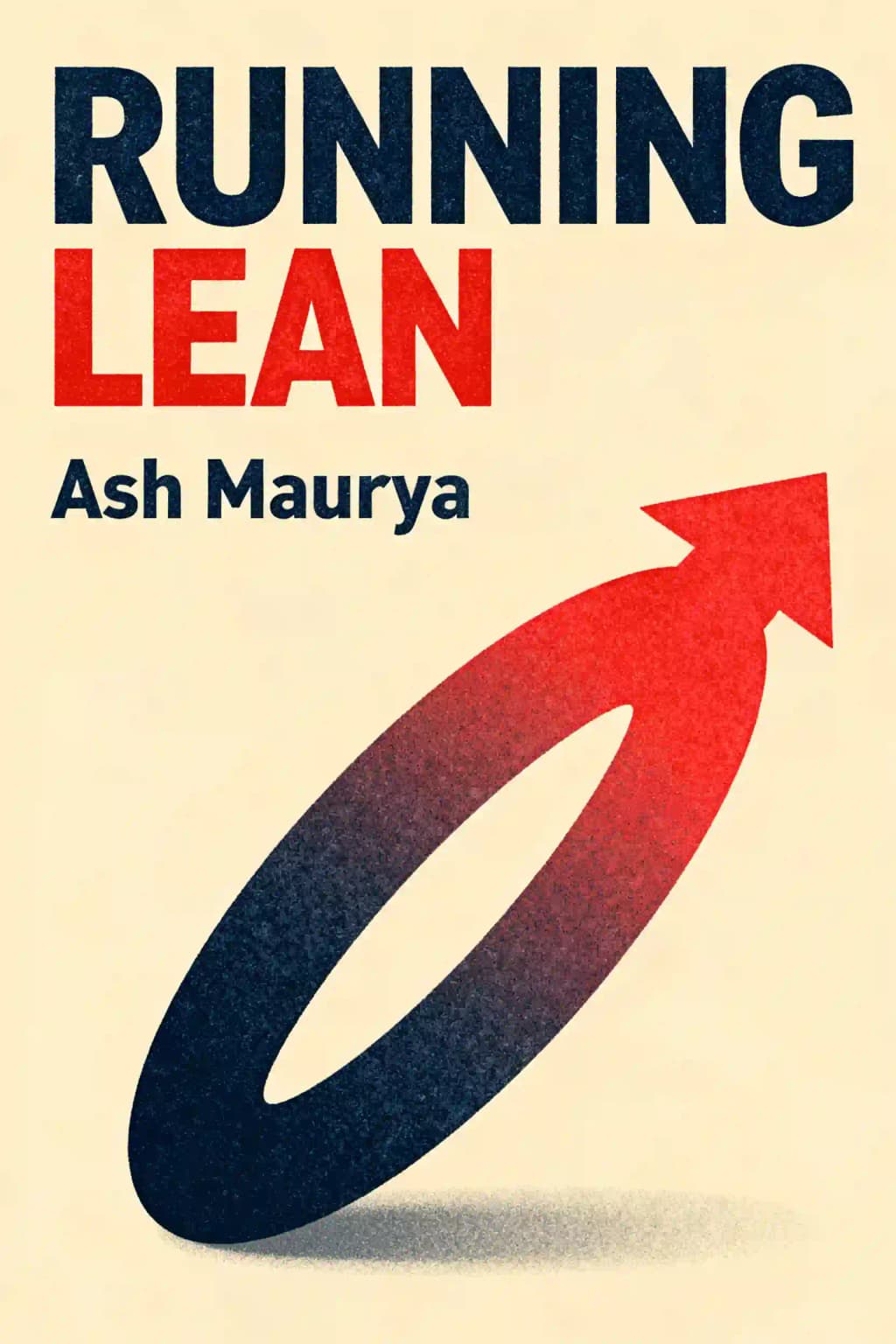
Ever wondered why some products soar while others crash and burn? In 2010, Ash Maurya introduced a revolutionary approach that transformed how entrepreneurs build successful products. "Running Lean" quickly became the bible for startups seeking to avoid the most common entrepreneurial pitfall: building something nobody wants. Now, a decade later, the third edition builds on insights gained from coaching hundreds of product teams worldwide. The methodology has been battle-tested across diverse industries and refined through thousands of hours of practical application. This isn't just another business book-it's a survival guide. Even tech titans like Google, Netflix, and Facebook have embraced these continuous innovation principles, recognizing that in today's hyper-competitive landscape, the speed of learning has become the ultimate unfair advantage. As Maurya often reminds readers, "Life's too short to build something nobody wants"-a mantra that has resonated with entrepreneurs globally, making this book required reading in accelerators, business schools, and corporate innovation labs worldwide.
第 2 章
The Entrepreneur's Dilemma: A Tale of Two Approaches
Imagine two entrepreneurs-Steve and Larry-both with similar backgrounds and promising startup ideas. One year later, Steve works alone with no revenue, while Larry has built a growing customer base and an expanding team. What made the difference? Their fundamentally different approaches to entrepreneurship.
Steve followed the traditional path: building first, seeking investment second, and approaching customers last. He spent months meticulously crafting his AR/VR product, only to face mounting delays and dwindling savings. When investors rejected his pitch as "too early," he retreated to part-time freelancing to fund his increasingly slow progress.
Larry, meanwhile, recognized that today's market has fundamentally changed. Building products is cheaper and easier than ever, creating global competition where investors value traction over intellectual property. Instead of falling into the "build trap," Larry started with problems before solutions, sketching his business model on a Lean Canvas and creating a traction roadmap that prioritized testing what's riskiest rather than what's easiest.
While Steve followed a Build-Demo-Sell approach, Larry used a Demo-Sell-Build playbook, defining his minimum viable product in under eight weeks without a working product. He soft-launched to just ten early adopters, charging from day one and providing high-touch service. This approach helped him recruit his dream team, who collectively focused on what's riskiest in 90-day cycles of modeling, prioritizing, and testing through small iterative experiments.
The difference between Steve and Larry wasn't their skills but their mindsets. Steve operated like an Artist driven by love for his product, taking a build-first approach that's highly risky today. Larry operated like an Innovator, turning inventions into working business models through continuous customer engagement. In today's competitive landscape, where customers have abundant choices, continuous innovation isn't just helpful-it's essential for survival.
The companies that learn fastest outperform their competitors by building what customers truly want. This is the essence of Continuous Innovation-rapid, iterative cycles of modeling, prioritizing, and testing rather than long analysis and execution phases. It's powered by ten critical mindsets across three activities: Model (business model is the product; love the problem, not solution; traction is the goal), Prioritize (right action, right time; tackle risks in stages; constraints are gifts; external accountability), and Test (place many small bets; evidence-based decisions; breakthrough requires unexpected outcomes).
第 3 章
Business Model as Your Product: The Lean Canvas Approach
Traditional business plans have become obsolete-they take too long to write, rarely get read, and are based on unknowable assumptions. The Lean Canvas offers a dynamic alternative: a one-page business model that takes 20 minutes to create and actually gets read. This introduces the first Continuous Innovation mindset: "Your business model is the product."
The Lean Canvas deliberately allocates less than one-ninth of its space to the Solution box because solutions typically aren't what's riskiest. Investors care about traction, customers care about their problems, and entrepreneurs must own the entire business model, not just the solution. This shift in perspective is transformative-it moves entrepreneurs from solution-obsession to a more holistic view of creating value.
Creating a Lean Canvas requires sketching your business model in one sitting (under 20 minutes), avoiding groupthink by having team members create individual canvases first, embracing the one-page constraint to distill your idea to its essence, thinking in the present rather than trying to predict the future, and starting with whatever box you understand best.
When defining customer segments, distinguish between customers (who pay) and users (who don't), model multiple perspectives using different colors or hashtags, and focus on identifying early adopters rather than mainstream customers. Your customer segments should represent your total addressable market while pinpointing your ideal starting customer profile.
Problems, not solutions, create spaces for innovation. List the top 1-3 problems you're tackling and document existing alternatives, recognizing that unless you're solving a brand new problem (unlikely), solutions probably already exist, though not necessarily from obvious competitors.
The Unique Value Proposition (UVP), positioned center-canvas, answers why your product is different and worth attention. While difficult to perfect initially, an effective UVP connects to your customer's #1 problem, targets early adopters with bold messaging, focuses on desired outcomes rather than just features or benefits, keeps it short (under 120 characters), and clearly answers what, who, and why.
Most entrepreneurs go either too broad (undifferentiated) or too narrow (missing better markets) with their first canvas. The solution is to simultaneously go broad and narrow by splitting your first "big idea canvas" into multiple specific canvases that explore different variants of your idea. This helps avoid tunnel vision around a single implementation and allows systematic testing of different approaches.
第 4 章
Stress Testing for Desirability: Finding Problems Worth Solving
Desirability addresses the fundamental question: Do customers want this? Looking at the evolution of music formats-from cassettes to CDs to MP3s to streaming-we see massive changes in how people consume music. While sound quality varied (improving with CDs but declining with MP3s), something else drove these transitions. As entrepreneurs building better products, we must understand what "better" truly means.
Better starts with recognizing that customers care about outcomes, not solutions. The best way to capture attention is through a compelling unique value proposition that promises either better desired outcomes, better ways of achieving those outcomes, or both. This requires razor-focus on who you're targeting and understanding the obstacles preventing them from achieving their desired outcomes.
While starting with problems before solutions seems simple, entrepreneurs often unconsciously invent problems to justify their pre-existing solutions. Instead of asking "What problem do my customers have?" they ask "What problem could my solution solve?" This Innovator's Bias makes everything look like a nail when you've already decided to build a hammer.
The Innovator's Gift provides the antidote to this bias with a simple premise: new problems come from old solutions. When seeking innovation, you want a solution that addresses well-understood problems with existing alternatives. People switched from cassettes to CDs not primarily for sound quality but to instantly play songs without rewinding. They moved to MP3s to buy individual songs rather than entire albums, and to streaming for access to millions of songs they didn't need to own. Successful innovation causes customers to switch from old solutions to new ones by addressing fundamental problems that were always present but tolerated until a better alternative emerged.
This insight connects to jobs-to-be-done theory-we "hire" products to accomplish specific jobs. All jobs start with triggering events (like hunger or tiredness), which lead us to employ habitual solutions until we encounter switching triggers-special events that make us realize our existing solution is inadequate. These switching triggers create opportunities for new products to be adopted, but only if they promise to be significantly better (3x-10x) than existing alternatives to overcome inertia and friction.
To cause a switch, your solution doesn't have to be functionally superior-emotional benefits can be equally powerful. Functional improvements address unmet needs, while emotional benefits connect to desired outcomes or wants. Positioning around emotional benefits ("We help you create a business plan that gets read") can be more compelling than functional positioning ("We help you create a business plan faster"), especially when customers don't fully understand their unmet needs.
第 5 章
Viability Testing: Making the Numbers Work
While a Lean Canvas helps deconstruct your idea into a coherent business model story, stakeholders still need to see the numbers. As the primary investor in your idea-with your time being your scarcest resource-you need to determine if your idea has the potential to become "big enough" to be worthwhile.
Traditional financial forecasts mask risky assumptions in layers of compounding lies. If funded based on these forecasts, you end up executing a plan rather than learning. Instead, use a back-of-the-envelope Fermi estimate that takes five minutes and focuses on input assumptions rather than outputs. Unlike the flawed "capture 1% of a huge market" approach, Fermi estimates use a bottom-up method with 5-7 key metrics to test viability without requiring precision beyond an order of magnitude.
Traction is often misused to mean any metric going up and to the right. Revenue and profit aren't good traction metrics either, as they're trailing indicators that start near zero or negative. True traction metrics are leading indicators of progress-customer-centric measurements of how your business model captures monetizable value from customers.
The customer factory metaphor represents everything inside your business: marketing, sales, customer service, and product. It turns unaware visitors (raw material) into happy customers (finished product). Traction is the throughput of this factory-the rate at which you make customers. This process breaks down into five universal macro steps that serve as leading key metrics: acquisition, activation, retention, revenue, and referral.
With your minimum success criteria (MSC) set, test your idea's viability by inputting best-guess estimates for your customer factory metrics in this order: revenue, retention, acquisition, activation, and referral. Calculate the number of active customers needed by dividing your yearly revenue target by yearly customer revenue. This number helps test whether your customer and early adopter segments are large enough.
All businesses experience customer churn, requiring ongoing acquisition just to sustain revenue. Rather than struggling with churn percentages, focus on customer lifetime (retention)-the inverse of churn. For SaaS companies, four years is considered good (2.08% monthly churn).
No customer acquisition funnel converts at 100%. The customer factory breaks conversion into three steps: acquisition, activation, and revenue. Most products start with customer conversion rates between 0.5-3%, with 1% being a safe assumption. This means you'll need significantly more leads than your target customer number.
When a business model fails viability testing, you have two options: revise your goal or fix your model. Since no one wants to lower their goals, focus first on fixing your business model. Raising prices is an underutilized lever-double your pricing and you'll need half the customers. If you don't lose more than half your customers when doubling prices, you come out ahead with lower operating costs. Avoid cost-based pricing; instead, price between two anchors: the ceiling (monetary value customers place on your solution) and the floor (cost of existing alternatives).
第 6 章
Feasibility Testing: The Traction Roadmap
Product roadmaps assume you know what you'll build for the next 18-24 months, which isn't realistic for startups. Instead, use a traction roadmap that's outcome-oriented rather than output-oriented. While your minimum success criteria (MSC) helps measure traction three years out, you need shorter-term milestones to determine feasibility and create a stage-based rollout plan.
Product growth can't follow a linear path because perfect execution plans don't exist in startups. Instead, growth follows an S-curve, with the first half resembling a hockey stick-flat at first, then increasingly steeper. To model your first three years, you need your MSC goal plus a growth rate assumption. Counterintuitively, using a higher growth rate (like 10x/year) requires fewer customers in the early years than a lower rate, since your endpoint is fixed by your MSC. A 10x model strikes the right balance between learning and scalability, making it appropriate for most startups-after all, every company starts with just one customer.
Many entrepreneurs rush to reach the steep part of the hockey-stick growth curve by trying to go fast on everything. But this approach often leads to getting lost faster and falling into the premature optimization trap-like optimizing for thousands of users before having any, hiring a VP of sales before having customers, or raising funding before achieving traction. The key to avoiding this trap is embracing Mindset #4: Right action, right time. At any point, only a few key actions will have the biggest impact on your business model-focus on those and ignore the rest.
The now-next-later rollout plan helps you view your traction roadmap across three time horizons that align with the three stages of the product life cycle: problem/solution fit, product/market fit, and scale. Each stage is roughly 10x larger than the previous one and drives what's riskiest in your business model (Mindset #5: Tackle your riskiest assumptions in stages).
The flat section of the hockey-stick curve is where you uncover key insights to build something unique and valuable. Counterintuitively, you need to decelerate, not accelerate, and you don't need a working product to acquire paying customers. Through a Demo-Sell-Build process, you deeply understand customers, identify real problems, and test solutions. This stage typically takes 3-6 months.
After defining a product customers will want (not just hope they want), you build your MVP and launch. The focus is demonstrating value delivery through continuous feedback loops with customers. The counterintuitive insight is that you don't need lots of users to achieve repeatability in your business model-which is this stage's key deliverable. Product/market fit typically takes 18-24 months for most products.
第 7 章
Communicating Your Idea: The Art of the Pitch
The #1 reason startups fail is building something nobody wants, while the #2 reason is not getting buy-in from key stakeholders. Whether you're in a large company facing demands for extensive business plans or a startup struggling to secure resources, you need to effectively communicate your idea. Pitching is a critical skill for entrepreneurs-not just for investment, but for acquiring customers, co-founders, and advisors.
Most elevator pitches either overwhelm with buzzwords or fall flat by being too solution-centric. The key mistake is trying to explain a solution in 30 seconds rather than piquing interest. An effective elevator pitch should tell your desirability story, following this template: "When [customers] encounter a [triggering event], they need to do [job-to-be-done] to achieve [desired outcome]. They would normally use [existing alternatives], but because of [switching trigger] these no longer work due to [problems]. If unaddressed, [what's at stake]. So we built a solution that helps [customers] achieve [desired outcome] by helping them [unique value proposition]."
Good pitching isn't about forcing your solution onto others but framing your business model story according to your audience's existing worldview. Understanding these different perspectives is crucial to developing effective pitches for investors, customers, and advisors.
Investors care about business models that promise returns on investment, not your solution itself. They want to know: How big is the market opportunity? How will you make money? How will you deter competition? Above all, they respond to traction-the beginnings of a hockey-stick growth curve will trigger their interest more than anything else.
Customers don't care about your solution; they care about the problems preventing them from achieving desired outcomes. Your unique value proposition must first capture their attention, then a demo helps them visualize moving from their problem state to having those problems solved by your solution.
When delivering your business model pitch using a learning frame, target potential "advisors" including co-founders, peer entrepreneurs, domain experts, and mentors. Ask for 30 minutes, use a combination of slides and handouts (Lean Canvas and traction roadmap), and follow the 20/80 rule-spend 20% of time (5 minutes) delivering your pitch and 80% soliciting feedback.
The recommended pitch deck follows the same order used when stress testing your models: desirability, viability, and feasibility. The structure helps organize your presentation logically while addressing the key aspects of your business model.
第 8 章
Validation Through 90-Day Cycles: From Design to Reality
While business model design provides a foundation, it's built on untested assumptions. Validation transforms your designed business model into a working one by focusing on what's riskiest-your limiting constraint or weakest link. Instead of guessing at risks, use a systems-based approach through Theory of Constraints (TOC). Like identifying a factory's slowest machine, find your business model's constraint where your riskiest assumptions live. Constraints are gifts that drive focus and right action at the right time.
90 days provides the ideal cadence for accountability-long enough for meaningful progress yet short enough to create urgency. This approach breaks a 3-year journey into just 12 cycles, each framed with traction goals (OKRs) and campaigns. Each campaign proposes how to achieve your cycle's OKR and breaks down into two-week sprints for faster feedback loops. Goals define the mission, campaigns define strategies, and sprints test these strategies.
A 90-day cycle has three phases: modeling, prioritizing, and testing. The first two weeks focus on modeling and prioritizing-aligning your team around a common OKR and selecting promising campaigns. The remaining ten weeks are for testing campaigns. The cycle concludes with a review to assess learnings and plan the next cycle.
During business model design, you rely on thought experiments, but validation requires actual customer experiments. Entrepreneurial experiments differ from scientific ones-entrepreneurs seek temporal truths to make business models work rather than perpetual truths, and they operate under time constraints prioritizing speed of learning. The goal is quickly finding signals in the noise and doubling down on them.
Without declaring expected outcomes upfront, you'll always "succeed" at seeing what happens because something always happens. This leads to rationalization traps-blaming poor results on circumstances like seasonality. Smart entrepreneurs are especially gifted at rationalizing anything. To avoid this, take an empirical approach by declaring outcomes before running experiments.
When evaluating experiments, focus on what customers actually do rather than what they say. Discovery experiments can be particularly challenging because qualitative learning tends to be subjective and prone to confirmation bias-entrepreneurs typically hear only what confirms their existing beliefs. Instead of relying on subjective interpretations of customer feedback, measure concrete customer actions.
第 9 章
Understanding Customers Better Than They Do Themselves
Understanding your customers' problems better than they do creates an automatic transfer of expertise-customers believe you must have the right solution. This phenomenon, called the "Strategy of Preeminence," gives you superpowers when developing products.
Uncovering problems through customer conversations is challenging because customers may not know their problems, might be reluctant to share them, can be biased by your questions, or might offer solutions instead of problems. Rather than asking directly about problems, effective discovery comes from exploring how customers use existing alternatives and finding friction points in their stories-struggles, workarounds, and gaps between desired and actual outcomes.
Products compete in a bigger context where different categories vie for the same jobs-to-be-done. Understanding this context is crucial to uncovering problems worth solving. Theodore Levitt famously said people want quarter-inch holes, not quarter-inch drill bits. But this doesn't go far enough-people don't actually want holes either. A drill bit manufacturer focused on making stronger bits might miss that customers are trying to hang paintings, and could lose market share to innovations like Command Strips that eliminate drilling altogether.
To find the bigger context, don't focus on building a better product (x), but on building a better user of (x)-like creating better photographers rather than better cameras, or better entrepreneurs rather than better business model canvases. This shift moves you beyond immediate features to focus on customers' desired outcomes.
A problem discovery sprint runs in a two-week timeframe using one-on-one interviews to understand why and how customers chose existing alternatives to accomplish a job. During interviews, adopt a journalist or detective persona and uncover the series of events from the switching trigger to their most recent encounter with the existing alternative. Insights are captured on a Customer Forces Canvas after each interview. Patterns typically emerge after just 10-15 focused interviews, covering about 80% of insights.
Rather than immediately targeting early adopters, run two interview batches: a broad-match sprint targeting people who recently used existing alternatives, followed by a narrow-match sprint focusing on ideal early adopters to verify insights. Plan for 20-30 interviews over 4 weeks (5-8 people weekly), with processing time built in. By the end, you should demonstrate customer/problem fit with evidence that you've identified a problem worth solving.
第 10 章
The Mafia Offer: Creating an Irresistible Solution
The key to successful product development is designing a solution that causes customers to switch from their existing alternatives. After identifying significant customer problems through discovery sprints, the challenge is building something remarkable quickly with limited resources. This requires creating a minimum viable product (MVP) that delivers just enough value to cause a switch, rather than trying to solve every problem discovered.
A solution design sprint runs over a two-week period, using problem discovery insights to design an MVP that causes customers to switch. While MVPs emphasize viability, the right solution must balance desirability, viability, and feasibility. The process involves reviewing problem discovery insights through these three lenses, often requiring multiple passes to find the optimal intersection point where all three aspects align.
Desirability hinges on problem identification and promise. A product that causes a switch promises customers a better way to complete their job without current struggles. To be effective, this promise must be significantly better (3x-10x) than existing alternatives, not just incrementally better. The right MVP addresses the smallest subset of problems that still creates enough value to warrant switching.
Finding a switch-worthy problem isn't enough-it must represent a viable business opportunity based on price and people. With viability constrained by your MSC goal and Fermi estimate assumptions, you must impose these constraints on your problems and UVP, focusing particularly on average revenue per user (ARPU) to determine which story clusters can deliver your target.
With desirability and viability addressed, you must ensure you can deliver your MVP quickly-ideally within two months. This timeframe is critical because most customers will only wait up to two months for a solution before considering alternatives. Longer development cycles risk market changes that might necessitate another problem discovery sprint.
Beyond the traditional Release 1.0 MVP, consider three alternative validation recipes: the Concierge MVP (where you manually deliver the service before automating), the Wizard-of-Oz MVP (cobbling together existing solutions rather than building from scratch), or the Foot-in-the-Door MVP (delivering the smallest UVP needed to enter the customer's world).
With your problem discovery and solution design sprints completed, it's time to assemble and deliver a compelling "mafia offer"-one your customers cannot refuse. The next two sprints will test all your gathered insights, with the goal of securing enough early adopter commitments to justify building your MVP.
To create a compelling product pitch, use the Hero's Journey story arc-the same structure found in Star Wars, Harry Potter, and countless blockbusters. In this framework, your customer is the hero (not you or your product), your competition is the villain, you are the guide character (like Obi-Wan or Dumbledore), and your product is the gift enabling transformation.
第 11 章
From Launch to Growth: The Path to Product/Market Fit
By now you understand your customers' needs better, but beware of the Innovator's Bias that can lead to building too much or the wrong product. Rather than running a big launch campaign prematurely, separate your product launch from your marketing launch. Start with a soft launch to early adopters focused on validating value delivery. Only when you can repeatedly demonstrate value to customers is a marketing launch warranted.
Don't shut down your customer acquisition activities to focus solely on product development. Your customer factory is like a flywheel-harder to start than to keep running. Continuous optimization requires a steady flow of users through the system, and establishing repeatability is a prerequisite for growth. Getting to your first 10 customers isn't repeatable if you don't know where your next 10 will come from.
To avoid losing track of time during product development, stay razor-focused on MVP release 1.0. Set a nonnegotiable launch date and announce it to create external accountability. Fight scope creep by reducing scope to the first 90 days of usage. Adopt continuous delivery to release features over time rather than cramming everything into the MVP. Avoid premature optimization and get regular feedback from early-access customers through screenshots and demos.
Rather than launching your MVP publicly or to your entire customer list (which often leads to problems), implement a batch rollout strategy. Start by handpicking your "best" early adopters who showed the most enthusiasm during your mafia offer pitch. It's acceptable to begin with friends or friendly early adopters who can quickly identify obvious issues. For subsequent batches, recruit customers with above-average motivation to use your product.
All businesses share a universal goal: make happy customers. This isn't about making customers happy (which is easy by giving things away for free) but helping them achieve desired outcomes while maintaining a working business model. The key is understanding how to influence customer behavior after acquisition.
After establishing repeatable acquisition, activation becomes the critical focus-this is where value is created and the "aha moment" happens. Activation is a causal step that drives retention, revenue, and referrals. The activation and retention steps together form the "happy customer loop" that's essential for causing customers to switch from their old solution to yours. This loop may require multiple cycles before your product becomes the new status quo.
Once your happy customer loop shows predictable repeatability-with customers demonstrating regular product use and measurable progress toward desired outcomes-it's time to shift focus toward growth through scalable channels. Until now, you've relied on high-touch interactions to prioritize learning over scalability, but meeting increasingly challenging traction goals requires identifying which scalable channels to pursue for product/market fit and beyond.
According to Eric Ries, sustainable growth follows one simple rule: "New customers come from the actions of past customers." This happens by reinvesting value captured from existing customers back into new customer acquisition. The three types of value you capture are money (revenue), content and data (byproducts of engagement), and referrals-each forming the basis for different growth loops.




![[the-lean-startup-by-eric-ries:c0000] The Lean Startup p1-1](/_next/image?url=https%3A%2F%2Fd1y2du6z1jfm9e.cloudfront.net%2Fassets%2Fpodcast%2Fgreen.png&w=1024&q=50)
![[the-lean-startup-by-eric-ries:c0001] The Lean Startup p1-1](/_next/image?url=https%3A%2F%2Fd1y2du6z1jfm9e.cloudfront.net%2Fassets%2Fpodcast%2Fyellow.png&w=1024&q=50)