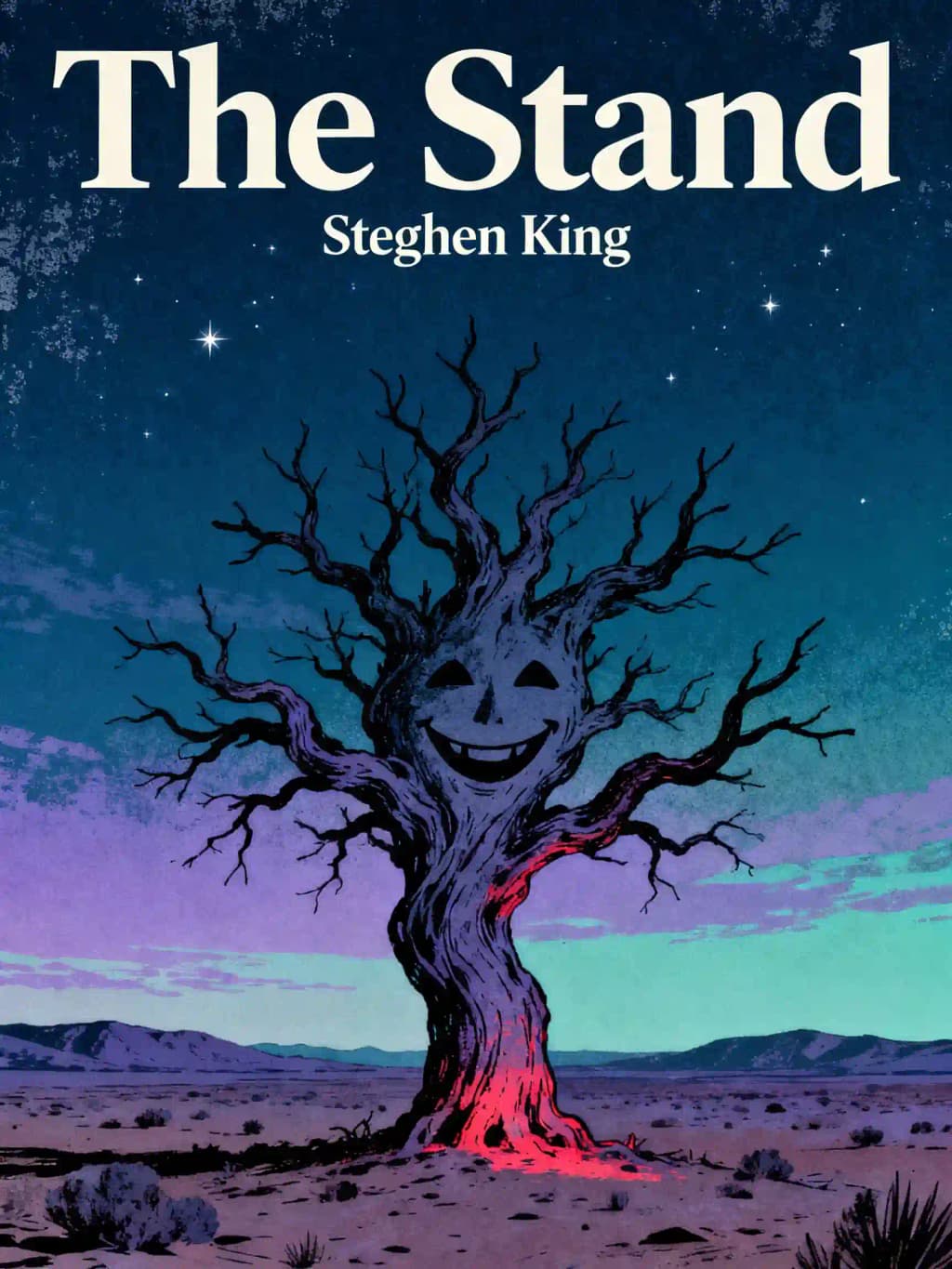
第 1 章
When a Cough Becomes the End of the World
Stephen King's apocalyptic masterpiece "The Stand" has become a cultural touchstone that continues to terrify and fascinate readers decades after its publication. Beloved by horror aficionados and literary critics alike, this epic tale of societal collapse and supernatural confrontation regularly tops fan polls as King's greatest work. Even horror-averse celebrities like filmmaker Quentin Tarantino and author George R.R. Martin cite it as a formative influence. The novel's exploration of humanity's resilience in the face of catastrophe has only grown more relevant with time, particularly following global health crises that echo the fictional "Captain Trips" superflu. What makes "The Stand" so enduring is not just its apocalyptic scenario, but King's remarkable ability to create characters so vivid they feel like people we've known our entire lives-people we root for, fear for, and ultimately, stand with.
第 2 章
The Apocalypse Begins with a Single Sneeze
The collapse of civilization begins with something utterly mundane: a security guard named Charles Campion flees a military base with his family after an accident releases a weaponized strain of influenza. By the time his car crashes into Hap's Texaco station in the tiny town of Arnette, Texas, Campion is already dying-his neck grotesquely swollen, face discolored, mucus crusted around his nose. The handful of men who help him, including Vietnam veteran Stu Redman, have no idea they've just been exposed to "Project Blue," a military bioweapon with a 99.4% mortality rate.
What makes King's apocalypse so terrifying is its methodical, almost mathematical inevitability. Each person infected with Captain Trips (as the superflu comes to be known) spreads it to others through ordinary human contact. A Texas highway patrolman who visits the gas station infects an insurance salesman during a routine traffic stop. The salesman infects dozens at a diner. A family carries it across state lines. A doctor's waiting room becomes a distribution center for death. The novel tracks this lethal chain letter as it multiplies exponentially through bridge games, cocktail bars, swimming pools, and everyday interactions.
The government's response proves as deadly as the disease itself. Rather than admitting the outbreak, authorities attempt a cover-up, quarantining towns like Arnette with barbed wire while feeding the public lies about a Russian flu strain. Stu Redman, mysteriously immune to the disease, is taken to a facility in Vermont where he witnesses the desperate, failing efforts to develop a vaccine. As doctors and soldiers themselves begin to die, Stu realizes he's become expendable-a loose thread to be cut. His escape into a rapidly emptying world marks the beginning of his journey as one of the novel's central protagonists.
Meanwhile, across America, others face the pandemic's horror: Frannie Goldsmith, a pregnant college student in Maine; Larry Underwood, a rock musician who's just scored his first hit single; Nick Andros, a deaf-mute drifter in Arkansas; Lloyd Henreid, a petty criminal trapped in his prison cell as guards and inmates die around him. Through these characters and others, King shows us the intimate human experience of watching society unravel-the confusion, denial, terror, and finally, the stark realization that the world they knew is gone forever.
第 3 章
Dreams in the Dark: The Supernatural Takes Hold
As the superflu claims its final victims, the survivors begin experiencing strange, shared dreams. Two figures emerge from their collective unconscious: Mother Abagail, a 108-year-old Black woman in Nebraska who represents goodness and light, and Randall Flagg, a demonic "dark man" who embodies malevolence. These supernatural forces exert a gravitational pull on the survivors, drawing them toward either Boulder, Colorado (Mother Abagail's haven) or Las Vegas, Nevada (Flagg's domain).
These dreams represent more than just convenient plot devices-they're the novel's exploration of humanity's spiritual nature. In a world stripped of institutions and technology, people become more attuned to forces beyond rational explanation. As sociologist Glen Bateman theorizes, perhaps humans have always possessed subtle psychic abilities that were drowned out by civilization's noise. He points to studies showing that planes and trains running at lower capacity crash more often than those at higher capacity-suggesting people subconsciously "know" when disasters will occur and avoid booking those trips.
The dreams also force characters to confront their own moral nature. Those drawn to Mother Abagail often struggle with doubt, weakness, and fear, yet choose to follow her because they recognize goodness, however imperfect their understanding of it. Those drawn to Flagg are seduced by promises of power, revenge, or simply the comfort of following a strong leader who removes the burden of moral choice.
Flagg himself is one of King's most chilling creations-a walking embodiment of chaos who has drifted through America's darkest moments, from racial violence to political assassinations. With his "hateful happiness" and terrible charisma, he attracts followers by offering them exactly what they crave: Lloyd Henreid is rescued from starvation in his prison cell; Trashcan Man, a mentally ill pyromaniac, is given license to "burn" to his heart's content; Harold Lauder, bitter at being overlooked and rejected, is promised revenge against those who've humiliated him.
Mother Abagail, by contrast, offers no easy rewards. She's a flawed prophet who admits to harboring hatred toward the God she serves, describing him as "a hard God, a jealous God" and acknowledging that "even the joy of serving Him is a bitter joy." Her followers must accept responsibility, make difficult choices, and recognize that goodness requires sacrifice.
第 4 章
Building from the Ruins: The Free Zone Community
In Boulder, Colorado, the survivors who've followed Mother Abagail's dream-guidance begin the difficult work of rebuilding society from scratch. They establish a "Free Zone Committee" to govern their growing community of roughly 1,000 people, working tirelessly to restore essential infrastructure. Their first priorities include restoring electrical power by reactivating a local hydroelectric plant, establishing a medical clinic in the Boulder Community Hospital, and creating systems for water distribution, waste management, and food storage. This section of the novel becomes a fascinating exploration of political philosophy-what kind of society would we build if given a second chance, and how much of our old world should we try to recreate?
The committee members, each bringing distinct perspectives and skills, represent different approaches to governance. Stu Redman, a former factory worker from Texas, brings practical common sense and natural leadership abilities. Glen Bateman, a retired sociology professor, contributes academic theories about social structures and historical patterns of civilization. Frannie Goldsmith, pregnant and pragmatic, advocates for long-term planning and public health measures. Nick Andros, despite being deaf and mute, provides thoughtful leadership through his written communications and remarkable insight into human nature. Larry Underwood and Ralph Brentner round out the committee, representing the everyday citizen's perspective.
King portrays this community-building process with remarkable nuance and attention to detail. The Free Zone isn't a utopia-it's filled with people carrying their pre-plague problems and prejudices. Some residents, traumatized by their experiences, turn to alcohol and drugs. Others engage in power struggles, spreading gossip and forming cliques. Committee meetings become bogged down in procedural debates over seemingly trivial matters like parking regulations and noise ordinances. The question of whether to arm security forces creates significant tension, with some advocating for strong protection against outside threats while others fear the recreation of a police state. Through these conflicts, King shows how quickly humans revert to familiar social patterns, even after catastrophe has wiped the slate clean.
The community faces numerous practical challenges: housing assignments, job allocations, food distribution, and the integration of new arrivals. They must also grapple with larger questions: Should they reinstate formal marriage ceremonies? How should crimes be punished? What role should religion play in their new society? Each decision forces them to balance efficiency with fairness, security with freedom.
The community's greatest challenge emerges from within, highlighting the fragility of their social experiment. Harold Lauder, an intelligent but deeply insecure young man nursing resentment over losing Frannie to Stu, forms a destructive alliance with Nadine Cross, a woman mystically bound to Randall Flagg. Their carefully planned act of terrorism-a dynamite explosion during a committee meeting-kills several key members, including Nick Andros, and severely damages both the physical infrastructure and psychological fabric of the community. This devastating act forces the survivors to confront the uncomfortable truth that evil doesn't just exist in Las Vegas with Flagg's followers-it lives within their own hearts and community, threatening their attempts at rebuilding civilization.
第 5 章
The Dark Side of Power: Flagg's Las Vegas
While Boulder struggles with democratic governance and individual freedom, Las Vegas under Randall Flagg operates with brutal efficiency. Flagg establishes a totalitarian regime where productivity and loyalty are paramount, creating a stark contrast to Boulder's messy democracy. His Vegas resembles a twisted version of pre-plague society, with casinos converted into administrative centers and hotels repurposed as housing blocks. Those who follow his rules enjoy remarkable comfort, security, and purpose-technical experts work on restoring power plants and communication systems, mechanics maintain vehicles and infrastructure, and all receive abundant food and shelter. But the price is absolute obedience, enforced through public crucifixions, constant surveillance, and Flagg's supernatural ability to peer into the minds of potential dissenters.
King's portrayal of Las Vegas isn't simplistic villainy-many who join Flagg are ordinary people seeking structure and certainty in a chaotic world. The community includes former teachers, accountants, and service workers who find comfort in clear hierarchies and defined roles. Lloyd Henreid, once a small-time criminal, becomes Flagg's devoted second-in-command after being rescued from certain death in prison. Others, like Jenny Engstrom and Rich Hoggins, appreciate the clear rules and lack of moral ambiguity, finding security in knowing exactly what's expected of them. When Tom Cullen observes that Vegas residents seem "wrong" somehow, it's not because they're monsters, but because they've surrendered their moral autonomy for security and certainty.
The novel's most disturbing scenes occur in Vegas, including the public crucifixion of Bobby Terry for using drugs. The execution becomes a community spectacle, carried out not by Flagg himself but by his followers, including the mentally unstable Trashcan Man, who helps nail the victim to the cross despite their previous friendship. This scene illustrates how systems of oppression function-not through constant direct control by leaders, but through ordinary people's willingness to participate in atrocities to maintain their standing in the community. The crowd's participation, from shouting encouragement to helping with the execution, demonstrates how quickly civilization can descend into barbarism when fear and power become the driving forces.
Yet even in this dark realm, cracks begin to appear in Flagg's carefully constructed system. Whitney Horgan and a small group of dissidents secretly plan to escape to Brazil, gathering supplies and information. Julie Lawry's desperate attempts to curry favor by informing on others reveal the culture of suspicion and betrayal that undermines community bonds. Small acts of resistance multiply - missed work shifts, whispered conversations, stolen supplies. And Flagg himself begins losing control-his powers noticeably waning, his temper flaring unpredictably, his followers quietly questioning his infallibility. When he murders his pregnant "bride" Nadine in a fit of rage, throwing her from a penthouse balcony, it signals not just a personal breakdown but the beginning of his regime's collapse. The incident reveals the fundamental instability of power built on fear and force rather than genuine loyalty and shared values.
第 6 章
The Final Stand: Confrontation and Sacrifice
The novel's climax begins with the dramatic return of Mother Abagail, who had vanished into the wilderness for forty days as penance for the sin of pride. Emaciated and near death, she delivers a divine message that becomes the catalyst for the final confrontation: four men must journey west to Las Vegas to confront Randall Flagg. This "stand" against evil comes with specific instructions - they must carry no weapons and rely solely on their faith and willingness to sacrifice. The chosen four - Stu Redman, Larry Underwood, Ralph Brentner, and Glen Bateman - accept this mission knowing it amounts to a death sentence.
Their westward trek transforms into a grueling spiritual pilgrimage through America's devastated landscape. As they traverse empty highways and abandoned towns, they undergo both physical and spiritual transformation. They lose significant weight, surviving on minimal provisions, and experience increasingly vivid dreams and premonitions. Each man feels himself being "emptied" like a vessel preparing for divine purpose, shedding their old selves with every mile. When Stu Redman suffers a severe leg break in a fall, the group faces their first test of faith. Despite Stu's protests and their deep reluctance, the others must leave him behind with basic supplies and continue their journey.
In Las Vegas, the confrontation unfolds in stages that reveal the true nature of both good and evil. Glen Bateman, when brought before Flagg, demonstrates extraordinary courage by laughing in the face of evil, declaring Flagg "nothing" - a mere impostor whose power relies on others' fear. His execution becomes a powerful testimony that exposes the emptiness behind Flagg's fearsome facade. Larry Underwood and Ralph Brentner, awaiting their public execution, achieve a transcendent state of peace and acceptance, having completed their spiritual journey from fear to faith.
The final confrontation subverts expectations of a traditional battle between good and evil. Instead, King presents evil's capacity for self-destruction. As Flagg prepares for a public execution of Larry and Ralph, designed to cement his power over his followers, the Trashcan Man arrives with his deadly offering - a nuclear warhead salvaged from the military's arsenal. This "gift," meant to please his master, becomes the instrument of destruction. In the novel's most electric moment, whether through divine intervention or the collapse of Flagg's own dark powers, the bomb detonates. The explosion obliterates Las Vegas and its inhabitants, including Flagg's followers who had begun to doubt their leader's infallibility.
The sacrifice of the Boulder representatives serves its purpose not through direct confrontation but by bearing witness to evil's inherent instability. Their journey and presence become the catalyst that allows evil's self-destructive nature to manifest fully, demonstrating that darkness ultimately contains the seeds of its own annihilation. This ending reinforces King's theme that good triumphs not through force but through faith, sacrifice, and the willingness to stand firm in the face of darkness.
第 7 章
Rebirth and Uncertainty: The Cycle Continues
The novel's epilogue weaves together threads of hope and foreboding in a complex tapestry of humanity's future. Stu Redman's return to Boulder, facilitated by the unlikely heroes Tom Cullen and Kojak, marks the beginning of this nuanced conclusion. After a harrowing journey through winter storms and near-death experiences, he finds Frannie has given birth to a son, Peter - a moment that should represent pure joy but instead becomes laden with tension when the infant shows symptoms of Captain Trips.
The baby's initial illness creates a period of gut-wrenching anxiety for the survivors, forcing them to face the possibility that all future children might be susceptible to the superflu. However, in a pivotal development, the infant begins to recover, his immune system - bolstered by antibodies inherited from his mother - successfully fighting off the disease that decimated humanity. This breakthrough suggests that natural selection and genetic inheritance might gradually build humanity's resistance to the superflu, offering the first concrete hope for long-term survival.
Yet King masterfully undercuts this optimism with subtle warnings about human nature. The transformation of Boulder's free zone into a structured society proceeds with alarming speed - armed police patrols emerge, political factions form, and bureaucratic systems calcify into familiar patterns of control and authority. Stu and Frannie's decision to leave for Maine represents more than just homesickness; it's a conscious rejection of centralized power and a bet on humanity's need to spread out and start anew.
Their conversation about humanity's future reveals deep insights about cycles of civilization. They speculate that dispersal might buy time - "Peter's lifetime, his children's lifetimes... Until the year 2100, maybe" - before humanity inevitably recreates the conditions that led to its near-extinction. Their hope lies not in preventing these cycles but in extending their duration, giving future generations more time to learn and possibly evolve.
The novel's final sequence delivers a masterful stroke of horror that transcends mere supernatural threats. Randall Flagg's survival and emergence on a distant island, where he encounters a primitive tribe, demonstrates evil's persistence and adaptability. His familiar pattern of manipulation - promising civilization while delivering corruption - shows how charismatic evil exploits human desires for advancement and security. The tribe's fearful worship of Flagg eerily mirrors the way modern societies can fall under the sway of destructive leadership.
King's closing line about life being "such a wheel" resonates on multiple levels. It's not just about the cycle of civilization's rise and fall, but about the persistent patterns in human nature - the tension between community and power, between progress and destruction, between good and evil. The wheel metaphor suggests both movement and stasis - while circumstances change, fundamental human nature remains consistent. Yet within this seemingly deterministic view, King emphasizes the importance of individual moral choice. The wheel may turn inexorably, but each person's decisions during their brief time upon it carry profound moral weight, suggesting that human dignity lies not in escaping the cycle, but in how we face it.
第 8 章
A Mirror to Our Deepest Fears and Highest Hopes
"The Stand" endures because it speaks to fundamental human concerns: our vulnerability to forces beyond our control, our capacity for both terrible cruelty and remarkable compassion, and our need to find meaning in suffering. Through characters like Stu Redman, who evolves from a taciturn loner to a community leader willing to sacrifice himself; Larry Underwood, who transforms from a self-centered musician to someone capable of genuine heroism; and Frannie Goldsmith, who maintains hope for the future even while burying her father and facing dangerous childbirth, King shows us ordinary people rising to extraordinary challenges.
The novel also interrogates our relationship with technology and power. The superflu itself is a product of military research-humanity destroyed by its own creation. The survivors must decide which aspects of pre-plague society to rebuild and which to abandon. Should they restore electrical power, knowing it might lead back to the same destructive path? Should they arm their security forces, knowing weapons often create more problems than they solve? In an age of climate crisis and emerging technologies with unknown consequences, these questions remain urgently relevant.
Perhaps most powerfully, "The Stand" explores faith in its many dimensions-not just religious faith, but faith in humanity, in community, and in the possibility of moral choice mattering in an apparently indifferent universe. Mother Abagail's God is complex and demanding, yet her faith sustains her through 108 years of hardship. The Boulder community must have faith in their ability to build something better than what came before. And ultimately, Larry, Ralph, and Glen must have faith that their sacrifice serves some purpose beyond their understanding.
In a world increasingly divided between those seeking simple answers and those embracing moral complexity, "The Stand" reminds us that the most important choice we make is not between left and right, but between light and dark-between facing our responsibilities to one another or surrendering to our basest impulses. As Frannie asks in the novel's final pages, "Do you think people ever learn anything?" The answer remains uncertain, but King suggests that asking the question itself might be our most human quality-and our greatest hope.
第 9 章
The Enduring Power of Story When Society Falls
"The Stand" demonstrates why storytelling itself becomes essential during times of crisis. Throughout the novel, characters make sense of their experiences through narratives-Stu recalls hunting stories with his friends, Frannie keeps a diary for her unborn child, Glen frames events through sociological theories, and Mother Abagail interprets her visions through biblical language. These stories provide not just comfort but orientation in a world where familiar landmarks have disappeared.
King himself seems to suggest that fiction serves a vital function in helping us rehearse for catastrophe. By immersing ourselves in imagined disasters, we develop emotional and cognitive resources for facing real ones. The novel's detailed portrayal of societal collapse-from the practical challenges of finding food and shelter to the psychological impact of massive loss-offers a kind of preparation for confronting our own mortality and the fragility of our institutions.
This may explain why "The Stand" has found new readers during actual health crises. The novel doesn't just frighten us with its vision of pandemic devastation; it also reassures us with its portrayal of human resilience. If Larry Underwood can evolve from a self-absorbed musician to a man willing to die for others, perhaps we too contain untapped reserves of courage. If Frannie can maintain hope while pregnant in a world where children might not survive, perhaps we too can find purpose in nurturing the future despite uncertainty.
In the end, "The Stand" is both warning and affirmation-a dark mirror reflecting our worst potentials and a beacon illuminating our best. Its enduring power lies not in its supernatural elements but in its profound humanity-its recognition that when everything else is stripped away, the choices we make about how to treat one another define us more than any external circumstance. As Mother Abagail tells her followers, "Love each other. My God, children, do that before dark comes." In a world increasingly shadowed by division and fear, this remains the most radical stand of all.