第 1 章
When Dissonance Became Music: The Century That Changed How We Listen
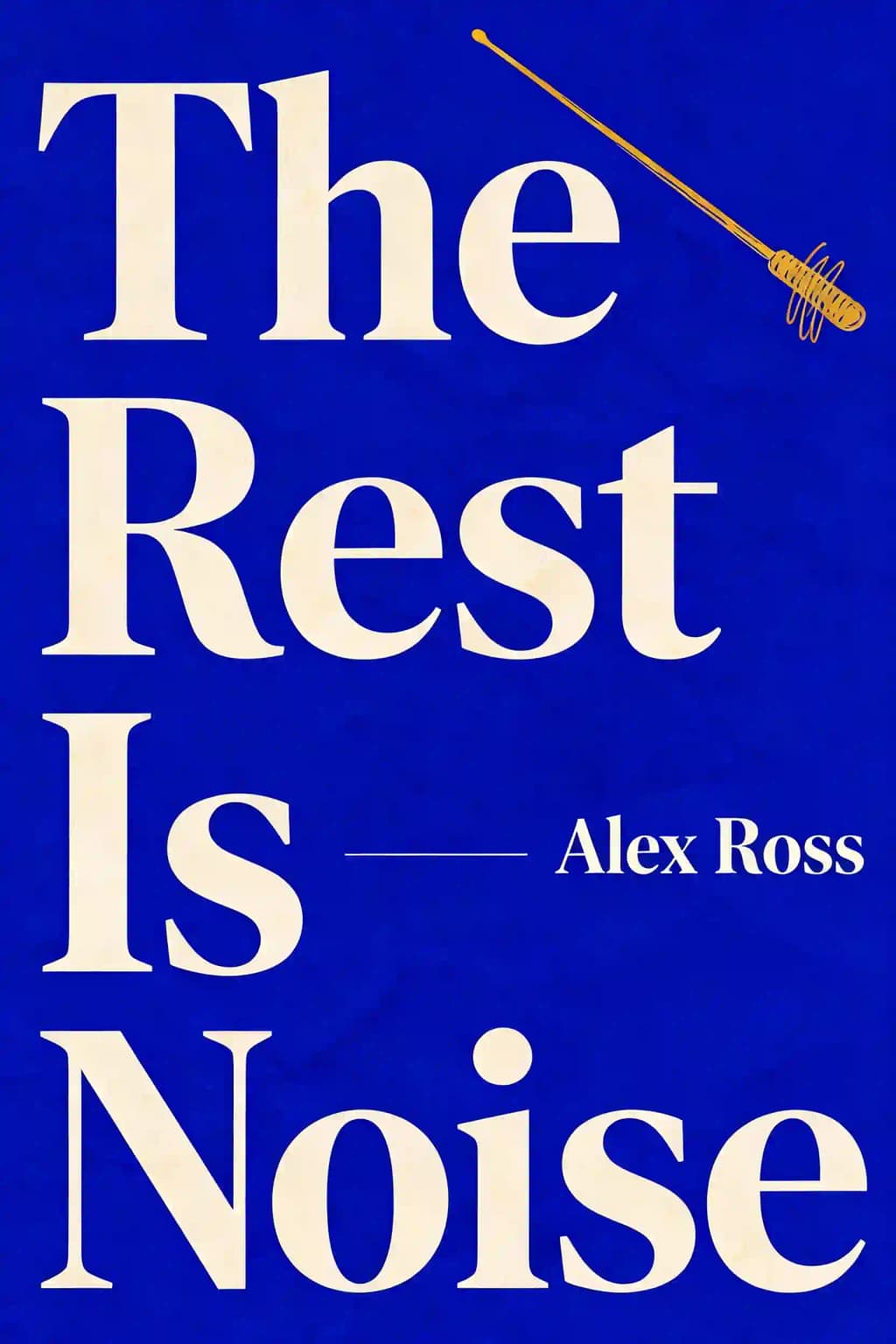
Imagine sitting in the audience of the Vienna Concert Hall in 1913. The orchestra begins playing Schoenberg's Chamber Symphony, and within minutes, the elegant crowd erupts into chaos-shouting, hissing, fistfights breaking out between supporters and detractors. This wasn't just another concert; it was a battleground in a musical revolution that would reshape the entire landscape of sound in the 20th century. Alex Ross's "The Rest is Noise" has become a cultural touchstone since its 2007 publication, praised by critics as "the most significant book about music in decades." Even David Bowie listed it among his 100 must-read books, while orchestras worldwide have created concert series based on its narrative. What makes this book so compelling is how it transforms our understanding of modern music-not as an abstract, academic exercise, but as a vivid human drama playing out against the century's most tumultuous events.
第 2 章
The Last Romantics: Wagner's Long Shadow
As the 20th century dawned, Richard Wagner's influence loomed impossibly large over the musical world. His operas represented unprecedented artistic achievements with psychological depth comparable to Tolstoy or James. In Bayreuth, the German city where his music "springs eternal" since the 1876 premiere of his complete Ring cycle, Wagner's final work "Parsifal" captured end-of-century spiritual longings with its mystical elements and innovative techniques where "time becomes space."
By 1906, Wagner had become a cultural colossus influencing not just music but literature, theater, and painting. His impact extended to diverse political movements from liberalism to feminism, despite his appropriation by anti-Semites and ultranationalists. Composers worldwide grappled with his overwhelming presence-some embracing his innovations, others rebelling against them.
Richard Strauss and Gustav Mahler emerged as the two giants who would carry music into the new century, each responding to Wagner's legacy in distinctive ways. Strauss resided in Berlin-Europe's noisiest, busiest metropolis-while Mahler made his home in Vienna, a slower-paced imperial city aestheticized "down to its pores" with gilt and glamour.
Mahler's childhood experiences profoundly shaped his musical sensibility. In a famous story he later shared with Freud during a four-hour psychoanalytic walking session, young Mahler once fled a parental argument only to hear a barrel organ playing "Ach, du lieber Augustin" in the street-fixing forever in his mind "the conjunction of high tragedy and light amusement," a juxtaposition that would characterize his symphonies.
As director of the Vienna Court Opera, Mahler transformed concert etiquette, enforcing strict rules against audience noise, late arrivals, and excessive applause between numbers, prompting Emperor Franz Joseph to wonder if music was really "such a serious business." This seriousness of purpose extended to his symphonies, which sought to revolutionize the form as Wagner had transformed opera.
第 3 章
America's Musical Awakening: From Import to Innovation
While Europe wrestled with Wagner's ghost, America was developing its own vibrant musical culture. Every major city maintained an orchestra, international opera stars circulated through New York, Chicago, and San Francisco, and virtuosos arrived in Manhattan by the boatload. The American orchestral scene mirrored Europe's, gravitating toward Austro-German traditions with many immigrant musicians conducting rehearsals in German.
For the wealthy elite, classical music functioned as a status symbol, with millionaires collecting musicians much as they acquired European art. Yet composers like Wagner and Puccini enjoyed broad appeal beyond high society. Theodore Thomas led his orchestra on cross-country tours playing to audiences of up to ten thousand, while Anton Seidl conducted all-Wagner concerts on Coney Island advertised by electric signs on Broadway.
New technologies democratized access to classical music. In 1906, Victor introduced its Victrola phonograph, and despite its exorbitant $200 price tag, it proved immensely successful. Caruso dominated the medium, with his recording of "Vesti la giubba" becoming the first million-selling record. That same year, Thaddeus Cahill unveiled his massive Telharmonium, broadcasting electronic arrangements of classical works to audiences at Telharmonic Hall opposite the Met.
What American musical culture lacked was distinctly American classical music. Despite Ralph Waldo Emerson's 1837 call in "The American Scholar" to stop listening "to the courtly muses of Europe," American composers remained derivative of European models. While American literature boasted Hawthorne, Melville, Thoreau, Whitman, and Twain, American composers like John Knowles Paine and Edward MacDowell failed to develop a uniquely American musical language. The country would have to wait for figures like Charles Ives and George Gershwin to create a truly American sound.
第 4 章
Vienna 1900: The Birth of Musical Modernism
Vienna at the turn of the century became the ultimate battleground between bourgeois aestheticism and the avant-garde. Throughout Europe, occult societies, political radicals, and psychological innovators like Freud were challenging established order. Vienna's "truth-seekers" or "critical modernists" rebelled against the city's gold-leafed aestheticism, speaking for society's outcasts while recognizing that Jews could never fully assimilate into an anti-Semitic culture.
This offensive against kitsch united figures like critic Karl Kraus, architect Adolf Loos, and artists Kokoschka and Schiele. For composers like Arnold Schoenberg, the rebellion was also practical: Vienna worshipped old music while contemporary works vanished from concert programs, leading him to declare, "If it is art, it is not for all, and if it is for all, it is not art."
Born in 1874 to a shopkeeper father from Pressburg and a mother from a family of cantorial singers, Schoenberg was largely self-taught, absorbing classical repertory from a military band in a Prater coffeehouse. He played in a string quartet that met in a messenger boys' room and learned musical forms from an encyclopedia, waiting for the "S" volume to compose his first sonata.
Schoenberg's early works surprise listeners expecting atonal exercises-they exude heady, luxurious tones reminiscent of Klimt's gilt portraits, mixing Straussian gestures with diaphanous Debussy-like textures. "Transfigured Night" (1899) ends with twelve bars of glistening D major, while "Gurre-Lieder" begins with a steam bath of E-flat major echoing Wagner's Ring. Yet unexplained dissonances and unresolved chords of longing signal the coming revolution.
Despite his provocative personality-Alma Mahler called him a "conceited puppy" who offered "paradox of the most violent description"-Schoenberg received crucial support from both Mahler and Strauss. Mahler, though perplexed by Schoenberg's music, publicly supported his controversial works. Strauss, who found the younger composer "very talented" if "overloaded," helped him find income sources and joined his Society for Creative Musicians.
第 5 章
The Scandal of Atonality: Music That Broke All Rules
"I feel the heat of rebellion rising in even the slightest souls," Schoenberg wrote in January 1910, anticipating the resistance to his musical revolution. Nothing in music history rivals the scandals that greeted his early works. His First String Quartet in 1907 provoked laughter and catcalls, with Mahler nearly fighting audience members who disrupted the performance. Days later, his First Chamber Symphony caused "seat-rattling, whistle-blowing, and ostentatious walk-outs." During the Second Quartet's premiere in 1908, critic Ludwig Karpath shouted "Stop it! Enough!" mid-performance.
The scandal surrounding Schoenberg's music stemmed from fundamental physics of sound. As Helmholtz explained in On the Sensations of Tone, certain intervals physically "attack the nerve endings"-particularly the semitone, which creates rapid "beats" that distress the ear. Modern theorist Fred Lerdahl explains that when two periodic signals stimulate overlapping areas of the basilar membrane, the resulting "roughness" creates physical discomfort. These very intervals-semitones, major sevenths, minor ninths-form the backbone of Schoenberg's atonal music.
Psychology also played a crucial role. Unlike viewing abstract paintings, where viewers can approach at their own pace and distance, concert audiences experience new music collectively, simultaneously, as a crowd-and crowds align as one mind. Schoenberg compounded his difficulties with his combative responses to critics, alternating between emphasizing his music's irrational, unconscious origins ("Art belongs to the unconscious! One must express oneself directly!") and insisting his works represented the logical, rational outcome of historical processes.
The early 20th century witnessed increasing dissonance across music: Liszt's keyless bagatelle, Satie's Rosicrucian chords, Strauss's Salome, Reger's near-atonality, Scriabin's "mystic chord," Russolo's Futurist "music of noise," and Ives's polytonal experiments. Yet only Schoenberg truly embraced atonality by eliminating old harmonies entirely rather than merely adding new ones. While Wagner, Strauss, and Mahler balanced novel sonorities with common chords, Schoenberg insisted "there was no going back"-or as his student Webern later put it, "We broke its neck."
第 6 章
Music in the Shadow of War: Berg's Wozzeck
"War!" Thomas Mann wrote in November 1914. "We felt purified, liberated, we felt an enormous hope." The Great War initially exhilarated many artists, including Schoenberg, who fell into "war psychosis," drawing parallels between Germany's assault on France and his own attack on bourgeois values. "Now we will throw these mediocre kitschmongers into slavery," he thundered to Alma Mahler, "and teach them to venerate the German spirit." This fervent nationalism, common among German-speaking intellectuals of the time, reflected a broader cultural belief that war would cleanse society of its perceived decadence.
The Second Viennese School's military service bordered on the absurd, their artistic sensibilities clashing with military life. Schoenberg, at forty, resembled a plump village schoolmaster in his ill-fitting uniform, conducting military bands rather than advancing compositions. Webern, barely visible beneath his oversized helmet, struggled with basic drills in his reserve battalion. Berg, whose artistic temperament proved particularly unsuited to military life, cut a peculiar figure posing self-consciously like a silent movie actor in his uniform photographs.
Physical and psychological limitations spared them from frontline combat, but not from military service's indignities. Schoenberg's role in a military orchestra felt far removed from his revolutionary musical ambitions. Webern's severe nearsightedness relegated him to peripheral duties. Berg's situation proved especially difficult - a nervous breakdown led to his assignment to a desk job under a sadistic superior who seemed to delight in humiliating the sensitive composer.
During this period, Berg found himself unable to compose substantially, instead filling notebooks with military terminology and bureaucratic language that would later influence his work. His encounter with Georg Buchner's play Woyzeck in May 1914 proved transformative. The story of a common soldier driven to madness and murder by military degradation and social exploitation resonated deeply with Berg's own experiences. "There is a bit of me in Wozzeck's character," he confided, "since I have been spending these war years just as dependent on people I hate." The parallel between Wozzeck's suffering and his own military humiliations provided both artistic inspiration and psychological catharsis.
Berg approached the opera with remarkable independence, setting Buchner's play "raw," personally editing and arranging the text into a libretto. He persisted despite Schoenberg's initial skepticism about the subject matter, even resorting to subterfuge - pretending to work on his teacher's biography while secretly composing Wozzeck. This deception revealed both Berg's determination and his continued deference to his mentor's opinion. The opera's 1925 premiere in Berlin marked a turning point in Berg's career, transforming him from an obscure Schoenberg disciple into a composer of international renown. The success, however, proved psychologically complex for Berg. According to his friend and philosopher Theodor Adorno, Berg became troubled by the work's popularity, interpreting it as evidence that he had compromised his artistic principles by creating something too accessible to mainstream audiences - a common concern among avant-garde composers of the period.
第 7 章
The Jazz Age: America Finds Its Voice
Charles Ives emerged as a stubborn, original American voice in a musical landscape dominated by European masters. Born into a distinguished New England family with Transcendentalist connections, Ives was influenced by his bandleader father George, who once marched two bands past each other to create deliberate cacophony. After studying at Yale with Horatio Parker and briefly working as a church organist in New York, Ives mysteriously withdrew from public musical life following his 1902 cantata "The Celestial Country." Instead, he built a successful insurance career while composing revolutionary music in isolation.
Ives's genius lay not merely in his dissonant innovations but in his heterogeneous combinations of American sounds. Works like "The Unanswered Question," the Second Symphony (incorporating hymns, marches, and folk tunes alongside European quotations), and "Three Places in New England" created distinctly American musical forms. His "St. Gaudens" movement, inspired by a sculpture of an African-American Civil War regiment, wove together spirituals, Stephen Foster songs, and battle hymns into a complex meditation on race and history. Rather than asserting a single perspective, Ives created "a kind of open-ended listening room, a space of limitless echoes."
Ives wisely delayed publicizing his modernist Transcendentalist style until 1920, when the Roaring Twenties brought forth what scholar Carol Oja calls a "marketplace for modernism"-an audience more receptive to disruptive sounds. The jazz-influenced music that captivated white audiences often came from Jewish composers like Jerome Kern, George Gershwin, Irving Berlin, and Richard Rodgers, who drew from African-American material. This cultural mixing defined American music, despite composer Edgard Varese's dismissive claim that "Jazz is not America. It's a negro product, exploited by the Jews."
George Gershwin, who claimed to "frequently hear music in the very heart of noise," epitomized the Jazz Age and harmonized all its discordant tendencies. Growing up on Manhattan's Lower East Side, he experienced his "flashing revelation" hearing Dvorak's Humoresque in the schoolyard. His "Rhapsody in Blue" debuted at Paul Whiteman's 1924 "Experiment in Modern Music," creating a sensation with its elegant clarinet glissando and dizzying modulations that blended blue notes with classical structures. European tours brought acclaim from Stravinsky, Ravel, and Berg, whose Lyric Suite particularly fascinated him.
第 8 章
Music Under Dictators: The Art of Fear
As American composers celebrated democratic ideals, Wagner's music became the soundtrack to Nazi Germany's atrocities. Hitler, who claimed Wagner as his favorite composer, frequently quoted from Die Meistersinger, while high-ranking Nazis like Hans Frank, Reinhard Heydrich, and Josef Mengele were accomplished musicians who revered Wagner. This connection was no coincidence-Wagner's anti-Semitic writings had provided intellectual justification for racial hatred, describing Jews as "the born enemy of pure humanity" and a "plastic demon" who could only be redeemed through "destruction."
Richard Strauss's moral collapse as president of the Reich Music Chamber from 1933-1935 exemplified German art's compromise with fascism. He appeared at Nazi functions, replaced Toscanini at Bayreuth, socialized with Nazi leaders, and gave Hitler gifts. Yet his collaboration was complex-he reluctantly replaced Bruno Walter only after being told Walter himself requested it, resisted removing Jews from the Music Chamber, defended Mahler's symphonies, and opposed banning Mendelssohn's music.
Meanwhile in the Soviet Union, Dmitri Shostakovich navigated an equally treacherous cultural landscape. Born in 1906, Shostakovich showed astounding musical aptitude from childhood. His First Symphony (1926) brought international acclaim with its gripping narrative drive. Yet by 1929, Shostakovich faced his first accusation of "formalism"-Soviet shorthand for Western modernism.
Shostakovich's career imploded in 1936 when Pravda published "Muddle Instead of Music," condemning his opera "Lady Macbeth of the Mtsensk District" after Stalin attended a performance. This attack wasn't merely personal-Shostakovich was being used as an example in a broader campaign against artistic independence. A Pravda editor later admitted, "We had to begin with somebody. Shostakovich was the most famous... a blow against him would create immediate repercussions."
After nearly two years of public silence, Shostakovich unveiled his Fifth Symphony on November 21, 1937. The stylistic shift was dramatic-a conventional four-movement structure proceeding from tragic minor to exultant major, comprehensible to ordinary listeners (Stalin included). An article published under Shostakovich's name called it "My Creative Response" and described it as an apology for his earlier works, promising "greater clarity and simplicity." Yet these words contained strategic ambiguities-"all that I have thought and felt" could encompass personal suffering, and simplicity didn't preclude emotional complexity.
第 9 章
American Music for All: Copland's Democratic Vision
Aaron Copland grew up in Brooklyn, where his father owned a department store. After moving to Paris, Copland studied with Nadia Boulanger, attending performances by the Swedish Ballet and frequenting artistic gatherings. Upon returning to America, he declared "The day of the neglected composer is over," joining forces with other modernists like Varese in what Virgil Thomson called a "commando unit" of American composers. Copland's early works like Piano Variations were harsh and challenging, earning him just $6.93 in royalties.
As the Depression deepened, with many Americans living without indoor plumbing, Copland and other composers embraced leftist politics. The Communist Party attracted intellectuals with its promise that "Communism is twentieth-century Americanism." Copland's political awakening intensified after visiting Mexico in 1932, where he wrote to the Koussevitzkys, "At last I have found a place where I feel at home." Influenced by Mexican muralists and Jose Vasconcelos's cultural nationalism, Copland incorporated folk elements into works like El Salon Mexico.
The Roosevelt administration transformed American cultural policy through the WPA and Federal Music Project, which employed thousands of musicians. Eleanor Roosevelt championed the arts, declaring "When the arts flourished, it was because the people cared." The FMP reached rural communities where classical music had never been heard, with one Oklahoma report noting: "The highlight of the month was a concert given in a country schoolhouse."
In 1942, Aaron Copland composed his Fanfare for the Common Man, inspired by Vice President Henry Wallace's speech heralding the "Century of the Common Man." This democratic ethos culminated in Appalachian Spring, commissioned by Martha Graham. The ballet depicted a young frontier couple establishing their homestead, embodying American optimism through Copland's spare, open harmonies and incorporation of the Shaker hymn "Simple Gifts." During recording sessions, Copland would instruct musicians to play "Softer, very sul tasto," seeking a delicate, transparent sound that captured the work's humble yet transcendent spirit-a perfect musical expression of American democratic ideals.
第 10 章
The Postwar Avant-Garde: Starting From Zero
In the aftermath of World War II, a radical new musical order emerged. Morton Feldman described this period as one where "for most people" the very concept of music had been transformed. Leonard Bernstein compared Stravinsky's adoption of twelve-tone technique to a major political defection, while Elliott Carter noted that the war had fundamentally altered musical consciousness.
In France, Pierre Boulez emerged as a fierce revolutionary, studying under Messiaen and causing scandals at concerts. He launched vicious attacks against Stravinsky and Schoenberg in his writings, declaring older compositional methods obsolete. His work Structures 1a represented total serialism, controlling every musical parameter through mathematical processes.
Across the Atlantic, John Cage developed an opposing approach that was "inclusive rather than exclusive," embracing chance operations and environmental sounds. His prepared piano pieces and later works like 4'33" challenged fundamental assumptions about music. While Boulez represented European control and precision, Cage embodied American openness and indeterminacy, though both rejected traditional musical values.
The German town of Darmstadt became ground zero for postwar musical radicalism. At the International Summer Courses for New Music, founded in 1946, composers gathered to rebuild musical culture from the rubble of fascism. What began as a forum for diverse modern styles quickly became dominated by the serialist orthodoxy of Boulez, Stockhausen, and their disciples.
By the mid-1950s, Darmstadt had developed its own rigid aesthetic code. As Hans Werner Henze recalled, "Everything had to be stylized, abstract, and non-illustrative." Those who deviated from strict serialism faced fierce criticism. When Henze incorporated lyrical elements into his Nocturnes and Arias, Boulez dismissed him as "my dear little Henze," effectively excommunicating him from the avant-garde.
第 11 章
Searching for Transcendence: Music After Modernism
After the darkness of the postwar avant-garde, the musical landscape shifted toward a search for transcendence. Olivier Messiaen emerged as the century's great religious composer, creating a musical language that fused Catholic mysticism with radical innovation. His harmonic language rejected both traditional tonality and atonality, instead building on what he called "the chord of resonance"-complex harmonies derived from the natural overtone series.
Messiaen's fascination with birdsong ("Birds are my first teachers") and his synesthesia, which allowed him to perceive sounds as colors, further expanded his musical palette. After surviving a German prison camp, where he composed the Quartet for the End of Time, Messiaen created increasingly ambitious works exploring Catholic theology. His music moved from the sensual Turangalila-Symphonie (described by critics as "an angel wearing lipstick") to the vast bird-inspired Catalogue d'oiseaux and ultimately to his opera Saint Francois d'Assise-an "immense cake" of sound depicting the saint's spiritual journey toward divine grace.
While Messiaen sought the divine, other composers pursued radical new directions. California fostered a distinctive American experimental tradition. Henry Cowell, raised in a "smelly old house" near San Francisco, saw California as "an undefiled Eden" where "a new race" of composers could emerge. Harry Partch, seeking to "find a way outside" conventional music, developed a 43-tone scale and built his own instruments after rejecting what he called the "Faustian" strain of European music.
La Monte Young, raised in rural Idaho, developed a fascination with sustained sounds from hearing wind whistling through the logs of his cabin and the hum of electrical transformers. His landmark compositions included the "Trio for Strings" (1958), which consisted almost entirely of sustained tones. Terry Riley's "In C" (1964) featured 53 melodic patterns that musicians could repeat at will against a steady eighth-note pulse, while Steve Reich developed his phasing technique after accidentally hearing tape loops going out of sync.
As the century drew to a close, musical extremes transformed into their opposites. Schoenberg's once-scandalous chords infiltrated Hollywood thrillers; Webern's compact twelve-tone structures evolved into La Monte Young's expansive drones; Feldman's indeterminacy influenced the Beatles; Reich's processes appeared in Talking Heads and U2. The artificial divide between classical and popular music dissolved as young composers incorporated pop influences naturally, while innovative pop artists like Bjork drew deeply from classical traditions.
The twenty-first century may witness a "great fusion" where intelligent pop and extroverted classical composition share common language. Yet some composers will maintain traditional distinctions, creating works like Haas's "in vain," Saariaho's "L'Amour de loin," and Lieberson's "Neruda Songs" that connect to classical masterpieces. This tension between engagement and withdrawal has animated music for centuries-from Renaissance debates over secular tunes in sacred music to nineteenth-century contrasts between Rossini's extroversion and Beethoven's introspection. In their solitude, composers communicate experiences of singular intensity, mapping what Debussy called the "imaginary country... that can't be found on the map."






![[PDF] Experimental Music: Cage and Beyond](/_next/image?url=https%3A%2F%2Fd1y2du6z1jfm9e.cloudfront.net%2Fassets%2Fpodcast%2Fblue.png&w=1024&q=50)


