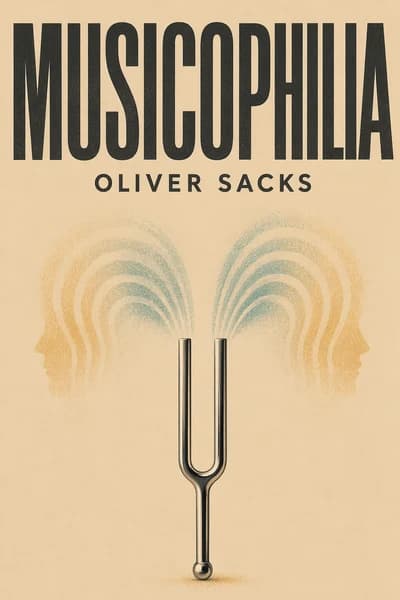
In "Musicophilia," renowned neurologist Oliver Sacks explores the mysterious relationship between music and the brain. When lightning struck Tony Cicoria, he inexplicably became obsessed with piano - just one of many mind-bending cases revealing how music can both heal neurological disorders and reshape our minds.
Oliver Sacks, the renowned neurologist and bestselling author of Musicophilia: Tales of Music and the Brain, combined his clinical expertise with a storyteller’s flair to explore the profound relationship between music and the human brain. A graduate of Oxford University, Sacks became celebrated for his case-study-driven narratives that bridge neuroscience and humanity, as seen in his iconic works like The Man Who Mistook His Wife for a Hat and Awakenings—the latter adapted into an Oscar-nominated film.
His writing, frequently featured in The New York Times, delves into neurological mysteries with empathy and scientific rigor. Musicophilia, a cornerstone of neuropsychology literature, examines conditions like musical hallucinations, perfect pitch, and musicogenic epilepsy, blending patient stories with insights into brain plasticity.
Sacks’ other notable books, including Hallucinations and An Anthropologist on Mars, further cement his legacy in making complex neurological concepts accessible. His works have been translated into over 25 languages and adapted into plays, operas, and films, solidifying his global influence. Awakenings alone has inspired generations of medical and literary audiences since its 1973 publication.
Musicophilia explores the profound relationship between music and the human brain through case studies of individuals with neurological conditions. Oliver Sacks examines how music can trigger recovery in Parkinson’s patients, unlock creativity after brain trauma, or cause hallucinations, emphasizing its universal yet mysterious role in human cognition and emotion.
This book is ideal for music enthusiasts, neuroscience students, and general readers intrigued by how art intersects with biology. Clinicians and therapists will also find insights into music’s therapeutic potential for conditions like Alzheimer’s, PTSD, and stroke recovery.
Yes—Sacks combines scientific rigor with storytelling, making complex neurology accessible. The book’s blend of case studies (like a lightning-strike victim turned pianist) and analysis of music’s cognitive impact has earned praise for its depth and readability, offering fresh perspectives for casual and academic audiences alike.
Sacks describes cases like Tony Cicoria, who developed an intense passion for piano after a lightning strike. He theorizes brain trauma may disrupt inhibitory circuits, unleashing latent creative pathways in the right hemisphere—a phenomenon termed “sudden musicophilia”.
The book explores:
Yes—Sacks details how rhythmic music temporarily “unfreezes” Parkinson’s patients, enabling coordinated movement. This aligns with therapies using metronomes or dance to bypass damaged neural pathways.
Sacks profiles individuals with extraordinary musical abilities despite cognitive disabilities, such as blind pianists with perfect pitch or autism-spectrum prodigies. He links these skills to heightened right-brain activity compensating for deficits elsewhere.
The book describes patients involuntarily “hearing” songs due to auditory deprivation or brain lesions. Sacks explains these hallucinations as the brain attempting to fill sensory voids, often tied to memory networks.
Some scholars note Sacks prioritizes anecdotal cases over systematic data. However, his narrative approach is widely praised for humanizing neurology and inspiring further research into music’s therapeutic applications.
Like The Man Who Mistook His Wife for a Hat, this book uses patient stories to explore neurodiversity. However, Musicophilia specifically highlights music’s unique power to heal, disrupt, and define human experience.
Sacks discusses amnesiacs like Clive Wearing, who retained musical memory despite losing all other recall. This underscores music’s deep ties to emotional and procedural memory systems bypassing damaged hippocampal regions.
As music therapy gains clinical traction, Sacks’ work remains foundational for understanding its scientific basis. The book also addresses modern issues like earworms and sensory overload, linking them to brain plasticity and auditory processing.
通过作者的声音感受这本书
将知识转化为引人入胜、富含实例的见解
快速捕捉核心观点,高效学习
以有趣互动的方式享受这本书
Music occupies more of our brain than language does—almost every neural subsystem we have is involved.
Music can move us to the heights or depths of emotion.
What happens when music hijacks the brain?
Musical capacities may lie dormant in all of us, waiting for the right-or wrong-neural circumstances to emerge.
将《Musicophilia》的核心观点拆解为易于理解的要点,了解创新团队如何创造、协作和成长。
将《Musicophilia》提炼为快速记忆要点,突出坦诚、团队合作和创造力的关键原则。

通过生动的故事体验《Musicophilia》,将创新经验转化为令人难忘且可应用的精彩时刻。
随心提问,选择声音,共同创造真正与你产生共鸣的见解。

"Instead of endless scrolling, I just hit play on BeFreed. It saves me so much time."
"I never knew where to start with nonfiction—BeFreed’s book lists turned into podcasts gave me a clear path."
"Perfect balance between learning and entertainment. Finished ‘Thinking, Fast and Slow’ on my commute this week."
"Crazy how much I learned while walking the dog. BeFreed = small habits → big gains."
"Reading used to feel like a chore. Now it’s just part of my lifestyle."
"Feels effortless compared to reading. I’ve finished 6 books this month already."
"BeFreed turned my guilty doomscrolling into something that feels productive and inspiring."
"BeFreed turned my commute into learning time. 20-min podcasts are perfect for finishing books I never had time for."
"BeFreed replaced my podcast queue. Imagine Spotify for books — that’s it. 🙌"
"It is great for me to learn something from the book without reading it."
"The themed book list podcasts help me connect ideas across authors—like a guided audio journey."
"Makes me feel smarter every time before going to work"

免费获取《Musicophilia》摘要的 PDF 或 EPUB 版本。可打印或随时离线阅读。
A surgeon stands in a phone booth during a storm. Lightning strikes. He collapses, clinically dead for moments before his heart restarts. When he awakens, something has fundamentally changed-not in his body, but in his soul. Suddenly, inexplicably, he craves Chopin. This man, who never cared for classical music, now spends hours at the piano, consumed by melodies he can't explain. His name is Tony Cicoria, and his transformation reveals something profound: music isn't just something we enjoy-it's hardwired into the architecture of our brains, waiting to be awakened by the right neurological trigger. These cases of sudden musical obsession aren't isolated curiosities. A builder gets hit on the head and develops an insatiable hunger for piano music. An elderly woman with no musical background hears Irish songs from her childhood playing endlessly after a seizure. What unites these stories is the discovery that our brains contain vast neural networks dedicated to music, lying dormant until neurological events-strokes, seizures, accidents-flip the switch. When a patient experiences "musical seizures," they don't just hear noise; they hear complete orchestras, familiar melodies, coherent compositions. One woman's seizures always began with the same childhood song. Another heard symphonies she could hum but never identify. Music can literally seize the brain, transforming consciousness itself.