第 1 章
When Freedom Becomes a Burden
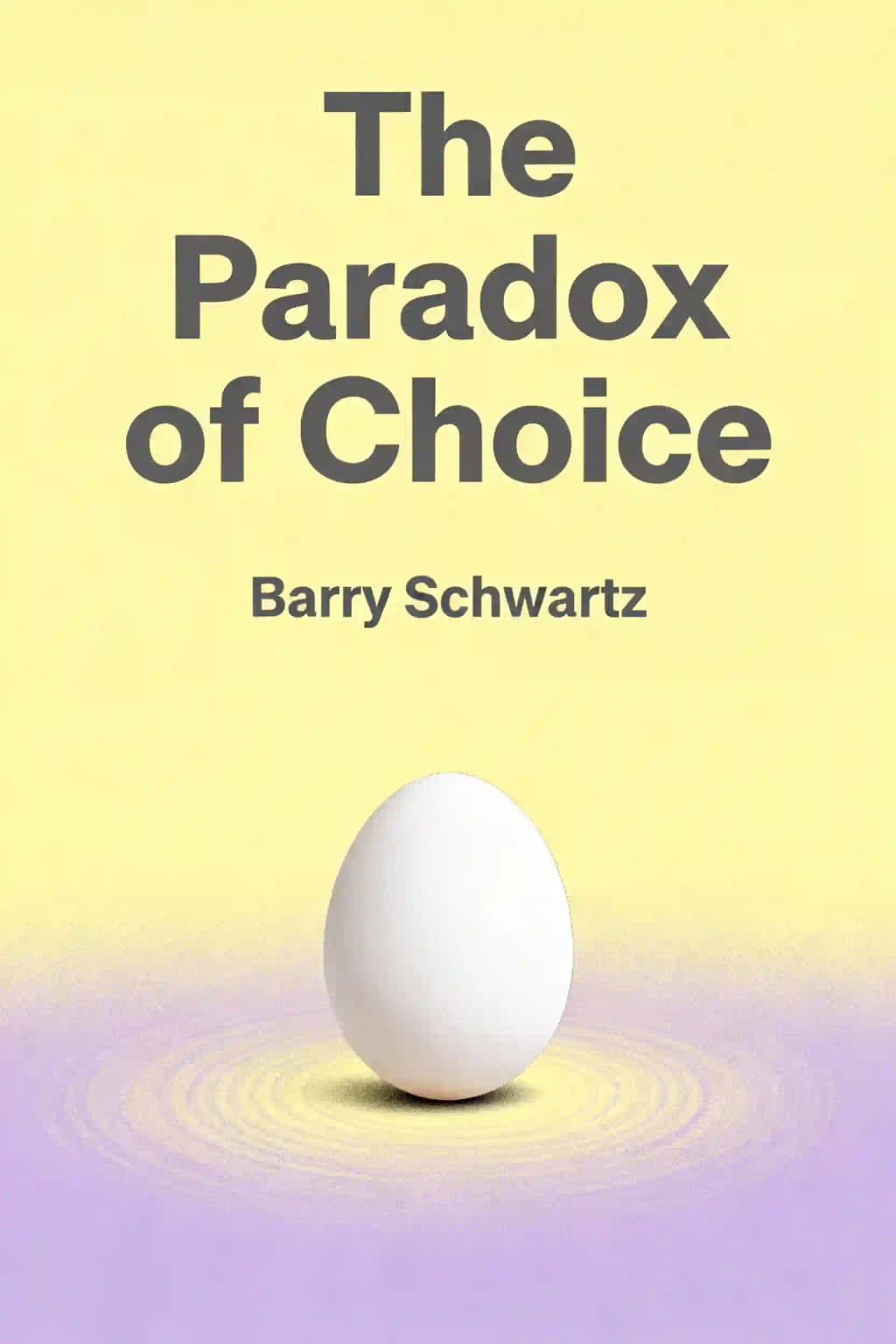
Have you ever gone shopping for a simple pair of jeans only to find yourself paralyzed by an overwhelming array of options? Slim fit, relaxed fit, stonewashed, button-fly, zipper-fly-what should have been a five-minute purchase becomes a day-long project filled with self-doubt and anxiety. This seemingly trivial experience captures the essence of a profound modern dilemma that affects nearly every aspect of our lives. "The Paradox of Choice" has become a cultural touchstone since its 2004 publication, with luminaries from Malcolm Gladwell to Daniel Kahneman citing its insights. The book has been translated into 27 languages and remains required reading in psychology programs worldwide. Author Barry Schwartz, with his trademark blend of academic rigor and accessible storytelling, takes us on a journey through the unexpected psychological costs of freedom. What makes this exploration so compelling is how it challenges one of our most cherished cultural assumptions-that more choice invariably leads to greater freedom and happiness.
第 2 章
The Explosion of Options in Modern Life
Walk into any supermarket today and prepare to be overwhelmed. On a recent visit to my local store, I counted 85 varieties of crackers, 285 types of cookies (including 21 kinds of chocolate chip cookies alone), and 95 different snack options. The beverage aisle offered 13 sports drinks, 65 box drinks for children, 85 juice varieties, and 75 iced teas. Moving through the store revealed 61 varieties of suntan products, 80 pain relievers, 40 toothpaste options, and 175 salad dressings. A typical supermarket now carries more than 30,000 items, with 20,000 new products introduced yearly-most doomed to failure.
This explosion of choice extends far beyond groceries. At electronics stores, we face 45 car stereo systems with 50 speaker options, 42 customizable computers, 110 different televisions, and enough stereo components to create over 6.5 million different combinations. Unlike supermarket items, these purchases last longer and cost more, giving our choices serious consequences.
Even education has transformed into an intellectual shopping mall. A century ago, college meant a fixed curriculum aimed at creating ethical citizens with common values. Today, Harvard students choose from about 220 courses to satisfy general education requirements across seven areas and can select from 40 majors or create their own. Princeton offers 350 courses for general education, Stanford even more.
Our entertainment options have similarly exploded. Television viewing has evolved from three networks to 200+ channels, with on-demand movies and specialized subscription services. Technologies like TiVo allow us to create personalized TV stations, watching whatever we want whenever we want it. Soon, when people gather to discuss last night's shows, no two viewers will have watched the same programs, leaving Americans without shared television experiences.
Studies reveal a counterintuitive truth about this abundance: more choice can actually decrease purchasing behavior. In a gourmet food store study, when 24 jam varieties were available for tasting, more people stopped to sample than when only 6 varieties were offered. However, 30% of those who encountered the smaller selection actually purchased jam, while only 3% facing the larger selection did so. Similarly, students facing a small array of chocolate options were more satisfied with their choice and four times more likely to choose chocolate over cash as compensation.
Why don't we simply ignore excess options? Marketers make products impossible to ignore, social comparison drives awareness of alternatives, and we suffer from the "tyranny of small decisions"-adding just one more option at a time until overwhelmed. Most importantly, our culture so deeply sanctifies freedom of choice that we blame our shopping dissatisfaction on anything but too many options.
第 3 章
The New Burden of Everyday Decisions
Much of human progress has involved reducing the time and energy needed to obtain life's necessities. However, in recent decades, this simplification has reversed, forcing us back into time-consuming "foraging behavior" as we sift through overwhelming arrays of options in almost every aspect of life.
A generation ago, utilities were regulated monopolies requiring no consumer decisions. Following the breakup of "Ma Bell," we now face dizzying arrays of phone service options and emerging choices in electric power providers. While deregulation may bring improved service and lower prices, it shifts responsibility to consumers who must "figure it out for themselves." Surveys reveal a paradox: people want both more control over life details and simpler lives.
Health insurance choices have expanded from simple local Blue Cross plans to complex arrays of HMOs and PPOs with various deductibles and coverage options. This market approach shifts decision burden to individuals, forcing them to navigate incredibly complicated options with potentially devastating financial consequences if they choose poorly.
Employers have shifted from "defined benefit" pension plans to "defined contribution" plans where retirement income depends on investment performance. Options have exploded-one accounting firm expanded from 14 pension options to 156. Studies show that when faced with numerous options, people typically divide contributions equally among available funds, regardless of risk profiles.
Medical care responsibility has shifted dramatically to patients. Where doctors once made all decisions paternalistically, patients now face overwhelming choices about treatments. As physician Atul Gawande notes, this shift improved care but went too far-many patients don't want complete autonomy. Research shows most cancer patients prefer not to choose their own treatments despite saying otherwise when healthy.
Our appearance has become a matter of choice rather than fate. In 1999, Americans underwent over a million cosmetic surgeries. Industry representatives now compare cosmetic surgery to everyday grooming-"like getting your nails done." This shift transforms beauty from "a gift bestowed upon the few" to "an achievement," making homeliness not just misfortune but personal failure.
Even our identities have become matters of choice. Modern society offers unprecedented freedom to choose who we are beyond inherited characteristics like race, ethnicity, nationality, religion, and socioeconomic class. We can embrace or repudiate our ethnic heritage, celebrate or suppress nationality, and even racial identification has become more fluid through multiracial marriages and increasing social tolerance.
While philosopher Albert Camus suggested everything in life is choice, most daily decisions don't register psychologically as real choices-they're automatic habits. The transformation in modern life is that choices have gone from implicit and psychologically unreal to explicit and very real across many domains. We're trapped in what Fred Hirsch called "the tyranny of small decisions"-saying yes to choice in each particular situation without considering the overwhelming burden of the entire package.
第 4 章
The Psychology of Decision-Making
Making good decisions involves multiple steps: identifying goals, evaluating their importance, considering options, assessing how each option meets your goals, selecting the best choice, and using consequences to refine future decisions. This process becomes increasingly difficult as options multiply, transforming choice from blessing to burden.
Understanding what we want requires accurately anticipating how choices will make us feel-no simple task. Daniel Kahneman's research shows three different utilities rarely align: "expected utility" (what we anticipate feeling), "experienced utility" (actual feelings during the experience), and "remembered utility" (how we recall the experience). Our memories follow the "peak-end rule"-we remember experiences based on how they felt at their peak moment and how they ended, rather than their duration or overall pleasure-to-pain ratio.
This explains why people choose longer unpleasant experiences with better endings over shorter ones, and why patients who had colonoscopies with milder endings (though longer overall discomfort) were more likely to return for follow-ups. Similarly, we remember vacations by their peaks and endings, not their duration, and consistently fail to predict our future preferences, as shown by studies where people choose variety for future snacks but select the same favorite when choosing in the moment.
Once we determine our goals, we gather information to evaluate options, drawing from past experience, friends' recommendations, and expert advice. But most prominently, we're influenced by advertising-the average American sees three thousand ads daily. Modern advertising focuses on branding rather than providing useful decision-making information. Since cigarette manufacturers discovered in the 1930s that consumers couldn't distinguish between brands in blind tests, marketing has emphasized creating perceived distinctiveness by associating products with lifestyles.
Even with accurate goals and good information, we often struggle to analyze and evaluate data properly. The "availability heuristic" causes us to overweight vivid, personal anecdotes while undervaluing statistical evidence. For example, a friend's negative experience with a Volvo might outweigh Consumer Reports' reliability ratings based on thousands of cases. We mistakenly assume that information easily recalled must be more common or frequent, when actually vividness and salience affect recall more than frequency.
How do we determine value? Context becomes our anchor. In a store with $1,500 suits, an $800 suit seems reasonable; in a store with $500 suits, it feels extravagant. Department stores use original ticket prices as anchors against which sale prices seem like bargains. Companies deliberately produce ultra-expensive models ($8,000 gas grills, $20,000 watches) not necessarily to sell them, but to make their expensive models seem reasonable by comparison.
How choices are presented-their "frame"-dramatically affects our decisions. Two gas stations charging identical prices ($1.45 cash/$1.55 credit) get different reactions based on whether the difference is framed as a "cash discount" or "credit surcharge." In medical decisions, people overwhelmingly choose a treatment that "saves 200 lives" over one with "a one-third chance of saving all 600," yet prefer a treatment with "a one-third chance that no one will die" over one where "400 people will die"-though these are mathematically identical choices.
When faced with too many options, our decision-making abilities become severely compromised. As options increase, three unfortunate effects emerge: decisions require more effort, mistakes become more likely, and the psychological consequences of those mistakes become more severe. The abundance of choice transforms us from "choosers" into "pickers." A chooser thoughtfully reflects on what's important, considers short and long-term consequences, and may even create alternatives if none are satisfactory. A picker, overwhelmed by choices "rushing by like a music video," simply grabs options hoping for the best.
第 5 章
Maximizers vs. Satisficers: Two Approaches to Choice
The fundamental choice we face when making decisions is whether to maximize (seek the absolute best) or satisfice (accept what's good enough). Maximizers exhaustively search all options before deciding, constantly worried they might miss something better. A maximizer shopping for a sweater might find one they love but continue searching other stores to ensure they're getting the best possible deal. Satisficers, by contrast, have standards but stop searching once those standards are met.
To identify maximizing tendencies, researchers developed a thirteen-item survey measuring people's decision-making approaches. The scale includes behaviors like constantly checking other radio stations while listening to music, channel surfing during TV shows, and approaching relationships like trying on clothes-always searching for something better despite being relatively satisfied with current choices. Maximizers engage in more product comparisons both before and after purchases, take longer to decide, compare their decisions to others more frequently, experience more regret, and generally feel less positive about their purchasing decisions.
The problems created by abundant choice are significantly worse for maximizers than for satisficers. While satisficers can ignore countless options once they find something that meets their standards, maximizers get trapped in endless anxiety, regret, and second-guessing with each new possibility. Research confirms this: people with high maximization scores experience less life satisfaction, less happiness, less optimism, and more depression than those with low scores. Those with extreme maximization scores showed depression scores in the borderline clinical range.
Maximizers are far more susceptible to all forms of regret, especially "buyer's remorse." Unlike satisficers who remain content with choices that meet their standards, maximizers torture themselves with thoughts like "If only I had gone to one more store" or "If only I had read Consumer Reports." These endless "if onlys" rob them of satisfaction from even good decisions.
Do maximizers at least make better decisions? The answer is nuanced: maximizers might do better objectively but worse subjectively. A maximizer might purchase a technically superior sweater after exhaustive searching, but their satisfaction is undermined by doubts about unexamined alternatives or better deals others might have found. What ultimately matters most is how we feel about our decisions, not just their objective quality.
While related, maximizing differs from perfectionism. Both involve high standards, but perfectionists focus on performance rather than consumption. The key distinction: perfectionists have very high standards they don't expect to meet, whereas maximizers have very high standards they do expect to meet. This explains why perfectionists, unlike maximizers, aren't typically depressed, regretful, or unhappy.
Even non-maximizers have specific domains where they maximize. The author scores low on the maximizing scale generally, hating shopping and sticking with familiar brands. Yet with food choices, he becomes a maximizer-wanting to try everything at buffets, second-guessing his restaurant orders, and suspecting others ordered better.
People maximize for two main reasons: first, many aren't aware of this tendency in themselves-they know they struggle with decisions and fear regret but don't recognize the root cause. Second, status concerns drive maximizing behavior. In our globally connected world, only "the best" ensures success, creating an arms race for excellence.
第 6 章
The Paradox of Choice and Happiness
Freedom and autonomy are critical to well-being, with choice being essential to both. Yet despite modern Americans having unprecedented choice, we don't seem to be benefiting psychologically from this abundance.
Choice serves both instrumental and expressive functions. Instrumentally, it enables people to get what they need and want, allowing for individual preferences within financial constraints. As Adam Smith observed, freedom of choice ensures efficient production and distribution of goods in a competitive market. Even more important is choice's expressive value-it lets us tell the world who we are. From clothing to voting, our choices communicate our identities and values.
Researchers measure happiness through questionnaires like the Satisfaction with Life Scale and newer "experience sampling methods" where participants report feelings in real time via handheld computers. These studies reveal that while people in rich countries are happier than those in poor ones, once basic subsistence is achieved, further wealth increases have minimal impact on happiness. Despite Americans' per capita income doubling over forty years and Japanese wealth increasing fivefold, happiness levels remained flat. What truly matters for happiness are close social relations-marriage, friendships, family ties, and religious community participation. Ironically, these social connections actually decrease freedom and choice by imposing responsibilities and commitments to others.
Building and maintaining meaningful social relationships requires significant time investment. Forming deep relationships doesn't happen instantly, and sustaining them demands ongoing attention that doesn't conveniently fit into our schedules. Yet time has become our scarcest resource, with technology failing to alleviate our time burdens. The proliferation of choices we face-from restaurants to investments to healthcare options-consumes precious time that could otherwise be spent nurturing relationships.
Meaningful social relationships require constraints that limit freedom. As economist Albert Hirschman noted in "Exit, Voice, and Loyalty," people respond to dissatisfaction either by exiting situations or voicing concerns. While exit is typical in marketplace contexts-switching restaurants or brands when unhappy-social relations demand voice and commitment. We don't dismiss friends and lovers as easily as vacation spots. Though constraints restrict freedom, they may ultimately make everyone better off, as unrestricted freedom can impede pursuit of what we value most.
We can ease the burden of choice by making decisions about when to make decisions. These "second-order decisions" include following rules (like always buckling seatbelts), using presumptions (default settings that guide most choices), applying standards (dividing options into acceptable and unacceptable categories), and establishing routines. Each approach constrains our choices but makes life more manageable.
Though we value autonomy and freedom of choice, research shows "wanting" and "liking" operate through different brain systems that don't always align. Drug addicts "want" drugs even when they no longer provide pleasure. Similarly, while 65% of people without cancer said they'd want to choose their treatment, 88% of actual cancer patients preferred not to choose. We consistently think we want choice, but often don't like it when we get it, causing more distress than we realize.
第 7 章
The Hidden Costs of Opportunity and Trade-offs
When making decisions like vacation plans or job choices, each new option adds to the list of potential trade-offs, complicating our choices and affecting our satisfaction with final decisions. Economists note that when choosing between options, we should only consider the opportunity cost of the next-best alternative. But psychologically, we struggle with this approach because options typically have multiple features.
When choosing dinner at a restaurant over other Saturday night activities, we don't just miss the second-best option (a movie), but also unique benefits from other alternatives-intellectual stimulation, relaxation, exercise, social connection. The more options available, the more opportunity costs we feel, and the less satisfaction we derive from our choice. We imagine ideal alternatives combining the best features of all options, making our actual choice seem inadequate by comparison.
Making trade-offs between competing values creates profound discomfort. In studies where participants had to choose between cars with different safety ratings and prices, most people refused to sacrifice safety for savings, even after they had previously established exactly how much each safety unit was worth to them. People experience negative emotions when forced to make such trade-offs, whether the stakes are high or low.
When faced with difficult trade-offs, people often postpone or avoid decisions entirely. Studies show that adding options can paradoxically reduce the likelihood of making any choice. In one experiment, 66% of people would buy a single CD player on sale, but when offered two different models, only 54% purchased either one-the added option created conflict through price-quality trade-offs. People desperately seek reasons to justify choices: they're more likely to choose an option when it clearly dominates an inferior alternative, and they're influenced by how questions are framed.
While we want experts to weigh trade-offs carefully, we hate doing it ourselves because it's emotionally unpleasant. This emotional cost doesn't just diminish satisfaction-it impairs decision quality. Negative emotions narrow our focus to just one or two aspects of a decision and distract us from the task at hand. As stakes rise, emotions intensify and thinking suffers. Conversely, positive emotions improve thinking by helping us see more possibilities and subtle connections.
When we analyze our choices, we often make less satisfying decisions. Studies show that people who verbalize their preferences can actually change those preferences in ways that don't reflect their true feelings. While analyzing relationships might seem to produce insight, research reveals that unanalyzed feelings better predict relationship longevity.
For most of human history, people faced simple "take it or leave it" decisions rather than choosing among multiple options with complex trade-offs. After millions of years of survival based on simple distinctions between good and bad, we may be biologically unprepared for the countless choices of modern life. This evolutionary limitation is visible in child development: babies and toddlers simply accept or reject what's offered, but young children struggle when suddenly asked to choose between options.
While we often seek the comfort of reversible decisions, research shows this approach comes with a psychological cost. Studies found that people who could reverse their choices (whether selecting photographs or art posters) were actually less satisfied with their selections than those who couldn't change their minds-even though almost no one exercised the option to switch. When decisions are reversible, we do less psychological work to justify our choices and continue weighing alternatives.
第 8 章
The Emotional Burden of Regret
Regret occurs whenever a decision turns out poorly or a better alternative becomes apparent. It comes in two forms: postdecision regret (or "buyer's remorse"), which diminishes satisfaction after a choice, and anticipated regret, which can cause decision paralysis before making a choice. Both types raise the emotional stakes of decisions. Research shows that individuals differ in susceptibility to regret, with those scoring high on regret measures being less happy, less satisfied, more depressed, and more likely to be maximizers.
People experience regret differently depending on whether it results from action or inaction. When presented with scenarios where two individuals end up in identical financial positions-one because he switched investments (action) and one because he failed to switch (inaction)-92 percent of respondents believed the person who took action would feel worse regret. This "omission bias" leads us to downplay regrets about failures to act compared to regrets about actions that don't turn out well. However, this bias reverses over time: in the short term we regret actions that disappointed, but in the long run we regret missed opportunities and failures to act.
How close we come to achieving our desired outcome significantly affects the intensity of regret. When presented with scenarios of two travelers missing flights-one whose flight left on time and another whose flight departed just five minutes before arrival-96 percent believed the person who nearly made their flight would feel worse. This "nearness effect" explains why Olympic silver medalists are often less happy than bronze medalists. Silver medalists focus on how close they came to winning gold, while bronze medalists feel grateful for not missing the podium entirely.
Responsibility is a crucial determinant of regret. Bad outcomes make people equally unhappy regardless of responsibility, but they trigger regret only when we bear responsibility for the choice. When these factors combine-being responsible for an action that turns out badly and that almost turned out well-regret becomes especially powerful.
Our capacity for "counterfactual thinking"-imagining how things could have been different-fuels regret. While this ability to envision alternative realities enabled human progress, it also creates endless opportunities for regret. Counterfactual thinking is typically triggered by negative events, focusing on aspects we could have controlled rather than external factors. We primarily engage in "upward counterfactuals" (imagining better outcomes) rather than "downward counterfactuals" (imagining worse outcomes).
We cling to past investments to avoid acknowledging mistakes and feeling regret. Whether it's unworn shoes in the closet or underperforming stocks, we resist cutting our losses. Studies show people with full-price theater tickets attend performances more frequently than discount buyers because they'd feel worse about wasting money. Similarly, people choose to go on a $50 ski trip over a potentially more enjoyable $25 one simply because they spent more on the former.
Despite its painful nature, regret serves several valuable functions. Anticipating regret helps us take decisions seriously and imagine various potential outcomes. Experiencing regret highlights our mistakes, preventing similar errors in the future. It can motivate us to correct poor decisions or mitigate their consequences. Regret also signals to others that we care about negative outcomes and will work to prevent recurrences.
第 9 章
The Adaptation Trap and Comparison Problem
While regret focuses our attention on paths not taken, we also face disappointment with the options we actually choose due to a fundamental psychological process: adaptation. We quickly get used to new possessions and experiences, taking them for granted and diminishing their pleasure-giving power. Whether it's a cutting-edge computer, cable TV, or year-round produce, what initially delights us soon becomes our expected baseline.
Hedonic adaptation operates in two ways. First, we simply "get used to" pleasurable experiences, like the initial ecstasy of walking into air conditioning on a hot day that quickly fades to mere comfort. Second, our reference points shift after experiencing something better. A worker content with a $40,000 salary who briefly earns $60,000 before returning to her old company at $45,000 will likely feel disappointed rather than grateful for what would have previously been considered a substantial raise.
Research shows that even extreme life changes produce surprisingly small long-term effects on happiness. Lottery winners, while initially ecstatic, eventually return to baseline happiness levels and even find everyday pleasures less enjoyable than non-winners do. Similarly, accident victims who become paralyzed, while initially devastated, develop coping skills and eventually report significant happiness.
We consistently fail to anticipate how adaptation will affect our future feelings. Studies show people dramatically overestimate how much both positive and negative changes will impact their long-term happiness. College students in the Midwest wrongly predicted Californians would be happier overall due to better weather, when in reality climate made little difference to life satisfaction.
Most human experiences can't be evaluated in absolute terms; they're judged against other factors. When we consider whether we liked a meal or vacation, we're really asking "Compared to what?" People evaluate experiences through four key comparisons: against what they hoped for, what they expected, what they've recently experienced, and what others have experienced.
Prospect theory, developed by Kahneman and Tversky, shows that evaluations are relative to a baseline. Experiences feel positive if they improve on what came before and negative if they're worse. Understanding how we judge experiences requires knowing where we set our hedonic zero point. Real hedonic charge comes when experiences exceed expectations, while distress comes when they fall short.
When evaluating our experiences, perhaps nothing matters more than comparisons to others. "How am I doing?" almost always carries an implicit "compared to others." Social comparison helps us evaluate ambiguous experiences-is a B+ good? Is your marriage healthy? Looking at others fine-tunes our assessments. While downward comparisons (to those worse off) typically boost self-esteem and mood, and upward comparisons (to those better off) typically produce jealousy and anxiety, this isn't always the case.
People engage in social comparison largely because they care about status, which inherently involves comparison. Much satisfaction from achievements and possessions comes from knowing not everyone can match them. As others catch up, those ahead escalate their desires to maintain their privileged position. Economist Robert Frank explains how people seek to be "big fish in small ponds"-often preferring situations where they earn less money but have higher relative status than earning more with lower relative status.
While status concerns aren't new, they're more acute today because of expanded telecommunications. In the past, social comparisons were necessarily local-we compared ourselves to neighbors and family. Now, with TV, movies and the internet, we see how the wealthy live constantly. We're all swimming in one giant pond, with an unrealistically high standard of comparison that decreases satisfaction even as our actual circumstances improve.
第 10 章
Finding Freedom Within Constraints
We live at the pinnacle of human possibility, surrounded by material abundance, yet this success has proven bittersweet. Despite achieving what our ancestors could only dream of, we discover that what we want doesn't satisfy us as expected. We have time-saving devices but never enough time. We're free to author our own lives but uncertain what stories to write.
To manage excessive choice, we must determine which choices truly matter and focus our energy there, letting other opportunities pass. By restricting our options, we can choose less and feel better. We should review our recent decisions, consider the time and anxiety invested in making them, and honestly assess whether the final outcome justified that investment.
Choosers reflect on what makes decisions important, whether any option should be chosen, whether new options should be created, and what choices reveal about themselves. They create new opportunities, while "pickers" merely select from available options. Being overwhelmed forces us to become pickers. To be choosers, we must rely on habits and norms to make some decisions automatic, giving us time to modify goals and avoid following the herd.
Maximizers suffer most in a culture of excessive choice, burdened by unrealistic expectations, regret, social comparisons, and disappointment. Learning to accept "good enough" simplifies decision-making and increases satisfaction. Though satisficers may objectively do less well than maximizers, they feel better about their decisions. Despite marketers constantly pushing "new and improved" options, everyone satisfices in some areas of life. The key is to consciously embrace satisficing rather than merely resign to it.
While considering alternatives we pass up (opportunity costs) helps evaluate options, excessive focus on rejected choices diminishes satisfaction with what we choose. To avoid opportunity cost disappointment: stick with habitual choices unless truly dissatisfied; resist "new and improved" marketing; don't seek problems where none exist; and let innovations find you through friends rather than constant searching.
While we prefer the option to return purchases, the very possibility of changing our minds increases the likelihood we will. When decisions are final, we engage psychological processes that enhance our feelings about our choices relative to alternatives. With reversible decisions, these processes don't activate as strongly. This principle applies most powerfully to major life choices like marriage. Committing to nonreversible decisions allows us to invest energy in improving what we have rather than questioning it.
Our evaluation of choices is profoundly affected by what we compare them with, including imaginary alternatives. The same experience can have both delightful and disappointing aspects, and which we focus on determines our satisfaction. Gratitude doesn't come naturally-when life is good, we rarely think about how it could be worse. With practice, we can learn to appreciate how much better things are than they might be.
We adapt to almost everything we experience with any regularity. While we can't prevent adaptation, we can develop realistic expectations about how experiences change over time. Our challenge is remembering that luxury items won't continue providing the same pleasure they initially did. Learning to be satisfied as pleasures become mere comforts eases disappointment.
Our evaluation of experience is substantially influenced by how it compares with our expectations. The easiest route to increasing satisfaction with decisions is removing excessively high expectations about them. To lower expectations effectively: reduce the number of options you consider, be a satisficer rather than a maximizer, and allow for serendipity.
We evaluate our experiences by comparing ourselves to others. Though social comparison can provide useful information, it often reduces our satisfaction. By comparing ourselves to others less, we will be satisfied more. Because satisficers more easily avoid social comparison than maximizers, learning that "good enough" is good enough may automatically reduce concern with others' achievements.
As the number of choices we face increases, freedom of choice eventually becomes a tyranny of choice. We should learn to view limits on possibilities as liberating, not constraining. Society provides rules, standards, and norms for making choices, and individual experience creates habits. By deciding to follow rules, we avoid having to make deliberate decisions repeatedly. This rule-following frees up time and attention for choices where rules don't apply.
Like the fish in its protective fishbowl, constraints enable us to experiment, explore, and create without worrying about basic survival. Choice within constraints, freedom within limits, allows us to imagine marvelous possibilities.