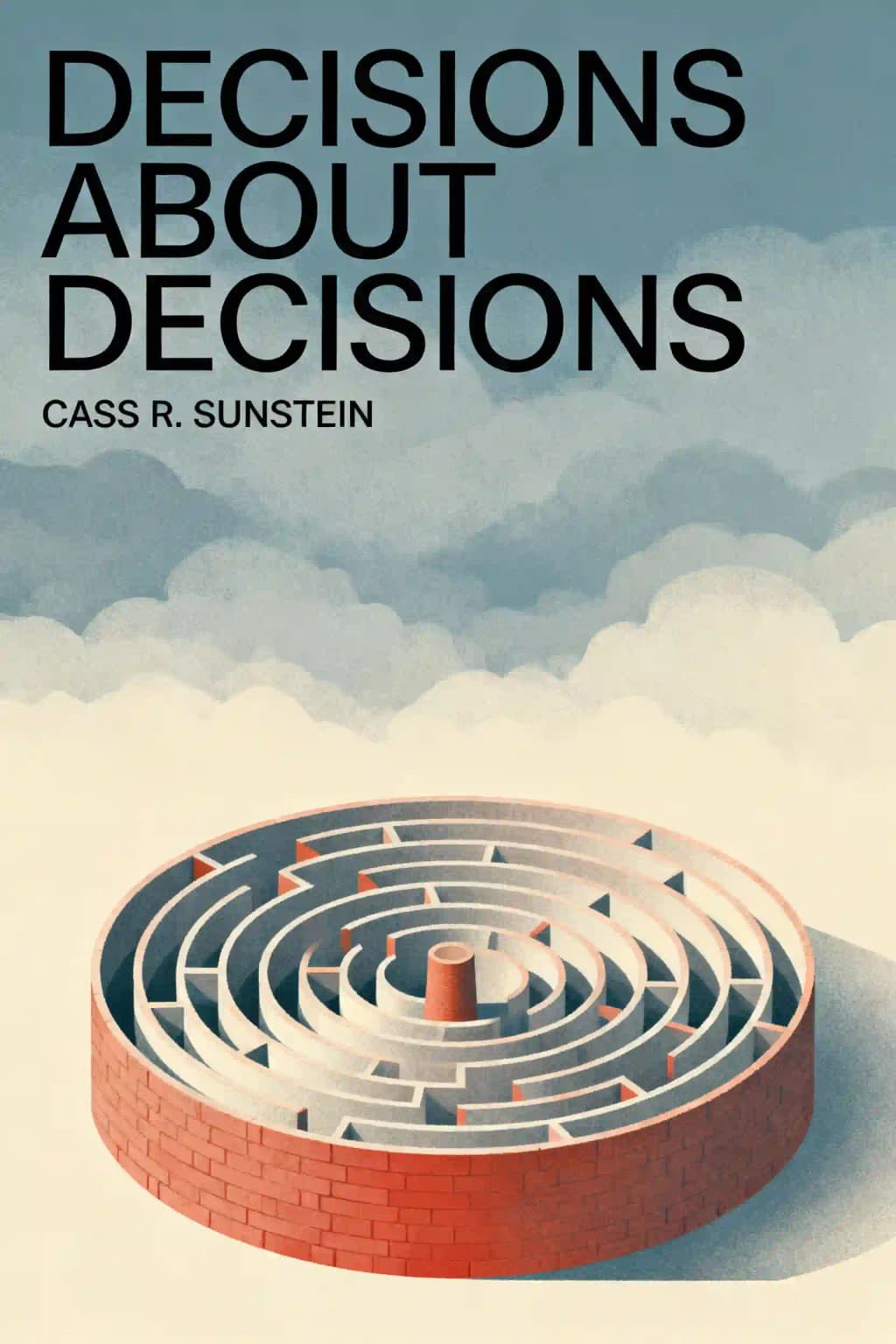
Decisions about Decisions
Practical Reason in Ordinary Life
《Decisions about Decisions》概述
In "Decisions About Decisions," Harvard's Cass Sunstein reveals how "second-order decisions" eliminate daily choice fatigue. This groundbreaking framework - embraced by behavioral economists and policy makers - shows why sometimes the most important decision is deciding how you'll decide.

《Decisions about Decisions》核心主题
- second-order decisions
- choice architecture
- decision costs
- behavioral heuristics
- meta-choice strategies
《Decisions about Decisions》经典语录
How do we decide how we decide?
Rules provide decisional simplicity but sometimes create absurd outcomes.
Picking deliberately avoids deliberation when it seems futile.
Delegation transfers decisions to others.
The optimal strategy depends on context.
《Decisions about Decisions》主要人物
- Cass R. SunsteinAuthor and Harvard law professor
- Frank RamseyPhilosopher and mathematician quoted on emotion
关于作者
《Decisions about Decisions》作者介绍
Cass R. Sunstein, bestselling author of Decisions About Decisions and pioneer of behavioral economics, blends legal scholarship with insights into human decision-making.
The Robert Walmsley University Professor at Harvard Law School and founder of its Behavioral Economics and Public Policy program, Sunstein draws from his experience as Obama’s regulatory affairs administrator and advisor to the WHO and Pentagon.
His work explores how institutions and individuals navigate cognitive biases, a theme central to his seminal book Nudge (coauthored with Richard Thaler) and Wiser: Getting Beyond Groupthink.
Recognized with the Holberg Prize (2018) – often called the “Nobel of law” – Sunstein’s 40+ books include The World According to Star Wars and #Republic. His frameworks inform policymaking worldwide, and studies rank him as the most cited contemporary legal scholar in the United States.
下载《Decisions about Decisions》摘要
免费获取《Decisions about Decisions》摘要的 PDF 或 EPUB 版本。可打印或随时离线阅读。
关于本书的常见问题
Decisions About Decisions explores practical strategies for managing everyday choices, focusing on second-order decisions—methods to streamline how we approach decisions. Cass R. Sunstein analyzes frameworks like the high-low strategy (prioritizing high-stakes choices while automating minor ones) and the opting method (breaking big decisions into smaller steps). The book emphasizes overcoming decision fatigue, navigating information overload, and balancing logic with emotional well-being.
This book is ideal for professionals, leaders, and students grappling with complex decisions. It benefits those seeking to reduce decision fatigue, improve efficiency in personal or workplace choices, or understand cognitive biases like strategic ignorance (avoiding overwhelming information). Sunstein’s insights are particularly relevant for fans of behavioral economics or his earlier work, Nudge.
Yes—it offers actionable frameworks for optimizing decision-making, backed by Sunstein’s expertise in behavioral science. Readers gain tools to simplify high-stakes choices, manage information overload, and avoid common pitfalls like overthinking. Its blend of academic rigor and real-world examples makes it a standout in the self-improvement genre.
While Nudge focuses on influencing decisions through choice architecture, this book emphasizes personal strategies for structuring decision-making processes. It introduces concepts like second-order decisions and the low-high approach (automating trivial choices to reserve energy for critical ones), offering a more individualized toolkit compared to Nudge’s policy-oriented perspective.
Second-order decisions are methods to simplify future choices, such as setting rules (e.g., “only check email twice daily”) or delegating tasks. Sunstein argues these meta-decisions reduce cognitive load, prevent decision fatigue, and improve consistency in high-stakes scenarios like financial planning or career moves.
The high-low strategy involves investing significant effort in high-impact decisions (e.g., buying a home) while using quick, heuristic-based choices for low-stakes matters (e.g., meal planning). Sunstein suggests this balance conserves mental resources and enhances overall decision quality.
Sunstein advocates strategic ignorance—intentionally limiting exposure to non-essential information—to avoid paralysis. For example, he recommends curating news sources or setting “information budgets” to prioritize relevant data while minimizing distractions.
Opting breaks daunting choices into incremental steps, allowing gradual exploration of options. For career changes, this might involve networking before applying to jobs. Sunstein highlights how this reduces anxiety and builds confidence in long-term decisions.
Yes—Sunstein analyzes when to trust algorithms (e.g., data-driven investing) versus relying on gut instincts (e.g., creative projects). He warns against over-reliance on either, advocating hybrid approaches that blend empirical evidence with human judgment.
Some critics argue the frameworks oversimplify complex scenarios or require significant upfront effort to implement. Others note Sunstein’s academic tone may alienate casual readers, though practical examples mitigate this.
Teams can adopt low-high strategies to delegate routine tasks (e.g., scheduling) and focus collaborative energy on strategic initiatives. Sunstein also emphasizes transparent processes to reduce bias and align stakeholders during conflicts.
- “The best decision about decisions is often to make fewer of them.”
Highlights the value of automating trivial choices. - “Strategic ignorance isn’t stupidity—it’s discipline.”
Encourages intentional filtering of information to maintain clarity.