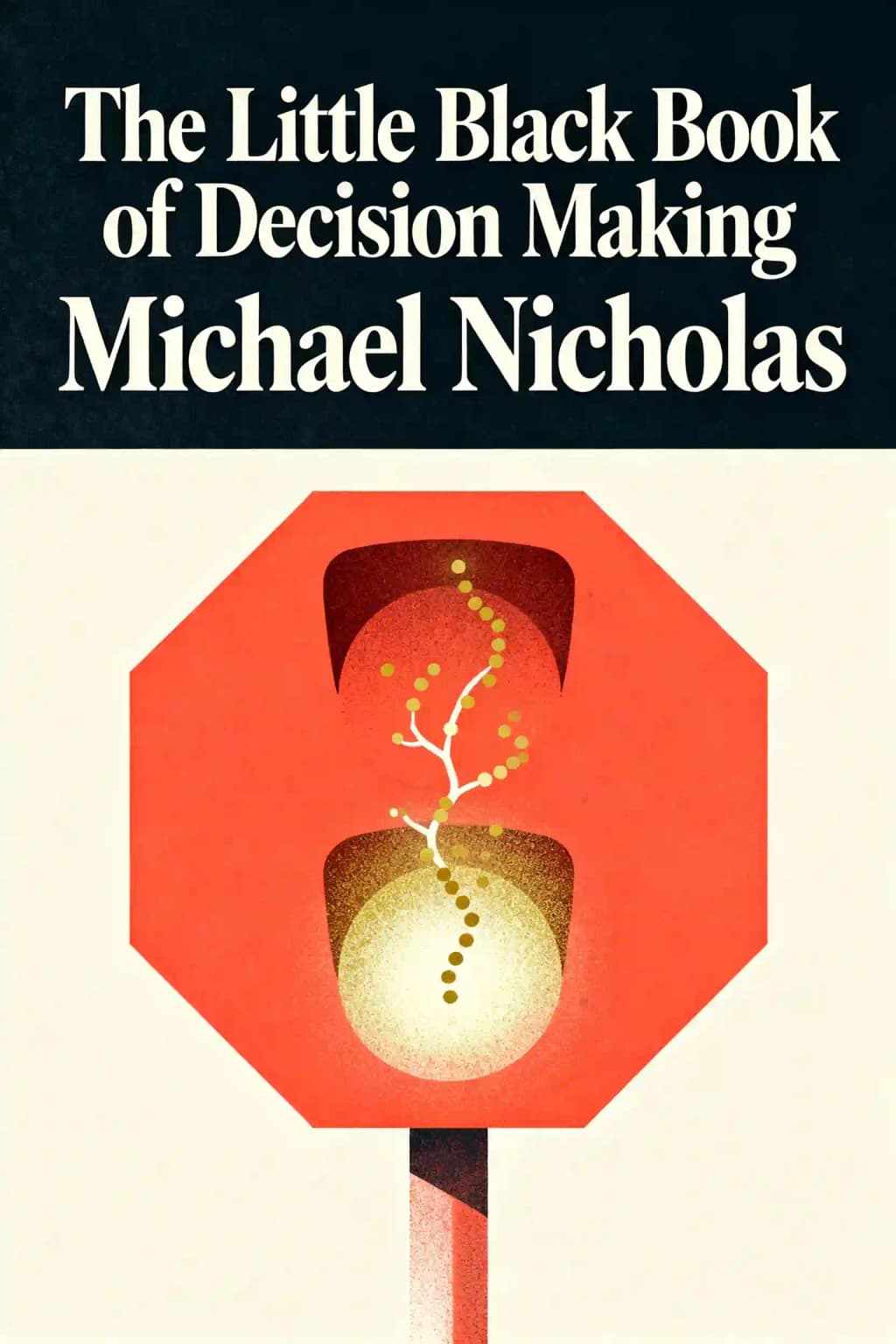
In a world of decision paralysis, Michael Nicholas delivers a game-changing guide endorsed by top executives. Beyond logic, this 2017 bestseller reveals why mindfulness and emotional intelligence trump rational thinking alone. What crucial blind spot is sabotaging your choices right now?
Michael Nicholas, author of The Little Black Book of Decision Making, is a leadership coach, corporate trainer, and decision-making expert renowned for blending scientific rigor with practical insights. With a background as a chartered engineer, he transitioned to integrating psychological research and leadership strategies, working with major UK blue-chip companies to optimize team dynamics and organizational decision-making.
His book addresses cognitive biases, decision fatigue, and systematic approaches to overcoming overwhelm, drawing from decades of experience and frameworks like those pioneered by Daniel Kahneman.
Nicholas has authored multiple works on leadership and cognitive psychology, and his methodologies are applied in corporate training programs globally. A sought-after speaker, he combines academic authority with real-world applicability, emphasizing predictable outcomes in complex human interactions. The Little Black Book of Decision Making has garnered widespread reader acclaim, reflected in its 3.84/5 Goodreads rating, and remains a trusted resource for professionals seeking to refine their strategic thinking.
The Little Black Book of Decision Making examines the interplay between rational analysis and intuition, providing frameworks to avoid cognitive biases and improve decision quality in fast-paced environments. Michael Nicholas combines neuroscience and real-world examples to help readers refine their judgment, emphasizing adaptability in business and leadership contexts.
Leaders, managers, and professionals facing complex decisions in dynamic industries (e.g., finance, healthcare, tech) will benefit most. The book’s practical insights into balancing logic with gut feeling also appeal to entrepreneurs and those seeking to sharpen their emotional intelligence in high-stakes scenarios.
Yes—it offers actionable strategies for avoiding decision-making traps like confirmation bias and overreliance on intuition. Readers praise its blend of academic rigor and real-world applicability, making it a valuable resource for leaders navigating uncertainty.
Nicholas describes intuition as a subconscious synthesis of experience and pattern recognition. He argues it must be “honed” through reflection and paired with logical checks to avoid pitfalls like snap judgments in unfamiliar scenarios.
It advocates for “meta-cognition”—consciously evaluating how you approach decisions—to improve team collaboration, risk assessment, and innovation. Case studies illustrate applying frameworks to hiring, strategy pivots, and crisis management.
Some reviewers note a focus on corporate contexts over personal decisions. Others suggest additional tools for quantifying intuition’s role, though most praise its balance of theory and practicality.
Drawing on 30+ years in military leadership (e.g., First Gulf War) and corporate consulting (HSBC, Deloitte), Nicholas emphasizes resilience, emotional intelligence, and adaptive thinking—themes reflected in the book’s pragmatic tone.
Yes—its principles for balancing logic/emotion apply to relationships, financial planning, and career changes. Techniques like bias audits help individuals avoid impulsive choices during stressful transitions.
Unlike purely academic texts, it prioritizes actionable steps over theoretical models. Compared to Thinking, Fast and Slow, it offers more direct workplace applications and fewer statistical deep dives.
Nicholas suggests reserving 10% of decision-making time to challenge assumptions—e.g., asking, “What if our initial data is flawed?” This habit reduces overconfidence and fosters agility.
通过作者的声音感受这本书
将知识转化为引人入胜、富含实例的见解
快速捕捉核心观点,高效学习
以有趣互动的方式享受这本书
Decision-making capability has become the ultimate competitive advantage.
Success is a lousy teacher. It seduces smart people into thinking they can't lose.
We cannot solve a problem from the level of consciousness that created it.
Everything innovative eventually becomes obsolete.
将《Little Black Book of Decision Making》的核心观点拆解为易于理解的要点,了解创新团队如何创造、协作和成长。
将《Little Black Book of Decision Making》提炼为快速记忆要点,突出坦诚、团队合作和创造力的关键原则。

通过生动的故事体验《Little Black Book of Decision Making》,将创新经验转化为令人难忘且可应用的精彩时刻。
随心提问,选择声音,共同创造真正与你产生共鸣的见解。

"Instead of endless scrolling, I just hit play on BeFreed. It saves me so much time."
"I never knew where to start with nonfiction—BeFreed’s book lists turned into podcasts gave me a clear path."
"Perfect balance between learning and entertainment. Finished ‘Thinking, Fast and Slow’ on my commute this week."
"Crazy how much I learned while walking the dog. BeFreed = small habits → big gains."
"Reading used to feel like a chore. Now it’s just part of my lifestyle."
"Feels effortless compared to reading. I’ve finished 6 books this month already."
"BeFreed turned my guilty doomscrolling into something that feels productive and inspiring."
"BeFreed turned my commute into learning time. 20-min podcasts are perfect for finishing books I never had time for."
"BeFreed replaced my podcast queue. Imagine Spotify for books — that’s it. 🙌"
"It is great for me to learn something from the book without reading it."
"The themed book list podcasts help me connect ideas across authors—like a guided audio journey."
"Makes me feel smarter every time before going to work"

免费获取《Little Black Book of Decision Making》摘要的 PDF 或 EPUB 版本。可打印或随时离线阅读。
You're sitting in a meeting. Someone challenges your idea. Your chest tightens. Your mind races to defend yourself. Before you know it, you've dismissed their input entirely-not because it lacked merit, but because your brain decided they were a threat. Sound familiar? Every day, we make thousands of decisions, yet most of us have never learned the mechanics of making them well. In boardrooms and living rooms alike, intelligent people repeatedly choose poorly-not from lack of information, but because ancient survival circuits override modern reasoning. The gap between knowing what we should do and actually doing it reveals something uncomfortable: we're far less rational than we believe.