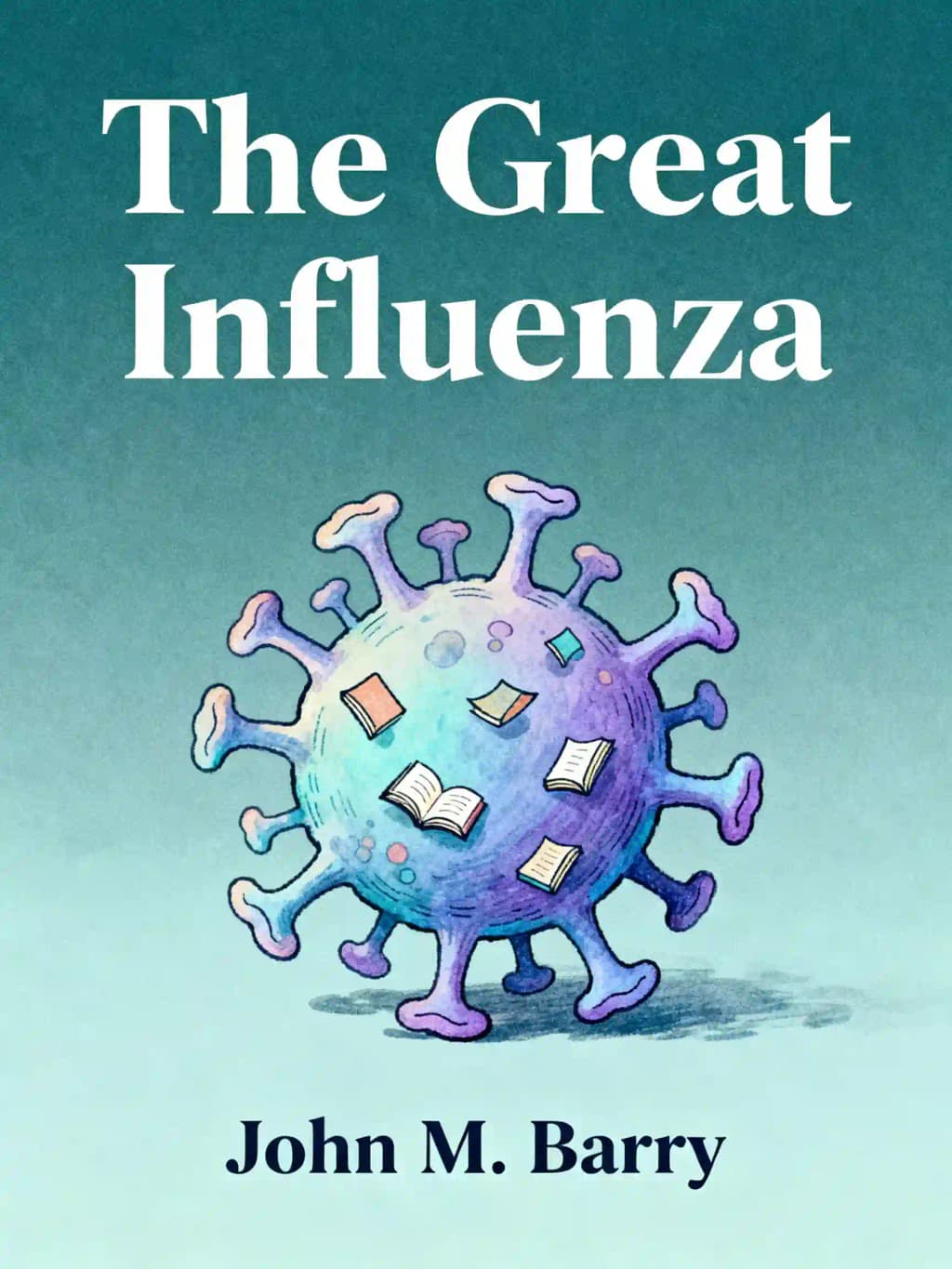
The Great Influenza
The Story of the Deadliest Pandemic in History
《The Great Influenza》概述
The deadliest pandemic in history revealed: "The Great Influenza" chronicles the 1918 catastrophe that transformed medicine forever. After reading it, President Bush restructured America's pandemic response, while Bill Gates calls it "a must-read" for understanding how societies navigate health crises.
《The Great Influenza》核心主题
- medical institutional reform
- viral mutation
- public health failure
- virology history
- wartime censorship
《The Great Influenza》经典语录
The virus moved faster than human knowledge.
Fear and suspicion spread as quickly as the virus.
Troop ships became floating petri dishes.
Human resilience shone through even in humanity's darkest hour.
It demonstrated nature's power to humble even advanced societies.
《The Great Influenza》主要人物
- William Henry WelchPathologist who helped modernize American medicine
- Paul LewisScientist who worked to develop a flu vaccine
- Oswald AveryResearcher who studied the biology of the virus
- Anna WilliamsResearcher who isolated a suspected bacterium
- Wilmer KrusenPhiladelphia health director during the pandemic
关于作者
《The Great Influenza》作者介绍
John M. Barry is the New York Times bestselling author of The Great Influenza: The Epic Story of the Deadliest Plague in History, celebrated for his meticulously researched narratives bridging history and science.
A historian and award-winning writer, Barry specializes in dissecting pivotal crises, from pandemics to environmental disasters, with a focus on their societal impacts. His 2004 exploration of the 1918 flu pandemic earned the National Academies of Science’s Keck Award for excellence in science communication and remains a cornerstone text in public health education.
Barry’s authoritative voice extends to other acclaimed works like Rising Tide: The Great Mississippi Flood of 1927 and How It Changed America—a Francis Parkman Prize winner—and Roger Williams and the Creation of the American Soul, which examines early American ideals of liberty. His writing has been featured in The Wall Street Journal, Time, and The Washington Post, and he has lectured at institutions like MIT and Johns Hopkins.
Recognized by The New York Times for crafting “essential” historical accounts, Barry’s books have been translated into over a dozen languages, with The Great Influenza spending over a year on bestseller lists and shaping modern pandemic preparedness discourse.
下载《The Great Influenza》摘要
免费获取《The Great Influenza》摘要的 PDF 或 EPUB 版本。可打印或随时离线阅读。
关于本书的常见问题
The Great Influenza chronicles the 1918 flu pandemic, tracing its origins in rural Kansas to its global devastation. John M. Barry examines the scientific race to understand the virus, leadership failures during the crisis, and the pandemic’s societal impact, including mistrust in science and mass orphanhood. The book highlights breakthroughs like Oswald Avery’s DNA research and critiques wartime propaganda that worsened the outbreak.
History enthusiasts, public health professionals, and readers interested in pandemic preparedness will find this book essential. It’s also valuable for leadership studies, as Barry analyzes how political decisions (like Woodrow Wilson’s refusal to halt troop movements) exacerbated the crisis. Scientists appreciate its deep dive into early virology and the challenges of medical research.
Yes, especially for its parallels to modern pandemics like COVID-19. Barry’s analysis of misinformation, institutional failures, and the human cost of ignoring science remains starkly relevant. The narrative blends rigorous research with vivid storytelling, making complex virology accessible to general readers.
The virus likely originated in Haskell County, Kansas, before spreading to Camp Funston, a crowded WWI army training camp. Infected soldiers carried it to Europe, where mutations created a deadlier strain. By autumn 1918, it reached near-global circulation via troop ships and railways.
Barry criticizes leaders like President Wilson, who prioritized wartime morale over public health, allowing unchecked troop deployments. Local governments also failed to enforce quarantines or honest reporting. Conversely, scientists like Paul Lewis risked their lives to isolate the pathogen, showcasing leadership’s dual impact.
Yes. Oswald Avery’s decade-long research on pneumococcal bacteria laid the groundwork for discovering DNA’s role in genetics. The crisis also spurred institutional reforms, including the eventual creation of the National Institutes of Health (NIH) and modern epidemiology practices.
Governments censored press reports to avoid wartime panic, dubbing it the “Spanish flu” to deflect blame. This secrecy hindered prevention efforts and public awareness. Barry argues that a free, transparent press could have mitigated the death toll by promoting early safety measures.
The virus killed mostly young adults, leaving millions of orphans. Public trust in science and institutions eroded, as vaccines failed and leaders lied. However, it also galvanized support for public health infrastructure, reshaping medical research priorities for decades.
Unlike The Splendid and the Vile (focused on Churchill’s leadership), Barry emphasizes scientific rigor and systemic failures. It’s more technical than Hot Zone but provides a broader historical lens, linking the pandemic to WWI politics and medical ethics.
Some historians argue Barry overemphasizes the U.S. role in the pandemic’s origin, as evidence for Kansas remains circumstantial. Others note the book’s dense scientific passages may challenge casual readers, though most praise its narrative depth.
Barry portrays the pandemic as a humbling reminder of nature’s power. Despite advances, scientists struggled to isolate the virus or create effective vaccines. The book underscores the importance of humility and adaptability in facing biological threats.
The 1918 pandemic mirrors contemporary issues: balancing public health with economic needs, combating misinformation, and ensuring transparent leadership. Barry’s insights into viral mutations and societal resilience offer urgent lessons for future crises.