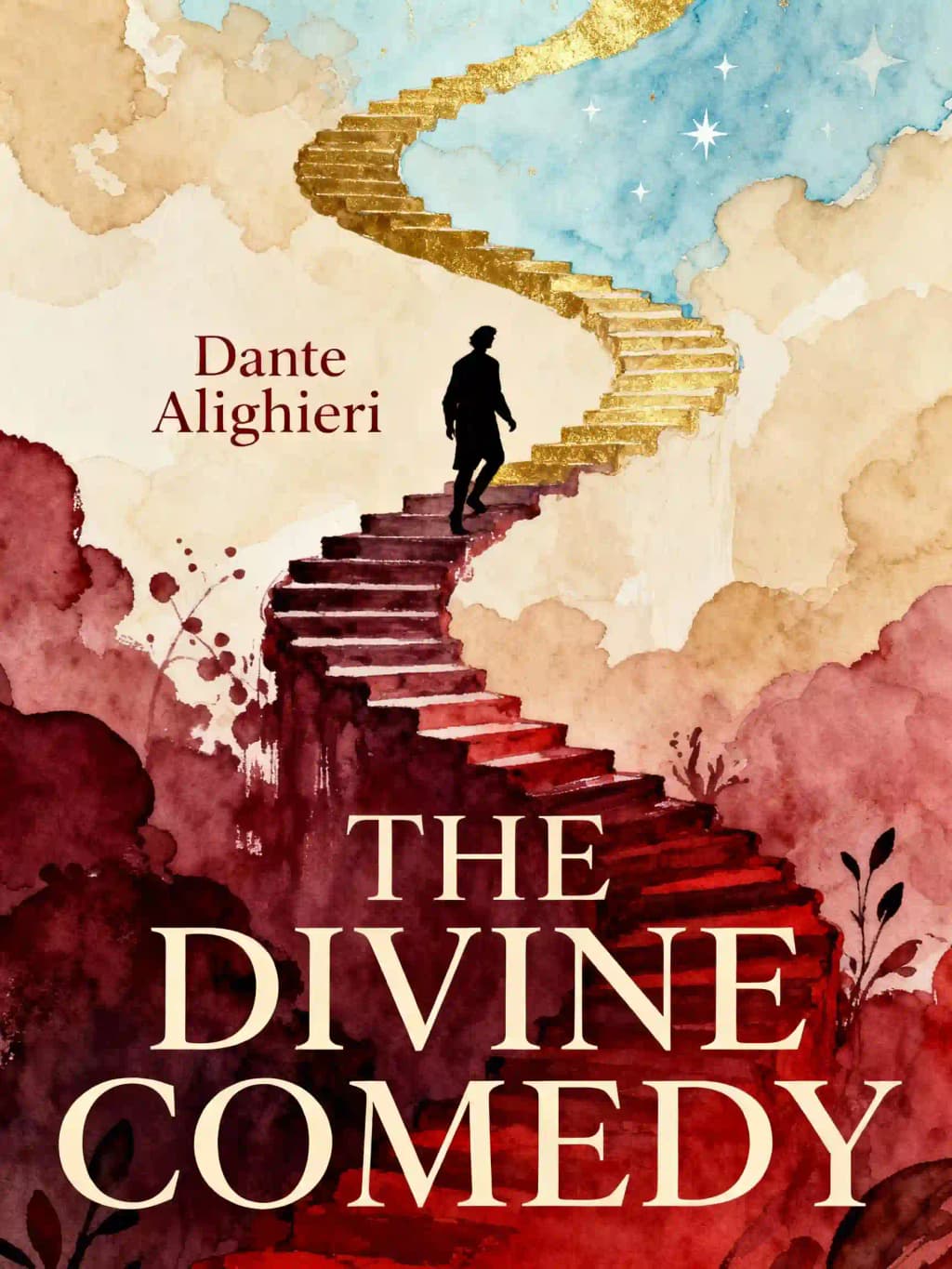
Dante's epic journey through Hell, Purgatory, and Paradise revolutionized Western literature. T.S. Eliot and James Joyce drew inspiration from this masterpiece that boldly placed corrupt politicians in Hell. What forbidden political commentary lies within this 100-canto spiritual odyssey?
Dante Alighieri (1265–1321), the visionary Italian poet and philosopher behind The Divine Comedy, is celebrated as the father of modern Italian literature. This epic poem, structured into Inferno, Purgatorio, and Paradiso, explores themes of morality, sin, redemption, and the Christian afterlife through a vivid allegorical journey.
Born in Florence, Dante’s political exile in 1302 profoundly influenced his writing, infusing the work with critiques of corruption and a yearning for spiritual and societal renewal. A pioneer of vernacular literature, he elevated the Florentine dialect to a literary language, cementing his legacy as Italy’s national poet.
His earlier work, La Vita Nuova (The New Life), intertwines poetry and prose to chronicle his idealized love for Beatrice Portinari, who later guides him in The Divine Comedy. Recognized for inventing terza rima, Dante’s innovative verse structure shaped European poetry.
Translated into over 50 languages, The Divine Comedy remains a cornerstone of Western literature, inspiring countless adaptations in art, literature, and theology.
The Divine Comedy traces Dante’s allegorical journey through Hell (Inferno), Purgatory (Purgatorio), and Heaven (Paradiso), guided by Virgil and Beatrice. Written in the 14th century, it explores themes of sin, redemption, and divine justice, framed within medieval Christian theology. The poem’s three-part structure reflects Dante’s progression from spiritual darkness to enlightenment, blending personal exile with universal human struggles.
This epic is essential for literature students, medieval history enthusiasts, and readers exploring Christian allegory. Its layered symbolism appeals to philosophers analyzing morality, poets studying the terza rima form, and historians examining Florentine politics. Those interested in Dante’s revolutionary use of Italian (over Latin) will find it linguistically groundbreaking.
Yes. As a cornerstone of Western literature, it offers timeless insights into human nature, sin, and salvation. Its inventive imagery (like Hell’s nine circles) influenced art and theology for centuries. While challenging, modern translations and annotations make its exploration of love, exile, and divine justice accessible.
Dante’s Purgatorio features seven terraces corresponding to the seven deadly sins: Pride, Envy, Wrath, Sloth, Avarice, Gluttony, and Lust. Penitents climb each terrace to purge sins through counteracting virtues—e.g., pride is healed by humility. Each level ends with an angel erasing one of seven “P” marks from Dante’s forehead.
Written during Dante’s 1302 exile from Florence, the poem allegorizes his political downfall and quest for meaning. Characters like Pope Boniface VIII in Inferno reflect his critiques of corruption. Beatrice’s guidance symbolizes divine grace transcending earthly turmoil, offering hope amid personal and societal crises.
Dante chose vernacular Italian to reach broader audiences, democratizing literature beyond scholarly Latin. This decision revolutionized Western writing, establishing Italian as a literary language. The terza rima structure (ABA rhyme scheme) further showcased Italian’s musicality.
Beatrice represents divine love, theological wisdom, and spiritual revelation. As Dante’s guide in Paradiso, she embodies grace leading souls to God. Her role contrasts with Virgil’s human reason, illustrating the limits of philosophy without faith.
The leopard, lion, and she-wolf blocking Dante’s path symbolize lust, pride, and greed—core sins trapping humanity in spiritual darkness. Their appearance in Canto 1 establishes the poem’s moral framework, motivating Dante’s journey toward redemption.
Dante’s Hell mirrors medieval Earth-centric models: a conical pit with nine circles, descending to Satan frozen at Earth’s core. Purgatory is a mountain with terraces; Paradise ascends through celestial spheres to the Empyrean, reflecting Aristotelian-Ptolemaic cosmology fused with Christian theology.
Some modern critics argue its rigid moral hierarchy reflects medieval dogma, particularly harsh judgments on figures like Cleopatra (lust) and Muhammad (schism). Others note limited female voices beyond Beatrice. However, its psychological depth and inventive allegory are widely praised.
The poem’s exploration of human flaws, resilience, and ethical choices resonates in discussions about power, justice, and personal growth. Phrases like “Abandon all hope” (Inferno Canto 3) remain cultural touchstones, while its structure influences genres from fantasy to psychological literature.
Unlike Homer’s focus on physical journeys, Dante emphasizes spiritual transformation. Both use supernatural guides (Virgil vs. Athena) and explore morality, but Dante’s Christian framework and autobiographical elements create a more introspective, allegorical narrative. The terza rima also contrasts with Homeric hexameter.
通过作者的声音感受这本书
将知识转化为引人入胜、富含实例的见解
快速捕捉核心观点,高效学习
以有趣互动的方式享受这本书
Midway upon the journey of our life I found myself within a forest dark, For the straightforward pathway had been lost.
There is no greater sorrow than to recall a happy time in wretchedness.
Abandon all hope, ye who enter here!
Your avarice afflicts the world, trampling the good and raising up the wicked.
将《The Divine Comedy》的核心观点拆解为易于理解的要点,了解创新团队如何创造、协作和成长。
将《The Divine Comedy》提炼为快速记忆要点,突出坦诚、团队合作和创造力的关键原则。

通过生动的故事体验《The Divine Comedy》,将创新经验转化为令人难忘且可应用的精彩时刻。
随心提问,选择声音,共同创造真正与你产生共鸣的见解。

"Instead of endless scrolling, I just hit play on BeFreed. It saves me so much time."
"I never knew where to start with nonfiction—BeFreed’s book lists turned into podcasts gave me a clear path."
"Perfect balance between learning and entertainment. Finished ‘Thinking, Fast and Slow’ on my commute this week."
"Crazy how much I learned while walking the dog. BeFreed = small habits → big gains."
"Reading used to feel like a chore. Now it’s just part of my lifestyle."
"Feels effortless compared to reading. I’ve finished 6 books this month already."
"BeFreed turned my guilty doomscrolling into something that feels productive and inspiring."
"BeFreed turned my commute into learning time. 20-min podcasts are perfect for finishing books I never had time for."
"BeFreed replaced my podcast queue. Imagine Spotify for books — that’s it. 🙌"
"It is great for me to learn something from the book without reading it."
"The themed book list podcasts help me connect ideas across authors—like a guided audio journey."
"Makes me feel smarter every time before going to work"

免费获取《The Divine Comedy》摘要的 PDF 或 EPUB 版本。可打印或随时离线阅读。
Midway through the journey of our life, we find ourselves in a dark wood, where the straight way is lost. With these haunting words, Dante begins his epic descent into the human psyche. The Divine Comedy isn't merely a medieval religious text - it's perhaps the most profound exploration of the human condition ever attempted. Written during Dante's exile from his beloved Florence between 1308 and 1320, this work transcends its Catholic framework to speak directly to our universal struggles with morality, purpose, and redemption. The poem's opening metaphor - life as a journey where we can become desperately lost - resonates across centuries because we've all experienced moments of profound disorientation. Haven't we all, at some point, found ourselves in our own dark woods, unsure of which path to take?




