第 1 章
Ancient Odyssey, Modern Relevance
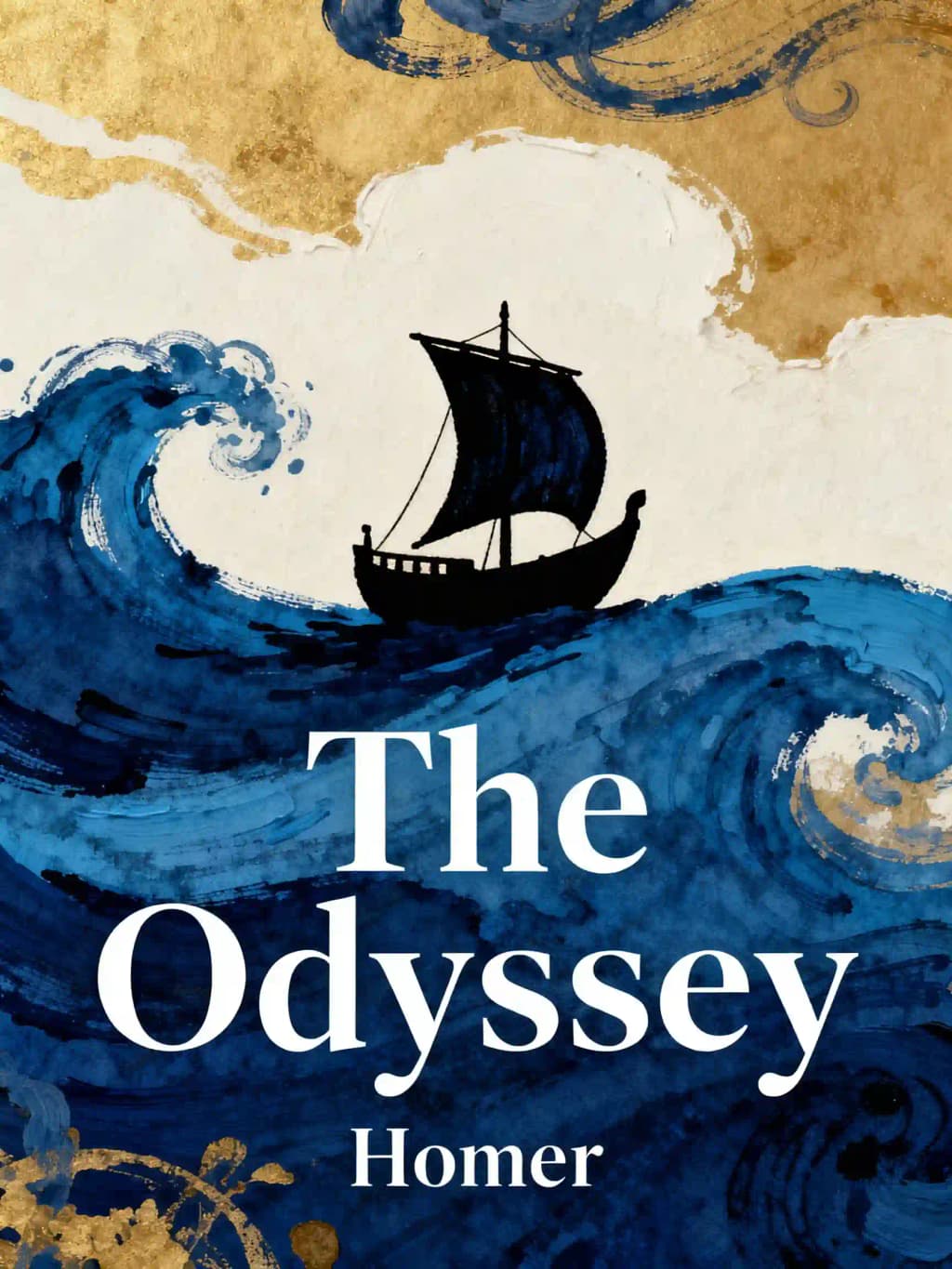
Homer's "The Odyssey" stands as one of the most enduring works in Western literature, captivating readers for nearly three millennia. This epic poem about a war hero's decade-long journey home has influenced countless works of literature, philosophy, and popular culture. Even today, celebrities like Brad Pitt and George Clooney cite it as a favorite, with Clooney's production company "Smokehouse Pictures" named after the place where Odysseus' loyal servants worked. The story's themes of homecoming, identity, and moral complexity continue to resonate-from James Joyce's modernist masterpiece "Ulysses" to the Coen brothers' film "O Brother, Where Art Thou?" Beyond entertainment, the poem raises profound questions about what constitutes a hero, the nature of home, and the complex relationship between mortals and divine forces. As we navigate our own journeys through life's challenges, Odysseus's determination to return home despite overwhelming obstacles offers timeless inspiration.
第 2 章
The Wandering Hero: Odysseus's Epic Journey
Odysseus's tale begins in the aftermath of the Trojan War, where unlike traditional epic heroes seeking glory through conquest, he simply wants to return home to his kingdom of Ithaca, his wife Penelope, and his son Telemachus. This seemingly straightforward quest becomes a decade-long odyssey filled with supernatural encounters, moral tests, and personal transformation.
After leaving Troy, Odysseus and his fleet encounter the Cicones, where his men's greed leads to a counterattack that costs many lives. This pattern of human folly continues when they meet the Lotus-Eaters, whose fruit makes men forget their homes-a powerful metaphor for the allure of escapism. When some crew members consume the lotus, Odysseus must physically drag them back to the ships, foreshadowing his role as the only man who will ultimately complete the journey home.
The most famous episode occurs when Odysseus and twelve men enter the cave of Polyphemus, a one-eyed giant who traps and begins devouring them. Here, Odysseus displays his trademark cunning by getting the Cyclops drunk, claiming his name is "Nobody," and blinding him with a heated olive stake. When other Cyclopes hear Polyphemus screaming that "Nobody is killing me," they assume no attack is happening and leave. This clever wordplay saves the remaining men, who escape by clinging to the undersides of sheep leaving the cave.
However, Odysseus's fatal flaw-his pride-emerges when he shouts his real name to the blinded Polyphemus, who then calls upon his father Poseidon to curse Odysseus's journey home. This moment transforms what might have been a straightforward voyage into a decade of wandering, as the vengeful sea god repeatedly thwarts Odysseus's attempts to reach Ithaca.
Subsequent adventures include encounters with the witch-goddess Circe, who transforms his men into pigs; a harrowing journey to the underworld to consult the prophet Tiresias; and navigating between the six-headed monster Scylla and the whirlpool Charybdis. Throughout these trials, Odysseus loses all his companions-some to monsters, others to their own foolishness when they slaughter the sacred cattle of the sun god Helios, bringing divine retribution.
After seven years as a captive of the nymph Calypso, who offers him immortality if he stays with her, Odysseus chooses mortality and home instead-a pivotal moment that defines his character as one who values human connection over divine perfection. With the help of the goddess Athena, he finally reaches Ithaca, where he must face one final challenge: reclaiming his home and wife from 108 suitors who have invaded his palace during his absence.
第 3 章
Divine Intervention: Gods and Mortals
The relationship between gods and humans forms a central theme in "The Odyssey," revealing a complex interplay of divine favor, punishment, and the limits of mortal agency. Unlike modern religious conceptions of deities as primarily concerned with morality, Homer's gods operate from personal preference and self-interest.
Athena, daughter of Zeus, emerges as Odysseus's most consistent divine ally. She admires his intelligence and cunning-qualities she herself embodies-and repeatedly intervenes on his behalf. When the poem opens, she persuades Zeus to release Odysseus from Calypso's island. Later, she helps him navigate the court of the Phaeacians, disguises him as a beggar upon his return to Ithaca, and ultimately aids in his battle against the suitors. Their relationship illustrates how divine favor in the Homeric world depends not on moral superiority but on shared values and proper religious observance.
In stark contrast, Poseidon harbors an implacable grudge against Odysseus for blinding his son Polyphemus. The sea god's wrath manifests in storms that destroy Odysseus's ships and delay his homecoming. This divine conflict creates much of the poem's tension, as Odysseus must navigate between Athena's protection and Poseidon's vengeance-a metaphor for the unpredictable forces that shape human destiny.
Zeus, as king of the gods, maintains a more detached perspective, concerned primarily with cosmic order rather than individual fates. When he allows Odysseus's return, he specifies that the hero must suffer adequately first-suggesting a divine economy of justice where actions have consequences, even if those consequences seem disproportionate by human standards.
Lesser deities play crucial roles as well. Hermes, the trickster god who shares Odysseus's polytropos ("much-turning") nature, delivers Zeus's command to Calypso and helps Odysseus resist Circe's magic. Aeolus gifts winds to aid Odysseus's journey, while the sun god Helios demands retribution when Odysseus's crew slaughters his sacred cattle.
The gods' interventions highlight both the potential and limitations of human agency in Homer's world. While mortals make choices that determine their fates-Odysseus chooses to blind Polyphemus and his men choose to eat the sacred cattle-divine forces can magnify the consequences of these actions beyond what seems proportionate. Yet the poem also suggests that proper reverence can mitigate divine wrath, as when Odysseus performs sacrifices to appease the gods.
This complex theological framework creates a world where human achievement requires both personal excellence and divine favor-a partnership rather than simple submission. Odysseus succeeds not merely through divine assistance but through his own remarkable resilience, intelligence, and adaptability, qualities that earn him Athena's respect and protection.
第 4 章
Penelope's Patient Power: Women in The Odyssey
While "The Odyssey" primarily follows Odysseus's journey, the poem also presents a nuanced portrait of female power through characters like Penelope, whose intelligence and determination form a domestic counterpart to her husband's martial prowess. For twenty years-ten during the Trojan War and ten during Odysseus's wanderings-Penelope maintains control of the household despite overwhelming pressure to remarry.
Her famous weaving deception exemplifies her cunning: promising to choose a suitor after completing a burial shroud for Odysseus's father Laertes, she secretly unravels each night what she weaves by day. This stratagem delays the suitors for three years until a disloyal servant reveals her trick. The parallel between Penelope's weaving and Odysseus's crafting of stories highlights their shared intelligence and capacity for strategic deception.
Unlike Helen of Troy, whose infidelity precipitated the Trojan War, Penelope remains steadfastly loyal to her absent husband. Yet the poem complicates this virtue by showing how her loyalty creates problems for her son Telemachus, whose inheritance the suitors devour while waiting for Penelope's decision. This tension between maternal duty and wifely fidelity creates a moral complexity that elevates Penelope beyond a simple symbol of feminine constancy.
The poem contrasts Penelope with several powerful divine females. Circe and Calypso, both described as "dread goddesses," represent different threats to Odysseus's homecoming. Circe initially transforms Odysseus's men into pigs but later becomes a helpful ally, providing crucial advice for his journey. Calypso offers Odysseus immortality and eternal youth-gifts that would separate him forever from his mortal family. Both goddesses possess sexual power over Odysseus (he shares their beds) but cannot ultimately prevent his departure, suggesting limits to even divine female influence.
Nausicaa, the Phaeacian princess who discovers shipwrecked Odysseus, represents unmarried feminine virtue. Her attraction to the stranger is depicted with remarkable psychological subtlety, as she hints to her handmaidens that she wouldn't mind having such a man as her husband. Yet she maintains proper decorum, helping Odysseus without compromising her reputation.
Female slaves in the poem reveal the precarious position of women without status or protection. The twelve disloyal slave women who sleep with the suitors receive brutal punishment-hanging by Telemachus in a particularly disturbing scene. By contrast, the loyal nurse Eurycleia, who recognizes Odysseus by his childhood scar, exemplifies the positive potential of service within the hierarchical household.
Through these varied female characters, "The Odyssey" explores how women exercise power within the constraints of a patriarchal society-through intelligence, fidelity, divine authority, or service. Penelope's patient resistance to the suitors, maintaining her autonomy through cunning rather than direct confrontation, offers a feminine counterpart to Odysseus's heroism that is no less impressive for being confined to the domestic sphere.
第 5 章
Coming of Age: Telemachus's Journey
The first four books of "The Odyssey," often called the "Telemachy," focus on Odysseus's son Telemachus as he transitions from passive youth to active participant in his family's restoration. When we first meet him, Telemachus is approximately twenty years old but lacks confidence and authority, unable to control the suitors who have invaded his home.
Athena's intervention marks the beginning of his transformation. Disguised as Mentor, she encourages him to seek news of his father and assert himself against the suitors. This divine nudge propels Telemachus into action, as he calls an assembly of Ithaca's nobles-his first public political act-and announces his intention to search for Odysseus. Though the suitors mock him, this declaration represents a crucial step toward claiming his identity as his father's son.
Telemachus's journey to Pylos and Sparta serves as both a practical quest for information and a symbolic coming-of-age. King Nestor and King Menelaus receive him with the hospitality due to a prince, treating him as Odysseus's rightful heir rather than a boy. Through their stories about his father's cleverness and courage during the Trojan War, Telemachus develops a clearer understanding of the legacy he must live up to. Helen's recognition of his physical resemblance to Odysseus-"his head, his beautiful eyes"-further reinforces his connection to his father.
The journey also teaches Telemachus practical skills of diplomacy and self-presentation. When Nestor asks about his parentage, Telemachus responds with appropriate modesty and respect, earning the old king's approval. In Sparta, he navigates the luxurious court of Menelaus and Helen with growing confidence. When he returns to Ithaca, he has gained not just information about his father but a new sense of his own capabilities.
The relationship between father and son forms the emotional core of the second half of the poem. Their reunion in Book 16 is deeply moving, as they weep together "with cries as shrill as birds." Yet their relationship is not without tension. When planning the suitors' slaughter, Telemachus occasionally questions his father's strategies, showing his development toward independent thought.
Most troublingly, Telemachus exceeds his father's orders regarding the execution of the disloyal slave women, insisting on hanging them rather than using swords as Odysseus commanded. His justification-"I refuse to grant these girls a clean death"-reveals a disturbing harshness that surpasses even his father's vengeance. This moment raises questions about whether Telemachus has fully internalized the wisdom that should accompany authority.
By the poem's end, Telemachus stands beside his father in battle against the suitors' families, having completed his transformation from boy to warrior. Yet the ambiguity surrounding his character development suggests that true maturity involves more than simply claiming patriarchal power-it requires the judgment and restraint that come only with experience.
第 6 章
Xenia: The Sacred Bond of Hospitality
Hospitality (xenia) functions as both a practical social system and moral framework throughout "The Odyssey," with violations of proper host-guest relations consistently leading to disaster. In a world without hotels or formal diplomatic structures, xenia provided essential protection for travelers while establishing reciprocal obligations between host and guest.
The ideal pattern of hospitality appears when Telemachus visits King Nestor and King Menelaus. Both rulers welcome him without initially asking his identity, provide food, drink, and bathing facilities, and only afterward inquire about his purpose. This sequence-welcome first, questions later-represents the proper protocol that honors Zeus Xenios (Protector of Guests).
Conversely, the suitors in Odysseus's palace exemplify the worst violation of hospitality norms. As uninvited guests who have overstayed their welcome for years, they consume Telemachus's inheritance without reciprocity, abuse the servants, and plot to murder their host's son. Their behavior marks them as morally corrupt, justifying their eventual slaughter.
The Cyclops Polyphemus represents another extreme violation of hospitality. When Odysseus and his men enter his cave and request guest-friendship, Polyphemus responds, "We Cyclopes do not care about Zeus...or any blessed gods." He demonstrates this impiety by eating his guests rather than feeding them. This inversion of proper hospitality-consuming guests instead of providing food-marks Polyphemus as outside civilized society.
The poem also explores more subtle violations of xenia. When Odysseus's crew slaughters the sacred cattle of Helios despite explicit warnings, they violate the implicit guest-host relationship between mortals and gods. Their punishment-death by shipwreck-reflects the seriousness of this transgression.
Odysseus himself experiences hospitality across the spectrum. The Phaeacians represent ideal hosts, welcoming the shipwrecked stranger, providing clean clothes, entertainment, and finally transportation home with lavish gifts. Circe initially offers poisoned hospitality by transforming Odysseus's men into pigs, but later becomes an exemplary hostess who provides crucial advice. Calypso offers excessive hospitality-eternal life and divine status-that would prevent Odysseus from fulfilling his human responsibilities.
Upon returning to Ithaca disguised as a beggar, Odysseus tests the hospitality of various characters. The swineherd Eumaeus, though poor, shares his humble resources generously, demonstrating that proper xenia depends on attitude rather than wealth. By contrast, the goatherd Melanthius abuses the disguised king, revealing his moral corruption.
The suitors' treatment of disguised Odysseus provides final confirmation of their unworthiness. Antinous hurls a footstool at the beggar, while Ctesippus throws an ox-foot, both gross violations of Zeus's protection of suppliants. These actions seal their fate, as Odysseus notes before revealing himself: "Dogs, you thought I would never return from Troy...now death's ropes bind you tight."
Through these varied examples, "The Odyssey" establishes hospitality not merely as social convention but as moral imperative. Those who honor xenia demonstrate their recognition of human interdependence and divine oversight, while those who violate it reveal themselves as threats to civilized order.
第 7 章
Identity and Disguise: The Many Faces of Odysseus
Odysseus's name and identity form central themes throughout "The Odyssey," with disguise and revelation creating much of the poem's dramatic tension. His very name (derived from the Greek odussomai, meaning "to be angry at" or "to hate") suggests both his capacity to provoke hatred in others and to hate his enemies in return. As his grandfather Autolycus explains when naming him, "I am disliked by many, all across the world, and I dislike them back."
This linguistic connection between name and nature highlights Odysseus's complex, often contradictory identity. He is described as polytropos ("many-turning" or "much-wandering"), polymetis ("of many counsels"), and polymechanos ("resourceful in many ways")-all suggesting his remarkable adaptability and multiplicity of character. Unlike heroes defined by a single quality, like swift-footed Achilles or giant Ajax, Odysseus shape-shifts according to circumstance.
His capacity for disguise appears throughout the poem. When encountering the Cyclops, he identifies himself as "Nobody," a deception that saves his remaining men. With Circe, he follows Hermes' advice to resist her magic, revealing himself as more than an ordinary mortal. Among the Phaeacians, he initially conceals his identity, weeping anonymously at songs about the Trojan War before dramatically revealing himself.
The most sustained disguise occurs when Athena transforms Odysseus into an elderly beggar upon his return to Ithaca. This disguise serves multiple purposes: it allows him to assess the situation in his palace, test the loyalty of servants and family members, and prepare his revenge against the suitors. The transformation is physical but also behavioral, as Odysseus adopts the humble demeanor and speech patterns appropriate to his disguised status.
This extended performance reveals Odysseus's remarkable self-control. When abused by the suitors, he restrains his anger, "like horn or iron." When recognized by his childhood nurse Eurycleia through his distinctive scar, he quickly silences her to maintain his cover. Even with Penelope, he maintains his disguise until he can be certain of her fidelity.
The poem also explores how others perceive Odysseus's identity. The Phaeacians know him only through his own narration of his adventures-a potentially unreliable account that emphasizes his cleverness while minimizing his failures. Telemachus has never known his father except through others' stories. Penelope has memories of the young Odysseus but must determine whether the man who returns after twenty years is truly her husband.
The test of the bed provides the poem's most powerful moment of identity confirmation. When Penelope orders servants to move the marriage bed, Odysseus reveals his knowledge that the bed cannot be moved because he built it around a living olive tree-a secret known only to the couple. This moment transcends disguise and deception, establishing an unshakable connection between husband and wife based on shared intimate knowledge.
Through these explorations of disguise and recognition, "The Odyssey" suggests that identity is neither fixed nor entirely fluid, but rather a complex negotiation between inner consistency and external transformation. Odysseus remains fundamentally himself despite his many disguises, yet his experiences also transform him from the warrior who left for Troy into the more mature man who returns to Ithaca.
第 8 章
The Price of Nostos: Homecoming and Its Costs
The Greek concept of nostos-homecoming-forms the central narrative arc of "The Odyssey," yet the poem complicates this seemingly straightforward goal by exploring its psychological, moral, and social dimensions. For Odysseus, returning to Ithaca requires not just physical travel but psychological transformation and moral compromise.
Unlike the Iliad's focus on kleos (glory) achieved through battlefield heroics, "The Odyssey" presents a hero whose primary goal is simply to return to his previous life. This shift reflects the poem's interest in restoration rather than transformation-Odysseus seeks not to change the world but to reclaim his place within it. Yet paradoxically, this conservative aim requires him to undergo profound personal changes.
The obstacles to Odysseus's homecoming are both external and internal. Divine forces-particularly Poseidon's wrath-create physical barriers through storms and monsters. Human enemies like the suitors threaten to make his home unrecognizable even if he reaches it physically. Most subtly, internal temptations offer alternatives to homecoming that test Odysseus's resolve.
Calypso's island represents the most explicit alternative to nostos. The nymph offers Odysseus immortality and eternal youth if he remains with her-gifts that would separate him forever from mortal concerns. His rejection of this offer reveals the depth of his commitment to human connection over divine perfection: "But even so, I want to go back home, and every day I hope that day will come."
The Lotus-Eaters present another alternative: forgetting home altogether through pleasant intoxication. This episode suggests that nostalgia (literally "the pain of homecoming") can be avoided not just through return but through obliteration of memory-a solution Odysseus firmly rejects by physically dragging his affected men back to the ships.
The Sirens offer perhaps the most insidious temptation: knowledge without return. Their song promises to make Odysseus "wiser" by revealing "all that comes to pass on the fertile earth," but listening without restraint means death and the permanent loss of homecoming. By having himself bound to the mast, Odysseus can experience their song without succumbing to its fatal allure-a metaphor for the careful balance between experience and safety that homecoming requires.
When Odysseus finally reaches Ithaca, he discovers that physical return does not automatically restore his former life. His palace has been invaded, his wife besieged by suitors, his son marginalized, and his identity forgotten by many. Reclaiming his home requires violence-the slaughter of 108 suitors and 12 disloyal slave women-that raises moral questions about the cost of restoration.
Even after this bloodshed, true homecoming remains incomplete. Tiresias's prophecy reveals that Odysseus must undertake one final journey inland, carrying an oar until someone mistakes it for a winnowing fan, before he can truly settle. This suggests that homecoming is not a single event but an ongoing process of reconciliation between past and present, familiar and foreign.
Through these complexities, "The Odyssey" presents nostos not as simple geographic return but as a profound psychological and moral challenge that requires negotiating between competing values and accepting that neither home nor the returning hero remain unchanged by separation.
第 9 章
The Problematic Hero: Moral Ambiguity in The Odyssey
Unlike the straightforward martial heroism of the Iliad, "The Odyssey" presents a morally ambiguous protagonist whose actions invite both admiration and criticism. Odysseus-described variously as a trickster, pirate, colonizer, and killer-embodies contradictions that have made him a controversial figure from antiquity to the present.
The poem acknowledges this ambiguity through its narrative structure. Much of what we know about Odysseus's adventures comes from his own account to the Phaeacians-a potentially unreliable narration that emphasizes his cleverness while minimizing his failures. When he describes weeping at Demodocus's song about the Trojan Horse, a simile compares his tears to those of "a woman whose husband has died in battle and who faces slavery"-suggesting either genuine empathy for suffering or a self-serving attempt to position himself as victim rather than perpetrator.
Odysseus's encounter with the Cyclops Polyphemus reveals the moral complexity of his actions. While his blinding of the giant can be justified as self-defense against a host who violated xenia by eating his guests, Odysseus's decision to reveal his name as he departs-"Cyclops, if anyone asks who blinded you, say it was Odysseus, sacker of cities"-transforms necessary violence into an act of pride that brings divine punishment. His epithet "sacker of cities" further reminds us that his military career involved destroying communities not unlike his own Ithaca.
His treatment of his crew raises additional questions. Though he often tries to protect them, he also keeps crucial information from them-like the contents of Aeolus's bag of winds-leading to disasters that might have been avoided through transparency. When Eurylochus leads the starving crew to slaughter the Sun God's cattle, his complaint that Odysseus drives his men beyond human limits contains a kernel of truth about the hero's demanding leadership.
The slaughter of the suitors presents the poem's most significant moral challenge. While their invasion of Odysseus's home and consumption of his resources clearly violate social norms, the extreme violence of his revenge-killing all 108 suitors without mercy-exceeds what modern readers might consider proportionate justice. Eupeithes, father of the slain suitor Antinous, offers a searing indictment of Odysseus as a man who has repeatedly led young men to their deaths-a charge the poem never fully refutes.
Even Odysseus's loyal supporters acknowledge his problematic tendencies. The swineherd Eumaeus, despite his devotion, remarks that his master "was devious, even when he was a child." Athena herself both praises and gently mocks his habitual lying, saying, "You shifty, inexhaustible man! Anyone who could surpass you in trickery would need to be very clever."
These moral ambiguities reflect the poem's sophisticated understanding of human complexity. Rather than presenting an idealized hero, "The Odyssey" shows a man shaped by war trauma, desperate circumstances, and the competing demands of survival, honor, and homecoming. His capacity for both compassion and cruelty, honesty and deception, protection and destruction makes him a recognizably human figure rather than a simple moral exemplar.
Through Odysseus, the poem asks whether the qualities that make a successful warrior-cunning, ruthlessness, pride-can be successfully adapted to peacetime leadership. His struggle to reintegrate into domestic life after years of violence anticipates modern concerns about veterans' experiences, suggesting that the "hero's journey" involves not just overcoming external obstacles but reconciling contradictory aspects of one's own character.
第 10 章
The Unfinished Journey: Understanding The Odyssey's Conclusion
"The Odyssey's" ending has puzzled readers since antiquity. Rather than concluding with the emotional reunion of Odysseus and Penelope, the poem continues through several potential ending points: the suitors' ghosts traveling to the underworld, Odysseus meeting his father Laertes, and finally a battle between Odysseus and the suitors' families that Athena abruptly halts.
This seemingly disjointed conclusion serves several important narrative functions. First, it addresses loose narrative threads, showing the consequences of the suitors' deaths for the broader community. The meeting with Laertes completes Odysseus's reintegration into his family, while the confrontation with the suitors' families acknowledges the social disruption caused by his violent return.
More profoundly, the extended ending reflects the poem's sophisticated understanding that homecoming is never truly complete. According to Tiresias's prophecy in Book 11, Odysseus must undertake one final journey inland carrying an oar until someone mistakes it for a winnowing fan. Only then, after making sacrifices to Poseidon, can he hope for a peaceful death "far from the sea." This unfinished quest suggests that reconciliation between Odysseus's maritime adventures and his domestic role remains incomplete at the poem's end.
The final battle's abrupt resolution through divine intervention further complicates the notion of closure. When Athena commands Odysseus to "stop this battle, or Zeus...will be angry," she imposes peace rather than allowing it to develop organically. Zeus's thunderbolt reinforces this divine mandate, suggesting that true reconciliation requires supernatural intervention rather than human resolution.
This ambiguous ending aligns with ancient legends about Odysseus's fate that extend beyond the poem. Some traditions held that he was eventually killed by Telegonus, his son with Circe, while others suggested he was exiled from Ithaca for killing the suitors. These variations reflect cultural anxiety about whether a figure defined by wandering and warfare can ever truly settle into peaceful domestic life.
The poem's cyclical structure reinforces this sense of incompleteness. It begins with Telemachus seeking news of his father and ends with Odysseus seeking reconciliation with his father, suggesting that intergenerational relationships remain works in progress rather than achieved states. Similarly, the initial divine council where Athena advocates for Odysseus's return finds its echo in the final divine intervention to stop the battle, creating a frame that emphasizes the gods' ongoing involvement in human affairs.
Rather than providing a definitive "happily ever after," the poem's conclusion acknowledges the complexity of reintegration after prolonged absence. Odysseus has reclaimed his physical home and political position, but the psychological and social dimensions of homecoming remain unresolved. This sophisticated treatment of return anticipates modern understandings of how war, displacement, and reunion create ongoing challenges that resist simple narrative closure.
By refusing to provide a neat ending, "The Odyssey" acknowledges that the tensions between adventure and stability, individual glory and family responsibility, violence and peace that define Odysseus's character cannot be fully resolved. Instead, these contradictions must be continually negotiated-a process that continues beyond the poem's final line, just as the impact of Homer's epic continues to resonate in literature and culture thousands of years after its composition.