第 1 章
Consciousness: The Hard Problem We Can't Ignore
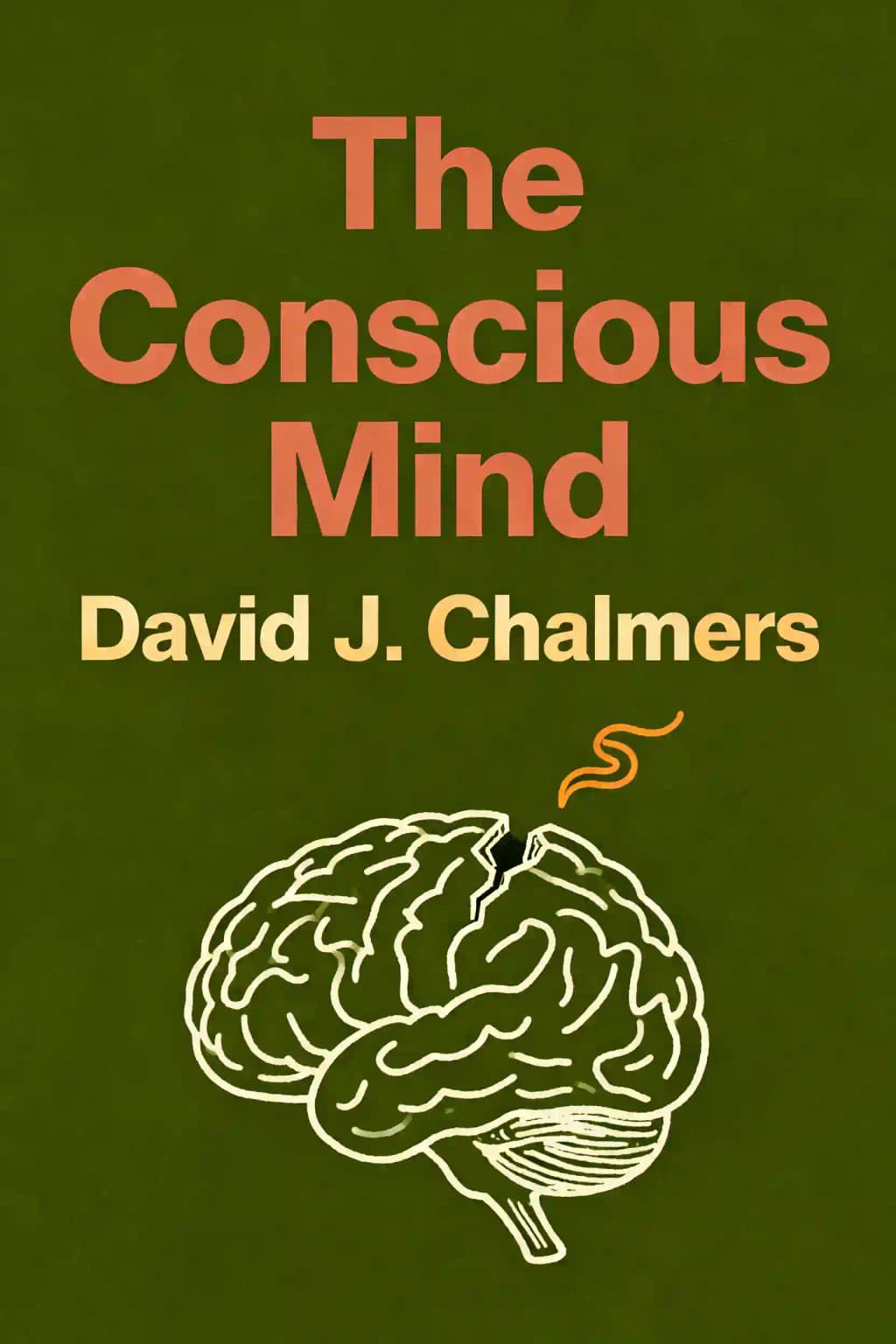
Have you ever wondered why the universe contains subjective experience? Why does it feel like something to be you? This question sits at the heart of David Chalmers' groundbreaking work, "The Conscious Mind." When published in 1996, this book sent shockwaves through philosophy of mind, challenging the materialist orthodoxy that dominated academic thinking. Cited over 15,000 times and translated into numerous languages, it remains one of the most influential philosophical works of the late 20th century. Elon Musk has referenced it as foundational to his thinking about artificial intelligence, while philosophers like Daniel Dennett consider it the most formidable challenge to materialist views of consciousness. What makes this book so powerful is how Chalmers systematically dismantles the idea that consciousness can be reduced to physical processes, while still maintaining a commitment to scientific understanding. Let's explore why this work continues to captivate minds across disciplines, from neuroscience to artificial intelligence.
第 2 章
The Mystery of Consciousness and Why It Matters
What exactly is consciousness? It's the subjective, first-person experience of being alive-the feeling of what it's like to see purple, taste chocolate, or feel pain. While we've made tremendous progress in understanding the physical world through physics and biology, consciousness remains stubbornly resistant to scientific explanation. Even as cognitive science advances our understanding of mental processes like memory, attention, and perception, the fundamental question of why these processes are accompanied by subjective experience remains unanswered.
Consider the rich variety of conscious experiences we have every day. Visual experiences like color sensations serve as paradigm examples of consciousness due to their pure qualitative nature. When you look at a vivid purple book cover, you might wonder: why should it feel like that? Why should it feel like anything at all? Nothing about the physical properties of light waves at 400 nanometers inherently suggests the experience of purple.
Auditory experiences seem even stranger. When a telephone rings, nothing about the quality of the sound seems to correspond directly to structures in the world, despite originating from specific physical processes. Musical experience represents perhaps the richest aspect of auditory experience-capable of completely absorbing us in a unified qualitative experience that somehow transcends its component notes and tones.
To make progress on this mystery, we need to distinguish between two concepts of mind. The psychological concept refers to the causal or functional basis of behavior-the mechanisms that allow us to discriminate, categorize, react to environmental stimuli, and report on mental states. The phenomenal concept refers to conscious experience itself-the subjective quality of what it feels like to be in particular mental states.
This distinction helps clarify that there are actually two mind-body problems. The "easy problem" involves explaining psychological functions: how we learn, remember, and behave. The "hard problem" is explaining why these functions are accompanied by conscious experience. As Chalmers memorably puts it: "Why is all this processing accompanied by an experienced inner life? We might have been zombies, but we're not. That's a puzzle that cries out for explanation."
第 3 章
The Failure of Reductive Explanations
Why can't we simply reduce consciousness to brain processes? After all, science has successfully reduced countless phenomena to more fundamental levels: heat to molecular motion, life to biochemical processes, and so on. Why should consciousness be any different?
To answer this question, we need to understand what makes reductive explanation possible. When a phenomenon can be reductively explained, it logically supervenes on lower-level facts. This means that once you fix all the lower-level facts, the higher-level facts come along automatically. For example, once you specify all the molecular facts about H2O-how the molecules are arranged and how they interact-you've automatically fixed the facts about water. There's nothing more to water beyond its molecular structure and dynamics.
But consciousness is different. Even after specifying all the physical facts about a brain-its neurons, synapses, and patterns of activity-the facts about conscious experience don't automatically follow. We can conceive of a physically identical system that lacks consciousness entirely. Philosophers call this hypothetical entity a "zombie"-a being physically identical to a conscious human but lacking any subjective experience.
Unlike Hollywood's shambling zombies, a philosophical zombie would be functionally and psychologically identical to a conscious human-processing information, reacting to stimuli, even reporting "experiences." It would say "Ouch!" when pricked with a pin and describe the "redness" of a rose. But there would be "nothing it is like" to be this zombie-no subjective experience behind these behaviors.
The logical possibility of zombies demonstrates that consciousness cannot be reductively explained in physical terms. If zombies are conceivable-and they certainly seem to be-then consciousness involves something beyond the physical facts. This isn't to say consciousness violates physical laws or floats free of the brain. Rather, the connection between physical processes and conscious experience must be taken as fundamental, not derived from anything simpler.
This conclusion is reinforced by thought experiments like Mary the color scientist. Imagine Mary has lived her entire life in a black-and-white room, studying the complete physics and neuroscience of color vision. Despite knowing every physical fact about color perception, when Mary finally sees red for the first time, she learns something new-what red looks like. This suggests that knowledge of physical facts doesn't entail knowledge of conscious experience.
第 4 章
The Case for Naturalistic Dualism
If consciousness cannot be reduced to physical processes, what follows? Chalmers argues for what he calls "naturalistic dualism." This view holds that consciousness involves properties beyond the physical, but these properties are still governed by natural laws and emerge from physical systems according to regular principles.
Unlike traditional Cartesian dualism, naturalistic dualism doesn't posit a separate mental substance that causally interacts with the physical world. Instead, it maintains that the physical world is causally closed-every physical event has a sufficient physical cause-while consciousness naturally supervenes on physical processes without disrupting them.
This position might initially seem counterintuitive. If consciousness doesn't affect physical processes, isn't it just an epiphenomenon-a causally irrelevant byproduct? Not necessarily. Chalmers explores several possibilities for how consciousness might be integrated into our scientific worldview without violating physical causal closure.
One intriguing possibility is that consciousness might be related to information. Physical systems realize information when they enter different states that have different effects. But perhaps this information has two aspects-a physical aspect involving causal relationships, and a phenomenal aspect involving conscious experience. On this view, consciousness might be understood as the intrinsic nature of the information that physics describes only extrinsically, in terms of its causal role.
This approach suggests that consciousness might be far more widespread in nature than we typically assume. If information has a phenomenal aspect, then even simple systems like thermostats might have extremely rudimentary forms of experience. This doesn't mean thermostats have complex mental lives or self-awareness, but they might instantiate some minimal form of phenomenal experience corresponding to their simple information states.
While this may initially seem absurd, consider the alternative. If consciousness suddenly "switches on" at some arbitrary level of complexity, we face the difficult question of why that particular threshold should be special. A more elegant approach is to see consciousness as fundamental and ubiquitous, becoming more complex and rich as the information processing it's associated with becomes more sophisticated.
第 5 章
The Coherence Between Consciousness and Cognition
Despite arguing that consciousness cannot be reduced to physical processes, Chalmers emphasizes that consciousness and physical processes aren't completely disconnected. There are systematic relationships between them that any theory must account for.
Most fundamentally, consciousness correlates closely with awareness-the availability of information for global control of behavior. When we're conscious of something, that information is typically accessible for verbal report, reasoning, and action control. This correlation is so reliable that it serves as the primary evidence for consciousness in others.
Beyond this general correlation, the structure of consciousness mirrors the structure of awareness. The three-dimensional structure of color experience corresponds to the three-dimensional structure of color information processing in the brain. The geometric structure of visual experience corresponds to the geometric structure of visual information processing. This principle of structural coherence allows us to explain many features of conscious experience in terms of the structure of the underlying physical processes, even if we can't explain why those processes are accompanied by experience at all.
These coherence principles serve as crucial methodological foundations for empirical consciousness research. They allow scientists to make inferences about conscious experience based on third-person data, and they guide the search for neural correlates of consciousness. When researchers use neurobiological findings to explain experiential features, they implicitly rely on these coherence principles as a bridge.
For example, neuroscientists studying color vision can explain why our color experience has a particular three-dimensional structure by examining how color information is processed in the visual system. They can explain why certain colors appear similar to each other by examining the similarity relationships encoded in neural activity patterns. This approach doesn't close the explanatory gap-it doesn't explain why there's experience at all-but it does allow us to explain many structural features of experience.
第 6 章
The Principle of Organizational Invariance
If consciousness arises from physical systems according to natural laws, which physical properties matter? A natural suggestion is that consciousness emerges from a system's functional organization-the abstract pattern of causal interaction between its parts-rather than from the specific physical substrate implementing that organization. This principle forms a cornerstone of modern consciousness theory and has significant implications for our understanding of artificial intelligence and potential machine consciousness.
This principle of organizational invariance has profound implications. It suggests that any system with the right functional organization will have conscious experiences, regardless of what it's made of. A system made of silicon chips could be conscious if it implements the right functional organization, as could a system made of beer cans and string (though the latter would be astronomically improbable). This extends to any conceivable material or medium that can maintain the required causal relationships - from biological neurons to optical circuits to hypothetical quantum computers.
Chalmers defends this principle through a series of thought experiments. Imagine gradually replacing neurons in a conscious brain with functionally equivalent artificial components. If consciousness depends on physical substrate rather than functional organization, then as we replace parts of the brain, consciousness should either fade gradually or suddenly disappear. This thought experiment, known as the "gradual replacement scenario," forces us to confront our intuitions about the relationship between physical structure and conscious experience.
Suddenly disappearing consciousness seems implausible-a single neuron replacement causing an entire field of experience to vanish would require bizarre discontinuities in natural law. Such a sharp threshold would be unlike anything else we observe in nature, where most properties change continuously rather than discretely. But fading consciousness creates an equally troubling scenario: a being halfway through the replacement process would have degraded experiences while still functioning identically to a fully conscious person. This intermediate being would make all the same claims about having vivid experiences while actually having diminished ones-meaning they would be systematically wrong about their own consciousness despite being functionally rational. This severe dissociation between consciousness and cognition seems highly implausible and would undermine our ability to trust any reports of conscious experience.
The most reasonable conclusion is that consciousness is preserved across functionally identical systems regardless of physical substrate. This supports a form of nonreductive functionalism, where functional organization suffices for conscious experience with natural necessity, though consciousness need not be reducible to that organization. This view has practical implications for artificial intelligence development, suggesting that machines could potentially be conscious if they achieve the right functional organization. It also raises important questions about the nature of consciousness in different implementations - from biological brains to future artificial systems - and challenges us to consider what specific aspects of functional organization are crucial for conscious experience.
The principle also suggests important ethical considerations: if consciousness depends on functional organization rather than physical substrate, we must carefully consider the moral status of any systems that might implement consciousness-supporting patterns, whether biological, artificial, or hybrid. This extends the sphere of moral consideration beyond traditional biological boundaries and forces us to reconsider what entities might deserve moral consideration based on their potential for conscious experience.
第 7 章
Strong Artificial Intelligence and Machine Consciousness
The principle of organizational invariance has profound implications for artificial intelligence. If consciousness depends on functional organization rather than biological substrate, then machines implementing the right kind of computation could be genuinely conscious.
Many who take a nonreductive view of consciousness are skeptical that artificial systems could ever be truly conscious, seeing consciousness as precisely what computers would lack. However, this skepticism doesn't necessarily follow from nonreductionism. Given that we've accepted the surprising fact that brains give rise to consciousness, it wouldn't be a further surprise if computation could do the same.
Searle's famous Chinese Room argument attempts to refute this possibility by presenting a counterexample: a person manipulating symbols according to a program who simulates understanding Chinese without actually understanding it. But this argument fails to appreciate how extraordinarily constraining a fine-grained functional organization truly is. When we properly understand the tight constraints of functional organization, we're left with something structurally similar to a brain, just with different components.
The fading and dancing qualia arguments apply equally well here. If we imagine replacing neurons in a Chinese speaker's brain one by one with tiny "demons" that duplicate each neuron's function, eventually consolidating these demons until there's just one demon managing billions of slips of paper representing neural states, the system would maintain the original brain's functional organization. The causal relations between neurons would be mirrored by relations between paper slips, mediated by the demon. If this final system lacks consciousness while the original had it, there must be intermediate systems with faded experiences-an implausible conclusion.
This doesn't mean that any computer program would be conscious. The right kind of functional organization is required-likely one that implements the kind of global information integration and accessibility associated with consciousness in humans. But there appears to be no in-principle barrier to creating conscious machines.
第 8 章
Consciousness and Information: A Speculative Framework
While we've established several principles connecting consciousness to physical processes, these don't constitute a complete theory. They operate at too high a level to be fundamental laws and leave many questions unanswered. What kind of organization gives rise to consciousness? How simple can an organization be before experience vanishes? How can we predict the specific character of an experience from its physical basis?
To address these questions, Chalmers proposes a speculative framework based on information. Information, in the technical sense, involves a state selected from an ensemble of possibilities. It can be realized physically when physical states have different effects on a system. But perhaps information also has a phenomenal aspect-perhaps wherever information is physically realized, it is also phenomenally realized as conscious experience.
This double-aspect principle suggests that information has both physical and phenomenal sides. Wherever we find an information space realized phenomenally (in conscious experience), we find the same information space realized physically (in brain processes). And wherever certain types of information are realized physically, they're also realized phenomenally.
This approach elegantly addresses the "explanatory coherence" requirement-that our theory should explain both consciousness itself and our judgments about consciousness in a coherent way. When we perceive colors, our central processes have access only to locations in an information space, not to the physical processes or wavelengths that produced them. The system simply "finds itself" in these information states without knowing how it got there. This direct access to information states naturally leads to judgments about "experience" and "qualities" that seem ineffable, immediate, and mysteriously primitive-precisely the judgments we make about consciousness.
The most challenging implication of this framework is that if information is the key to consciousness, and information is widespread in physical systems, then perhaps consciousness is similarly widespread. Even simple systems like thermostats realize information. This suggests that consciousness might be ubiquitous in nature, with simple systems having correspondingly simple experiences.
While this may initially seem absurd, it grows more plausible upon reflection. As we descend the scale of complexity from humans to simpler creatures, where should consciousness "wink out"? Rather than consciousness disappearing abruptly, it might gradually simplify to match simpler information processing systems. Before consciousness vanishes completely, we would expect to find maximally simple phenomenology in systems with correspondingly simple "perceptual psychology"-like thermostats, which make basic distinctions that guide action.
第 9 章
The Quantum Connection: Consciousness and Physics
The problem of quantum mechanics rivals consciousness in its difficulty. Quantum mechanics provides a remarkably successful calculus for predicting observations, but making sense of the world it describes seems nearly impossible. Many have suggested these two mysteries might be linked, especially since quantum mechanics seems deeply tied to observation and experience.
The standard framework of quantum mechanics involves two principles: the Schrodinger equation, which describes how quantum systems evolve when not being observed, and the measurement postulate, which describes what happens when a measurement occurs. The measurement postulate is particularly puzzling because it seems to give special status to "measurement" without defining this concept in basic physical terms.
Some have suggested that measurement occurs when a quantum system affects consciousness-a view associated with Eugene Wigner that necessarily presupposes mind-body dualism. On this view, all physical systems follow Schrodinger dynamics until they interact with consciousness. This leads to counterintuitive consequences: macroscopic objects like pointers or Schrodinger's cat would exist in superposed states until observed by a conscious being.
An alternative approach is Hugh Everett's interpretation, which holds that the Schrodinger equation completely describes reality, with no additional principles. The physical state of the world is entirely described by a wave function evolving according to this equation. This interpretation accepts that the world is in a superposed state at every level, including the macroscopic. When observing a superposed system, our brains enter a superposition, with separate mental states corresponding to different measurement outcomes.
The central question becomes: why do we experience a discrete world when microscopic reality is described by superposed wave functions? This is precisely the kind of question a theory of consciousness should answer. The theory of consciousness advocated by Chalmers predicts that a superposed brain state would be associated with multiple distinct subjects of discrete experience-exactly what Everett's interpretation requires.
This combination of the Schrodinger equation with an independently motivated theory of consciousness can predict our experience of a discrete world without additional physical principles. While all quantum mechanics interpretations have counterintuitive implications, the Everett interpretation has the virtue of simplicity, postulating only the universally accepted Schrodinger equation while offering locality and compatibility with relativity that other interpretations lack.
第 10 章
The Future of Consciousness Studies
Chalmers' work represents a watershed moment in the study of consciousness. By clearly articulating the hard problem and demonstrating the limitations of reductive approaches, he opened up new avenues for investigation that take consciousness seriously as a fundamental feature of reality. His framework has influenced fields ranging from neuroscience to artificial intelligence, encouraging researchers to look beyond purely mechanistic explanations of mental phenomena.
The principles and frameworks he developed-from the coherence between consciousness and cognition to the information-based approach-provide a foundation for future research. His dual-aspect theory of information, suggesting that information has both physical and experiential aspects, has inspired new research directions in quantum consciousness studies and integrated information theory. These approaches seek to bridge the explanatory gap between objective brain processes and subjective experience through sophisticated mathematical models and empirical investigations.
The impact of Chalmers' work extends beyond philosophy into practical applications. Researchers in neuroscience now regularly incorporate consciousness studies into their experimental designs, examining neural correlates of consciousness while acknowledging the limitations of purely physical explanations. In artificial intelligence, his ideas have influenced discussions about machine consciousness and the development of more sophisticated measures of awareness in AI systems.
Perhaps most importantly, Chalmers showed that we can make progress on the problem of consciousness without either reducing it away or retreating to mysticism. We can acknowledge the irreducibility of conscious experience while still developing naturalistic theories that integrate it into our scientific worldview. This balanced approach has helped legitimate consciousness studies within mainstream academia while maintaining its philosophical rigor.
As we continue to develop more sophisticated technologies that simulate and perhaps eventually replicate human cognitive capacities, the questions Chalmers raised will only become more pressing. Will our artificial intelligence systems eventually become conscious? If so, how would we know? What ethical implications would this have? These questions have become increasingly relevant with the development of large language models and advanced neural networks that display increasingly sophisticated behavior patterns.
The implications of Chalmers' work extend into emerging fields like virtual reality, brain-computer interfaces, and artificial general intelligence. His framework helps us think about questions of digital consciousness, the nature of uploaded minds, and the potential for conscious experiences in synthetic systems. Recent developments in these areas, from neural implants to immersive virtual environments, make these philosophical questions increasingly practical concerns.
By providing a framework for thinking about these questions, "The Conscious Mind" remains as relevant today as when it was first published, challenging us to expand our conception of reality to include the subjective experience that is, in many ways, its most remarkable feature. The book continues to influence new generations of researchers and thinkers who are working to understand consciousness in its many manifestations, from biological brains to potential artificial minds.