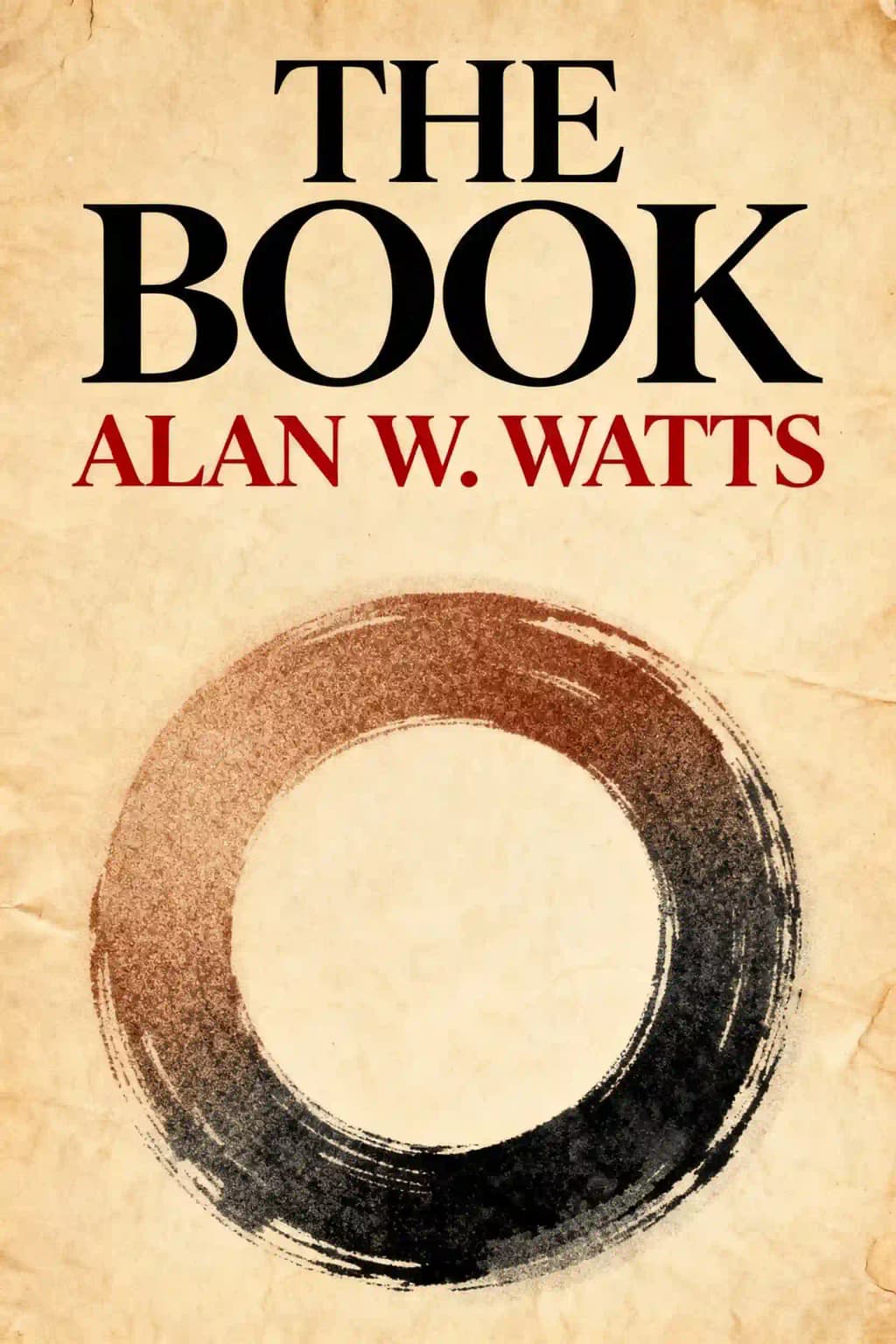
Alan Watts' philosophical masterpiece shatters our illusion of separateness, revealing the taboo truth about our interconnected existence. John Lloyd called it "the best book on what actually is," while Deepak Chopra deemed it "the perfect guide for a course correction in life."
Alan Wilson Watts (1915–1973) is celebrated for his groundbreaking work in bridging Eastern and Western philosophy and is the esteemed author of the-book-by-alan-w-watts.
A British-American writer and speaker, Watts became renowned for translating Buddhist, Taoist, and Hindu teachings into accessible insights for Western audiences. His exploration of spirituality, consciousness, and the human condition spans genres from philosophical essays to guided meditations, rooted in his theological education and decades of lecturing, including his influential broadcasts on KPFA radio.
Notable works like The Way of Zen (1957), a seminal bestseller on Zen Buddhism, and The Wisdom of Insecurity (1951), a guide to overcoming anxiety, established him as a countercultural icon of the 1960s. Watts’ talks, now remastered into over 180 audio lectures, continue to inspire millions globally, with his books translated into dozens of languages.
His legacy endures through timeless prose that merges intellectual rigor with poetic clarity, solidified by his posthumous induction into the pantheon of 20th-century philosophical greats.
The Book explores the illusion of separateness between individuals and the universe, blending Eastern philosophy with Western thought. Watts challenges conventional views of identity, arguing that the ego is a construct and true reality lies in interconnectedness. Key themes include non-duality, embracing the present, and rethinking death as part of life's natural flow.
This book suits seekers of spiritual growth, philosophy enthusiasts, and those questioning societal norms. It’s valuable for readers interested in Eastern wisdom, psychology, or integrating science with spirituality. Watts’ accessible style makes complex ideas approachable for both newcomers and seasoned students of existential inquiry.
Yes, for its transformative perspective on self-identity and existence. Readers praise its life-changing insights into interconnectedness and critiques of cultural conditioning. Though simple in structure, it offers profound reflections on living authentically beyond ego-driven narratives.
Watts presents non-duality as the fundamental unity of all existence, dissolving perceived boundaries between self and world. Drawing from Hindu and Buddhist traditions, he argues that separation is an illusion—we’re not observers but expressions of the universe experiencing itself.
This metaphor illustrates the interdependence of opposites like life/death and self/other. Watts suggests recognizing this unity beyond dualities leads to harmonious living. The "game" represents societal constructs that fragment reality into conflicting categories, urging readers to transcend binary thinking.
Watts critiques the ego as a false construct creating artificial separation. He posits that identifying as an isolated "I" leads to suffering, advocating instead for awareness of our interconnected nature with all existence. This shift alleviates existential anxiety and fosters ecological mindfulness.
By embracing present-moment awareness and understanding the ego’s illusory nature, Watts guides readers to perceive inherent unity. This realization encourages compassionate engagement with others and the environment, moving beyond individualistic perspectives.
Watts parallels quantum physics’ interconnectedness with Eastern non-duality, suggesting both reveal reality as a unified process. He bridges spiritual insights with scientific discoveries about consciousness, emphasizing that modern physics aligns more with Vedanta than Western dualism.
These lines encapsulate core themes of unity, presence, and transcendent acceptance.
Its critique of cultural conditioning and emphasis on interconnectedness resonate in modern crises of identity and environmental disconnect. The text offers timeless wisdom for navigating existential anxiety in an increasingly fragmented world, making it essential for 21st-century seekers.
Watts reframes death as a natural process and opportunity for awakening, not an endpoint. He challenges cultural fears by presenting it as integral to life’s rhythm—a return to the universal flow rather than a final cessation. This perspective encourages embracing mortality as part of cyclical existence.
Watts argues institutional religions perpetuate separation through rigid dogmas, unlike Eastern traditions that emphasize direct mystical experience. He advocates for a spirituality rooted in personal insight over doctrinal compliance, aligning with Zen and Taoist principles of fluid, experiential understanding.
通过作者的声音感受这本书
将知识转化为引人入胜、富含实例的见解
快速捕捉核心观点,高效学习
以有趣互动的方式享受这本书
We do not “come into” this world; we come out of it, as leaves from a tree.
The only way to make sense out of change is to plunge into it, move with it, and join the dance.
This is the real secret of life — to be completely engaged with what you are doing in the here and now. And instead of calling it work, realize it is play.
No valid plans for the future can be made by those who have no capacity for living now.
We don't "come into" this world; we come out of it.
将《The book; on the taboo against knowing who you are》的核心观点拆解为易于理解的要点,了解创新团队如何创造、协作和成长。
将《The book; on the taboo against knowing who you are》提炼为快速记忆要点,突出坦诚、团队合作和创造力的关键原则。

通过生动的故事体验《The book; on the taboo against knowing who you are》,将创新经验转化为令人难忘且可应用的精彩时刻。
随心提问,选择声音,共同创造真正与你产生共鸣的见解。

"Instead of endless scrolling, I just hit play on BeFreed. It saves me so much time."
"I never knew where to start with nonfiction—BeFreed’s book lists turned into podcasts gave me a clear path."
"Perfect balance between learning and entertainment. Finished ‘Thinking, Fast and Slow’ on my commute this week."
"Crazy how much I learned while walking the dog. BeFreed = small habits → big gains."
"Reading used to feel like a chore. Now it’s just part of my lifestyle."
"Feels effortless compared to reading. I’ve finished 6 books this month already."
"BeFreed turned my guilty doomscrolling into something that feels productive and inspiring."
"BeFreed turned my commute into learning time. 20-min podcasts are perfect for finishing books I never had time for."
"BeFreed replaced my podcast queue. Imagine Spotify for books — that’s it. 🙌"
"It is great for me to learn something from the book without reading it."
"The themed book list podcasts help me connect ideas across authors—like a guided audio journey."
"Makes me feel smarter every time before going to work"

免费获取《The book; on the taboo against knowing who you are》摘要的 PDF 或 EPUB 版本。可打印或随时离线阅读。
A peculiar hallucination grips modern civilization-one far more dangerous than any drug-induced fantasy. We believe ourselves to be isolated islands of consciousness, skin-wrapped packages of selfhood floating through an alien universe. This delusion, argues one of the twentieth century's most provocative philosophers, lies at the root of our environmental catastrophes, technological anxieties, and profound sense of meaninglessness. We don't merely misunderstand ourselves; we've forgotten the most fundamental truth of existence: we aren't separate beings who came into this world. We are expressions of it, like waves rising from the ocean or apples growing from trees. Every attempt to conquer nature, control our futures, or escape our mortality flows from this single misperception-that "I" exists as something separate from "everything else."