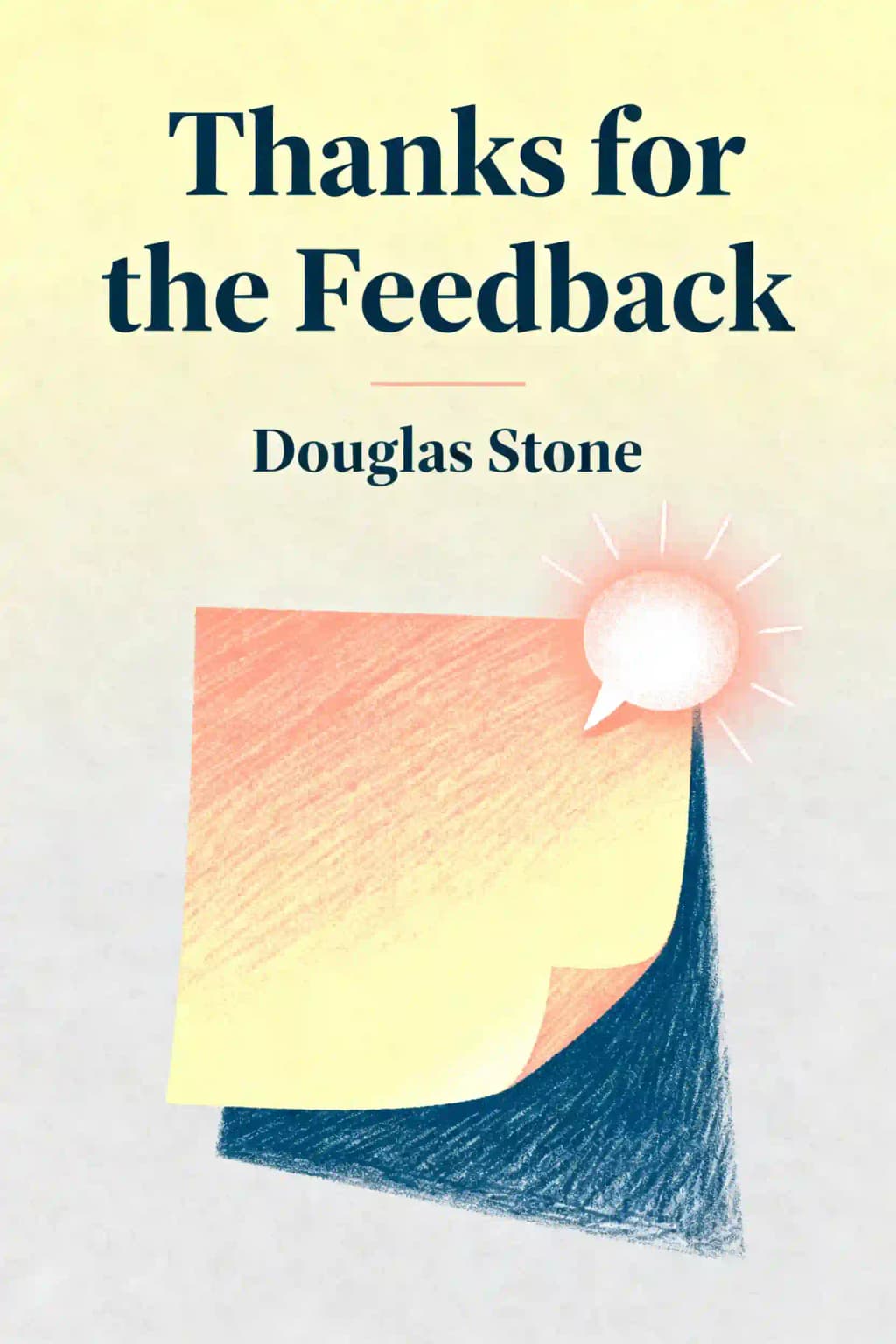
Thanks for the Feedback
The Science and Art of Receiving Feedback Well
《Thanks for the Feedback》概述
In "Thanks for the Feedback," Stone and Heen revolutionize how we receive criticism. This NYT bestseller transformed corporate culture and personal relationships alike. Adam Grant called it "potentially life-changing" - no wonder it's become essential reading for anyone seeking greater self-awareness and stronger connections.

《Thanks for the Feedback》核心主题
- receiving feedback
- emotional triggers
- blind spot awareness
- performance evaluation
- difficult conversations
《Thanks for the Feedback》经典语录
Truth triggers occur when we believe the feedback is simply wrong or unfair.
Evaluation tells you where you stand against expectations or others.
Labels serve as general topic indicators but aren't the actual feedback.
We need all three types, but problems arise when what we want doesn't match what we're given.
《Thanks for the Feedback》主要人物
- Douglas StoneCo-author and expert on receiving feedback
- Sheila HeenCo-author and expert on receiving feedback
- KipCase study regarding hiring bias and blind spots
- DonaldLaw firm partner used as a case study
关于作者
《Thanks for the Feedback》作者介绍
Douglas Stone is the co-author of the bestselling book Thanks for the Feedback: The Science and Art of Receiving Feedback Well and a leading expert in negotiation and communication. A lecturer at Harvard Law School for nearly three decades, Stone co-founded Triad Consulting Group, where he advises organizations like Google, Apple, and the U.S. State Department on high-stakes conversations. His work bridges practical strategies with psychological insights, focusing on improving workplace dynamics and personal relationships.
Stone co-authored the seminal Difficult Conversations: How to Discuss What Matters Most, a New York Times bestseller widely used in corporate training and academic curricula. His frameworks are taught in executive programs and implemented by institutions ranging from the Massachusetts Supreme Judicial Court to global NGOs.
Known for translating complex interpersonal challenges into actionable tools, Stone’s methods emphasize empathy, clarity, and collaborative problem-solving. Thanks for the Feedback has been integrated into leadership development programs worldwide, helping professionals navigate criticism and foster growth. The book has been endorsed by industry leaders and cited as essential reading in fields from education to healthcare.
下载《Thanks for the Feedback》摘要
免费获取《Thanks for the Feedback》摘要的 PDF 或 EPUB 版本。可打印或随时离线阅读。
关于本书的常见问题
Thanks for the Feedback explores the challenges of receiving feedback and provides strategies to process evaluations, coaching, and criticism constructively. It combines neuroscience, psychology, and practical frameworks to help readers navigate feedback in professional and personal contexts, emphasizing the receiver’s role in interpreting and acting on input.
Professionals, managers, and individuals seeking to improve communication, leadership, or personal relationships will benefit. It’s particularly valuable for those in roles requiring frequent feedback exchanges (e.g., HR, coaching) or anyone struggling with defensiveness or misinterpretation of critiques.
Yes—it’s a New York Times bestseller praised for reshaping how feedback is received. The science-backed strategies and relatable examples make it essential for workplace dynamics, conflict resolution, and personal growth. Its focus on receiver education fills a gap missed by most feedback literature.
The authors categorize feedback into:
- Appreciation (motivational recognition)
- Coaching (skill development)
- Evaluation (performance assessment)
Misalignment between the giver’s intent and receiver’s perception often causes conflict.
It identifies three “feedback triggers”:
- Truth triggers (disputing feedback’s accuracy)
- Relationship triggers (distrusting the giver)
- Identity triggers (threats to self-image)
The book offers tools to separate emotions from insights.
Key steps include:
- Clarifying the feedback’s purpose (appreciation, coaching, or evaluation)
- Distinguishing between “what happened” and “feelings”
- Separating the feedback’s value from its delivery flaws
“Feedback is not just what happens to you—it’s how you make sense of it.” This underscores the book’s thesis that receivers control how they interpret and act on input, even when poorly delivered.
It provides tactics for managers to reduce defensiveness during reviews, helps teams normalize constructive criticism, and teaches employees to extract actionable insights from ambiguous feedback (e.g., “You need to be more proactive”).
Some reviewers note the concepts require significant self-awareness to implement and argue the book occasionally overcomplicates feedback dynamics with jargon. However, most praise its actionable strategies.
While Difficult Conversations focuses on navigating tough talks, this book zeroes in on the receiver’s role. Both emphasize mutual understanding, but Thanks for the Feedback offers more tools for internal reflection and emotional regulation.
As remote work and AI-driven performance tools expand, receiving asynchronous or algorithm-generated feedback demands new skills. The book’s principles help filter signal from noise in modern communication channels.
Stone (Harvard Law lecturer, Triad Consulting founder) and Heen (negotiation expert) draw on 30+ years of organizational consulting. Their work with companies like Microsoft and the WHO informs the book’s real-world applicability.