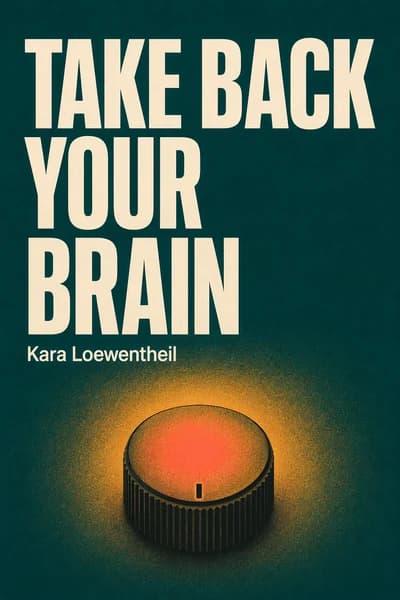
Rewire your brain against society's sexist programming with Kara Loewentheil's #1 bestseller. What if the mental blocks holding you back aren't your fault? Endorsed by Rebecca Minkoff as "a movement," this guide transforms limiting beliefs into unstoppable confidence.
Kara Loewentheil is the bestselling author of Take Back Your Brain: How a Sexist Society Gets in Your Head—and How to Get It Out and a renowned feminist mindset coach. A Yale and Harvard Law School graduate, she transitioned from litigating reproductive rights and directing a Columbia University think tank to pioneering feminist cognitive coaching. Her work blends evolutionary biology, psychology, and feminist theory to help women rewire thought patterns shaped by systemic sexism.
Loewentheil hosts the globally top-ranked UnFck Your Brain* podcast (48+ million downloads), recommended by The New York Times and featured on platforms like Glennon Doyle’s "We Can Do Hard Things." She founded The School of New Feminist Thought, where her evidence-based methods—validated in a Journal of the American Medical Association clinical trial—help women combat anxiety, imposter syndrome, and patriarchal conditioning.
Her revolutionary approach to dismantling internalized oppression through self-coaching tools has created a seven-figure coaching business and transformed thousands of lives worldwide. Loewentheil’s insights bridge academic rigor with actionable strategies, making her a leading voice in modern feminist thought and mental empowerment.
Take Back Your Brain offers a feminist framework to combat negative self-talk shaped by societal sexism. Kara Loewentheil combines cognitive psychology with actionable exercises to help women identify and reprogram harmful thought patterns, empowering them to build confidence and reclaim mental autonomy. The book addresses systemic influences on self-perception and provides tools for lasting mindset shifts.
This book is ideal for women struggling with perfectionism, anxiety, or self-doubt rooted in societal conditioning. It’s also valuable for feminists seeking actionable strategies to counteract internalized sexism and readers interested in self-help with a sociological lens. Coaches and mental health professionals may also find its frameworks useful for client work.
Yes, particularly for those seeking evidence-based methods to address gendered thought patterns. Reviews praise its blend of academic rigor and practical exercises, with many citing transformative results in managing anxiety and self-criticism. The book’s focus on systemic causes of mental distress distinguishes it from generic self-help guides.
The “Brain Gap” refers to the disconnect between women’s capabilities and their self-perception due to sexist socialization. Loewentheil argues this gap perpetuates anxiety and self-doubt, offering cognitive tools to align thoughts with authentic potential rather than societal expectations.
The book teaches readers to:
Some readers note the concepts require consistent effort to implement, which may challenge those seeking quick fixes. Others suggest the systemic analysis could be expanded with more intersectional perspectives. However, most reviews highlight its actionable nature compared to theoretical feminist works.
Unlike generic positivity guides, Loewentheil’s approach explicitly links personal mindset issues to broader sexist structures. It uniquely combines cognitive behavioral techniques with feminist theory, offering both individual tools and societal context.
While focused on women’s experiences, the book’s framework for identifying socially conditioned thoughts applies to anyone affected by gendered norms. Men seeking to understand internalized masculinity or support women in their lives may find it insightful.
Notable lines include:
Loewentheil reframes perfectionism as a response to patriarchal pressure, not a personal flaw. The book provides exercises to replace perfectionist thoughts with self-compassion and realistic standards.
Practical applications include:
The book expands on concepts from her UnFck Your Brain* podcast, offering structured exercises and deeper sociological analysis. Fans of the podcast will find it a comprehensive manual, while new readers gain standalone value.
通过作者的声音感受这本书
将知识转化为引人入胜、富含实例的见解
快速捕捉核心观点,高效学习
以有趣互动的方式享受这本书
Women continue undermining themselves through deeply embedded socialization.
Emotions aren't true or false—they're simply bodily sensations.
Women face a cruel catch-22.
Changing thoughts can change feelings felt like finding life's secret.
There's never a 'right' way to think or a thought you 'should' think.
将《Take Back Your Brain》的核心观点拆解为易于理解的要点,了解创新团队如何创造、协作和成长。
将《Take Back Your Brain》提炼为快速记忆要点,突出坦诚、团队合作和创造力的关键原则。

通过生动的故事体验《Take Back Your Brain》,将创新经验转化为令人难忘且可应用的精彩时刻。
随心提问,选择声音,共同创造真正与你产生共鸣的见解。

"Instead of endless scrolling, I just hit play on BeFreed. It saves me so much time."
"I never knew where to start with nonfiction—BeFreed’s book lists turned into podcasts gave me a clear path."
"Perfect balance between learning and entertainment. Finished ‘Thinking, Fast and Slow’ on my commute this week."
"Crazy how much I learned while walking the dog. BeFreed = small habits → big gains."
"Reading used to feel like a chore. Now it’s just part of my lifestyle."
"Feels effortless compared to reading. I’ve finished 6 books this month already."
"BeFreed turned my guilty doomscrolling into something that feels productive and inspiring."
"BeFreed turned my commute into learning time. 20-min podcasts are perfect for finishing books I never had time for."
"BeFreed replaced my podcast queue. Imagine Spotify for books — that’s it. 🙌"
"It is great for me to learn something from the book without reading it."
"The themed book list podcasts help me connect ideas across authors—like a guided audio journey."
"Makes me feel smarter every time before going to work"

免费获取《Take Back Your Brain》摘要的 PDF 或 EPUB 版本。可打印或随时离线阅读。
Have you ever found yourself sobbing under your desk, feeling like a failure despite outward success? You're not alone. Millions of women live with a relentless inner Voice constantly berating them about their competence, body, relationships, and worth. This Voice isn't random-it's the result of patriarchal programming that teaches women their value depends on appearance, others' opinions, achievements, and universal approval. This creates what Kara Loewentheil calls the "Brain Gap"-the disconnect between what we consciously believe (like feminist principles) and what we unconsciously feel (deep insecurity). Our brains begin life like empty pages, absorbing information from everyone around us through both explicit messages and implicit observations. While many learned thoughts help us navigate life, we also absorb harmful societal biases without realizing it. What makes this particularly insidious is how these thoughts drive our emotions, which then determine our actions. Though we'd like to believe we're rational beings, our behavior is actually driven by our feelings, which are created by our often unconscious thoughts. Societal messages about women's worth are secretly setting the GPS for your brain, directing you away from where you actually want to go. When we question these thoughts, our brains resist through denial, anxiety, or avoidance. This resistance is normal-like a moat surrounding a castle of gold. Uncomfortable to wade through, but necessary to reach the treasure inside.