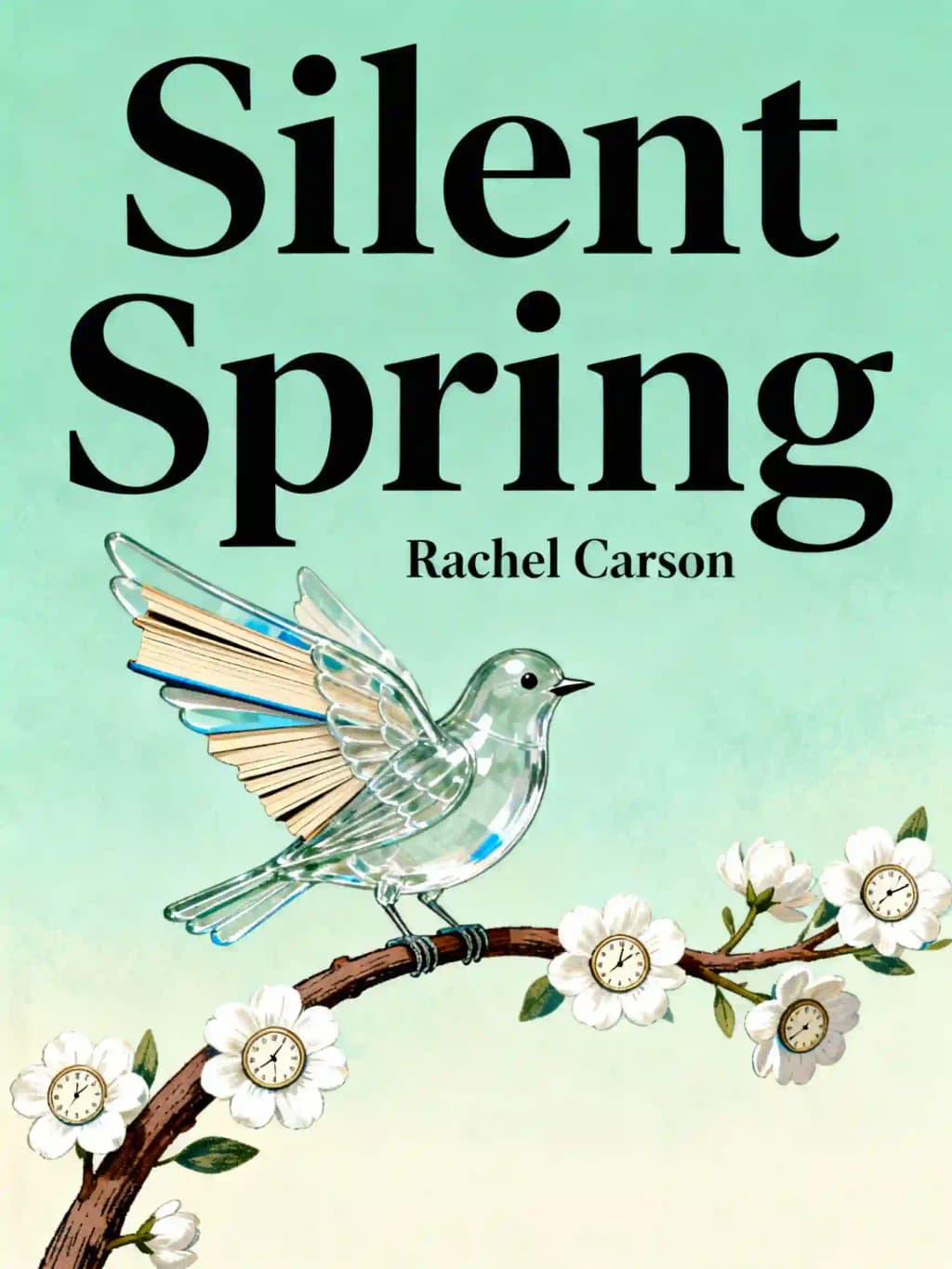
Silent Spring, Rachel Carson's 1962 environmental bombshell, exposed pesticides' hidden devastation. Endorsed by JFK's Science Advisory Committee and serialized in The New Yorker, this revolutionary text sparked the EPA's creation. What everyday chemicals might be silently destroying your world right now?
Rachel Louise Carson (1907–1964) was a pioneering marine biologist and environmental activist. She authored Silent Spring, the landmark 1962 environmental science classic that exposed the ecological dangers of pesticides.
Born in rural Pennsylvania, Carson blended scientific rigor with lyrical prose in her works. These include the National Book Award–winning The Sea Around Us and Under the Sea-Wind, which explored marine ecosystems.
As editor-in-chief for the U.S. Fish and Wildlife Service, she synthesized complex research for public audiences. This skill shaped Silent Spring’s accessible critique of DDT and industrial chemical use. Her research spurred congressional hearings, influenced the 1972 U.S. DDT ban, and inspired the Environmental Protection Agency’s creation.
The book ignited global conservation movements, sold over 600,000 copies in its first year, and has been translated into 30+ languages. A 1963 CBS documentary adaptation amplified its impact, cementing Carson’s legacy as a catalyst for modern environmentalism.
Silent Spring examines the environmental devastation caused by synthetic pesticides like DDT, arguing they act as indiscriminate "biocides" that harm ecosystems, wildlife, and human health. Rachel Carson critiques chemical companies for spreading misinformation and urges a shift toward sustainable pest-control methods. The book sparked the modern environmental movement by linking human actions to planetary degradation.
Environmental advocates, policymakers, scientists, and anyone interested in ecology or public health will find Silent Spring essential. Its warnings about pesticide overuse and corporate accountability remain relevant for readers concerned about climate change, biodiversity loss, or regulatory transparency.
Yes. Silent Spring remains a cornerstone of environmental literature, credited with banning DDT and inspiring global ecological policies. Its themes of corporate accountability, environmental interconnectedness, and precautionary science resonate amid modern climate crises.
Carson primarily targets DDT, detailing its role in bird population declines, groundwater contamination, and human carcinogenicity. She also critiques parathion and dieldrin, emphasizing their bioaccumulation in food chains and resistance development in pests.
Carson argues pesticides like DDT rarely target pests alone, instead indiscriminately killing insects, birds, and beneficial species. The term "biocide" underscores their broad ecological harm, disrupting food webs and enabling invasive species outbreaks.
The book links pesticides to cancer, liver damage, and reproductive issues, citing cases of farmworkers and communities exposed to chemicals. Carson highlights DDT’s carcinogenic potential and advocates for stricter safety testing.
Silent Spring catalyzed the 1970s environmental movement, leading to DDT’s U.S. ban and the EPA’s creation. It established ecological interconnectedness as a public concern and inspired global policies prioritizing environmental health over industrial shortcuts.
Chemical companies attacked Carson’s credibility, dismissing her as "hysterical" and unscientific. Critics argued her warnings would reverse agricultural progress, though many claims were later validated by research.
Carson blends scientific data (e.g., pesticide bioaccumulation studies) with vivid narratives of poisoned landscapes and human illnesses. This approach made complex ecology accessible, galvanizing public demand for policy reform.
Unlike narrower climate texts, Silent Spring framed ecological harm as a systemic ethics issue, intertwining science with social critique. It predates but complements works like The Sixth Extinction or Braiding Sweetgrass.
The book’s themes—corporate influence on science, chemical regulation gaps, and ecosystem fragility—mirror contemporary debates over PFAS, neonicotinoids, and climate policy. Its warnings about ecological tipping points remain urgent.
通过作者的声音感受这本书
将知识转化为引人入胜、富含实例的见解
快速捕捉核心观点,高效学习
以有趣互动的方式享受这本书
Man's attitude toward nature is today critically important simply because we have now acquired a fateful power to alter and poison nature.
Why should we tolerate a system that is poisoning the food that sustains us?
The most alarming of all man's assaults upon the environment is the contamination of air, earth, rivers, and sea with dangerous and even lethal materials.
Only within the moment of time represented by the present century has one species -- man -- acquired significant power to alter the nature of the world.
将《Silent spring》的核心观点拆解为易于理解的要点,了解创新团队如何创造、协作和成长。
将《Silent spring》提炼为快速记忆要点,突出坦诚、团队合作和创造力的关键原则。

通过生动的故事体验《Silent spring》,将创新经验转化为令人难忘且可应用的精彩时刻。
随心提问,选择声音,共同创造真正与你产生共鸣的见解。

"Instead of endless scrolling, I just hit play on BeFreed. It saves me so much time."
"I never knew where to start with nonfiction—BeFreed’s book lists turned into podcasts gave me a clear path."
"Perfect balance between learning and entertainment. Finished ‘Thinking, Fast and Slow’ on my commute this week."
"Crazy how much I learned while walking the dog. BeFreed = small habits → big gains."
"Reading used to feel like a chore. Now it’s just part of my lifestyle."
"Feels effortless compared to reading. I’ve finished 6 books this month already."
"BeFreed turned my guilty doomscrolling into something that feels productive and inspiring."
"BeFreed turned my commute into learning time. 20-min podcasts are perfect for finishing books I never had time for."
"BeFreed replaced my podcast queue. Imagine Spotify for books — that’s it. 🙌"
"It is great for me to learn something from the book without reading it."
"The themed book list podcasts help me connect ideas across authors—like a guided audio journey."
"Makes me feel smarter every time before going to work"

免费获取《Silent spring》摘要的 PDF 或 EPUB 版本。可打印或随时离线阅读。
What if tomorrow morning arrived in complete silence-no robins greeting the dawn, no bees humming through gardens, no flutter of wings against the sky? This wasn't a dystopian fantasy when Rachel Carson posed this question in 1962. It was already happening. Across American towns, spring mornings had grown eerily quiet. Birds that once filled the air with song were vanishing, trembling with mysterious ailments, or lying dead beneath trees. The culprit wasn't a natural plague or enemy sabotage. We had done this to ourselves through an invisible rain of chemicals we believed would make life better. Carson's *Silent Spring* detonated like a bomb in American consciousness. The chemical industry spent $250,000 trying to silence her, launching vicious personal attacks even as she privately battled the breast cancer that would kill her within two years. Yet her message couldn't be suppressed. President Kennedy ordered investigations. The public demanded answers. And from this single book emerged the modern environmental movement and eventually the Environmental Protection Agency. Carson showed us something terrifying: our war on nature was a war on ourselves.