第 1 章
Shipwrecked and Saved: A Journey of Survival and Redemption
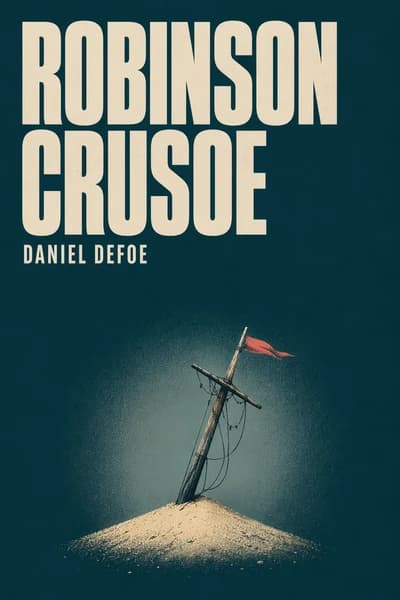
Robinson Crusoe has become so deeply embedded in our cultural consciousness that its elements are universally recognizable-the shipwreck, desert island, goatskin clothing, talking parrot, and Man Friday. What began as Daniel Defoe's first novel at age sixty has transformed into a cultural touchstone that continues to resonate three centuries later. The book has influenced everything from reality television shows like "Survivor" to philosophical discussions about isolation, imperialism, and self-reliance. Beyond its adventure elements, it's considered the first true English novel, pioneering a literary form that would dominate for centuries. Beloved by readers from William Golding to J.M. Coetzee, the novel has been adapted countless times across all media. Its enduring power lies in its exploration of fundamental human questions: How do we survive when stripped of civilization? What is the essence of humanity when all social structures fall away? And perhaps most importantly, how do we find meaning in seemingly hopeless circumstances?
第 2 章
Against All Warnings: The Beginning of Misfortune
Born in York in 1632, Robinson Crusoe emerges from a respectable middle-class family, where his father, a successful merchant from Bremen, had settled and married into English society. His father's carefully reasoned advice to embrace the middle station of life-that sweet spot between poverty's hardships and wealth's burdens-comes with compelling examples of both rich and poor men's miseries that he had witnessed throughout his career. The elder Crusoe paints a vivid picture of the comfortable security found in middle-class life, with its freedom from both manual labor and the anxieties of great wealth.
Despite momentary hesitation and his parents' passionate opposition, which includes his mother's tearful entreaties and his father's stern warning about God abandoning wayward sons, Crusoe's wanderlust prevails. Without farewell or blessing, he boards a ship in Hull bound for London on September 1, 1651, at age eighteen, carrying only a small sum of money and the weight of his disobedience. This fateful decision marks the beginning of a journey that would transform his life in ways he could never imagine.
His first voyage brings immediate and terrifying misfortune when a violent storm strikes off the Yorkshire coast. The ship heaves in mountainous waves, while experienced sailors cry out in fear. Terrified and violently seasick, Crusoe, in his first encounter with mortality at sea, makes desperate promises to God, vowing to return home if spared. Yet when the weather calms, a sailor companion, familiar with such youthful declarations, craftily plies him with punch, drowning his remorse in alcohol and false courage.
Days later, anchored in Yarmouth Roads, another catastrophic storm descends, more severe than the first. The gale destroys eleven merchant vessels in their view, with only their crew surviving. Their own ship springs a dangerous leak, and despite hours of desperate pumping by all hands, including the inexperienced Crusoe, they must abandon it just before it founders beneath the waves.
After reaching shore safely and receiving charity from the generous merchants of Yarmouth, Crusoe receives a stark warning from his companion's father, an experienced sea captain. The old sailor calls him a "Jonah," referring to the biblical figure whose disobedience brought disaster to his shipmates, and solemnly predicts continued disasters should Crusoe persist in his seafaring ambitions. Yet Crusoe's "ill fate," as he later terms it, drives him forward against all reason and counsel. This pattern of ignoring warnings and following impulse rather than wisdom establishes the narrative's moral framework-one where consequences follow choices with mathematical precision.
Despite these early disasters, Crusoe's stubborn determination leads him to continue his seafaring adventures, eventually making a profitable voyage to Guinea. This initial success, rather than inspiring gratitude and contentment, fills him with dangerous ambition and dreams of quick fortune. These dreams lead to another voyage where Turkish pirates, operating from their base in Sallee, capture his vessel. For two years, he serves as a slave to the pirate captain, daily contemplating escape while watching the Mediterranean waters lap against the Barbary Coast, seeing no opportunity-until his master begins taking him fishing in a small boat, providing the first glimmer of possible freedom in his captivity.
第 3 章
Freedom and Fortune: From Captivity to Prosperity
When ordered to take the boat fishing with only a Moor named Ismael and a boy called Xury, Crusoe meticulously plans his bid for freedom. Over several days, he secretly stockpiles provisions - bread, water, a compass, and gunpowder - hiding them in discrete locations around the vessel. When the perfect moment arrives, he decisively tosses Ismael overboard during calm seas. Though the Moor proves an excellent swimmer, Crusoe maintains control by training his musket on him until he turns back toward shore, calling out promises of revenge that fade into the distance.
Keeping the loyal Xury with him - a boy of about sixteen who swears "to be faithful to me, and go all over the world with me" - Crusoe navigates southward along the African coast. They face numerous perils: packs of roaring lions prowling the beaches at night, hostile tribes shooting arrows from the shoreline, and treacherous waters that threaten to dash their small craft against rocks. Their days become a careful balance of hugging the coast close enough to spot danger but far enough out to avoid the shallow reefs.
After several harrowing adventures, including a dramatic encounter where Crusoe shoots a lion that had been stalking them and trades with peaceful natives who provide them with fresh water and meat, they spot a Portuguese ship on the horizon. The Portuguese captain, moved by Crusoe's tale of escape and survival, demonstrates extraordinary kindness. Not only does he refuse payment for passage to Brazil, but he also assists Crusoe in selling his boat and remaining goods at the best possible price. The matter of Xury becomes a painful moral dilemma - the captain offers to buy the boy's freedom with a bond guaranteeing his release after ten years of service. Though torn by guilt, Crusoe ultimately accepts, reasoning that the boy's future would be better secured under the captain's guidance.
In Brazil, Crusoe applies himself to learning the intricacies of sugar cultivation, from selecting the right soil to managing the complex harvesting process. He forms a crucial partnership with Wells, a fellow plantation owner who shares his knowledge of local agricultural practices. Together, they weather crop failures, seasonal floods, and labor shortages. Through careful management and the captain's continued assistance in retrieving his London investments, Crusoe gradually builds his enterprise. He purchases a Negro slave and a European servant named John, expanding his operation to rival the largest plantations in the region.
His success manifests in fifty large rolls of superior tobacco and extensive sugar cane fields that promise substantial future wealth. However, Crusoe's fundamental character flaw - an insatiable restlessness that borders on self-sabotage - emerges when several merchant acquaintances propose a potentially lucrative slave-trading venture to Guinea. Despite having built a plantation worth several thousand pounds and establishing himself in respectable society, he succumbs to the lure of quick profits. Looking back from his later years, Crusoe acknowledges this decision as evidence of his "profound lack of prudence" - a moment of folly that would lead to consequences far beyond his imagination.
第 4 章
Castaway: The Island of Despair
Sailing northward from Brazil before heading toward Africa, Crusoe's ship encounters a violent hurricane that takes them completely off course. After twelve terrifying days of storm, they find themselves near Guiana or northern Brazil. Against returning to Brazil, they decide to sail for Barbados, but a second storm drives them westward until land is spotted and their ship strikes sand.
As violent waves break over them, the crew takes to their boat, which soon overturns. Through desperate swimming against mountainous waves, Crusoe alone reaches shore-the sole survivor. With nothing but a knife, tobacco pipe, and small tobacco box, he spends his first night in a thorny tree, beginning his life as a castaway on what he would later call "the Island of Despair."
The next morning, Crusoe discovers the ship has been lifted off the sand by the tide and driven closer to shore. Seeing an opportunity to salvage supplies, he swims out to the vessel and finds provisions untouched by water. Over thirteen days, he makes eleven trips to the ship, salvaging cables, rigging, sails, tools, food, and even money (which he initially scorns as useless). On his final visit, a storm arises, forcing him to swim back to shore. By morning, the ship has vanished completely.
With survival now his primary concern, Crusoe establishes a fortress against potential dangers-savages, wild beasts, and the elements. He selects a small flat area on a steep hillside, drawing a half-circle before it where he plants two rows of strong stakes sharpened at the top. Between these rows, he lays pieces of ships' cable until his wall is nearly five feet thick. Inside this fortress, he brings all his provisions and goods, making a large tent for protection from rain and digging into the hill to create a cave-like dwelling.
As he settles into his solitary existence, Crusoe battles periods of melancholy but counters these with rational reflections on his blessings-he is alive when eleven others perished, has food to eat, and shelter from the elements. He establishes a calendar by cutting notches on a post, marking each day, with longer marks for weeks and months, beginning September 30, 1659. This methodical approach to time becomes crucial to maintaining his sanity in the face of overwhelming isolation.
第 5 章
Survival and Sovereignty: Building a Kingdom of One
As months pass, Crusoe improves his dwelling with remarkable ingenuity. He reinforces his tent with a wall of turfs about two feet thick, adds rafters leaning against the rock, and thatches them against the rain. He enlarges his cave by working into the rock, creating a back entrance outside his fortification for more storage space. Despite never having handled tools before, he crafts furniture-particularly a table and chair-which allow him to enjoy what few comforts he has.
His daily journal records his activities: hunting expeditions, furniture making, digging to expand his cave, and crafting tools like a wooden shovel. He captures and nurses a young goat with a broken leg that grows tame and remains with him, giving him the first thought of breeding creatures for food when his ammunition runs out. By April, he completes his defensive wall-a half-circle about twenty-four yards long connecting two points of rock, with his cave door at center-making it extraordinarily strong despite rain delays.
During woodland explorations, Crusoe discovers wild pigeons, melons growing abundantly, and grapes hanging ripe on vines. He attempts to domesticate young pigeons, but they fly away when grown. For lighting, he fashions crude lamps from goat tallow, clay dishes, and oakum wicks. One day, while rearranging supplies, he empties a bag of old poultry feed husks near his fortification. About a month later, to his astonishment, he notices green stalks sprouting-perfect English barley and rice! This apparent miracle deeply affects him, bringing tears to his eyes as he considers God's providence in his sustenance.
After completing his wall with an interior ladder for access, Crusoe faces a terrifying earthquake that causes parts of his cave to collapse. Before he can recover, a dreadful hurricane arises, followed by heavy rain. These natural disasters prompt him to consider relocating, though he ultimately decides to remain while building a second camp as a precaution.
Through years of trial and error, Crusoe masters agriculture, harvesting barley and rice that promise future bread supply. He creates baskets for carrying earth and storing corn, though he still lacks proper vessels for liquids and cooking. His exploration of the island reveals its western shore to be superior to his settlement side-teeming with countless turtles and abundant fowl. Despite this pleasantness, he feels no inclination to relocate, as his original habitation has become natural to him.
第 6 章
Spiritual Awakening: From Despair to Providence
In his fourth year on the island, Crusoe marks his anniversary with devotion and newfound comfort. His perspective has transformed-he now views the world as remote and irrelevant to his existence, separated by "a great gulf fixed." He recognizes his peculiar advantages: freedom from worldly temptations, sovereignty over his domain, and possession of all he needs. This existence teaches him that possessions are only valuable to the extent they're useful, leading him to focus on what he enjoys rather than what he lacks.
However, his greatest transformation occurs during a severe illness in June of his fifth year. Struck with fever and chills, he becomes bedridden and experiences a terrifying dream of a flaming figure descending from the clouds, condemning him: "Seeing all these things have not brought thee to repentance, now thou shalt die." This nightmare awakens his dormant conscience, leading him to reflect on his godless life-eight years of seafaring wickedness without a single thought of divine providence.
During a brief respite from fever, Crusoe prepares water mixed with rum, broiled goat meat, and roasted turtle eggs-the first meal over which he asks God's blessing. Contemplating the sea from shore, he begins questioning the origin of all creation, concluding that God has not only made everything but directs all events, including his present condition. In his distress, he discovers both physical and spiritual remedies in his chest: tobacco and a Bible. Opening the Bible randomly, he finds words that speak directly to his condition: "Call on me in the day of trouble, and I will deliver, and thou shalt glorify me."
As he recovers, Crusoe begins reading the New Testament daily, experiencing genuine repentance for the first time. On July 4, reading "He is exalted a Prince and a Saviour, to give repentance, and to give remission," he cries out earnestly for Jesus to grant him repentance-the first true prayer of his life. He now understands that deliverance from sin is a far greater blessing than deliverance from his physical isolation.
By his second anniversary on the island (September 30th), Crusoe observes the day with solemn thanksgiving, acknowledging how God's presence has transformed his solitude from misery to contentment. His spiritual outlook has profoundly changed-where previously he would suddenly be overcome with anguish at his imprisonment in this wilderness, he now finds comfort in Scripture and the conviction that God would never forsake him.
第 7 章
The Footprint: Fear Returns
After fifteen years of peaceful solitude, Crusoe's world is shattered when he discovers a single footprint in the sand-too large to be his own. "I stood like one thunderstruck, as if I had seen an apparition," he recalls. This discovery plunges him into terror, making him flee to his fortress "like one pursued" and sleep none that night.
For days, his thoughts race between believing it was the Devil or savages from the mainland. He reproaches himself for not storing more corn, now fearing he might lose his crops if discovered. The irony isn't lost on him: "How strange a checker-work of Providence is the life of man! I who once longed for human company now trembled at the mere thought of seeing another person."
This fear drives Crusoe to extraordinary lengths for security. He constructs a second fortification with seven gun ports and plants thousands of stakes outside his wall-a project that takes many weary months. Within two years, he has a thick grove, and in five or six years, an impassable wood concealing his dwelling. For access, he uses two ladders-both removable for complete security. He also secures his goats by creating hidden enclosures throughout the island.
Wandering to the western point of the island one day, Crusoe makes a horrifying discovery that explains the footprint-this is where savages from the mainland occasionally land. The beach is scattered with human skulls, hands, feet, and other bones, with evidence of cannibalistic feasts. He stands astonished, sickened by such inhuman brutality, and flees back toward his habitation.
This discovery actually eases his mind about safety-these savages never come searching for anything on the island, and having been concealed for eighteen years, he can remain hidden if careful. Still, such abhorrence fills him that he stays within his "circle"-his castle, bower, and woodland enclosure-for nearly two years after.
第 8 章
Friday: Companionship at Last
In his twenty-fourth year on the island, Crusoe spots five canoes on his shore with about thirty savages dancing around a fire. Two wretches are brought out for slaughter-one immediately killed, while the other flees with incredible speed directly toward Crusoe's dwelling. Providence clearly calls him to save this man's life. Crusoe runs down with his guns, knocks down one pursuer with his gunstock, and shoots the other.
The fleeing savage, though terrified by the gunfire, gradually approaches when beckoned. He kneels repeatedly in gratitude, finally placing Crusoe's foot upon his head as a token of lifelong servitude. Crusoe names him Friday after the day he saved him, teaches him to call him "Master," and gives him clothes-linen drawers, a goat-skin jerkin, and a hare-skin cap.
Friday proves to be "the most faithful, loving servant imaginable, devoted like a child to a father." His natural goodness leads Crusoe to melancholy reflections on how poorly civilized men use their advantages compared to these "savages." Crusoe delights in teaching Friday everything useful, especially language, and finds him an eager, diligent student.
This year proves the pleasantest of all Crusoe's island life. Friday now speaks English well enough for conversation, restoring use to Crusoe's tongue after years of silence. Beyond the mere pleasure of speech, Crusoe finds singular satisfaction in Friday's character-his simple, unfeigned honesty growing more apparent daily until he genuinely loves him.
Through their conversations, Crusoe learns that Friday's people are Caribs who sometimes prevailed in battles but had been outnumbered when he was captured. Friday also describes "white bearded men" (clearly Spaniards) living far westward who had "killed much mans." When Crusoe inquires how he might reach these Europeans, Friday suggests using "two canoe"-a vessel large as two canoes combined. This kindles Crusoe's hopes of eventual escape with Friday's help.
第 9 章
Rescue and Return: The Circle Completes
After twenty-seven years on the island, Crusoe spots an English ship anchored about two leagues away, with a longboat approaching shore. Though initially joyful at the sight of countrymen, some instinct warns him to remain cautious. He observes eleven men disembarking, three of whom appear to be prisoners. The sailors scatter to explore while their prisoners sit dejectedly on the ground.
Approaching the prisoners, Crusoe discovers they are the ship's captain, his mate, and a passenger, marooned by mutineers. The captain explains his men have mutinied and left them to perish on this seemingly uninhabited island. When Crusoe suggests taking the sailors prisoner, the captain warns that two are particularly dangerous villains but believes the others would return to duty if these ringleaders were secured.
Through clever strategy and surprise attacks, Crusoe and his allies capture the mutineers in groups. The captain then takes the recovered boat with cooperative sailors to seize the vessel. They execute their plan perfectly, arriving at the ship at midnight and swiftly securing the deck. When the rebel captain and his men resist, the mate shoots the rebel captain through the head, ending all resistance.
With the ship secured, Crusoe's deliverance is visibly at hand. The captain treats him as a deliverer, acknowledging the miraculous hand of Providence in their success. After twenty-eight years, two months, and nineteen days on the island, Crusoe sets sail for England on December 19, 1686, arriving in June 1687.
Upon returning to civilization, Crusoe discovers his parents have died, but his plantation in Brazil has flourished tremendously under his partner's care. Despite being presumed dead, his ownership rights remain intact, with his share generating over two hundred moidores annually. Through his old friend the captain who first rescued him off the African shore, Crusoe recovers his wealth and settles his affairs in Brazil by letter.
Though comfortably settled with considerable wealth in England, Crusoe remains restless. Having no family and few relations, he can't resist the inclination to wander again, particularly to see his island and learn the fate of those he left behind. In 1694, he joins his nephew on a trading voyage to the East Indies, during which he visits his island colony and finds it thriving with about twenty young children from eleven men and five women prisoners they had brought from the mainland.
第 10 章
Legacy of Isolation: Why Crusoe Endures
Three centuries after its publication, Robinson Crusoe continues to captivate readers and inspire adaptations across all media. The novel's enduring power lies in three key elements: isolation, technique, and race. Crusoe's profound loneliness-living alone for twenty-four years before Friday arrives-speaks to fundamental human fears and resilience. While Defoe pays less attention to the psychological toll than modern readers might expect, the theme of isolation resonates deeply in our increasingly connected yet often alienated world.
Crusoe avoids madness through constant work, becoming "master of every mechanic art" despite never having "handled a tool" before. His experience recapitulates economic history as he masters agriculture and industry, demonstrating the human capacity for adaptation and innovation. This aspect of the novel particularly appealed to thinkers like Jean-Jacques Rousseau, who saw in Crusoe the ideal educational model of self-reliance and practical learning.
The relationship between Crusoe and Friday represents the novel's most complex and troubling aspect. Friday shows "subjection, servitude, and submission" to Crusoe, who regards him as a "natural servant." Modern readers and adaptations have rightfully critiqued this racial politics, yet the relationship also contains moments of genuine affection and mutual dependence that complicate simple interpretations.
Beyond these elements, the novel's religious dimension remains powerful-Crusoe's spiritual journey from rebellion to repentance mirrors the broader Christian narrative of fall and redemption. His gradual recognition of Providence's hand in his life offers a framework for finding meaning in suffering that continues to resonate with readers of all faiths and none.
In the end, Robinson Crusoe endures because it speaks to fundamental human questions: How do we survive when stripped of civilization's comforts? How do we find purpose in apparent meaninglessness? And how do we reconcile our desire for both freedom and connection? These questions remain as relevant today as they were three centuries ago, ensuring Defoe's castaway will continue to captivate generations of readers to come.