第 1 章
A Descent into Savagery: Innocence Lost on Paradise
What happens when civilization's thin veneer is stripped away? William Golding's "Lord of the Flies" offers a chilling answer that has captivated readers since its 1954 publication. Initially rejected by 21 publishers before finding a home, this dark exploration of human nature has sold over 25 million copies worldwide and remains required reading in countless schools. The novel's influence extends far beyond literature-it inspired everything from The Simpsons episodes to survival reality shows like "Kid Nation." When Stephen King was asked which book he wished he'd written himself, he named this haunting tale. Perhaps most telling is how its title has entered our cultural lexicon as shorthand for societal breakdown, with real-world events often described as "Lord of the Flies situations." Through the microcosm of schoolboys stranded on an island, Golding confronts us with humanity's most uncomfortable truth: the beast lurks not in the jungle, but within ourselves.
第 2 章
Paradise Corrupted: The Fall Begins
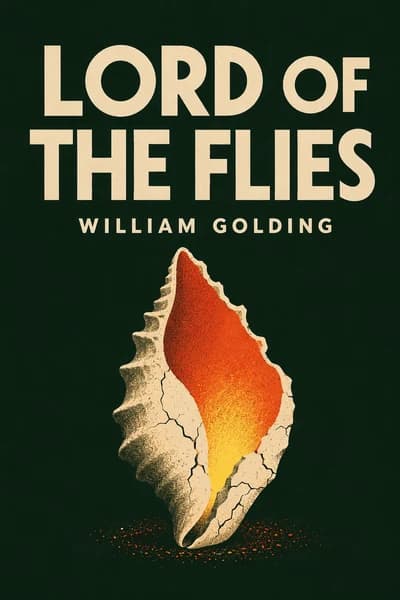
A plane crash during a wartime evacuation leaves a group of British schoolboys stranded on a pristine, uninhabited tropical island. Among the first to gather are Ralph, a fair-haired, athletic boy, and Piggy, an overweight, asthmatic intellectual with glasses. Finding a beautiful conch shell, Ralph blows it like a trumpet, summoning other survivors scattered across the island.
The boys quickly establish a primitive democracy, electing Ralph as chief over Jack Merridew, the authoritarian leader of a choir group. Ralph's first decision is to explore the island with Jack and a quiet, thoughtful boy named Simon, confirming they're on an uninhabited paradise with fruit trees, wild pigs, and fresh water. The moment feels exhilarating-"This belongs to us," they declare, reveling in their newfound freedom.
Ralph establishes three priorities: maintaining a signal fire for rescue, building shelters, and having fun. But beneath this sensible plan, troubling signs emerge. During their exploration, Jack encounters a piglet trapped in creepers and draws his knife to kill it, but hesitates-"the enormity of the knife descending and cutting into living flesh" momentarily overwhelms him. Red-faced with embarrassment, he vows, "Next time there would be no mercy."
This hesitation marks a crucial moment-Jack stands at the threshold between civilization and savagery. His embarrassment reveals how deeply ingrained social norms remain, yet his promise of "no mercy" foreshadows the darkness to come. Meanwhile, a small boy with a mulberry-colored birthmark mentions seeing a "beastie" or "snake-thing" in the forest, introducing the first seeds of fear that will eventually consume the group.
When Ralph suggests building a signal fire on the mountain, the boys abandon all order in their excitement. Using Piggy's glasses to focus sunlight, they ignite a massive blaze that quickly grows out of control, spreading to the forest below. In the aftermath, they realize the boy with the birthmark is missing-their first casualty, sacrificed to their recklessness. The silence that follows is the sound of innocence beginning to crack.
Haven't we all felt that intoxicating freedom when authority disappears? The thrill of realizing no one is watching, no one is judging? These boys experience this on a grand scale-and like many of us when boundaries dissolve, they discover both the exhilaration and the terror of absolute freedom.
第 3 章
Order Versus Chaos: The Growing Divide
"The shelters aren't good. And the-the other thing. They're starting not to care."
Ralph's frustrated words to Jack capture the growing division on the island. While Ralph labors with Simon to build shelters for the younger boys, Jack becomes obsessively focused on hunting, disappearing into the forest for hours. The other boys, initially enthusiastic about Ralph's plans, quickly abandon work for swimming and play. This tension between immediate pleasure and long-term survival becomes the central conflict driving the boys apart.
When Jack returns empty-handed from another hunt, he and Ralph argue over priorities. For Ralph, the signal fire and shelters represent hope for rescue and protection. For Jack, hunting isn't just about meat-it's about power and primal satisfaction. "I thought I might kill," he explains with disturbing intensity, describing how he feels compelled to track and kill, how he's learning to read the forest's signs like "something sleeping there, behind my mind."
This divergence in values manifests physically as well. While Ralph maintains his appearance and civilized demeanor, Jack gradually transforms-his hair grows long and tangled, his skin darkens from sun exposure, and eventually, he adopts face paint that liberates him from "shame and self-consciousness." The painted mask becomes a new identity that allows Jack to access darker impulses.
Meanwhile, the younger boys (nicknamed "littluns") create their own society within the larger group. They build elaborate sand castles at the beach's edge, play games, and share nightmares about a beast they believe roams the island at night. Their fears, dismissed by the older boys, nonetheless spread like a contagion through the group.
In one telling scene, Roger-Jack's eventual lieutenant-follows a littlun named Henry to the shore. Roger begins throwing stones near the boy, deliberately missing but drawing closer with each throw. What stops him from hitting Henry directly isn't compassion but "the taboo of the old life"-the invisible boundaries of civilization still restrain his arm. This restraint will not last.
Simon, unlike the others, finds solace in solitude. He discovers a secluded clearing in the jungle-a natural bower surrounded by aromatic bushes that bloom at night. This sanctuary, where Simon retreats for quiet contemplation, represents the spiritual dimension absent from both Ralph's practical leadership and Jack's violent impulses.
Isn't it fascinating how quickly social structures deteriorate when external enforcement disappears? The boys aren't inherently evil-they're simply children without guidance, gradually forgetting the rules that once seemed so permanent. Their descent mirrors countless historical examples where seemingly stable societies collapsed into tribalism and violence when institutional constraints failed.
第 4 章
Fear's Slow Poison: The Beast Emerges
"What are we? Humans? Or animals? Or savages?"
Piggy's desperate question cuts to the heart of the boys' deteriorating situation. As their time on the island stretches from days into weeks, fear becomes the invisible force driving them toward savagery.
The fear begins with the littluns' nightmares about a "beastie" but soon infects the older boys as well. During a chaotic assembly, the possibility that ghosts might exist on the island is raised, causing panic. Ralph struggles to maintain order, watching helplessly as "the world, that understandable and lawful world, was slipping away." When he insists they follow the rules, Jack delivers his most direct challenge yet: "Bollocks to the rules! We're strong-we hunt!"
The beast takes physical form when a parachutist, shot down in a distant aerial battle, descends onto the island. The dead airman's body, still attached to his parachute, is positioned on the mountain where their signal fire burns. When the wind blows, the corpse moves in a grotesque bowing motion. Sam and Eric, on fire duty, mistake this figure for a monster and flee in terror.
Their report of seeing something with wings, teeth, and claws that "followed" them spreads panic through the group. Jack seizes this opportunity, positioning himself as the protector who will hunt and kill the beast. Ralph's practical questions-how can they fight something that "doesn't leave tracks"?-are dismissed as cowardice. The conch shell, once the symbol of democratic order, loses its power as Jack declares, "We don't need the conch anymore."
When Ralph, Jack, and Roger climb the mountain to investigate, they too glimpse the parachutist's silhouette moving in the darkness. Believing they've confirmed the beast's existence, they flee in panic. This shared terror becomes the catalyst for the final breakdown of their fragile society.
The beast serves as the novel's central metaphor-a projection of the boys' own inner darkness. As Simon will later realize in his hallucinatory conversation with the Lord of the Flies, "Maybe there is a beast... maybe it's only us." The boys create the very monster they fear, giving form to the savagery growing within themselves.
This psychological insight remains profoundly relevant. Don't we still see how fear transforms rational people into tribal groups seeking scapegoats and strong protectors? How easily we surrender reason and morality when threatened? The beast on the mountain isn't real, but the fear it generates creates monsters of the boys themselves-just as our own fears can bring out our darkest impulses.
第 5 章
Power's Seductive Call: Jack's Rebellion
"Who'll join my tribe?"
Jack's challenge marks the final fracture in the boys' society. After their terrifying encounter with what they believe is the beast, Jack calls an assembly by blowing the conch-a deliberate usurpation of Ralph's authority. He accuses Ralph of cowardice and incompetence, then asks for a vote to remove him as chief.
When no one raises a hand to support him, Jack's humiliation turns to rage. "I'm not going to play any longer. Not with you," he declares, tears streaming down his face. He invites anyone who wants to hunt with him to follow, then storms off alone to the forest. This moment of emotional vulnerability quickly hardens into something more dangerous-Jack's wounded pride transforms into a determination to create his own tribe based on different values.
Initially, only a few boys join Jack, but his promise of hunting, feasting, and "having fun" proves increasingly attractive, especially when contrasted with Ralph's focus on maintaining the signal fire and building shelters. Jack's first successful pig hunt becomes a turning point. The killing is described in disturbing, almost sexual terms-Jack finds the sow's throat and "his hand was full of the warm blood" as the pig collapses beneath him.
After the kill, Jack takes a critical step toward ritualized savagery. He orders Roger to "sharpen a stick at both ends," then impales the severed pig's head on it as "a gift for the beast." This offering-the Lord of the Flies (Beelzebub, a name for the devil)-becomes both an attempt to appease the imagined monster and a symbol of the boys' descent into primitive superstition.
Jack's transformation is complete when he appears at Ralph's camp "stark naked save for paint and a belt," inviting everyone to a feast. His painted face serves as both camouflage for hunting and a mask behind which his civilized identity can disappear. The face paint allows the boys to shed responsibility for their actions-they become different people, unbound by the rules of their former world.
The contrast between Ralph's failing attempts to maintain the signal fire and Jack's successful hunts creates an inevitable shift in power. When Jack's tribe raids Ralph's camp to steal fire, they cross the final line-from separation to active hostility. The raid foreshadows the violence to come, as Jack's group increasingly defines itself not just by what it does (hunting) but by its opposition to Ralph's values.
Power corrupts, as the saying goes, but Golding shows us something more nuanced-how power reveals. Jack doesn't become evil; rather, his position of authority allows his pre-existing impulses toward dominance and cruelty to flourish unchecked. Haven't we all witnessed how certain personalities seem to bloom in positions of control, revealing aspects of themselves previously hidden?
第 6 章
Sacrifice of the Innocent: Simon's Death
"Kill the beast! Cut his throat! Spill his blood!"
The rhythmic chant builds to a frenzy as Jack's tribe performs a ritualistic dance around their beach fire. The storm brewing over the island mirrors the violence building within the group, creating an atmosphere of primal energy and suspended reason. Ralph and Piggy, despite their misgivings, find themselves drawn into the circle, caught up in the hypnotic power of the ritual.
Meanwhile, Simon, who has spent the day alone in his secret place in the forest, has made a crucial discovery. After hallucinating a conversation with the pig's head-the Lord of the Flies-where it taunts him with the truth that the beast is not an external threat but something within the boys themselves, Simon climbs the mountain. There, he discovers that the feared beast is actually the dead parachutist, tangled in lines and rocks.
Understanding the truth, Simon decides he must tell the others. He staggers through the forest toward the beach where the feast is taking place, weakened by his day-long fast and the emotional toll of his vision. As the storm breaks over the island, Simon crawls from the forest into the circle of dancing boys.
In their frenzied state, the boys mistake Simon for the beast. The description of what follows is both poetic and horrifying: "The sticks fell and the mouth of the new circle crunched and screamed. The beast was on its knees in the center, its arms folded over its face. It was crying out against the abominable noise something about a body on the hill." Unable to hear Simon's message about the dead parachutist, the boys surround him in a frenzy, beating and tearing at him with their bare hands and teeth until he is dead.
After the storm passes, Simon's body is carried out to sea by the tide, surrounded by "strange, moonbeam-bodied creatures with fiery eyes"-phosphorescent sea creatures that create a beautiful, almost spiritual departure that contrasts with the brutal murder. This poetic treatment of Simon's death underscores his role as a Christ-like figure-the visionary who understood the truth but was sacrificed by those he tried to save.
The morning after, Ralph and Piggy struggle with their complicity in Simon's death. Ralph acknowledges the brutal truth-"That was murder"-while Piggy desperately tries to rationalize their actions, insisting they were scared and caught up in the "bloody dance" during the storm. "It was an accident," Piggy repeats, "that's what it was. An accident." But his trembling voice betrays his self-deception.
Simon's death represents the point of no return for the boys' society. Having crossed the line into murder, they can no longer pretend to be playing at savagery-they have become what they pretended to be. The killing reveals how thin the veneer of civilization truly is, how quickly moral boundaries can dissolve under the right conditions.
Doesn't this scene force us to question our own capacity for violence when swept up in group mentality? History is filled with examples of ordinary people committing extraordinary acts of cruelty when subsumed into a mob. Simon's death isn't just a pivotal moment in the novel-it's a warning about human nature that continues to resonate.
第 7 章
Civilization's Last Stand: Piggy's Glasses
"Which is better-to have rules and agree, or to hunt and kill?"
Piggy's question, posed during the final confrontation at Castle Rock, distills the novel's central conflict to its essence. By this point, Jack's tribe has fully embraced savagery, painting their faces, performing ritualistic dances, and establishing a primitive fortress at Castle Rock. Ralph's group has dwindled to just four boys-himself, Piggy, and the twins Sam and Eric.
The theft of Piggy's glasses marks a critical turning point. Without fire, Ralph's group loses their last technological advantage and their hope for rescue. The glasses represent not just practical survival but the power of intellect and reason-the foundations of civilization that Jack's tribe has rejected. When Jack's painted savages raid Ralph's shelter at night to steal the glasses, they're symbolically choosing darkness over light, instinct over reason.
After the raid, Piggy insists they confront Jack's tribe, not just to recover his glasses but to assert the principle that "what's right's right." Despite his near-blindness and physical limitations, Piggy shows remarkable courage in this moment, clinging to moral principles even as the world around him descends into chaos. He holds the conch shell-now an empty symbol of a forgotten order-as he makes his final appeal to reason.
The confrontation at Castle Rock escalates quickly. While Ralph and Jack fight, Roger deliberately dislodges a massive boulder from the cliff above. The rock strikes Piggy, shattering the conch into "a thousand white fragments" and sending Piggy plummeting to his death on the rocks below. The simultaneous destruction of Piggy and the conch represents the final collapse of rational civilization on the island.
Roger's role in Piggy's death is significant. Unlike Jack, whose violence stems from power struggles and hunting instinct, Roger's cruelty is more calculated and sadistic. Earlier in the novel, we saw him throwing stones near Henry but stopping short of hitting him directly, still constrained by "the taboo of the old life." Now, with those constraints removed, Roger acts with "a sense of delirious abandonment," revealing the darkest potential of human nature when freed from social consequences.
After Piggy's death, Jack seizes complete control, screaming "I'm chief!" and hurling his spear at Ralph. The tribe captures the twins and tortures them until they agree to join. Ralph, wounded and alone, flees into the forest, now hunted like the pigs they once pursued.
Piggy's death scene forces us to confront uncomfortable truths about human society. Civilization isn't maintained by our inherent goodness but by systems of rules and consequences that keep our darker impulses in check. When those systems fail, as they do on the island, we don't automatically maintain moral behavior-instead, we often revert to tribal instincts that prioritize power over justice.
Isn't it telling that throughout history, intellectuals like Piggy are often the first targets when societies collapse into violence? Those who appeal to reason become threats to power structures built on fear and force.
第 8 章
The Hunt and the Rescue: Darkness and Light
"He ran stumbling through the thick sand to the open space, and the others followed him. A circling movement developed and a chant. While Roger mimed the terror of the pig, the littluns ran and jumped on the outside of the circle."
The novel's final chapter presents the ultimate inversion-Ralph, once the leader and symbol of civilization, becomes the hunted prey. Jack's tribe has fully embraced their savage identity, and their plan to hunt Ralph "like a pig" reveals how completely they've abandoned their former humanity. The twins' warning that Roger has "sharpened a stick at both ends" makes their intention clear-Ralph will be killed and his head mounted as an offering to the beast, just like the sow's head that became the Lord of the Flies.
Ralph's desperate flight through the burning forest creates some of the novel's most intense imagery. Jack's tribe has set the entire island ablaze to flush him out, destroying their paradise in their determination to eliminate the last reminder of their former civilization. Ralph becomes "a shock of hair and Piggy's glasses," reduced to his most primitive self by terror. The description of his flight-"pure fear on flying feet"-captures the primal horror of the hunt.
Just when all seems lost, with Ralph cornered on the beach expecting death, the perspective suddenly shifts. Ralph looks up to see "a huge peaked cap" belonging to a naval officer whose ship has been drawn to the island by the smoke from the fire. The officer's appearance creates a jarring contrast between the primitive world the boys have created and the adult world of war they've escaped from-a world that, ironically, exhibits many of the same savage tendencies on a larger scale.
The officer's casual misunderstanding of the situation-"Having a war or something?"-highlights the thin line between civilized warfare and savage violence. When he expresses disappointment that British boys would behave so poorly, expecting something "like the Coral Island" (a reference to R.M. Ballantyne's more optimistic adventure novel), the irony is complete. The boys have indeed created their own society, but it has revealed the darkness rather than the nobility of human nature.
The novel's final image is devastating in its emotional power. Ralph, confronted with the full weight of what has happened on the island, breaks down in uncontrollable sobs, weeping "for the end of innocence, the darkness of man's heart, and the fall through the air of the true, wise friend called Piggy." The other boys join in this collective mourning, briefly reunited in their grief before returning to the adult world that awaits them.
The officer, embarrassed by this display of emotion, looks away toward his "trim cruiser" waiting in the distance-a symbol of the supposedly civilized world that is itself engaged in global warfare. This final irony suggests that the boys' experience on the island is not an aberration but a microcosm of human society as a whole.
Doesn't this ending force us to question our own assumptions about civilization? The naval officer represents rescue and a return to order, but the world he comes from is engaged in the same violence the boys have enacted-just with more sophisticated weapons and elaborate justifications. Perhaps the true horror is not that children can become savages when left alone, but that the savagery never really leaves us, regardless of our age or social structures.
第 9 章
The Beast Within: Golding's Enduring Message
"Maybe there is a beast... maybe it's only us."
Simon's insight captures the novel's central message-the beast the boys fear is not an external threat but the darkness within human nature itself. Through the microcosm of children stranded without adult supervision, Golding explores fundamental questions about humanity that continue to resonate nearly seven decades after the book's publication.
The novel's power lies in its unflinching examination of how quickly the veneer of civilization can crumble when social constraints are removed. The boys begin with the best intentions, attempting to create a miniature democracy complete with rules and roles. Yet within weeks, they have descended into tribal warfare, superstition, and murder. This transformation isn't presented as an anomaly but as a revelation of what lies beneath our civilized behavior.
Each character represents different aspects of human nature and society. Ralph embodies pragmatic leadership and the desire for order; Piggy represents intellect and rational thinking; Jack personifies the hunger for power and dominance; Simon offers spiritual insight and natural goodness; Roger represents sadism unleashed from social constraints. Through their interactions and eventual fates, Golding suggests that without the structures of civilization to contain our darker impulses, power and violence will inevitably triumph over reason and morality.
The novel's setting-a beautiful tropical island-creates a powerful contrast with the ugliness that emerges from the boys. This paradise becomes progressively corrupted, culminating in the final conflagration that consumes the entire island. The destruction of this Eden parallels the boys' loss of innocence, suggesting that human nature itself contains the seeds of its own destruction.
Perhaps most disturbing is how Golding portrays this descent as natural rather than aberrant. The boys don't become savages because they are inherently evil individuals; they follow a trajectory that Golding suggests is inherent in human society when stripped of its artificial constraints. The ease with which they abandon their former values-particularly the younger children who quickly adapt to Jack's tribal structure-implies that civilization is not our natural state but a fragile construction constantly at risk of collapse.
The novel's final irony-being rescued by adults engaged in their own global warfare-extends this critique beyond the microcosm of the island. The naval officer who saves Ralph represents a world that has merely institutionalized the same violence and tribalism the boys have discovered. His disappointment that British boys would behave so poorly reveals his own naivety about human nature.
"Lord of the Flies" continues to disturb readers precisely because it challenges our comfortable assumptions about ourselves. We like to believe that moral behavior comes naturally to us, that given freedom we would create just and peaceful societies. Golding suggests the opposite-that our default setting is closer to Jack's tribe than to Ralph's assembly, that we are drawn to power and spectacle rather than reason and fairness.
In today's world of polarized politics, tribal identities, and social media echo chambers, haven't we seen how quickly civil discourse can degenerate into dehumanization of "the other"? How easily we can be swept up in group mentality? The beast Golding identified continues to manifest in our modern world, making his dark vision as relevant now as it was in 1954.
The true horror of "Lord of the Flies" is not that it presents a distorted view of humanity, but that it holds up a mirror in which we might recognize uncomfortable truths about ourselves. The beast is not something alien or external-it is us, waiting for the right conditions to emerge.