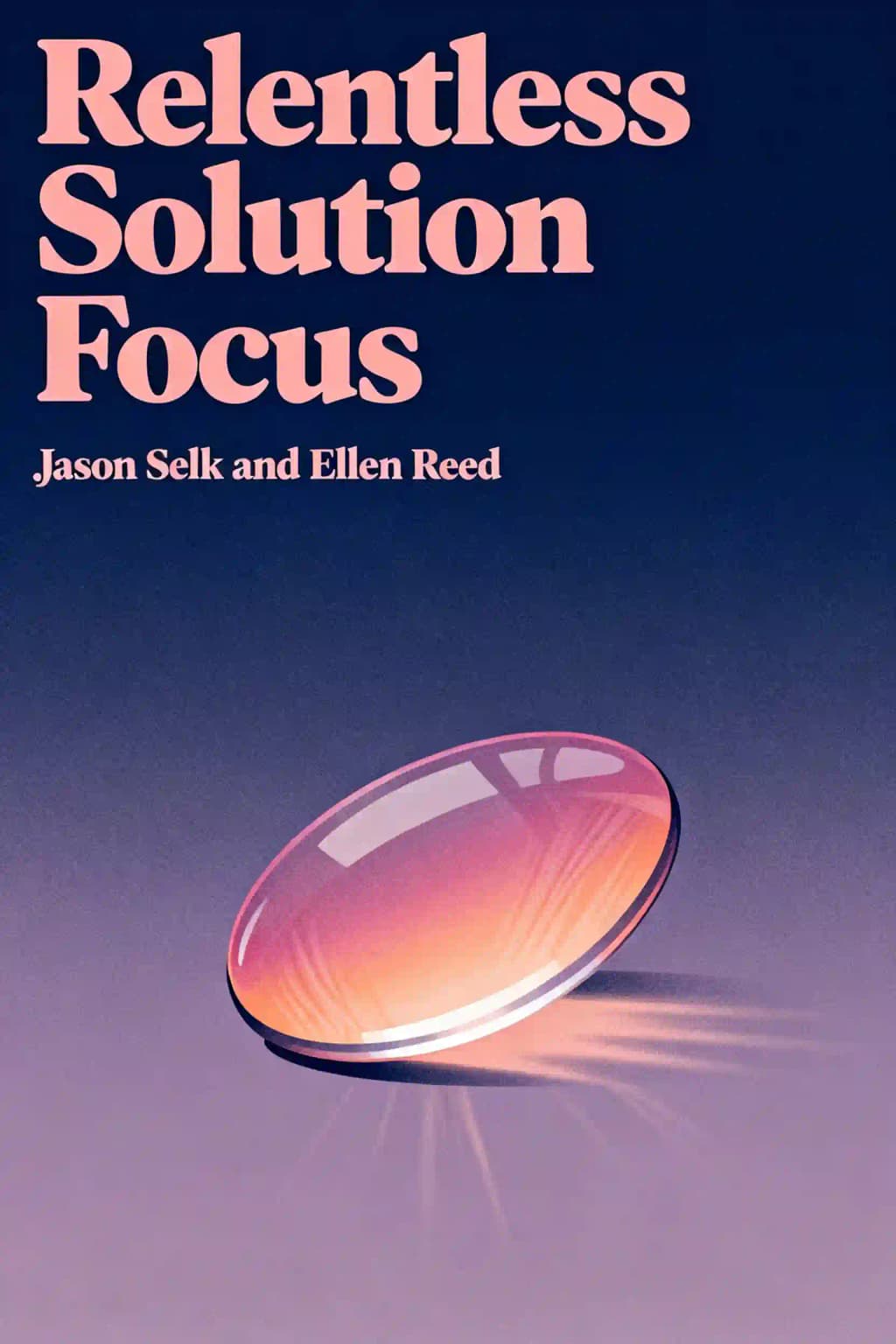
Transform your mind from problem-obsessed to solution-focused with Dr. Jason Selk's game-changing approach that helped the St. Louis Cardinals win two World Series. Why do Fortune 100 executives swear by this mental training method? Because it rewires your brain for unstoppable performance under pressure.
Jason Selk, PhD, and Ellen Reed, PhD, co-authors of Relentless Solution Focus, are leading experts in mental toughness and performance psychology.
Selk, a former Director of Mental Training for the World Series-winning St. Louis Cardinals, combines elite sports strategies with corporate leadership principles. He has coached Fortune 500 executives and organizations like Morgan Stanley and Enterprise Rent-A-Car. His bestselling books, including Executive Toughness (ranked among the top career development books by Book Authority) and Organize Tomorrow Today (a 2016 CEO Read bestseller), establish him as a pioneer in goal achievement frameworks.
Reed, a performance coach with over 15 years’ experience, applies solution-focused techniques to business professionals, student-athletes, and teams through the Level Up coaching platform.
Together, their work emphasizes accountability, optimism, and systematic problem-solving, distilled from decades of research with NFL, NHL, and NBA athletes. Both regularly contribute to Forbes and Inc., with appearances on CNBC, ESPN, and NBC. Their methodologies are implemented by organizations ranging from Auburn University’s baseball program to global financial institutions, cementing their reputation for transforming high-pressure challenges into consistent success.
Relentless Solution Focus provides a three-step framework to shift from problem-centered thinking to solution-oriented action. Authors Jason Selk and Ellen Reed emphasize mental toughness strategies like the "Mental Workout" and "Success Log" to overcome stress, improve decision-making, and build confidence. The method trains readers to prioritize incremental progress over perfection, fostering resilience in careers, relationships, and personal growth.
This book suits professionals, athletes, and anyone seeking to improve productivity, manage stress, or enhance interpersonal communication. Its practical tools are valuable for leaders, coaches, and individuals navigating career transitions or personal challenges. Fans of Simon Sinek or Daniel Coyle will appreciate its actionable mindset strategies.
Yes, the book offers evidence-based techniques like replacing "Problem-Centered Thinking (PCT)" with "Relentless Solution Focus (RSF)" to reduce anxiety and spur proactive problem-solving. Readers praise its blend of sports psychology, meditation principles, and kaizen (continuous improvement) for tangible results in high-pressure environments.
The RSF method involves three steps: 1) Acknowledge problems briefly, 2) Shift focus to actionable solutions, and 3) Track progress daily via a "Success Log." This framework combats negativity bias, triggers dopamine-driven motivation, and builds momentum through small wins.
By reframing challenges as solvable tasks, RSF lowers cortisol (stress hormone) levels and encourages clarity under pressure. The "Mental Workout" routine—5 minutes of visualization, affirmations, and gratitude—trains the brain to default to solution-seeking mode.
While Atomic Habits emphasizes incremental behavior change, Relentless Solution Focus targets mindset shifts to overcome paralysis-by-analysis. Both advocate daily habits, but RSF adds structured tools like the "Success Log" to measure progress.
Some reviewers note the framework requires disciplined practice, which may overwhelm those new to self-help routines. However, the authors provide clear examples from sports and business to simplify application.
Yes. RSF’s emphasis on solution-oriented communication reduces team conflict and accelerates decision-making. The "Must-Do List" technique helps managers prioritize high-impact tasks, while the "Mental Workout" boosts focus during crises.
These lines underscore the book’s core philosophy: actionable optimism fuels success.
The "Success Log" habit replaces self-criticism with documented achievements, while affirmations like "What’s the solution here?" rewire default thinking patterns. This reduces rumination and fosters accountability.
In an era of rapid technological change and workplace uncertainty, RSF’s stress-management tools help individuals adapt without burnout. Its focus on incremental progress aligns with agile workflows and remote team dynamics.
通过作者的声音感受这本书
将知识转化为引人入胜、富含实例的见解
快速捕捉核心观点,高效学习
以有趣互动的方式享受这本书
PCT is like drinking a low-dose poison daily.
The more we focus on problems, the more problems we find.
RSF is the antidote to mental weakness.
Solutions of inaction rarely yield positive results.
将《Relentless Solution Focus》的核心观点拆解为易于理解的要点,了解创新团队如何创造、协作和成长。
将《Relentless Solution Focus》提炼为快速记忆要点,突出坦诚、团队合作和创造力的关键原则。

通过生动的故事体验《Relentless Solution Focus》,将创新经验转化为令人难忘且可应用的精彩时刻。
随心提问,选择声音,共同创造真正与你产生共鸣的见解。

"Instead of endless scrolling, I just hit play on BeFreed. It saves me so much time."
"I never knew where to start with nonfiction—BeFreed’s book lists turned into podcasts gave me a clear path."
"Perfect balance between learning and entertainment. Finished ‘Thinking, Fast and Slow’ on my commute this week."
"Crazy how much I learned while walking the dog. BeFreed = small habits → big gains."
"Reading used to feel like a chore. Now it’s just part of my lifestyle."
"Feels effortless compared to reading. I’ve finished 6 books this month already."
"BeFreed turned my guilty doomscrolling into something that feels productive and inspiring."
"BeFreed turned my commute into learning time. 20-min podcasts are perfect for finishing books I never had time for."
"BeFreed replaced my podcast queue. Imagine Spotify for books — that’s it. 🙌"
"It is great for me to learn something from the book without reading it."
"The themed book list podcasts help me connect ideas across authors—like a guided audio journey."
"Makes me feel smarter every time before going to work"

免费获取《Relentless Solution Focus》摘要的 PDF 或 EPUB 版本。可打印或随时离线阅读。
Your alarm goes off. Before you even open your eyes, your brain is already compiling a threat assessment: the difficult meeting at 10 a.m., the project deadline looming, the argument from yesterday still unresolved. Sound familiar? This mental pattern isn't a character flaw-it's evolutionary programming. Our ancestors survived by spotting danger, but in today's world, this same wiring sabotages us daily. We generate between 12,000 and 60,000 thoughts each day, and roughly 80% skew negative. Even more striking: 85% of what we worry about never actually happens. We're essentially poisoning ourselves with imaginary problems. The cost isn't just emotional-chronic problem-focused thinking floods our system with cortisol, weakening our immune system, impairing cognitive function, and literally shortening our lifespan by an average of 14 years. The question isn't whether you have negative thoughts. It's whether you'll let them run your life.