第 1 章
When Navy SEALs Teach Us How to Face Life's Battles
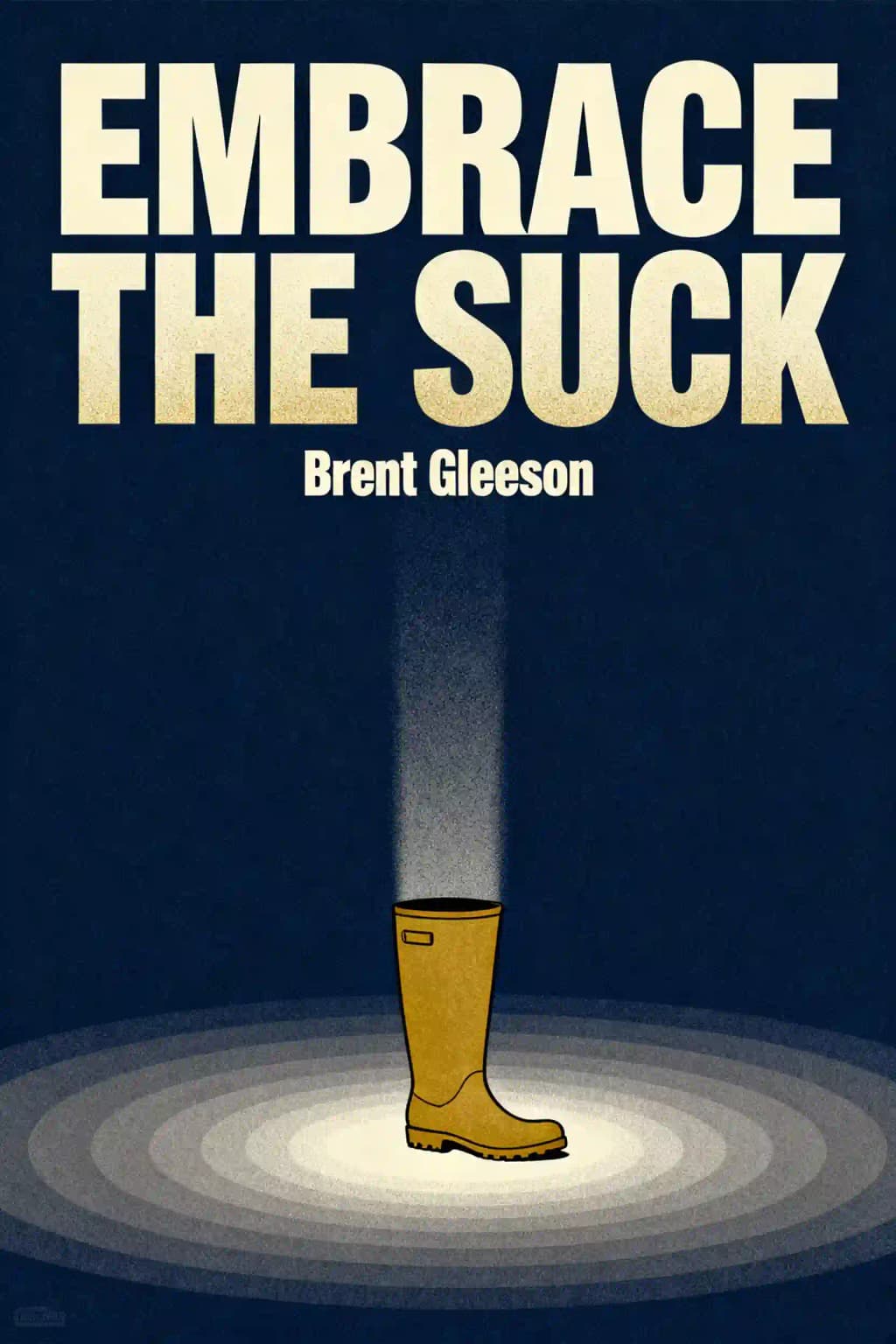
Have you ever wondered what separates those who crumble under pressure from those who thrive in it? Brent Gleeson's "Embrace the Suck" offers a masterclass in resilience from someone who has faced the most extreme physical and mental challenges imaginable. As a former Navy SEAL who transitioned into successful entrepreneurship, Gleeson provides a battle-tested roadmap for developing mental toughness that has resonated with readers worldwide, including celebrities like David Goggins and Jocko Willink who champion similar philosophies. The book has become required reading in many corporate leadership programs and elite sports teams' mental conditioning regimens. What makes this work particularly compelling is how it translates the brutal lessons of SEAL training-where the dropout rate exceeds 80%-into practical strategies for everyday challenges. Through vivid storytelling and actionable mental models, Gleeson shows us that our greatest growth happens precisely when we stop avoiding discomfort and instead learn to "embrace the suck."
第 2 章
Pain Is the Gateway to Extraordinary Growth
Pain is inevitable in life, but suffering is optional. This distinction forms the core philosophy of resilience training in the Navy SEALs. During BUD/S training in Coronado, California, Gleeson experienced the infamous Hell Week-five and a half days of constant physical torture, sleep deprivation, and psychological stress designed to break candidates. Standing waist-deep in the frigid Pacific Ocean at 2 AM, shivering uncontrollably while instructors shouted that quitting would bring immediate relief, Gleeson made a profound discovery: embracing the reality of pain rather than fighting against it transformed his experience.
The "rock portage" exercise vividly illustrates this concept. Teams carried heavy inflatable boats over jagged rocks near the Hotel del Coronado, leaving lasting scars on their hands and wrists. Gleeson's mother, watching briefly before retreating to their hotel room, couldn't bear to see her son's suffering. Yet this suffering had purpose-it was forging mental toughness that would serve him in future combat situations.
This approach aligns with Polish psychologist Kazimierz Dabrowski's theory that emotional pain is necessary for psychological growth. Dabrowski observed that periods of intense suffering often precede significant personal development-what he called "positive disintegration." We must break down before we can rebuild stronger.
Gleeson's Pain Transformation Process offers a practical framework: First, fully experience emotions rather than masking them with substances or distractions. Second, challenge your perspective on suffering-ask what you might learn from this experience. Third, surround yourself with positive influences while eliminating negative ones. Fourth, stay physically active to avoid dwelling on uncontrollable events. Fifth, recognize that "bad things come in threes" is merely confirmation bias. Finally, practice acceptance and forgiveness to release resentment.
When we transform pain into purposeful suffering-pain with meaning-we develop resilience that serves us in every area of life. The question isn't whether you'll experience pain, but whether you'll let it destroy you or transform you.
第 3 章
Reframing Adversity: Playing the Hand You're Dealt
Life deals bad cards to everyone, but winners don't blame luck-they create their own through vision, preparation, and resilience. Jason Redman's story exemplifies this mindset. As a Navy SEAL in Iraq, Jason took seven rounds during an ambush, including one that destroyed the right side of his face. Despite devastating injuries, he walked himself to the medevac helicopter and later posted a famous orange sign on his hospital door rejecting pity: "This is a room of fun, optimism, and intense rapid regrowth."
Over five years, Jason endured thirty-seven surgeries requiring 1,200 stitches, 200 staples, and fifteen skin grafts. Rather than being defined by this adversity, he transformed it into fuel for a new mission, becoming a successful entrepreneur, motivational speaker, and author. His story demonstrates that anyone with resolve can overcome seemingly insurmountable odds.
When faced with adversity, we often waste valuable time dwelling on why bad things happen rather than finding root causes and taking action. Gleeson introduces a five-step model to transform causal thinking into action-oriented execution:
1. Name the Shitty Thing That Happened: Acknowledge reality without sugarcoating.
2. Identify the High-Level Cause: Determine what broadly led to this situation.
3. Determine the Deep-Level Root Cause: Ask "why" five times, focusing only on factors within your control.
4. Document Lessons Learned: Conduct a personal after-action review.
5. Create an Action Plan: Develop specific, realistic, time-bound goals.
Using this model consistently builds mental calluses and emotional fortitude, enabling faster recovery from setbacks. The author emphasizes that anything truly worth achieving involves pain, adversity, or challenge-they're inseparable from winning. While you can't control what the "Wheel of Misfortune" has in store, you can control your response and how quickly you bounce back.
The key insight is that resilience isn't about avoiding difficult situations but developing the capacity to recover from them quickly and learn from each experience. As Gleeson notes, "Your capacity to bounce back from adversity is directly proportional to your willingness to own your situation."
第 4 章
Aligning Actions with Core Values
Core values serve as fundamental beliefs that guide principles and help distinguish right from wrong in both personal and professional contexts. Without clearly defined values, we drift aimlessly, making decisions based on convenience or immediate gratification rather than lasting conviction. Gleeson powerfully illustrates the importance of values through the story of John Skop, his BUD/S class leader who tragically died during Hell Week from pulmonary edema. Despite being an exceptional candidate with unwavering values of courage, commitment, and service to others, John's untimely death proved that life's brevity makes living by meaningful values all the more crucial.
The commanding officer's stark announcement-"Mr. Skop is dead"-and subsequent warning that this would be "the first of many brothers you'll lose" carried profound weight, foreshadowing the numerous SEAL funerals that would follow after 9/11. This harsh reality served as a powerful reminder that our time is finite and reinforced the critical importance of living authentically according to one's values, just as John had done until his final moments. His legacy continues to inspire others to live with purpose and conviction.
Gleeson introduces the Personal Values Manifesto, a comprehensive five-step process for clarifying and living by your core values:
1. Write core values on Post-it notes (examples: faith, integrity, wellness, family, courage, innovation, leadership, community service)
2. Categorize values into 4-6 core themes that represent your fundamental beliefs
3. List specific supporting behaviors for each value (e.g., for "family": weekly date nights, attending children's events, daily family meals)
4. Create specific accountability mechanisms (monthly reviews, accountability partners, tracking systems)
5. Document values prominently and keep them visible in your workspace and home
This structured process ensures that your daily actions consistently align with your deepest beliefs and long-term aspirations. Without this deliberate alignment, you risk sacrificing what matters most for short-term gains or external pressures. Gleeson illustrates this through contrasting stories: "Jeff," a successful executive who compromised his values for financial gain, ultimately losing his family, reputation, and freedom; and "John," who consistently lived by his values of integrity and service until his death, leaving a lasting positive impact on his community and family.
The Personal Values Manifesto serves as more than just a theoretical framework-it provides practical guardrails for making difficult decisions when faced with ethical dilemmas or temptations. By clearly defining and documenting what you stand for in advance, you create a moral compass that guides you through challenging situations. This becomes particularly crucial during times of stress or when facing pressure to compromise your principles for immediate benefits.
Regular review and refinement of your values ensure they evolve with your growth while maintaining their core essence. This dynamic approach to value-based living helps create a legacy of purposeful action and meaningful impact, regardless of life's duration.
第 5 章
Taming Temptation Tiger: Building Self-Control
Gleeson presents a powerful metaphor: you stand on a cliff edge gazing at "Glory Town" (your goals and ambitions) across a ravine where "Temptation Tiger" lives below. The tiger-sophisticated, charming, and offering immediate pleasures-invites you down for drinks, drugs, gambling, and companionship. Despite initial hesitation, you accept, only to wake up with nothing, unable to climb toward your real dreams.
This metaphor illustrates how temptation lures us away from our values and long-term goals. Gleeson shares his personal story of giving in to temptation during his youth, getting into a fight that left him with broken teeth and a battered face. This experience eventually led him to seek purpose through military service, training rigorously with his friend Matt to prepare for SEAL selection.
Self-control, Gleeson explains, is one of two key predictors of success in life (alongside intelligence), and unlike intelligence, it can be strengthened. Research shows self-control works like a muscle-it depletes with use but grows stronger with regular exercise. Studies demonstrate that people who begin exercise programs show improved self-control across multiple areas of life, from reduced procrastination to decreased impulsive spending.
The Taming Temptation Tiger mental model offers five components:
1. Clearly define your goals with measurable outcomes
2. Visualize winning by mentally rehearsing both the process and outcome
3. List obstacles and rank your weaknesses
4. Remove roadblocks by eliminating activities that impede progress
5. "Unfuck Yourself" by finding accountability partners and developing plans for rapid course correction when you falter
This framework provides practical strategies for resisting immediate gratification in favor of long-term success. By acknowledging our vulnerabilities and creating systems to overcome them, we build the mental fortitude needed to achieve our most ambitious goals.
第 6 章
Embracing Failure as a Pathway to Success
Failure is not just inevitable-it's essential for growth. Gleeson illustrates this through a humorous mission in Iraq where everything went wrong, from blown Humvee tires to getting stuck waist-deep in human waste. This vivid example shows how missions-and life-rarely go according to plan, requiring adaptability and resilience.
Gleeson connects this to his embarrassing first keynote speaking experience at the 2012 Inc. 500|5000 Conference, where editor-in-chief Eric Schurenberg bluntly told him his presentation "wasn't good." Rather than being discouraged, this feedback motivated him to improve. He shares examples of successful people who faced epic failures-Oprah Winfrey being fired from her first TV job, Jerry Seinfeld being booed off stage, and Walt Disney being told he "lacked imagination."
Professor Covington's research on self-worth protection shows how people develop defense mechanisms when they don't believe they can succeed. He categorizes students into four groups:
1. Success-Oriented Students who see failure as an improvement opportunity
2. Over-Strivers who fear failure and overexert themselves
3. Failure-Avoiding Students who do the bare minimum
4. Failure-Accepting Students who have accepted defeat as their reality
The healthiest approach is adopting the success-oriented mindset, viewing failure as feedback rather than a reflection of your worth. Gleeson presents Eight Failure Realities that explain how failure distorts perception, creates self-doubt, and can lead to self-sabotage. The antidote is focusing on what you can control-your "three-foot world," as illustrated by Mark Owen's rock climbing story.
To mitigate failure through calculated risk, Gleeson offers a framework: Define the Goal concisely; List Threats and Hazards; Identify Resources for Successful Execution; Assess Go/No-Go Criteria; and Always Debrief to document lessons for future attempts. This approach transforms failure from a devastating setback into a valuable learning opportunity.
第 7 章
Daily Discomfort: The Path to Extraordinary Achievement
David Goggins exemplifies the power of purposeful suffering. After leaving the Air Force, Goggins became an exterminator, gained weight, and fell into depression before deciding to transform his life. Despite weighing 297 pounds when he approached Navy recruiters about becoming a SEAL, Goggins lost significant weight and eventually graduated from BUD/S training after completing Hell Week three times.
His drive for purposeful suffering led him to attend Army Ranger School (graduating as Top Honor Man) and take up ultramarathon running to raise money for fallen special operations soldiers' families. With no prior experience, Goggins ran 101 miles in his first ultramarathon, qualified for the Boston Marathon, and placed fifth in the notoriously difficult Badwater 135. He constantly challenges himself, recently completing the five-day Moab 240 to "recertify myself as a savage."
Stress and anxiety can be powerful tools when properly harnessed rather than avoided. Behavioral psychologists Alia Crum and Thomas Crum developed a three-step model for using stress productively:
1. See it - acknowledge and identify the source of stress
2. Own it - recognize that we stress about things that matter to us
3. Use it - understand that the body's stress response evolved to enhance functioning
The key is shifting our perspective from anxiety to excitement and opportunity. Gleeson shares his own BUD/S preparation approach: "puke during or after every workout, push the limits every time"-a barbaric but effective method. For personal fitness goals, he recommends creating a "Wheel of Misfortune" with exercises targeting your weakest areas.
Over time, the discomfort dissipates and you may even begin to enjoy activities you once loathed. The principle applies across all domains-whether physical, professional, or personal. By consistently practicing the art of getting comfortable being uncomfortable, you expand your capacity for achievement in every area of life.
第 8 章
Choosing Worthy Suffering: The Purpose Behind Pain
Not all suffering is created equal. Gleeson recounts a mission in Iraq where, despite a 103-degree fever and stomach illness, he participated in a high-stakes operation that ended with him embarrassingly soiling himself during the assault. Despite his teammates' mockery and discomfort, he chose this suffering to fight alongside his brothers rather than sit out the mission.
Life presents us with approximately 35,000 choices daily, with even small decisions potentially creating butterfly effects with monumental consequences. Gleeson illustrates decision-making through a metaphor of a comfortable village surrounded by a mysterious forest. While villagers fear the unknown dangers beyond their borders, those with curiosity and inner fire eventually venture out despite potential discomfort, pain, or even death.
The initial journey brings cold, darkness, and fear, making one nostalgic for comfort. But surviving the first night proves the risk worthwhile. As Churchill advised: "When you're in hell, just keep going." After enduring these challenges, you discover a thriving metropolis beyond the forest-a paradise you'd never have found without leaving your comfort zone.
The Embrace the Suck model offers five research-backed suffering practices:
1. Find safe relationships to process suffering - social support is crucial for coping with trials.
2. Face and express emotions rather than suppressing them, which can lead to anxiety and depression.
3. Process emotions completely through their natural arc to experience their adaptive benefits.
4. Reflect on and reorder priorities by intentionally changing routines to align with what truly matters.
5. Use your suffering experiences to help others, creating meaning and redemption from pain.
Whether pain comes from choice or circumstance, purposeful suffering leads to a better life. BUD/S graduates endure because they accept suffering as a pathway to their goal. This applies equally to elite athletes, entrepreneurs, or anyone expanding their comfort zone for something they're passionate about. By embracing the suck and the "good problems" that follow, you'll find your version of greatness.
第 9 章
Discipline and Accountability: The Foundation of Achievement
In BUD/S training, students are divided into boat crews that teach teamwork, communication, discipline, and accountability-skills essential for battlefield success. The most successful crews demonstrate members who prioritize their teammates over themselves, creating a high-performance web. These crews develop specific communication protocols, establish clear roles, and maintain unwavering focus on mission objectives. During Hell Week, disciplined crews work collaboratively, hold each other accountable, and continuously improve (kaizen), while undisciplined crews fall apart under pressure. The contrast becomes evident in critical exercises like log PT and beach runs, where coordinated teams maintain formation and rhythm while others struggle with basic coordination.
Dave Schlotterbeck's transformation of Alaris Medical Systems demonstrates how accountability drives organizational change. Finding his company paralyzed by fear and lack of discipline, Dave implemented a culture-driven transformation that aligned rituals and beliefs with necessary actions. He introduced daily accountability meetings, transparent performance metrics, and peer review systems. Team leaders were required to post weekly progress reports and conduct monthly strategy reviews. Within three years, Alaris increased share price from $0.31 to $22.35, growing 15% annually in a market where competitors achieved only 3%. This remarkable turnaround was achieved through systematic implementation of accountability measures at every organizational level.
Self-discipline is essential for expanding beyond your comfort zone. The nine-step process for mastering self-discipline includes:
1. Know your weaknesses through honest self-assessment - conduct regular performance reviews and seek feedback from mentors
2. Remove temptations from your environment - create a workspace that minimizes distractions and supports focused work
3. Set clear goals with execution plans - develop SMART objectives with specific milestones and deadlines
4. Practice daily diligence to build habits - establish morning routines and regular check-ins
5. Create new habits through simple, manageable steps - start with 5-minute commitments that gradually expand
6. Change your perception about willpower to see it as unlimited - reframe challenges as opportunities for growth
7. Develop contingency plans for challenges - create if-then scenarios for potential obstacles
8. Find coaches who provide constructive feedback - build a network of mentors and accountability partners
9. Forgive yourself when you fall short - use setbacks as learning opportunities rather than defeat
Without discipline, you become like a jellyfish, carried by external forces rather than steering your own life. This manifests in missed deadlines, unfulfilled potential, and a reactive rather than proactive approach to challenges. True self-discipline transforms you from a passive drifter into an active doer who controls their destiny. It enables consistent progress toward goals, resilience in face of setbacks, and the ability to maintain focus despite distractions. Successful individuals consistently attribute their achievements not to talent alone, but to the unwavering discipline that turns potential into reality.
第 10 章
Executing with Purpose: The Outcome Pyramid
No plan survives first contact with the enemy, but proper preparation and violent execution are essential for success. Gleeson recounts his first combat mission in Iraq, where his SEAL team was tasked with securing a strategically critical hydroelectric dam. During the fast-rope insertion from a Black Hawk helicopter hovering 60 feet above the target, his equipment caught on the helicopter floor, leaving him dangling twenty feet above concrete with a raging river on both sides. When finally freed, he hit hard, splitting his eyebrow open to the bone. Despite this potentially devastating setback, he quickly recovered, controlled his adrenaline response, and caught up with his team as they breached the facility - demonstrating the SEAL principle that mission success always comes before personal comfort.
The Outcome Pyramid serves as a comprehensive framework that ties everything together, showing how to move from existing results toward desired outcomes through five interconnected layers:
1. At the top sits your clear, quantifiable, time-bound Outcome. This must be specific and measurable - not "improve sales" but "increase Q4 revenue by 25% over last year."
2. Below that are Actions - your detailed tactical plan to achieve that outcome. This includes specific initiatives, milestones, and metrics to track progress. For example, if the outcome is revenue growth, actions might include launching three new products, expanding into two new territories, and implementing a new sales training program.
3. The third tier contains Beliefs - your Personal Values Manifesto that drives your actions. These core values serve as decision-making filters and behavior guides. Examples include integrity, excellence, innovation, and accountability.
4. The fourth tier is Purpose - your overarching "why" that influences your values. This is your mission, your reason for existing beyond profit. It answers the question: "What difference are we trying to make in the world?"
5. The foundation is Rituals - the daily practices that support everything above. These might include morning planning sessions, weekly team reviews, monthly strategic assessments, and regular training or development activities.
The pyramid ensures vertical alignment between tactical execution and strategic vision, helping leaders model the right mindset and behavior for violent execution. Each layer reinforces the others - rituals support purpose, purpose shapes beliefs, beliefs guide actions, and actions deliver outcomes. When properly aligned, this creates unstoppable momentum toward your goals.
Remember, a good plan executed violently today beats a perfect plan next week - because perfect plans don't exist, and tomorrow brings new challenges. The key is maintaining flexibility while staying true to your purpose and values. Like Gleeson's experience at the dam, unexpected challenges will arise, but proper preparation and unwavering commitment to the mission enable you to adapt and overcome.
第 11 章
Facing Mortality: Living a Life Without Regrets
Humans have a 100% mortality rate, yet we fear death's unknown aspects-when, how, why, and what we'll accomplish before it comes. Death gives life meaning; without it, everything would be inconsequential. We must live purposefully, so when our time comes, we can say "I'm ready."
Gleeson shares the profound impact of losing fellow SEALs in Afghanistan during Operation Red Wings in 2005. Attending Mike Murphy's funeral at Calverton National Cemetery, he witnessed the solemn tradition of teammates hammering their Trident pins into Mike's casket. This operation resulted in the largest loss of life for US forces since the Afghanistan invasion began, and the largest SEAL loss since Vietnam.
Drawing on Stephen Covey's principle "Begin With the End in Mind," Gleeson challenges readers to consider what they want people to say at their eulogy. Will they talk about material possessions and achievements, or virtues, character, and relationships? Most of us want to be remembered for our integrity, kindness, and the impact we had on others-not our job titles or possessions. When we know how we want to be remembered, we can take daily actions that align with that vision.
We're all going to have to "sing our death song" someday. What mark do you want to leave on the world? What do you absolutely not want to regret when your time comes? Will you reflect back knowing you played it safe, or that you left everything on the battlefield of life?
As we conclude this journey, it's time for you to step onto your battlefield and go to war with yourself. Build resilience, set lofty goals, pursue excellence, and master maximum performance. Remember the key Navy SEAL principles: Embrace the suck. The only easy day was yesterday. Get comfortable being uncomfortable. And finally, never be out of the fight-Numquam Proelia Derelinquam.