In "Purple Hibiscus," Adichie's stunning debut explores freedom amid tyranny. Compared to Achebe by Yale scholars and praised by Ondaatje and Rushdie, this Commonwealth Prize winner inspired Ibrahim Mahama's massive Barbican installation. What price do we pay for silence?
Chimamanda Ngozi Adichie is an acclaimed Nigerian novelist and feminist icon, author of Purple Hibiscus, a groundbreaking coming-of-age novel exploring family, religion, and political upheaval in postcolonial Nigeria. Born in Enugu in 1977 and raised on the University of Nigeria campus, Adichie draws from her Igbo heritage and firsthand experiences of societal transition to craft this emotionally charged debut.
A graduate of Johns Hopkins’ Creative Writing program and Yale’s African History program, she masterfully interweaves personal and political narratives, establishing themes of liberation and identity that recur in her later works like Half of a Yellow Sun (Orange Prize winner) and Americanah (National Book Critics Circle Award finalist).
Renowned for her TED Talks “The Danger of a Single Story” and “We Should All Be Feminists” (sampled in Beyoncé’s music), Adichie received a MacArthur “Genius Grant” in 2008. Purple Hibiscus, her first novel, has sold over 1 million copies worldwide, been translated into 30 languages, and remains a staple in global literature curricula.
Purple Hibiscus follows 15-year-old Kambili Achike as she navigates life under her abusive father, Eugene, a wealthy Catholic extremist in post-colonial Nigeria. The novel explores themes of religious hypocrisy, familial trauma, and cultural identity through Kambili’s journey of self-discovery during a visit to her progressive aunt, Aunty Ifeoma.
This book is ideal for readers interested in post-colonial African literature, feminist narratives, and stories of resilience. It resonates with those exploring themes of religious intolerance, domestic violence, or the clash between tradition and modernity.
Key themes include religious hypocrisy (Eugene’s violent piety vs. his exploitation of workers), silence vs. speech (Kambili’s journey to finding her voice), and colonialism’s legacy (contrasted with Igbo traditions). The purple hibiscus symbolizes rare, hard-won freedom.
The Achike family embodies oppression and resistance: Eugene’s tyrannical rule contrasts with Aunty Ifeoma’s nurturing household. Kambili’s mother, Beatrice, silently endures abuse, while brother Jaja rebels, culminating in patricide.
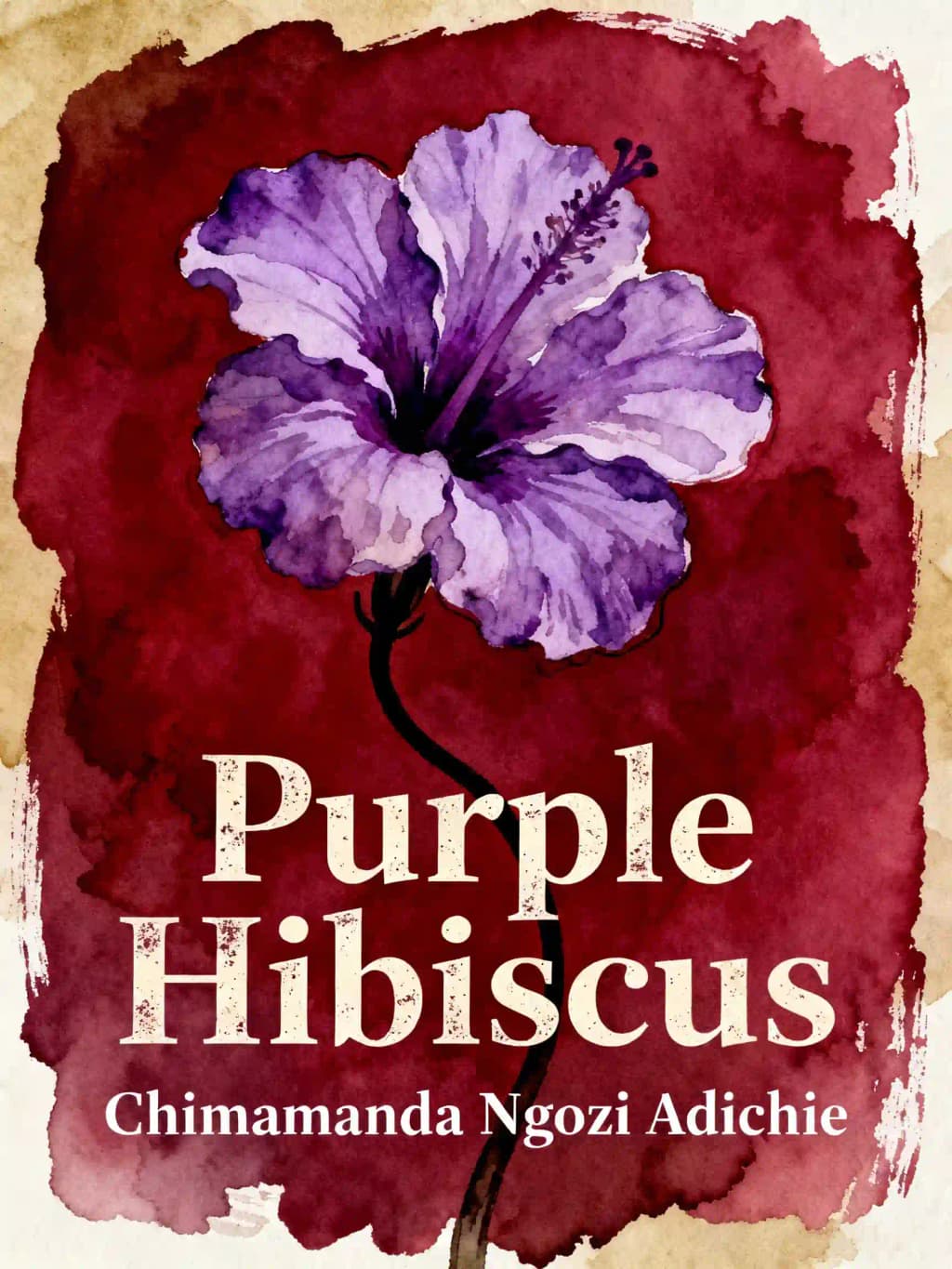
The genetically modified flower symbolizes hybridity—blending tradition and modernity, resilience in harsh conditions. Its growth mirrors Kambili and Jaja’s liberation from their father’s control.
Eugene weaponizes Catholicism to justify abuse, while Aunty Ifeoma blends faith with Igbo traditions. Kambili’s evolving spirituality embraces both prayer and ancestral reverence, rejecting dogmatism.
Post-colonial Nigeria’s political instability mirrors familial tyranny. Eugene’s wealth stems from colonial-era exploitation, while Aunty Ifeoma’s activism critiques corrupt governance tied to colonial legacies.
Initially silenced by fear, Kambili gains agency through her bond with Aunty Ifeoma and Father Amadi. Her forbidden romance and newfound critical thinking mark her transition to selfhood.
Some argue the novel’s portrayal of domestic violence risks sensationalism, while its binary depiction of tradition vs. colonialism oversimplifies Nigeria’s cultural complexity.
Themes of authoritarianism, religious extremism, and women’s resilience remain urgent. Its critique of toxic patriarchies aligns with global #MeToo and decolonial movements.
While sharing themes of identity and politics, Purple Hibiscus is more introspective than Half of a Yellow Sun’s historical scope. Its lyrical simplicity contrasts with Americanah’s transnational satire.
通过作者的声音感受这本书
将知识转化为引人入胜、富含实例的见解
快速捕捉核心观点,高效学习
以有趣互动的方式享受这本书
Adichie came almost fully made.
It's not your fault.
I cannot have a heathen in my house.
We don't sing at home.
Words spurted from everyone.
将《Purple Hibiscus》的核心观点拆解为易于理解的要点,了解创新团队如何创造、协作和成长。
将《Purple Hibiscus》提炼为快速记忆要点,突出坦诚、团队合作和创造力的关键原则。

通过生动的故事体验《Purple Hibiscus》,将创新经验转化为令人难忘且可应用的精彩时刻。
随心提问,选择声音,共同创造真正与你产生共鸣的见解。

"Instead of endless scrolling, I just hit play on BeFreed. It saves me so much time."
"I never knew where to start with nonfiction—BeFreed’s book lists turned into podcasts gave me a clear path."
"Perfect balance between learning and entertainment. Finished ‘Thinking, Fast and Slow’ on my commute this week."
"Crazy how much I learned while walking the dog. BeFreed = small habits → big gains."
"Reading used to feel like a chore. Now it’s just part of my lifestyle."
"Feels effortless compared to reading. I’ve finished 6 books this month already."
"BeFreed turned my guilty doomscrolling into something that feels productive and inspiring."
"BeFreed turned my commute into learning time. 20-min podcasts are perfect for finishing books I never had time for."
"BeFreed replaced my podcast queue. Imagine Spotify for books — that’s it. 🙌"
"It is great for me to learn something from the book without reading it."
"The themed book list podcasts help me connect ideas across authors—like a guided audio journey."
"Makes me feel smarter every time before going to work"

免费获取《Purple Hibiscus》摘要的 PDF 或 EPUB 版本。可打印或随时离线阅读。
What does it cost to be perfect? For fifteen-year-old Kambili Achike, perfection means speaking only when spoken to, earning top marks in every subject, and never questioning her father's rigid schedule. It means living in a sprawling mansion in Enugu, Nigeria, yet feeling suffocated by silence. Through Kambili's eyes, we enter a world where wealth and brutality coexist, where a man celebrated as a community hero terrorizes his own family behind closed doors. Chimamanda Ngozi Adichie's stunning debut captures the suffocating weight of domestic violence wrapped in religious devotion, set against Nigeria's turbulent political landscape of the 1990s. Before she became globally renowned for "Half of a Yellow Sun" and her viral TED talk, Adichie crafted this intimate portrait of a family's unraveling-a story so vivid and heartbreaking that Chinua Achebe himself declared she "came almost fully made" as a writer.