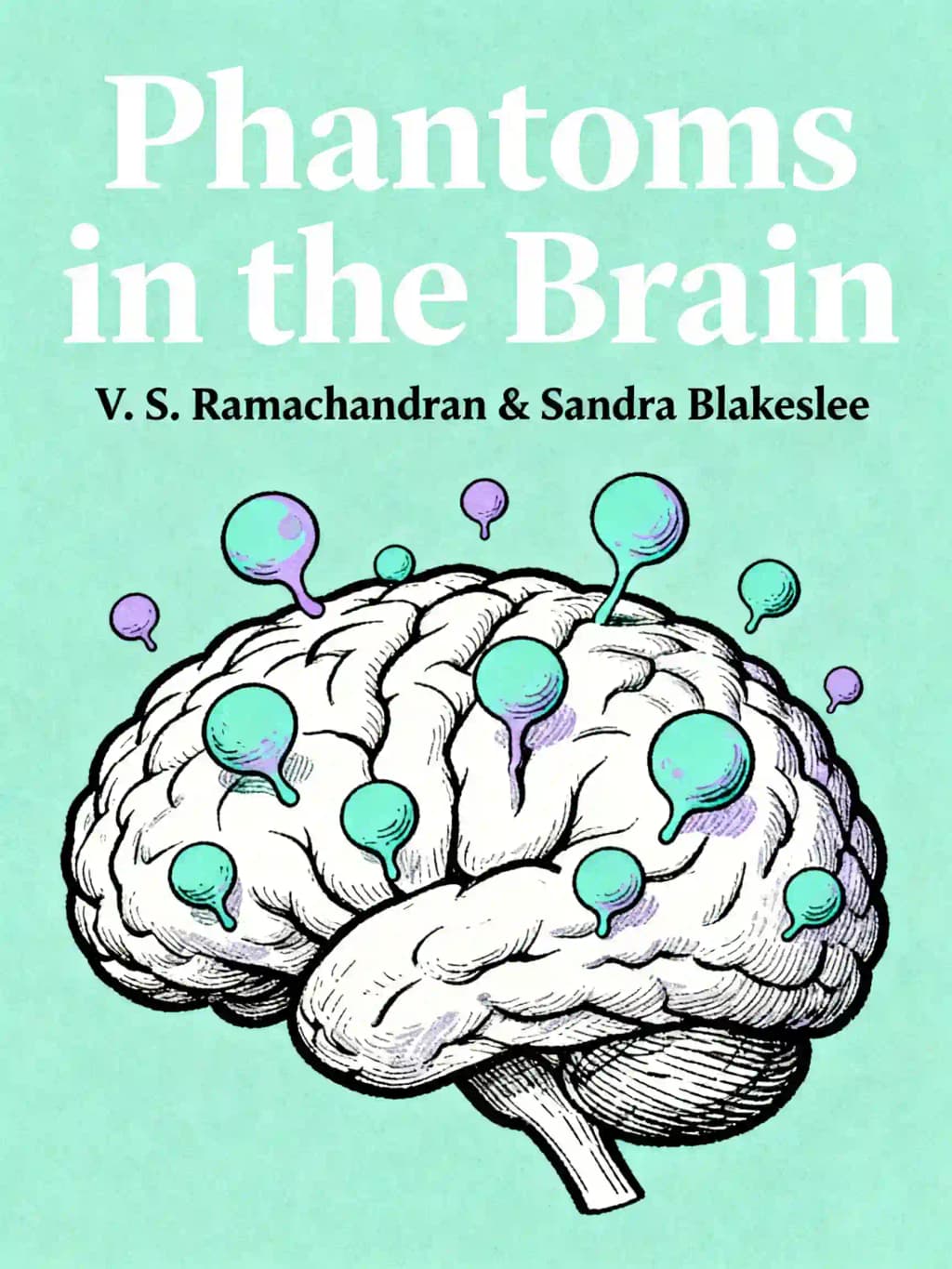
Journey into the brain's hidden world with Ramachandran's groundbreaking exploration of phantom limbs and neural plasticity. Translated into nine languages and adapted for PBS, this bestseller reveals why Richard Dawkins called him "The Marco Polo of neuroscience." What mysteries lurk in your own mind?
V.S. Ramachandran, a pioneering neuroscientist, and Sandra Blakeslee, a New York Times science writer, co-authored the bestselling book Phantoms in the Brain: Probing the Mysteries of the Human Mind. Ramachandran, director of the Center for Brain and Cognition at UC San Diego, combines his clinical work with neurological disorders like phantom limbs and Capgras delusion to explore consciousness and brain plasticity.
Blakeslee, renowned for translating complex science into accessible narratives, brings decades of reporting on neuroscience to the collaboration. The book’s blend of case studies and neurophilosophy cemented its status as a pop-science classic, adapted into a PBS NOVA special and translated into nine languages.
Ramachandran’s other works, including The Tell-Tale Brain and The Emerging Mind (based on his BBC Reith Lectures), further dissect brain-behavior relationships. Blakeslee has co-authored influential books like On Intelligence and The Body Has a Mind of Its Own.
Phantoms in the Brain remains a cornerstone of neuroscience literature, praised for bridging clinical insight with broader questions about human identity.
Phantoms in the Brain explores neurological mysteries through case studies of patients with conditions like phantom limbs, hallucinations, and brain damage. V.S. Ramachandran uses these examples to explain perception, self-deception, and brain adaptability, blending scientific rigor with accessible storytelling. Key themes include sensory map reorganization and the brain’s resource-saving strategies.
This book suits neuroscience enthusiasts, psychology students, and curious general readers. Ramachandran’s engaging style makes complex topics like neuroplasticity and consciousness accessible without oversimplification. Professionals in healthcare or education will also appreciate its insights into brain dysfunction and rehabilitation strategies.
Yes—it’s a landmark work for its pioneering insights into brain function. Critics praise its inventive experiments (like mirror therapy for phantom pain) and thought-provoking theories. The blend of clinical cases, humor, and clear explanations makes it both informative and entertaining.
Phantom limbs arise from the brain’s sensory cortex reorganizing after amputation, where adjacent body regions “invade” the missing limb’s neural territory. Ramachandran demonstrates how visual feedback via mirrors can alleviate pain, showcasing the brain’s adaptability.
Ramachandran links Capgras to a disconnect between facial recognition and emotional processing. Damage to the amygdala-limbic system prevents patients from feeling familiarity, leading them to believe loved ones are impostors. This highlights the brain’s role in constructing emotional meaning.
Anosognosia is a condition where patients deny disabilities (e.g., paralysis). Ramachandran suggests it’s a psychological defense mechanism: the brain creates plausible narratives to avoid confronting traumatic reality, revealing how self-awareness and denial are neurologically intertwined.
Ramachandran discusses mirror neurons—cells activating when observing others’ actions—as key to empathy, learning, and cultural evolution. He speculates they may explain phenomena like laughter and art, though notes this remains theoretical.
The final chapter tackles the “hard problem” of consciousness, arguing qualia (subjective experiences) arise from brain activity. Ramachandran critiques dualism, proposing consciousness emerges from neural interactions, though acknowledges gaps in understanding self-awareness.
His iconic mirror box lets patients “move” phantom limbs by reflecting their intact limb. This visual trickery rewires faulty brain maps, reducing pain and paralysis—a breakthrough in neurorehabilitation.
Ramachandran advocates low-tech, patient-centered methods over expensive imaging. By studying quirks like phantom breasts or religious euphoria post-seizures, he reveals broader principles about brain modularity and adaptability.
Some scientists note Ramachandran’s theories are speculative, relying on small case studies. However, his creative hypotheses—like laughter evolving as a “false alarm” signal—are praised for sparking new research directions.
Like Sacks, Ramachandran uses patient stories to humanize neurology. However, he emphasizes testable hypotheses over narrative, blending clinical observation with evolutionary psychology. Sacks himself endorsed the book in its foreword.
通过作者的声音感受这本书
将知识转化为引人入胜、富含实例的见解
快速捕捉核心观点,高效学习
以有趣互动的方式享受这本书
Neuroscience is still in its early 'experiment-driven' stage.
Once we understand brain functions better, the question of 'where' becomes less important than 'how.'
Each neuron exists in dynamic equilibrium with adjacent neurons.
The brain's ability to create reality.
The brain operates through extraordinarily dynamic connections.
将《Phantoms in the Brain》的核心观点拆解为易于理解的要点,了解创新团队如何创造、协作和成长。
将《Phantoms in the Brain》提炼为快速记忆要点,突出坦诚、团队合作和创造力的关键原则。

通过生动的故事体验《Phantoms in the Brain》,将创新经验转化为令人难忘且可应用的精彩时刻。
随心提问,选择声音,共同创造真正与你产生共鸣的见解。

"Instead of endless scrolling, I just hit play on BeFreed. It saves me so much time."
"I never knew where to start with nonfiction—BeFreed’s book lists turned into podcasts gave me a clear path."
"Perfect balance between learning and entertainment. Finished ‘Thinking, Fast and Slow’ on my commute this week."
"Crazy how much I learned while walking the dog. BeFreed = small habits → big gains."
"Reading used to feel like a chore. Now it’s just part of my lifestyle."
"Feels effortless compared to reading. I’ve finished 6 books this month already."
"BeFreed turned my guilty doomscrolling into something that feels productive and inspiring."
"BeFreed turned my commute into learning time. 20-min podcasts are perfect for finishing books I never had time for."
"BeFreed replaced my podcast queue. Imagine Spotify for books — that’s it. 🙌"
"It is great for me to learn something from the book without reading it."
"The themed book list podcasts help me connect ideas across authors—like a guided audio journey."
"Makes me feel smarter every time before going to work"

免费获取《Phantoms in the Brain》摘要的 PDF 或 EPUB 版本。可打印或随时离线阅读。
A man reaches for his coffee with an arm that no longer exists. A woman insists her paralyzed hand works perfectly, even as it lies motionless. Another patient laughs uncontrollably at her mother's funeral, unable to stop despite her horror. These aren't tales from science fiction-they're real neurological conditions that reveal something extraordinary: your brain is constantly constructing the reality you experience, and sometimes that construction goes spectacularly wrong. Through these medical mysteries, we discover that consciousness isn't a passive receiver of information but an active storyteller, constantly editing and revising the narrative of who we are and what we perceive. Each bizarre symptom becomes a clue in understanding how our minds create the seamless experience we call reality.