第 1 章
A Tale of Dreams and Dust: The American Tragedy
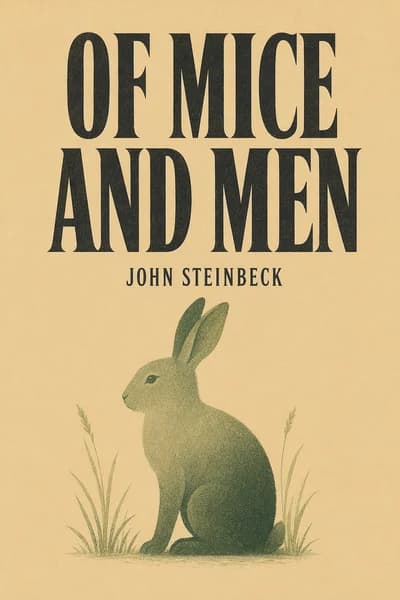
Of Mice and Men stands as one of literature's most heartbreaking explorations of friendship and shattered dreams. Published in 1937 during the depths of the Great Depression, John Steinbeck's novella continues to resonate with readers nearly a century later. The book sells over 1 million copies annually and remains a staple in American classrooms despite frequent attempts to ban it. Celebrities from James Franco to John Krasinski have cited it as formative reading, and its cultural impact extends from Broadway adaptations to countless parodies (including Chris Farley's famous SNL sketch where he crushes a rabbit). What makes this slim volume so enduring? Perhaps it's the universal struggle it captures-the tension between our dreams and the harsh realities that often crush them, just as surely as Lennie crushes the soft things he loves too much.
第 2 章
The Unlikely Friendship at the Heart of Tragedy
In Depression-era California, we meet two migrant workers bound by an unusual friendship. George Milton, small but sharp-witted, serves as protector and guide to Lennie Small, whose massive physical strength contrasts sharply with his childlike mind. Their relationship immediately stands out as extraordinary in a world where most ranch workers travel alone, suspicious and self-protective. They move from job to job together, sharing meals, conversations, and a vision of the future that sustains them through the harshest conditions of 1930s agricultural work.
"Guys like us, that work on ranches, are the loneliest guys in the world," George explains. "They got no family. They don't belong no place." Yet George and Lennie have something special-each other. Their connection provides mutual benefits: George gains purpose through caring for Lennie, while Lennie receives protection and guidance he couldn't manage alone. The dynamic between them reflects a deeper human need for companionship, made more poignant by the isolation that surrounds them in the dusty California valleys.
Their friendship revolves around a shared dream-owning a small farm where they'll "live off the fatta the land" and where Lennie can tend rabbits. This vision sustains them through hardship, giving meaning to their difficult existence. George recites it like a bedtime story when Lennie needs comfort, and Lennie has memorized his role in the telling. The dream becomes almost liturgical, a ritual that reinforces their bond and provides hope in an otherwise bleak landscape. Each telling adds details: the alfalfa for the rabbits, the patch of garden, the fruit trees, and the safety of having their own place where no one can throw them out.
What makes their bond particularly poignant is its unspoken nature. These men don't discuss their feelings directly-that's not the ranch worker way. Instead, George shows his care through actions: protecting Lennie from trouble, ensuring he has food, and repeatedly rescuing him from situations his limited understanding creates. When George claims they simply "got used to each other," we understand this understatement masks deeper attachment. Their relationship echoes the complexity of family bonds, with George assuming both brotherly and paternal roles, teaching Lennie everything from basic hygiene to workplace behavior.
Their relationship faces constant external pressures. The ranch environment breeds suspicion about any close male friendship, as shown when the boss questions why George speaks for Lennie. Other workers eye them warily, wondering about their motives for staying together. In a world where self-interest dominates, their mutual loyalty appears almost incomprehensible to others. The harsh realities of Depression-era survival make their friendship seem both more precious and more vulnerable. Yet this very loyalty ultimately leads to the story's tragic conclusion, when George must make the devastating choice to kill Lennie mercifully rather than let him face Curley's vengeful mob - a final act of protection that demonstrates both the depth of their bond and the cruel circumstances that destroy it.
第 3 章
The Dream That Sustains and Destroys
"Everybody wants a little piece of land," Crooks observes bitterly. "Nobody never gets to heaven, and nobody gets no land." Yet the dream of owning property persists as the central motivating force throughout the novella.
For George and Lennie, their farm fantasy represents more than mere property ownership-it embodies freedom, security, and dignity. They envision a place where they answer to no boss, where they can welcome friends and turn away enemies, where they can plant crops and raise animals according to their own judgment. Most importantly, it represents permanence in their transient lives.
"We got a future," George declares when the dream seems within reach. "We got somebody to talk to that gives a damn about us." This statement reveals the dream's true power-it provides hope and human connection in a world characterized by isolation.
The dream gains momentum when old swamper Candy offers his savings toward purchasing the land. Suddenly, what seemed like a distant fantasy becomes potentially achievable. "I been thinking about it a lot," Candy says. "We could live there, not just stay a little while." For Candy, the dream represents escape from the fate awaiting him when he's too old for ranch work-being "canned" like his ancient dog.
Even Crooks, the isolated Black stable hand, briefly allows himself to imagine joining their venture before reality reasserts itself. The dream's infectious quality reveals how desperately each character longs for something better than their current circumstances.
Ultimately, the dream collapses under reality's weight when Lennie accidentally kills Curley's wife. As George realizes what has happened, he understands their dream has died too. The novella's final scene, where George recites their farm vision one last time before shooting Lennie, transforms their shared dream from source of hope to bittersweet eulogy.
Steinbeck suggests dreams serve dual purposes-they provide essential psychological sustenance while simultaneously setting us up for heartbreak when they inevitably collide with reality. Yet even knowing this, we continue dreaming because the alternative-living without hope-proves unbearable.
第 4 章
The Outsiders: Prejudice and Marginalization
The ranch microcosm reveals America's entrenched prejudices through characters defined by their differences. Crooks, segregated in his own room because of his race, has internalized society's judgment. "A guy goes nuts if he ain't got nobody," he tells Lennie. "I tell ya a guy gets too lonely an' he gets sick." Yet when Candy suggests he might join their farm venture, Crooks immediately retreats, conditioned by experience to expect disappointment.
Curley's wife-significantly never given a name beyond her husband's possession-represents women's limited options. Her dreams of Hollywood stardom gave way to a loveless marriage where she serves as trophy and prisoner. "I coulda made somethin' of myself," she laments, revealing thwarted ambition beneath her flirtatious exterior. Her isolation drives her to seek attention from the ranch hands, behavior that ultimately leads to her death.
Candy fears becoming useless as age diminishes his abilities. After his dog is shot, he recognizes his own fate: "They'll put me on the county when I'm no good anymore." His eagerness to join George and Lennie's venture stems from desperate desire to secure his future before he's discarded.
Lennie's mental disability makes him vulnerable despite his physical strength. His inability to understand social norms or control his actions repeatedly endangers him. George must constantly intervene, explaining, "Lennie's a God damn nuisance most of the time, but you get used to goin' around with a guy an' you can't get rid of him."
What's striking is how these characters accept their marginalization as inevitable rather than unjust. They've so thoroughly absorbed society's prejudices that they see their treatment as natural, not worth fighting against. Even more revealing is how they sometimes turn against each other rather than forming alliances. When threatened, Curley's wife immediately reminds Crooks of his vulnerability: "I could get you strung up on a tree so easy it ain't even funny."
Steinbeck suggests prejudice creates isolation not just through external barriers but by teaching the marginalized to distrust potential allies. The characters' brief moments of connection-like when Lennie visits Crooks's room-show possibilities for solidarity that ultimately remain unrealized.
第 5 章
The Harsh Reality of Depression-Era America
Steinbeck's novella provides an unflinching portrait of rural America during the Great Depression. The ranch setting, with its bunkhouse, stable, and barley fields, represents thousands of similar agricultural operations where migrant workers labored for minimal wages under difficult conditions.
The economic desperation of the era shapes every character's decisions and outlook. Men travel from ranch to ranch seeking temporary work, carrying their possessions in bindles, saving what little they can while spending the rest on whiskey and visits to "cat houses" on Saturday nights. This cycle keeps them perpetually poor and rootless, unable to establish permanent homes or relationships.
"I seen hundreds of men come by on the road an' on the ranches, with their bindles on their back an' that same damn thing in their heads," Crooks observes. "Every damn one of 'em's got a little piece of land in his head. An' never a God damn one of 'em ever gets it."
The ranch hierarchy reflects America's social stratification. At the top sits the boss, who makes brief appearances to assert authority. Below him is his son Curley, whose position comes from nepotism rather than merit. Slim, the skilled jerkline skinner, earns respect through competence rather than status. At the bottom are the common laborers, with Crooks further marginalized by race and Candy vulnerable due to age and disability.
Women occupy a particularly difficult position in this world. The only females mentioned are either absent mothers (like Lennie's Aunt Clara), prostitutes at the local brothel, or Curley's wife-whose presence on the all-male ranch makes her both powerful through her sexuality and vulnerable through her isolation.
The novella's setting isn't just geographic but temporal-taking place over a mere three days, emphasizing how quickly circumstances can change and dreams can shatter. This compressed timeline heightens the sense of inevitability in the tragic conclusion, suggesting the characters were doomed from the start by economic and social forces beyond their control.
第 6 章
Violence as Communication and Control
Violence permeates the ranch environment, functioning as both communication method and control mechanism. Physical aggression replaces dialogue when words prove inadequate, and threats of violence maintain the social order. The ranch workers, trapped in their harsh economic reality, resort to physical dominance as their primary means of establishing hierarchy and resolving conflicts, revealing a primitive social structure where might often equals right.
Curley, compensating for his small stature, uses his boxing skills to intimidate others. His aggressive behavior stems from a deep-seated need to prove himself, particularly as the boss's son, making him especially dangerous. He specifically targets Lennie, sensing vulnerability despite his size, and his constant antagonism creates a pressure cooker atmosphere on the ranch. When the confrontation finally occurs, Lennie's crushing of Curley's hand demonstrates how quickly violence escalates beyond control-a pattern that repeats with fatal consequences. The incident serves as a microcosm of the ranch's violent culture, where minor provocations can lead to devastating outcomes.
Even George, who cares deeply for Lennie, occasionally resorts to harsh words and threats. "If I was alone I could live so easy," he vents after Lennie causes trouble, revealing the complex nature of their relationship. Though he doesn't mean it literally, his frustration emerges as verbal aggression because he lacks other emotional vocabulary. These outbursts highlight how violence, whether physical or verbal, becomes the default language of the powerless.
The most disturbing violence involves Lennie, whose inability to control his strength leads to unintended deaths-mice, puppies, and ultimately Curley's wife. His actions highlight the tragic gap between intention and consequence, demonstrating how destructive force can be, even when wielded without malice. "I don't want to hurt you," he tells the dead puppy, "but you wasn't big enough." This pattern of accidental destruction builds throughout the narrative, creating an inevitable trajectory toward tragedy.
The novella's most significant act of violence-George shooting Lennie-paradoxically stems from love rather than hatred. By killing Lennie quickly and painlessly while he envisions their dream farm, George spares him from Curley's vengeful mob. This mercy killing represents the culmination of George's care for Lennie, even as it destroys their relationship and dream. The act serves as both protection and sacrifice, highlighting the complex moral landscape where violence can be an expression of love.
Carlson's earlier shooting of Candy's dog foreshadows this conclusion. Both killings are presented as necessary acts of compassion, yet both leave survivors devastated. After his dog's death, Candy laments, "I ought to of shot that dog myself," recognizing that taking responsibility would have provided some dignity in the painful situation. These parallel mercy killings suggest that in this harsh world, even acts of kindness must be expressed through violence.
Steinbeck suggests violence emerges inevitably from environments where men lack power over their circumstances. Unable to control their economic situation or future prospects, they assert control through physical dominance over others, creating cycles of aggression that ultimately solve nothing. The ranch becomes a microcosm of society where violence serves as both the language of the powerless and the tool of the powerful, creating a tragic cycle that traps all participants in its destructive pattern.
第 7 章
The Natural World: Beauty and Indifference
Steinbeck frames his novella with peaceful natural settings that contrast sharply with human cruelty. The story opens and closes at a tranquil pool beside the Salinas River, where sycamores rustle and wildlife thrives - rabbits emerge from the brush, herons stand motionless in the shallows, and water snakes glide smoothly across the surface. This natural sanctuary temporarily shields George and Lennie from human judgment, creating moments of pure serenity that stand in stark contrast to the harsh realities of their migrant worker existence. Yet even here, nature's indifference to suffering becomes apparent in the presence of predators and the cycle of life and death.
Lennie's relationship with animals serves as both characterization and foreshadowing. He loves petting soft creatures - mice, rabbits, puppies - but cannot moderate his strength, resulting in repeated accidental killings. This pattern of loving something to death serves as tragic metaphor for his ultimate fate. His interactions with animals reveal his childlike nature: the pure joy he takes in stroking soft fur, his genuine distress when he hurts creatures he loves, and his inability to learn from past mistakes. When he mourns his dead puppy, saying "I didn't bounce you hard," we glimpse both his genuine remorse and his fundamental inability to understand consequences, a dual nature that makes his character both sympathetic and ultimately dangerous.
The natural world operates according to different rules than human society, following laws of survival and necessity rather than moral considerations. Slim, who embodies practical wisdom throughout the novel, demonstrates this when he matter-of-factly drowns excess puppies: "If you want to keep 'em all, you got to raise 'em all. That's a lot of pups." His action, while seemingly harsh to modern sensibilities, acknowledges natural limitations without sentimentality. This practical approach to life and death in nature contrasts with the more complex moral decisions humans face in society.
Steinbeck frequently describes Lennie using animal imagery - comparing him to a bear dragging his paws, a horse drinking from a trough, or a terrier sniffing at a rat hole. These comparisons suggest Lennie exists partially outside human moral frameworks, operating instead by instinct and immediate desires. His movements are described as lumbering and powerful, his behaviors often more instinctual than reasoned. His innocence stems from this animal-like existence in the present moment, without full comprehension of past actions or future consequences. This characterization serves to both humanize Lennie and highlight his fundamental inability to function within human society's constraints.
The novella's title itself, drawn from Robert Burns's poem "To a Mouse," acknowledges nature's indifference to human plans and ambitions. Burns observes that mice are "blest" compared to humans because they live only in the present, while people suffer from remembering the past and fearing the future. This philosophical observation perfectly captures the central contrast between Lennie, who experiences only immediate sensations and desires, and George, who must forever carry the burden of memory, responsibility, and moral choice. The natural world serves as both refuge and reminder of humanity's complex relationship with instinct, responsibility, and consequences.
第 8 章
Mercy and Sacrifice: The Meaning of George's Final Act
The novella's most profound moment comes when George shoots Lennie rather than allowing him to be captured by Curley's lynch mob. This act represents both mercy and sacrifice-mercy toward Lennie, who dies happily envisioning their dream farm, and sacrifice of George's own moral comfort and future happiness.
George's decision emerges from clear-eyed assessment of the alternatives. If captured, Lennie would face either lynching (painful death) or imprisonment (a living death for someone who needs freedom and cannot understand confinement). By taking Lennie's life himself, George ensures his friend dies without fear or pain, hearing about the rabbits he'll tend rather than facing angry accusations.
"I want you to stay with me," Lennie says moments before his death, unaware of George's intentions. "You gonna give me hell?" This request for their normal interaction pattern shows how completely Lennie trusts George-making George's decision simultaneously more painful and more necessary.
The parallel with Candy's dog becomes explicit when Slim comforts George afterward: "You hadda, George. I swear you hadda." This echoes Candy's regret about allowing someone else to shoot his dog: "I ought to of shot that dog myself, George. I shouldn't ought to of let no stranger shoot my dog."
George's sacrifice extends beyond the immediate act. By killing Lennie, he destroys their friendship, their shared dream, and part of himself. Without Lennie, George becomes just another lonely ranch hand, drifting from job to job without purpose or companion. The dream that sustained him dies with Lennie.
Steinbeck leaves us with the image of George walking away with Slim while the other men stand bewildered by his grief. Only Slim, the novella's moral center, truly comprehends what George has lost and what his action cost. The others, like Carlson, remain confused: "Now what the hell ya suppose is eatin' them two guys?"
This final scene encapsulates the novella's central tragedy-that sometimes the greatest acts of love require the most painful sacrifices, and that these profound moments remain incomprehensible to those who have never experienced deep connection or loss.
第 9 章
The Enduring Legacy of Steinbeck's Masterpiece
Of Mice and Men achieves remarkable depth in its slim length through Steinbeck's masterful simplicity. Using straightforward language and minimal description, he creates characters whose humanity shines through their rough exteriors and difficult circumstances. The novella's power comes not from flowery prose but from its unflinching examination of fundamental human experiences-friendship, loneliness, hope, and loss. Each sentence serves a purpose, each scene builds deliberately toward its inevitable conclusion, demonstrating how literary impact need not depend on length or elaborate style.
Steinbeck's achievement lies in democratizing tragedy. Unlike classical tragedy featuring kings and nobles, Of Mice and Men presents ordinary men whose sufferings matter just as profoundly. George and Lennie's story suggests every human connection contains the potential for both transcendent joy and devastating heartbreak. The ranch workers, with their modest dreams and daily struggles, become figures as compelling as any ancient hero. Their tragedy resonates precisely because of its commonplace nature - we recognize in their story echoes of countless human relationships marked by both devotion and pain.
The novella's enduring relevance stems from its exploration of universal themes that transcend its specific setting. We continue recognizing ourselves in George's protective frustration and underlying affection, Lennie's innocent destructiveness and childlike trust, Candy's deep-seated fear of uselessness in an increasingly mechanized world, Crooks's defensive isolation born of systematic discrimination, and Curley's wife's thwarted ambitions trapped within societal constraints. Each character embodies struggles that remain startlingly contemporary - social isolation, economic insecurity, discrimination, and the search for meaning in a harsh world.
Perhaps most significantly, the story challenges American mythology while acknowledging its powerful appeal. The dream of independence and land ownership-central to American identity-appears simultaneously as essential psychological sustenance and cruel illusion. The ranch George and Lennie imagine, with its rabbits and self-sufficiency, represents not just a physical place but the universal human yearning for dignity and autonomy. Steinbeck suggests we need our dreams to survive even while recognizing they may never materialize, creating a tension that speaks to the broader human condition.
In our contemporary world of increasing isolation despite technological connection, the simple friendship between George and Lennie continues resonating with particular poignancy. Their loyalty to each other in a harsh, competitive environment reminds us that human bonds remain our most valuable possession-worth protecting even at tremendous cost. The ranch's bunkhouse, with its lonely men each dreaming private dreams, mirrors our modern condition of physical proximity without genuine connection.
Like all great literature, Of Mice and Men doesn't offer easy answers but invites us to grapple with difficult questions: What responsibilities do we have toward those who depend on us? When does mercy require painful choices? How do we maintain hope while facing reality? These questions, as relevant today as in 1937, ensure Steinbeck's novella will continue speaking to readers for generations to come. The work's lasting influence can be seen in countless literary works, films, and stage adaptations that continue exploring its themes of friendship, sacrifice, and the human need for connection in an often-indifferent world.