第 1 章
The Truth About Your Writing: What Nobody Dares to Tell You
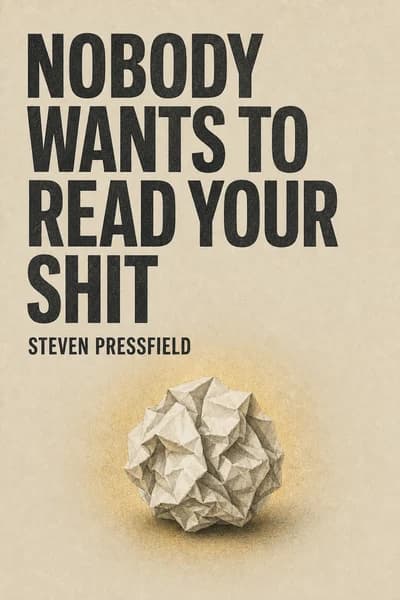
The first time I encountered Steven Pressfield's work, I was struggling with my own creative demons. His book had been recommended by everyone from Seth Godin to Elizabeth Gilbert. Even Oprah had featured his concepts on overcoming creative blocks. The cultural impact was undeniable-here was a writer who had managed to articulate what countless creatives felt but couldn't express. What makes Pressfield's perspective so valuable is his journey through multiple writing disciplines, from advertising to Hollywood to bestselling novels. In "Nobody Wants to Read Your Sh*t," he delivers the brutal truth every writer needs to hear, wrapped in wisdom that can only come from decades of professional writing experience.
第 2 章
The Harsh Reality Every Creator Must Face
The most important lesson in writing comes not from prestigious creative writing programs or MFA degrees but from the trenches of advertising-the field Pressfield initially hated most yet respected least. Working on Madison Avenue, crafting commercials and copy for products nobody particularly cared about, he learned the fundamental truth that would shape his entire creative philosophy: Nobody wants to read your sh*t. People aren't mean; they're just busy. They have smartphones buzzing with notifications, Netflix queues overflowing with content, and endless social media feeds competing for their attention. They have no inherent interest in your commercial for Rice Krispies, your screenplay, or your novel. This isn't personal rejection-it's reality.
What's the solution? You must make your message so compelling that a person would be crazy not to read it. This means developing what advertisers call the "hook"-that irresistible element that grabs attention and won't let go. When you truly understand nobody wants to read your sh*t, you develop empathy. You start thinking from the audience's perspective rather than your own. You ask yourself the hard questions: Is this interesting enough to compete with a TikTok video? Am I giving the reader enough value for their precious time? Is she bored? Would she put this down? Would this make someone miss their subway stop?
This perspective shift is transformative. Instead of assuming readers owe you their attention, you recognize that capturing and holding it is your responsibility-your sacred duty as a creator. The writing becomes about them, not you. You streamline your message to its simplest, most powerful form, cutting away anything that doesn't serve the reader. You make it fun, sexy, interesting, or informative-whatever it takes to keep someone engaged. Every sentence must earn its place. Every paragraph must drive forward. Every chapter must deliver value.
This principle extends beyond just writing. Whether you're creating a podcast, designing a website, or crafting a presentation, the same truth applies. Your audience's attention is a gift, not a right. The most successful creators understand this and approach their work with humility and determination, always asking: "Why should anyone care about this?" The answer to that question becomes the foundation of all great creative work.
第 3 章
Finding Your Voice Through Struggle
For years, Pressfield struggled with authenticity in his writing. Every word he wrote screamed of effort and fakery. He was self-conscious, full of pretension. Even when writing about real events from his life, the paragraphs came out hollow and phony. Meanwhile, when reading Turgenev, Hemingway, or Henry Miller, every phrase rang like gold. Even their commas felt perfect.
The breakthrough came from an unexpected source-his personal letters. Writing to friends, he'd sometimes stop and think, "Wow, that sounds like me." In letters, he wasn't "trying" to write; he was simply communicating. This revealed a crucial insight: we discover who we are through what we say and do, not through self-conscious effort.
Voice isn't manufactured-it emerges when we stop trying to sound like writers and instead focus on communicating clearly. It develops through practice, through millions of keystrokes and erasures. The cells remember. Something changes at a fundamental level, even when we can't articulate how or why.
This journey to find one's voice is often accompanied by external pressure to quit. Pressfield recalls bosses offering promotions and raises, friends giving concerned looks, everyone wondering when he'd come to his senses and rejoin normal society. Yet something inside wouldn't let him stop writing, even when logic suggested he should.
第 4 章
The Structure Behind Every Great Story
Whether you're writing a novel, screenplay, or non-fiction book, understanding structure is non-negotiable. The three-act structure-beginning, middle, and end-forms the backbone of virtually every successful narrative. It's not formulaic; it's fundamental to how humans process stories.
In movies, this structure is particularly crucial because the audience experiences the work in one continuous block of time. You must hook them (Act One), build tension and complications (Act Two), and deliver a satisfying payoff (Act Three). This is how jokes work. It's how seduction works. It's how persuasion works.
For longer works like novels or television series, David Lean's principle applies: every work can be divided into between eight and twelve major sequences. Each sequence functions like a mini-movie, building to the next with epic grandeur. This approach creates a stately, majestic feeling while accommodating the different rhythm of consumption these formats demand.
Understanding structure allows you to manipulate time and attention. The inciting incident-the event that makes the story start-must occur in Act One. A good inciting incident contains the seeds of the climax within it. When Apollo Creed picks Rocky Balboa for a title shot, we immediately anticipate the final boxing match. When sex traffickers kidnap Liam Neeson's daughter in "Taken," we know exactly where the story is heading.
第 5 章
The Hero's Journey: The Universal Story Template
The hero's journey is the primal myth of the human race, the cosmic pattern that each of our lives follows whether we know it or not. It's hardwired into our psyches as an operating system to help us navigate life, appearing across cultures from ancient myths to modern blockbusters. From Moses leading his people out of Egypt to Luke Skywalker battling the Empire, this pattern repeats endlessly.
In its simplest form, the hero starts in an Ordinary World - think of Frodo in the Shire or Katniss in District 12. They receive a Call to Adventure (finding the One Ring, volunteering for the Hunger Games) which they initially reject out of fear or self-doubt. A Mentor figure emerges - like Gandalf, Obi-Wan Kenobi, or Haymitch - who provides guidance, wisdom, and often magical or practical tools for the journey ahead. The hero then crosses a Threshold into a Special World, marking the point of no return, whether it's stepping through a wardrobe into Narnia or boarding a train to Hogwarts.
In this Special World, the hero encounters enemies and allies, faces increasingly difficult ordeals, and ultimately confronts the primary Villain - be it Voldemort, Sauron, or their own inner demons. Through these trials, they acquire both physical Treasure (magical objects, vital information, or actual riches) and psychological treasure (wisdom, self-knowledge, or love). The return journey often involves a desperate escape or pursuit, like Indiana Jones outrunning a boulder or Dorothy fleeing the Wicked Witch's castle.
This template percolates inside all our psyches, forming the backbone of how we understand narrative itself. Unconsciously, we evaluate every story against it. When a book or movie aligns with this Ur-Story, we say it "works." It moves us. It satisfies us emotionally because it reflects the fundamental pattern of human growth and transformation. When it doesn't comport to the template, we walk away unsatisfied, often unable to articulate exactly why.
Every genre represents a specialized variation of the hero's journey. In Romance, the "special world" is the realm of love, with the first kiss as the threshold crossing and the breakup as the supreme ordeal. In Murder Mysteries, the detective crosses the threshold by taking the case, with red herrings as trials and the revelation of the killer as the climactic confrontation. The conventions of genres - the gunslingers' final showdown in Westerns, the lovers breaking up before reconciling in Romance, the detective's moment of revelation in Mystery - are all crucial stations in that genre's version of the hero's journey. The human psyche evaluates narratives according to how closely they follow these expected beats, which explain why even formulaic stories can deeply satisfy when they honor this ancient pattern.
第 6 章
Writing for a Star: Creating Unforgettable Characters
In Hollywood, scripts are nothing until they're made into movies, and movies need stars. This principle transfers beautifully to novels and non-fiction. Your protagonist must have star quality-they need scale, depth, centrality to the story, a transformative arc, and memorable qualities.
What makes a role for a star? Their issues drive the story. Their desire is monumental with life-and-death stakes. Their passion is unquenchable. At critical points, their actions dictate how the story turns. The story ends when their issues are resolved.
The protagonist embodies the theme. The more powerful the theme, the more powerful the starring role that carries it. Consider Karen Blixen (Meryl Streep) in "Out of Africa." The theme is ownership-is it possible to truly possess anything? Karen believes it is, referring to "my school, my Kikuyu, my Limoges." She also wants her lover Denys to be "hers." By the end, she loses everything and learns she cannot "own" anything or anyone.
Don't be afraid to make your hero suffer. Suffering is drama. The greater the ordeal we put our protagonist through, the more compelling their journey becomes. Give your star both an outer and inner journey. Car chases and passionate love affairs are great fun, but by themselves won't create a memorable character. A star wants an interior arc as well.
第 7 章
The Villain: Worthy Opposition Makes Compelling Conflict
The second act belongs to the villain, and this antagonistic force must be carefully crafted to create maximum dramatic impact. Once the threat is established, it needs to remain front and center, constantly pressuring the protagonist and raising the stakes. The scarier and more competent the monster - whether literal or metaphorical - the deeper the jeopardy becomes. This escalating danger produces increasingly powerful emotional responses in the audience's hearts, drawing them deeper into the story's conflict.
A memorable villain requires a brilliant speech that crystallizes their worldview. Gordon Gekko's "Greed is good" monologue from "Wall Street" stands as perhaps the greatest movie villain speech ever written, perfectly encapsulating the character's philosophy while making a seductive argument for ruthless capitalism. Hannibal Lecter's intellectual discussions about human nature, the Joker's chaos theory speeches, and Roy Batty's "tears in rain" monologue are other prime examples. A classic villain speech must allow the antagonist to state their point of view so rationally and eloquently that a portion of the audience finds themselves thinking, "This villain is undeniably evil - but they've got a compelling point."
The antagonist serves as the primary carrier of the counter-theme, representing an opposing worldview to the protagonist's values. The more clearly we articulate this through dialogue, action, and character choices, the more deeply the audience becomes emotionally invested in the conflict. To achieve maximum dramatic power, writers must deliver the blood-freezing realization that part of the audience, too, believes what the villain believes and might, under certain circumstances, be capable of performing similar acts. This recognition of our own potential for darkness creates internal conflict within viewers.
Every character must represent something greater than themselves, embodying universal themes and human qualities. Jake Gittes in "Chinatown" represents determined truth-seeking in a corrupt world. William Munny in "Unforgiven" embodies the impossibility of escaping one's violent nature. Rick Blaine in "Casablanca" stands for choosing principle over personal desire. These characters transcend their narrow significance as individuals to become archetypes that speak to fundamental human experiences and moral choices.
Even seemingly minor elements like props, artifacts, and wardrobe should carry symbolic weight that reinforces the theme and story. The ring in "Lord of the Rings," the briefcase in "Pulp Fiction," or the spinning top in "Inception" - these objects become powerful symbols that deepen the narrative's meaning and resonate with the central conflict between protagonist and antagonist.
第 8 章
The Art of Storytelling in Non-Fiction
The principles of storytelling apply equally to non-fiction. Whether you're writing a memoir, a business book, or a TED talk, the structure remains the same: Hook, Build, Payoff. A beginning that grabs the listener, a middle that escalates tension, and an ending that brings it all home with a bang.
Start with theme. Before anything else, decide what the story is about. What does your grandmother's life crossing the prairie in a Conestoga wagon mean? Is it about female empowerment? The white man's crime against Native Americans? The human toll of a grand national dream? Find that issue and break it down into a single sentence.
Make your hero embody the theme. Cut everything that isn't on-theme. Of what remains, present it all in the context of your central idea. Identify the climax-the moment that represents the ultimate expression of your theme-and structure your narrative to build toward it.
When Pressfield wrote "The War of Art," his editor Shawn Coyne transformed a pile of pages into a powerful three-act structure: Hook (describing "Resistance"-the invisible negative force of self-sabotage), Build (chapters answering how to overcome Resistance), and Payoff (setting Resistance within a cosmic context). This structure reinforced the reader's journey from identifying the enemy to knowing how to fight it to being fortified by unseen but powerful forces.
第 9 章
The Invisible Forces: Resistance and the Muse
Resistance is real, palpable, and universal. Self-sabotage isn't just a concept but a tangible force that every creative person encounters daily. Radiating off the blank page, the empty canvas, the unexposed film is a force of relentless, merciless, protean evil. It manifests in countless forms: procrastination, self-doubt, perfectionism, distractions, and the endless reasons we find to avoid doing our work. That's Reality. Anyone who tells you different is lying. Resistance grows stronger as we get closer to our most important work, making the final steps toward creation often the hardest to take.
Yet as powerful as this negative, destructive force is, equally mighty is the positive, creative force we call the Muse. When you sit down and open the faucet, sometimes the material that appears will exceed your fondest visions. You'll stare at it and exclaim, "Where in the world did that come from?" These moments of pure inspiration feel like gifts from beyond, arriving fully formed and perfect in their conception. The Muse doesn't appear on schedule, but she rewards consistency and dedication, showing up most often when we've already begun the work.
The artist enters the Void with nothing and comes back with something. Her skill is to turn off the self-censor, to jump off the cliff, to believe. This requires tremendous courage and faith - faith not in a specific outcome, but in the creative process itself. We're believing in a conception of the universe where consciousness is not random or pointless, but purposeful and generative. We're believing in a mental reality that is active, creative, self-organizing, infinitely diverse yet cohesive. This reality exists beyond our everyday consciousness, accessible only when we quiet our analytical mind and open ourselves to possibility.
We're believing the universe has a gift specifically for us, and if we make ourselves available, it will deliver this gift into our hands. This isn't mystical thinking but a practical approach to creativity. By showing up consistently, preparing ourselves through practice and dedication, we create the conditions for inspiration to strike. The Muse favors the prepared mind, the dedicated heart, and the persistent soul. Every great work of art, every breakthrough invention, every revolutionary idea began with someone facing the Void, acknowledging both Resistance and the Muse, and choosing to begin anyway.
第 10 章
The Writer's Evolution: From Amateur to Professional
The difference between an amateur and a professional isn't talent-it's approach. Amateurs fade at the finish line. They bail when the project gets difficult. Professionals finish, no matter what. They show up daily, treat writing as their job, and understand that inspiration follows discipline, not the other way around. While amateurs wait for the perfect moment, professionals create despite imperfect conditions.
Writing a novel is like crossing the continent in a prairie schooner. You must master delayed gratification by breaking the trek into mini-treks your sanity can handle. This means setting achievable daily word counts, perhaps 500 or 1,000 words, rather than attempting marathon sessions that leave you burned out. The enemy in an endurance enterprise isn't time-it's Resistance. Resistance will try to overawe you with the magnitude of the task, whispering that you're not good enough, that the project is too big, that you should quit while you're ahead.
Think in blocks of time. Think in multiple drafts. Pressfield does between ten and fifteen drafts of every book. The first draft might be rough, the second slightly better, the third showing promise. This takes the pressure off-you're not trying to build Rome in one day. If Draft #6 is still a mess, you can relax knowing you have nine more attempts to make it work. Each draft serves a purpose: the first gets the story down, the second strengthens character arcs, the third tightens plot holes, and so on.
Surrender to the material, but then master it. A screenplay can be controlled, but a novel is too big for that. You must put yourself at the service of the idea while discovering what it "wants" to be. This might mean following unexpected character decisions, exploring subplots you hadn't planned, or letting the story venture into territory you hadn't mapped. Once you've found that story, you must tame it using the principles of storytelling and the conventions of the genre. This means understanding three-act structure, character development, pacing, and the expectations of your chosen genre. Writerly self-indulgence ends here. Now you must serve the reader, crafting each scene, each paragraph, each sentence with their experience in mind.
Professional writers understand that the craft involves both art and engineering. The artistic phase allows for exploration and discovery, while the engineering phase demands precision and ruthless editing. They know when to switch between these modes, when to let the story breathe and when to rein it in. This balance, more than raw talent, defines the professional writer's journey.
第 11 章
The Ultimate Truth: Nobody Wants to Read Your Sh*t
What "Nobody Wants to Read Your Sh*t" ultimately means is that none of us wants to hear self-centered, ego-driven, unrefined demands for attention. Why should we? It's boring. But if you can make something beautiful, fun, sexy, and interesting-we'll buy it. Your book, poem, or movie can even be despairing as long as it's profoundly conceived and takes our understanding of life a little bit deeper.
As writers, we must learn to leave space for the reader to work our offerings like a miner refines ore until what emerges is solid, glistening gold. If we're truly paying attention, our passage through life's varying disciplines becomes an education in editing out the ego until we move into the realm of the gift, where what we offer is for the reader's good and not our own.
The writer's life is like Captain Ahab's final moments-lashed to your obsession, plunging your harpoon again and again into the flesh of this creature you can never kill. But unlike Melville's concept, you don't hate the whale. You love it. The whale is your unwritten book, your calling as an artist. You die the artist's death, which leads to resurrection in a higher form and recruits you to the next hunt, the pursuit of the next Thing You Love.
第 12 章
From Rejection to Mastery: The Long Game of Writing
Writing is a long game. A novel will take you two years to write. Or three or four or five. Can you sustain yourself financially and emotionally over that period? Can your spouse and children handle it? Can you maintain your motivation, self-belief, and sanity?
You don't learn writing in school but through apprenticeships under multiple masters. It happens on the street, in the studio, in relationships with peers and mentors. You kiss ass, work for free, do what others won't. You learn by taking classes, reading scripts, submitting work for critique. You're in the trenches getting hosed, headbanged, dismissed. People exploit you, and you let them-it's the price of learning.
Pressfield worked for twenty-six months straight on his first completed novel, taking only two months out for migrant labor. He never sold that book, or the next one either. It was ten more years before he got his first check for writing, and ten more after that before "The Legend of Bagger Vance" was published. But that moment when he first typed "THE END" was epochal-a dragon he'd been fighting all his life had dropped dead at his feet.
The next morning, his writer friend Paul barely looked up when Pressfield announced he'd finished. "Good for you," Paul said. "Start the next one today."
That's the writer's life. You finish one project and immediately begin the next. You write your White Whale-the idea you're compelled to pursue the way Ahab was driven to hunt Moby Dick. You'll know it because you're scared to death of it. Great ideas make you break out in a sweat.
How do careers happen? From the inside out. You get seized by an idea. You follow it. It fails. You get seized by another idea. You follow it and it fails too. You do that hundreds of times. Finally, an idea or two succeeds. While you're thrashing from one idea to the next, you can discern no pattern. It all feels random. But when you look back, you can see not just a pattern. You can see a career. It was there all along, infallibly working itself out.