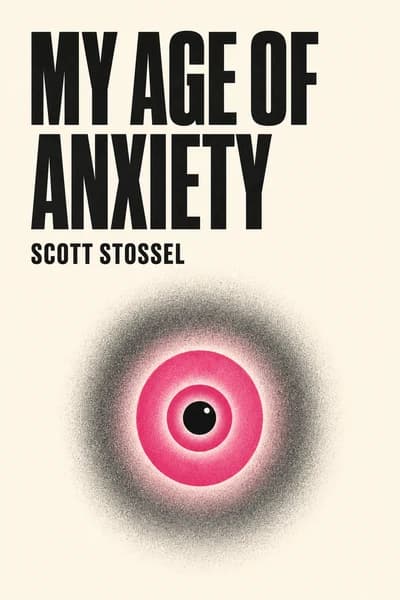
Stossel's intimate journey through anxiety's labyrinth - named Best Book by The New York Times and TIME - blends personal struggle with scientific exploration. What makes this condition simultaneously universal yet uniquely personal? Discover why this brave chronicle became required reading for understanding modern mental health.
Scott Stossel, bestselling author of My Age of Anxiety: Fear, Hope, Dread, and the Search for Peace of Mind, is an acclaimed journalist and editor renowned for blending personal narrative with rigorous historical and scientific analysis.
As editor of The Atlantic since 1992 and a key architect of its digital expansion, Stossel has shaped public discourse through his work at the intersection of culture, politics, and mental health. His writing, featured in The New Yorker, The New York Times, and The Washington Post, often explores themes of anxiety, resilience, and human behavior.
Beyond My Age of Anxiety—a New York Times top-ten bestseller translated into over 20 languages—Stossel authored the award-winning biography Sarge: The Life and Times of Sargent Shriver. Recognized with the Jed Foundation’s “Voices of Mental Health Award” and the Wellcome Trust Prize shortlist, his work bridges scholarly research and accessible storytelling.
Stossel’s insights on anxiety have been cited in JAMA and featured widely in media, solidifying his authority in mental health advocacy.
My Age of Anxiety blends memoir, scientific research, and historical analysis to explore anxiety's biological roots, cultural perceptions, and treatments. Stossel shares his lifelong struggle with severe anxiety disorders while examining how society has understood and managed anxiety across centuries. The book delves into therapies, medications, and the stigma surrounding mental health, offering a deeply personal yet scholarly perspective.
This book is ideal for individuals grappling with anxiety, mental health professionals, and readers interested in medical history or psychology. Its mix of personal narrative and rigorous research provides validation for those with anxiety while offering clinicians historical context. It’s also valuable for anyone seeking to understand anxiety’s societal impact.
Yes, for its candid exploration of anxiety and thorough research, though its length and density may challenge some. While praised for validating personal struggles and providing historical insights, critics note its exhaustive detail might overwhelm sensitive readers. Those seeking quick fixes may find it less practical.
Key themes include the interplay of biology and environment in causing anxiety, the evolution of treatments (from Freudian therapy to modern medication), and the persistent stigma around mental health. Stossel also highlights anxiety’s paradoxical role as both a debilitating condition and a survival mechanism.
Stossel traces anxiety from ancient Greek philosophies to 20th-century psychiatric breakthroughs, analyzing how perceptions shifted from moral failing to medical condition. He discusses landmark treatments, including early sedatives, behavioral therapy, and SSRIs, while critiquing gaps in understanding causes and cures.
Stossel recounts lifelong struggles with panic attacks, phobias (e.g., flying, germs), and embarrassing physical symptoms like vomiting before public speaking. He details decades of therapy, experimental medications, and unconventional treatments (e.g., hypnosis), offering raw insights into anxiety’s daily toll.
The book evaluates therapies (CBT, exposure therapy), medications (Valium, Prozac), and alternative approaches (yoga, meditation). Stossel emphasizes that no single solution works universally, advocating for personalized combinations while acknowledging the limitations of current medical models.
Critics argue the book’s length (~500 pages with footnotes) and academic tone deter casual readers. Some note it prioritizes historical analysis over actionable advice, and its vivid descriptions of anxiety may inadvertently heighten readers’ symptoms.
Unlike purely personal narratives, Stossel’s work stands out for weaving memoir with extensive research, offering a dual lens on anxiety’s individual and societal dimensions. It’s often compared to Kay Redfield Jamison’s bipolar memoirs but with a stronger focus on medical history.
The book was a New York Times bestseller, shortlisted for the Wellcome Trust Prize, and earned Stossel the Psychiatric Rehabilitation Association’s 2015 Board of Directors Award. It also won praise for destigmatizing mental health discussions.
With anxiety disorders rising globally, the book remains a critical resource for understanding their biological and cultural roots. Its exploration of stigma and treatment gaps aligns with ongoing debates about mental health accessibility and holistic care approaches.
As The Atlantic’s editor and an award-winning journalist, Stossel combines rigorous research skills with literary flair. His professional credibility and personal vulnerability create a unique authority on anxiety’s complexities, enhancing the book’s depth.
通过作者的声音感受这本书
将知识转化为引人入胜、富含实例的见解
快速捕捉核心观点,高效学习
以有趣互动的方式享受这本书
"Myself and fear were born twins"
"Fear brings about diarrhea"
"constantly churning inside-like a duck: paddling, paddling, paddling."
"easily failing under any excitement."
"Without anxiety, little would be accomplished.
将《My Age of Anxiety》的核心观点拆解为易于理解的要点,了解创新团队如何创造、协作和成长。
将《My Age of Anxiety》提炼为快速记忆要点,突出坦诚、团队合作和创造力的关键原则。

通过生动的故事体验《My Age of Anxiety》,将创新经验转化为令人难忘且可应用的精彩时刻。
随心提问,选择声音,共同创造真正与你产生共鸣的见解。

"Instead of endless scrolling, I just hit play on BeFreed. It saves me so much time."
"I never knew where to start with nonfiction—BeFreed’s book lists turned into podcasts gave me a clear path."
"Perfect balance between learning and entertainment. Finished ‘Thinking, Fast and Slow’ on my commute this week."
"Crazy how much I learned while walking the dog. BeFreed = small habits → big gains."
"Reading used to feel like a chore. Now it’s just part of my lifestyle."
"Feels effortless compared to reading. I’ve finished 6 books this month already."
"BeFreed turned my guilty doomscrolling into something that feels productive and inspiring."
"BeFreed turned my commute into learning time. 20-min podcasts are perfect for finishing books I never had time for."
"BeFreed replaced my podcast queue. Imagine Spotify for books — that’s it. 🙌"
"It is great for me to learn something from the book without reading it."
"The themed book list podcasts help me connect ideas across authors—like a guided audio journey."
"Makes me feel smarter every time before going to work"

免费获取《My Age of Anxiety》摘要的 PDF 或 EPUB 版本。可打印或随时离线阅读。
Picture a grown man, moments away from marrying the love of his life, collapsing at the altar-not from joy, but from sheer terror. This isn't a scene from a romantic comedy. It's the lived reality of someone whose nervous system treats a wedding ceremony like a mortal threat. Anxiety disorders now affect more people worldwide than any other mental health condition, yet we still struggle to understand why some of us experience everyday life as a psychological minefield. What transforms normal human vigilance into a prison of perpetual dread? The answer lies somewhere in the tangled web of genes, childhood experiences, brain chemistry, and perhaps even the ghosts of trauma that echo across generations. For some families, anxiety runs like a dark river through the bloodline. Four generations share the same pattern: ritualistic behaviors, panic attacks, hospital stays, medications that promise relief but deliver numbness instead. One great-grandparent loses a child in the 1920s-a devastating event whose shockwaves ripple forward in time, shaping the nervous systems of descendants not yet born. Pregnant mothers under stress produce more anxious children, as if fear itself can be transmitted in utero. This inheritance creates a cruel paradox: we're simultaneously victims of our biology and products of our environment, trapped between "neurotic Jewish histrionics" and "repressed WASP sensibility"-anxiety wearing a mask of calm.