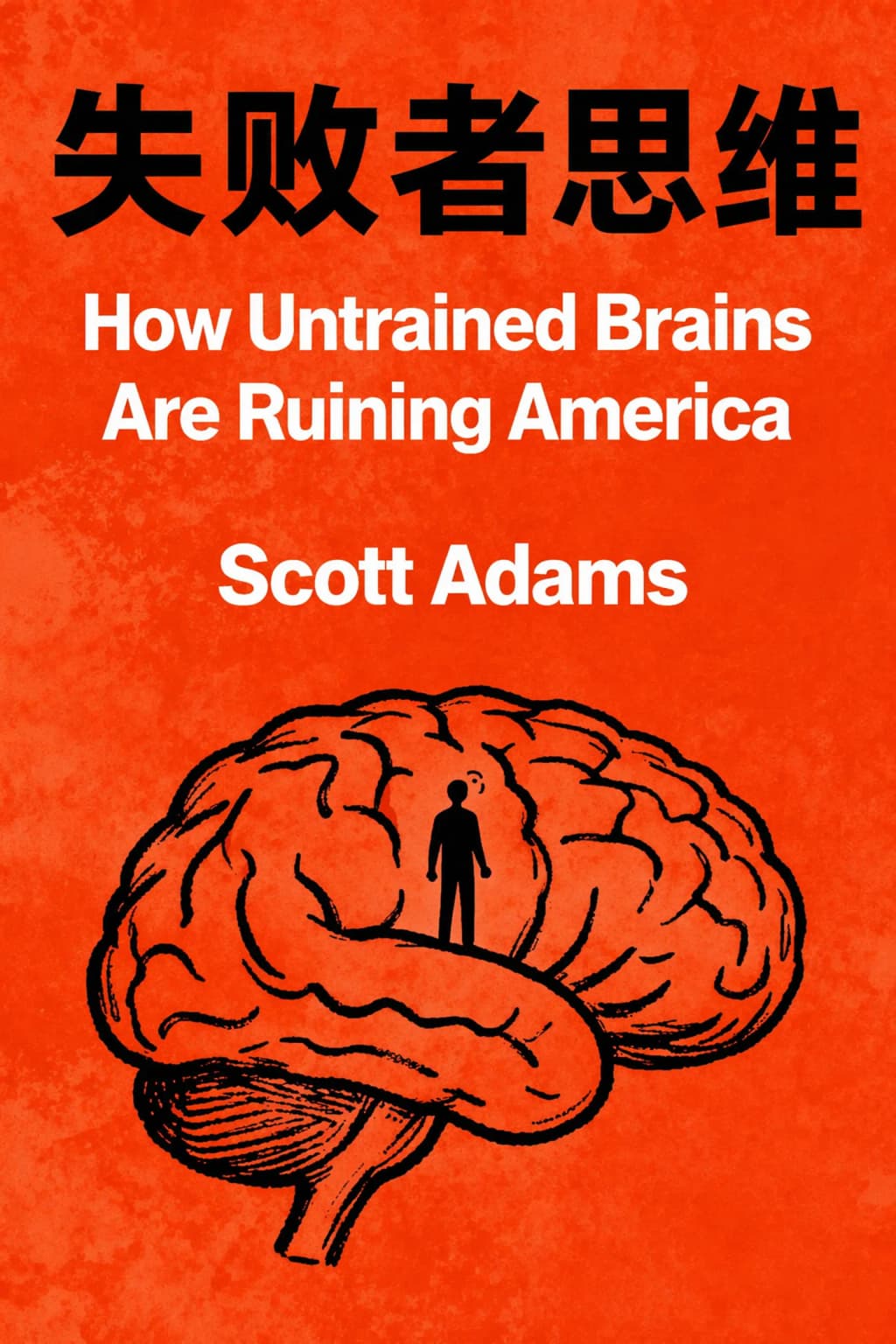
Dilbert creator Scott Adams exposes the dangerous thinking patterns destroying America's discourse. With a 4.6 Goodreads rating, this mental toolkit helps readers navigate today's polarized landscape. Ever wonder why smart people make terrible arguments? Adams reveals the surprising cognitive traps we all fall into.
Scott Adams, creator of the internationally syndicated Dilbert comic strip and bestselling author of Loserthink: How Untrained Brains Are Ruining America, merges sharp workplace satire with cognitive science to dissect flawed decision-making.
A former Pacific Bell engineer and UC Berkeley MBA graduate, Adams draws on 16 years of corporate experience to analyze systemic thinking errors in his self-help/political commentary hybrid. His earlier nonfiction works, including The Dilbert Principle and How to Fail at Almost Everything and Still Win Big, established his reputation for blending humor with pragmatic life strategies.
With Dilbert reaching 2,000 newspapers globally at its peak and his blog attracting millions of monthly readers, Adams’ insights on productivity and organizational psychology have been cited in The Wall Street Journal and Harvard Business Review.
Loserthink expands his trademark critique of irrational systems, offering tools to combat cognitive biases—a theme honed through his TEDx talks and appearances on platforms like The Joe Rogan Experience. The book debuted on The New York Times bestseller list, solidifying Adams’ influence as a counterintuitive thinker in modern discourse.
Loserthink by Scott Adams identifies unproductive mental habits ("loserthink") that trap people in irrationality, using insights from psychology, economics, and engineering. It teaches readers to avoid cognitive pitfalls like ego-driven decisions, overreliance on language-based reasoning, and confirmation bias, while offering tools to think like experts across disciplines.
This book suits critical thinkers, professionals, and anyone navigating misinformation. It’s ideal for readers seeking to improve decision-making, recognize manipulative arguments, or escape echo chambers—particularly in workplaces, politics, or social media.
Yes, for its actionable frameworks to combat irrationality. Adams blends humor with practical advice, though some critiques note uneven persuasiveness. Highlights include strategies to avoid "halfpinions" (focusing only on pros/cons) and mind-reading fallacies.
Adams, creator of Dilbert, holds an MBA and draws from corporate satire, economics, and hypnosis. His experience analyzing workplace inefficiencies informs the book’s critique of groupthink and cognitive biases.
Adams warns against misinterpretation fueled by viral content and echo chambers. He advocates testing ideas through diverse perspectives and rejecting "mind-reading" assumptions about others’ intent.
Critics argue some analogies oversimplify complex issues, and political examples may date the content. However, its core cognitive tools remain broadly applicable.
While How to Fail focuses on systems for success, Loserthink targets mental errors. Both emphasize adaptability, but Loserthink adds interdisciplinary thinking frameworks.
Yes. Its emphasis on probabilistic reasoning and avoiding "ego traps" aids decision-making in negotiations, leadership, and innovation. The engineer’s mindset (testing assumptions) is particularly valuable for problem-solving.
"Don’t engage in mind reading. It isn’t a human skill." This underscores the book’s theme: avoid assuming others’ motivations and focus on observable evidence.
These are self-imposed cognitive limitations, like clinging to outdated beliefs or overvaluing coincidence. Adams advises escaping them by exploring alternative explanations and probabilistic thinking.
Its tools combat AI-driven misinformation, polarized debates, and rapid technological shifts. The book’s focus on critical thinking remains vital for navigating modern complexities.
通过作者的声音感受这本书
将知识转化为引人入胜、富含实例的见解
快速捕捉核心观点,高效学习
以有趣互动的方式享受这本书
Loserthink...is about unproductive thinking habits that plague even the brightest minds.
Reality's guardians have abandoned their posts.
Being absolutely right and being spectacularly wrong feel exactly the same.
将《Loserthink》的核心观点拆解为易于理解的要点,了解创新团队如何创造、协作和成长。
将《Loserthink》提炼为快速记忆要点,突出坦诚、团队合作和创造力的关键原则。

通过生动的故事体验《Loserthink》,将创新经验转化为令人难忘且可应用的精彩时刻。
随心提问,选择声音,共同创造真正与你产生共鸣的见解。

"Instead of endless scrolling, I just hit play on BeFreed. It saves me so much time."
"I never knew where to start with nonfiction—BeFreed’s book lists turned into podcasts gave me a clear path."
"Perfect balance between learning and entertainment. Finished ‘Thinking, Fast and Slow’ on my commute this week."
"Crazy how much I learned while walking the dog. BeFreed = small habits → big gains."
"Reading used to feel like a chore. Now it’s just part of my lifestyle."
"Feels effortless compared to reading. I’ve finished 6 books this month already."
"BeFreed turned my guilty doomscrolling into something that feels productive and inspiring."
"BeFreed turned my commute into learning time. 20-min podcasts are perfect for finishing books I never had time for."
"BeFreed replaced my podcast queue. Imagine Spotify for books — that’s it. 🙌"
"It is great for me to learn something from the book without reading it."
"The themed book list podcasts help me connect ideas across authors—like a guided audio journey."
"Makes me feel smarter every time before going to work"

免费获取《Loserthink》摘要的 PDF 或 EPUB 版本。可打印或随时离线阅读。
Have you ever found yourself stuck in circular thinking patterns that lead nowhere? Scott Adams calls this "loserthink" - unproductive mental habits that plague even the brightest minds. This isn't about intelligence or education but about the invisible mental prisons limiting our potential. What makes Adams' approach particularly valuable is how it transcends political tribalism, offering tools for clearer thinking regardless of ideological affiliation. Drawing on his background as a trained hypnotist, successful entrepreneur, and cultural commentator, Adams identifies the thinking traps that keep us from seeing reality clearly and making better decisions. These mental blindspots affect everyone from business leaders to everyday citizens, creating unnecessary friction in our personal lives and society at large. The good news? Once you can see these mental prisons, you can break free from them.