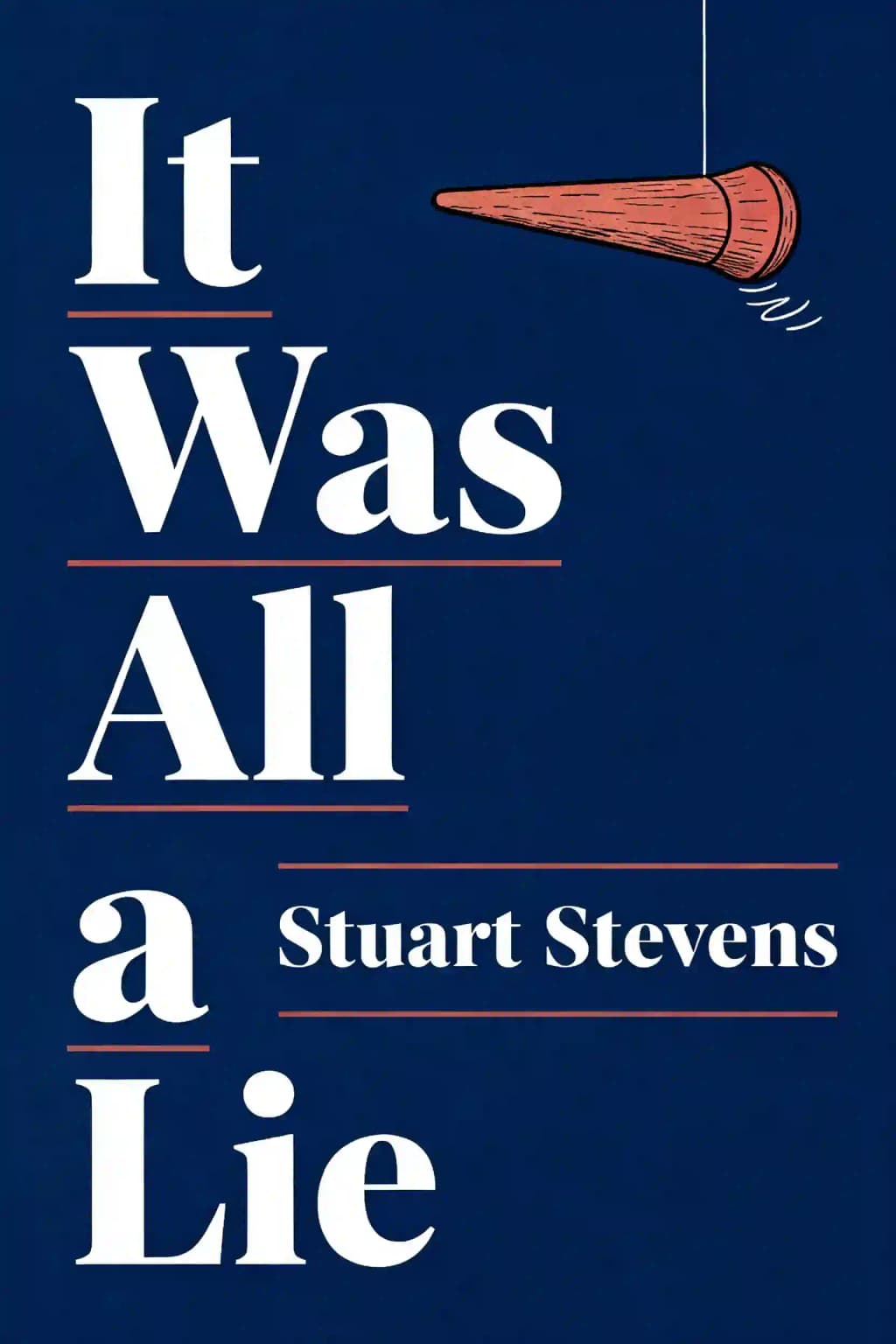
It Was All a Lie
How the Republican Party Became Donald Trump
《It Was All a Lie》概述
A Republican insider's explosive confession: Stuart Stevens, once a GOP strategist, reveals how his party abandoned principles for power. This New York Times bestseller asks a haunting question: Did conservative values ever truly exist, or was it all just political theater?

《It Was All a Lie》核心主题
- republican party evolution
- white grievance politics
- political marketing hypocrisy
- southern strategy legacy
- partisan identity crisis
《It Was All a Lie》经典语录
Family values has always been more weapon than principle.
Evangelicals provided religious cover for moral squalor.
Trump has convinced the party that Christian virtues are weaknesses.
The Republican Party has been running a decades-long scam.
《It Was All a Lie》主要人物
- Stuart StevensAuthor and veteran Republican political strategist
- Mitt Romney2012 presidential candidate and Stevens' client
- Barry Goldwater1964 candidate who shifted the party's race policy
关于作者
《It Was All a Lie》作者介绍
Stuart Stevens, bestselling author of It Was All a Lie: How The Republican Party Became Donald Trump, is a veteran political strategist and commentator whose four-decade career includes shaping campaigns for President George W. Bush, Senator Mitt Romney, and numerous GOP leaders. A seventh-generation Mississippian, Stevens blends his insider perspective with sharp critique in this exposé of the Republican Party’s ideological decay, arguing that Trump’s rise revealed long-buried contradictions in conservative values.
His insights draw from decades as a top Republican operative before becoming a leading voice in the Never Trump movement and advising the Lincoln Project.
Stevens’ prior works, including The Innocent Have Nothing to Fear and The Conspiracy to End America, explore political integrity and democratic erosion, themes amplified by his essays in The New York Times and The Washington Post. A graduate of Oxford and UCLA Film School, he also wrote for acclaimed TV series like Northern Exposure and holds distinctions in endurance sports, including skiing to the North Pole.
It Was All a Lie has been hailed as a “blinking red distress alert” for democracy, endorsed by figures like James Fallows for its urgent, revelatory prose.
下载《It Was All a Lie》摘要
免费获取《It Was All a Lie》摘要的 PDF 或 EPUB 版本。可打印或随时离线阅读。
关于本书的常见问题
It Was All a Lie critiques the Republican Party’s decades-long descent into hypocrisy, racial resentment, and moral compromise, arguing that Donald Trump’s rise was an inevitable outcome of these trends. Stuart Stevens, a former GOP strategist, exposes systemic lies about fiscal responsibility, “family values,” and race, tracing their roots from Barry Goldwater’s opposition to civil rights to Reagan’s “welfare queens” rhetoric.
This book is essential for readers interested in modern U.S. political history, GOP insider perspectives, or the roots of polarization. It appeals to historians, political enthusiasts, and anyone questioning how Trumpism reshaped conservatism. Stevens’ candid reckoning also targets current Republicans grappling with their party’s identity.
Yes—it’s a sharp, well-sourced indictment of GOP hypocrisy from an insider. Voted “thought-provoking” and “eye-opening” by reviewers, it offers critical context for understanding today’s political climate. Stevens’ blend of personal experience and historical analysis makes it a standout in political nonfiction.
Key themes include:
- Racial resentment: How opposition to civil rights became central to GOP strategy.
- Moral hypocrisy: The gap between “family values” rhetoric and actions.
- Fiscal irresponsibility: Tax cuts and deficit spending as political tools.
- Trump’s inevitability: How party leaders enabled extremism for power.
Stevens argues Trump capitalized on decades of GOP fearmongering, racial division, and anti-establishment rhetoric. By embracing lies and abandoning principles, party leaders created a vacuum Trump filled with populist anger.
- 1964 Civil Rights Act: Goldwater’s opposition set the party’s southern strategy.
- Reagan’s presidency: Demonization of welfare programs and states’ rights rhetoric.
- 2016 election: Exploitation of misinformation and media fragmentation.
Yes. Stevens condemns Reagan for racial dog whistles, Mitt Romney for 2012 pivot failures, and Mitch McConnell for prioritizing judicial appointments over democratic norms.
Unlike outsider perspectives, Stevens offers firsthand accounts of GOP campaign strategies. It complements books like Fear (Woodward) and Fire and Fury (Wolff) by explaining systemic party failures.
He urges Republicans to reject conspiracy theories, confront racial inequities, and prioritize truth over power. However, he remains skeptical about the party’s willingness to reform.
Some reviewers argue Stevens overlooks Democratic complicity in polarization, while others call it overly pessimistic about reconciliation. Conservatives may dismiss it as a “RINO” narrative.
As a GOP strategist for 30+ years (working on Romney’s 2012 campaign), Stevens provides insider credibility. His Mississippi roots and anti-Trump activism post-2016 frame his moral critique.
The book remains vital for understanding ongoing GOP loyalty to Trump, January 6th denialism, and battles over voting rights. Its warnings about authoritarianism resonate in current elections.