第 1 章
The Architects of Dysfunction: How Republican Rule Broke American Government
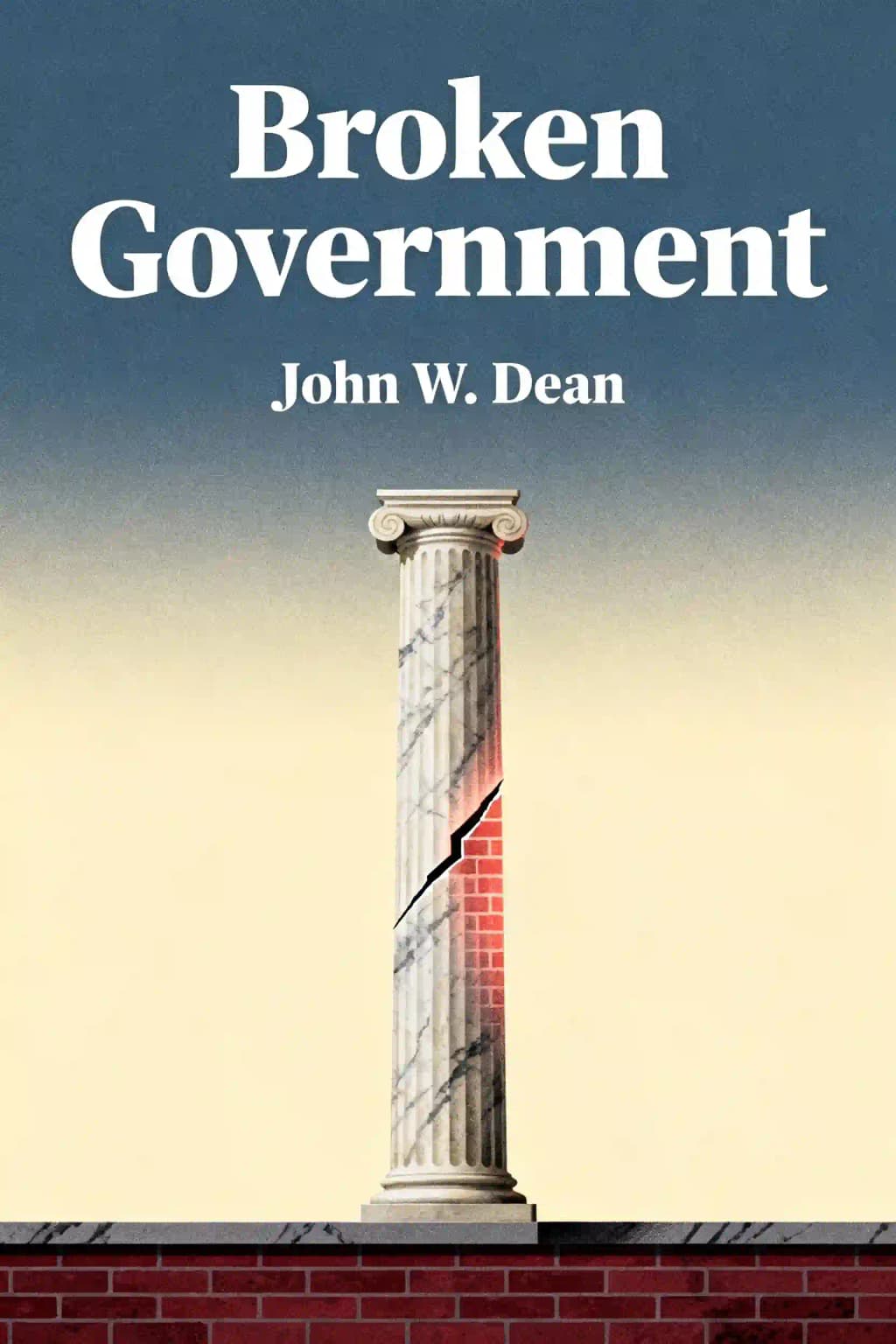
When Donald Trump declared he could shoot someone on Fifth Avenue and not lose voters, it wasn't just bombast-it was the culmination of a decades-long Republican strategy to reshape American government. In "Broken Government," John W. Dean-Nixon's White House Counsel turned whistleblower-delivers a scathing indictment of modern Republican governance that has resonated across political lines. As a New York Times bestseller, the book struck a chord with readers frustrated by governmental dysfunction, earning praise from historians and political scientists alike. What makes Dean's analysis particularly powerful is his insider perspective: as a lifelong Republican who served at the highest levels of government, his critique carries weight across the political spectrum. His transformation from Nixon loyalist to constitutional defender offers a compelling narrative arc that mirrors America's own political evolution since Watergate-a journey from constitutional crisis to the systematic dismantling of governmental norms.
第 2 章
The Dangerous Dismissal of "Process Issues"
"Nobody cares about process issues." This dismissive refrain echoes through political campaigns and media coverage, yet nothing could be further from the truth. While candidates and journalists often avoid discussing the mechanics of governance-how bills become laws, how oversight functions, how constitutional checks operate-these "process issues" form the foundation of effective government.
The conventional wisdom that voters don't care about process has been thoroughly debunked by political scientists John Hibbing and Elizabeth Theiss-Morse, whose groundbreaking research revealed that for many Americans, process matters more than policy. Through extensive nationwide interviews, they discovered that while citizens may struggle with policy complexities, they judge institutions primarily by how key processes are carried out. Among politically-engaged Americans, approximately 14% view politics primarily through a process lens-representing roughly 20 million voters spanning party lines.
This dismissal of process concerns has real consequences. When CNN aired its "Broken Government" series before the 2006 midterms, it drew solid audiences despite criticism from right-wing figures like Lynne Cheney, who claimed the network was "following a Democratic Party line." The series resonated because it addressed what voters intuitively understood: something fundamental had broken in Washington's machinery.
The media's reluctance to cover process stems partly from the Project for Excellence in Journalism's guidance to avoid "tactical" reporting. Yet ironically, studies show that process remains the mainstay of political reporting-Morris and Clawson found that 95% of New York Times and 87% of CBS Evening News congressional stories mentioned legislative process aspects. The difference lies in what kind of process receives attention: partisan conflicts and political maneuvering get coverage, while deeper institutional breakdowns often don't.
This blindspot extends to political campaigns. In 2004, the Democratic Party platform completely omitted process matters for the first time ever, giving Bush a pass on concerning behaviors like excessive secrecy. When questioned, Democrats consistently responded that secrecy is "a process issue" that interests no voters-a fundamental misreading of public concern.
第 3 章
The Republican Governing Philosophy: Designed to Fail
Contemporary Republicans excel at winning elections, raising money, and opposing Democrats but struggle with actual governance-unsurprising given conservatism's fundamentally antigovernment attitude. They embrace Reagan's inaugural declaration that "government is not the solution to our problem; government is the problem." This isn't just rhetoric-it's a governing philosophy that shapes how Republicans wield power, from local councils to federal institutions.
Modern conservatives consistently espouse beliefs in limited government, individual liberty, free markets, and decentralized power. These principles manifest in policies like tax cuts, deregulation, and resistance to social programs. As political scientist Alan Wolfe observes, Republicans seek power primarily to prevent liberals from solving problems through government and to build a political machine exchanging favors between business and the party. This approach is evident in their handling of environmental regulations, healthcare policy, and financial oversight. Unlike liberals who want to use government to address problems, conservatives view government primarily as a burden to minimize rather than a tool for public good.
This creates a fundamental contradiction: conservatives ideologically want smaller government but expand it for political gain, resulting in bigger yet more incompetent government. For instance, while advocating fiscal restraint, Republican administrations have consistently increased military spending, expanded surveillance programs, and created new bureaucracies like the Department of Homeland Security. They find themselves in the awkward position of controlling institutions they fundamentally distrust, leading to governance that prioritizes dismantling rather than improving. This paradox is particularly visible in areas like education, where Republicans simultaneously criticize federal involvement while implementing extensive testing requirements and oversight mechanisms.
The consequences of this approach became evident during Republican congressional control from 1997 to 2007. Under GOP leadership, Congress abandoned oversight responsibilities, particularly in areas of corporate regulation and environmental protection. They condoned excessive executive secrecy, weakened Freedom of Information Act compliance, tolerated deception about the Iraq War, supported controversial torture policies, and fostered unprecedented partisan hostility. The period saw decreased committee hearings, rushed legislation without proper review, and the transformation of oversight functions into partisan weapons. Even traditionally non-partisan establishment figures like Thomas Mann and Norman Ornstein felt compelled to speak out in their book "The Broken Branch," warning that Congress was imploding under Republican rule.
This dysfunction extended beyond Congress to regulatory agencies, where political appointees often worked to undermine their organizations' core missions. Examples include the EPA's reduced enforcement of environmental regulations, the SEC's lighter touch on financial oversight, and FEMA's deteriorating emergency response capabilities, most notably exposed during Hurricane Katrina. This pattern of institutional sabotage, combined with ideological resistance to government solutions, created a self-fulfilling prophecy: government indeed became less effective, but primarily because of deliberate actions to make it so.
第 4 章
How Republicans Broke Congress: A Systematic Dismantling
Republican congressional leadership operated as a secretive cabal serving private rather than public interests, fundamentally destroying the House's deliberative function. Unlike previous majorities that maintained inclusive processes, Republicans systematically excluded Democrats from legislation, focusing predominantly on serving corporate interests and wealthy donors. This shift became particularly evident in the way committee assignments were handled and how floor debates were structured.
Newt Gingrich's transformation of congressional culture proved especially destructive. By encouraging members to leave families in home districts rather than Washington, he eliminated the traditional cross-party socializing that had historically moderated partisan hostility. The impact was profound: congressional spouses no longer organized bipartisan events, children no longer attended the same schools, and the informal dinner parties that once fostered compromise disappeared. When members and staffs don't know each other personally, government functions suffer dramatically - civility breaks down, debate devolves into "pithy, partisan attacks," and genuine deliberation collapses. This social isolation created echo chambers where extreme positions could flourish without challenge.
The Republican-controlled Congress perfected the art of minimizing substantive work while maximizing partisan damage. Matt Taibbi's firsthand account of the Senate rushing through the Military Commissions Act of 2006 (dubbed the "torture bill") exemplified this approach. Despite Senator Leahy's impassioned protest that "Over 200 years of jurisprudence in this country, and following an hour of debate, we get rid of it?", the bill passed with minimal discussion of its far-reaching implications for civil liberties and international law.
The GOP's legislative process became increasingly opaque and rushed. They routinely passed massive appropriations bills with little scrutiny, rolling multiple complex bills into "Omnibus" legislation passed just before deadlines. The 2006 congressional calendar contained only ninety-seven working days - the smallest number in sixty years - while major legislation affecting millions of Americans received cursory review. Committee work, once the backbone of legislative deliberation, deteriorated significantly. Bills that historically required weeks of hearings and careful markup were pushed through with minimal expert testimony or substantive debate.
Republicans institutionalized the use of "closed rules" in the House, severely limiting debate and prohibiting amendments, effectively shutting Democrats out of the legislative process. The fifteen-minute voting rule was regularly violated when leadership needed more time to pressure holdouts, sometimes extending votes for hours until the desired outcome was achieved. This practice, known as "the art of the one-vote victory," became a hallmark of Republican control, undermining traditional parliamentary procedure.
The most damaging institutional change was the wholesale abandonment of congressional oversight responsibilities. Unlike Democrats who maintained robust oversight even with a Democratic president, Republicans completely abandoned executive branch oversight under Bush. The contrast was stark: while Clinton faced over 1,000 congressional subpoenas and investigations reviewing more than 2 million government documents, the Republican Congress issued zero subpoenas to the Bush White House. This abdication of oversight responsibility fundamentally altered the balance of power between branches, leading to unprecedented executive overreach and lack of accountability.
第 5 章
The Imperial Presidency Reborn: Cheney's Mission
Dick Cheney brought decades of policy experience to the White House, paired with a president who was "process ignorant" with little inclination to wade into policy minutiae. While Bush lacked governing experience, Cheney had accumulated significant political baggage during his years at the American Enterprise Institute and Halliburton, which he systematically unpacked as vice president.
Cheney's antipathy toward Congress began during the Ford administration when he witnessed Congress reining in what Arthur Schlesinger called "the imperial presidency" following Watergate. Unlike most Americans who were relieved by the restoration of constitutional checks and balances, Cheney viewed Watergate not as a criminal conspiracy but as "a power struggle between the legislative and executive branches."
Throughout his career, Cheney consistently advocated for presidential supremacy in foreign policy. As Secretary of Defense under George H.W. Bush, he urged bypassing Congress when Saddam Hussein invaded Kuwait in 1990, arguing the president could go to war without congressional approval. Even as Bush Sr. weighed options, Cheney's Pentagon moved into full war mode with secretly developed high-risk battle plans.
When questioned by Senator Edward Kennedy about whether Bush needed congressional approval before attacking Iraq, Cheney flatly stated the president "does not require any additional authorization," citing precedent where presidents had committed forces without declarations of war. Kennedy observed, "We've not seen such arrogance in a president since Watergate."
Cheney wasn't trying to restore the imperial presidency-Reagan and Bush I had already accomplished that. Rather, he convinced Bush that his legacy should be taking presidential power to an even more awesome level. This vision of enhanced presidential power became known as the "unitary executive theory"-a concept that began innocuously but evolved into something far more radical. In its extreme form, it means the president controls the entire executive branch, is the "sole organ" in national security matters, and can neither be constrained by Congress nor the courts.
第 6 章
Judicial Transformation: The Conservative Court Project
Despite the enduring myth of judicial objectivity, appellate judges inevitably allow their political philosophies and personal beliefs to influence their judicial decisions. While conscientious judges strive for objectivity and adherence to precedent, complete detachment from one's political and moral framework is fundamentally impossible. The law is rarely definitive - conflicting precedents, competing interpretative approaches, and inherent language ambiguities all require judges to exercise judgment that inevitably reflects their core values and worldview. This reality becomes particularly evident in cases involving constitutional interpretation, civil rights, and regulatory authority.
Nixon dramatically transformed judicial selection by making it a central campaign issue in 1968, promising to appoint "strict constructionist" judges who would counter what he characterized as the Warren Court's judicial activism. When Chief Justice Earl Warren announced his retirement, Nixon orchestrated unprecedented Republican opposition to block President Johnson's nominee Abe Fortas through the first-ever Senate filibuster against a Supreme Court nominee. This marked a turning point in the politicization of the confirmation process. After becoming president, Nixon and Attorney General John Mitchell then forced Fortas off the Court entirely through threats of investigation into his financial dealings, establishing a troubling precedent of political pressure on sitting justices.
Reagan significantly expanded this politicization, weaponizing potential Supreme Court selections during his 1980 campaign and approaching judicial appointments as a calculated means to influence court direction long after leaving office. His administration developed detailed ideological screening processes for judicial candidates and established close ties with conservative legal organizations like the Federalist Society. As Terry Eastland explained in his influential book on executive power, this systematic approach wasn't about good governance or judicial qualifications but advancing conservative political objectives through the courts.
The 1987 Bork nomination battle represented a watershed moment, though it wasn't simply a case of liberal demagoguery as conservatives often claim. During extensive confirmation hearings, Bork's intellectual arrogance, numerous equivocations and "confirmation conversions" severely damaged his credibility. He suddenly claimed the First Amendment protected more than just "political speech" and abandoned previous controversial positions on women's rights and civil rights legislation. Though ultimately defeated, Bork's originalist judicial philosophy continues profoundly influencing fundamentalist judges, and his contentious nomination became the benchmark against which later conservative nominations are measured.
Both Bush presidents aggressively continued pushing the judiciary rightward through strategic nominations. Clarence Thomas was confirmed by the narrowest margin ever for a Supreme Court justice (52-48) despite compelling evidence supporting Anita Hill's sexual harassment claims and concerns about his limited judicial experience. George W. Bush's nominees John Roberts and Samuel Alito performed masterfully in hearings that Senator Edward Kennedy later described as "a great charade." Both nominees skillfully avoided revealing their true judicial philosophies while carefully distancing themselves from their earlier conservative writings and legal opinions. Their subsequent rulings on campaign finance, voting rights, and executive power have largely validated progressive concerns about their ideological commitments.
This decades-long conservative court project has fundamentally reshaped the federal judiciary and altered the nature of the confirmation process, making judicial appointments an increasingly partisan battlefield with profound implications for American law and society.
第 7 章
The Fundamentalist Court Vision: Remaking American Law
Legal experts warn that a fundamentalist Supreme Court majority would dramatically transform American law, though incrementally rather than immediately. Attorney Martin Garbus paints a chilling picture of potential changes: gutted workplace safety standards, banned abortions, weakened minimum wage laws, abolished equal rights protections, defunded public schools, and neutered regulatory agencies. These changes would fundamentally alter the relationship between government and citizens, potentially reversing decades of progressive legislation and judicial precedent established since the New Deal era.
Fundamentalists believe presidential powers in national security are virtually unlimited. Under their view, when national security is threatened, the President can do whatever necessary to protect the country-precisely the position taken by the Bush administration under John Yoo's legal advice. This interpretation could justify warrantless surveillance, indefinite detention, and expanded executive orders without congressional oversight. They embrace the unitary executive theory with few restrictions on presidential powers, considering elections the only meaningful check. This vision would significantly expand executive branch authority over independent agencies and reduce congressional oversight capabilities.
Judicial fundamentalists reject campaign finance reform as inconsistent with the First Amendment, viewing money as protected speech and corporations as having full First Amendment rights. They would define obscenity by personal standards rather than community standards, potentially leading to inconsistent enforcement across jurisdictions. They would encourage closing sex businesses, potentially threatening adult magazines, and increase censorship of public airways. This approach could extend to restricting certain forms of artistic expression and political speech deemed offensive by individual judges.
Without incorporation of the Bill of Rights to the states, the wall between church and state would crumble. Fundamentalists reject separation arguments even where the First Amendment applies, noting the Constitution only prohibits "establishing" a national religion. Under their approach, states could embrace particular religions and tax citizens to support them. School prayers, Ten Commandments displays, and prayers at public events would become standard. Religious institutions could receive direct government funding, and religious considerations could influence public policy decisions at state and local levels.
Fundamentalists have refined procedural requirements to make it increasingly difficult for plaintiffs to use federal courts. They use standing doctrine to keep courts out of areas they believe shouldn't be litigated, regularly dismissing lawsuits by members of Congress attempting to compel presidents to execute laws or honor treaties. This restrictive approach to standing has particularly affected environmental cases, civil rights claims, and challenges to government surveillance programs. While blocking public access to courts, they go out of their way to protect corporate property interests, consistently ruling in favor of business interests in regulatory disputes and employment cases. This dual approach creates a justice system more accessible to corporate interests than individual citizens seeking redress for constitutional violations.
The fundamentalist vision would also likely impact environmental regulations, treating them as unconstitutional takings of private property, and could restrict federal authority over interstate commerce, potentially undermining federal environmental protection, worker safety standards, and civil rights enforcement.
第 8 章
Repairing the Broken System: Restoring Constitutional Balance
The breakdowns in our three branches of government don't require radical reforms or constitutional amendments-they simply need to operate as originally intended. Contemporary Republican leaders have systematically abandoned long-standing procedures and norms that maintained governmental balance for generations. The solution isn't complex new systems, but rather returning to time-tested principles of checks and balances.
Since Democrats took charge of Congress in January 2007, they've implemented significant reforms to return the legislative branch to traditional standards and procedures. The atmosphere on Capitol Hill has improved dramatically, with increased civility, bipartisan dialogue, and demographic diversity. Democrats amended House rules to end corrupt practices like the K Street Project, which essentially required lobbying firms to hire Republicans to gain access. They banned lobbyist gifts exceeding $100, restricted corporate-funded travel, and mandated comprehensive ethics training for all members and staff. Procedural reforms included prohibiting the practice of holding votes open to manipulate outcomes, ending the exclusion of minority party members from conference committees, and implementing strict "pay-as-you-go" fiscal responsibility rules requiring new spending to be offset. Most importantly, Congress has resumed its vital constitutional oversight role through regular hearings, investigations, and demands for executive branch accountability.
The Cheney doctrine of strengthening presidential power by rewriting constitutional interpretation and ignoring established law has demonstrated the dangers of unchecked executive authority. Conservative scholars like Harvard professor Harvey Mansfield have defended expansive presidential powers that exceed the rule of law, incorrectly asserting that the Framers embraced John Locke's vision of an all-powerful executive. This fundamental misreading of constitutional history contradicts two centuries of Supreme Court precedent and scholarly consensus. As Louis Fisher, constitutional law scholar at the Library of Congress, definitively notes, "The Framers consciously and deliberately broke with the British model of John Locke," creating instead a system of shared powers and mutual checks.
The GOP's rigid demand for ideological purity in federal judicial nominees threatens to weaken the third branch's role as a constitutional co-equal. Empirical research from legal scholars demonstrates that intellectual and experiential diversity on the bench, along with vigorous dissent, consistently produces sounder legal reasoning and more carefully considered judgments. This makes the prospect of a unified bloc of judicial fundamentalists controlling the federal judiciary deeply troubling for constitutional democracy. Historical examples show that courts function best with judges from varied backgrounds and perspectives who can challenge each other's assumptions and reach carefully reasoned consensus.
The restoration of proper constitutional balance requires returning to core principles: robust congressional oversight, contained executive power, and an independent, intellectually diverse judiciary. Recent reforms have begun this process, but sustained commitment to constitutional norms rather than partisan advantage remains essential.
第 9 章
The Constitutional Crossroads: Process as Democracy's Safeguard
When the Framers met in Philadelphia in 1787, Madison's Virginia Plan proposed three separate branches of government with checks and balances. Madison had studied three basic forms of government-monarchy, oligarchy, and democracy-and sought to combine their best elements into a republic where sovereignty resided with the people who elect representatives.
The Constitution never anticipated a political party's ideology eliminating separation of powers. Over four decades, Nixon, Reagan, and both Bushes have restructured the federal judiciary with uniformly conservative judges, creating a fundamentalist bench that doesn't reflect majority American will. Republicans have dismantled established governmental processes, inventing self-serving schemes without justification.
Though most Americans don't understand Washington's institutional workings, they recognize when government is broken. Those who work inside government or report on it understand that proper processes produce good policy, while compromised processes lead to bad outcomes. Process-oriented citizens tend to be more educated and politically engaged than average. However, research reveals that all citizens can understand process in simple terms: they judge whether officials are acting in their own self-interest rather than serving the public.
American voter ignorance remains staggeringly high despite increased education and information availability. Studies show half of Americans would fail a basic current affairs test, with many actively misinformed about key issues. Most voters can't name their senators or congressional candidates, and lack understanding of basic government structure. After years studying voter ignorance and apathy, there appear to be no known fixes. People who are ignorant have made a rational choice and are often content with their position. Ironically, even the apathetic don't want to be taken advantage of by the system or have their tax dollars wasted.
The appropriations process is Washington's lifeblood but intentionally kept obscure by officials. Republicans have repeatedly abused this process, even shutting down government as a political tactic. Since 1789, Congress has held the exclusive constitutional power of the purse-the authority to tax, authorize spending, and appropriate funds from the Treasury. As Madison wrote in Federalist No. 58, this power is "the most complete and effectual weapon" for representatives to address grievances and implement necessary measures.
The 2008 election presents a critical opportunity to address government repair rather than selecting candidates bound to cause more damage. If process continues to be ignored, our Founders' system of separated powers with checks and balances will vanish, replaced by "autocratic presidentialism" that Republicans euphemistically call "unilateralism" and "unitary executive theory." The health of our democracy depends on restoring proper governmental processes-the invisible machinery that makes representative government work.