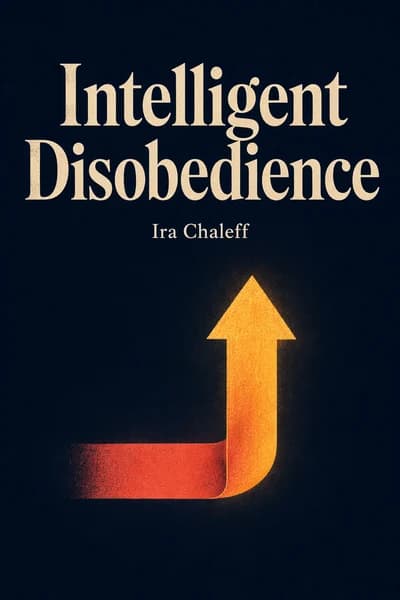
When disobedience becomes a moral imperative - endorsed by Stanford Prison Experiment's Philip Zimbardo. "Intelligent Disobedience" challenges blind obedience with real-world examples across military and business settings. What if the most ethical decision is refusing to follow orders?
Ira Chaleff, author of Intelligent Disobedience, is a pioneering leadership consultant and followership expert whose work has redefined organizational dynamics. A bestselling author and founder of the International Leadership Association’s Followership Learning Community, Chaleff is renowned for his research on ethical decision-making and constructive dissent.
His seminal book The Courageous Follower: Standing Up To and For Our Leaders and co-edited volume The Art of Followership established him as a leading voice in leadership-follower studies, cited by the Harvard Business Review as a pioneer in the field.
Chaleff serves as president of Executive Coaching & Consulting Associates and has advised organizations including NASA, the FBI, and the Congressional Management Foundation. An adjunct faculty member at Georgetown University, his frameworks are integrated into military officer training programs and global leadership curricula. Recognized among the “100 best minds on leadership” by Leadership Excellence, Chaleff’s work continues to empower professionals to navigate authority with integrity and courage.
Intelligent Disobedience explores how to ethically challenge authority when orders conflict with moral or legal standards. Chaleff uses examples like guide dogs trained to disobey unsafe commands and historical cases like the Nuremberg trials to argue for a framework of "thoughtful refusal." The book provides tools to assess risks, communicate concerns, and act responsibly while maintaining organizational loyalty.
This book is essential for professionals in hierarchical fields (military, healthcare, corporate), educators teaching ethics, and anyone seeking to navigate authority conflicts. It’s particularly valuable for leaders fostering cultures of accountability and followers aiming to uphold integrity without jeopardizing careers.
The "Nuremberg Defense" refers to the "just following orders" justification used by Nazis during war crime trials. Chaleff critiques this mindset, emphasizing that blind obedience enables harm. He argues for personal accountability, even under pressure, using psychological studies to show how ordinary people often comply with unethical directives.
Guide dogs are trained to disobey commands that endanger their owner (e.g., refusing to cross a busy street). Chaleff parallels this with workplace scenarios, advocating for employees to practice "intelligent disobedience" by rejecting harmful orders while maintaining trust through transparent communication.
The book outlines a 4-step process:
Building on The Courageous Follower, which stresses proactive followership, this book delves deeper into resisting unethical authority. Both works emphasize mutual leader-follower responsibility, but Intelligent Disobedience adds practical tactics for navigating high-stakes disobedience.
These lines underscore the book’s thesis: ethical autonomy must balance loyalty to authority.
Chaleff advises organizations to train employees in “constructive defiance,” such as using pre-approved challenge protocols (e.g., “red flag” systems) and normalizing pushback during risk assessments. Examples include pilots using standardized checklists to override rushed commands.
Some argue Chaleff underestimates the career risks of disobedience in rigid hierarchies. Critic Craig Biddle praises the concept but notes the book lacks guidance for those facing retaliation without institutional support.
The book’s principles help address issues like unethical AI use, whistleblowing, and DEI conflicts. For example, teams can apply its framework to challenge biased algorithms or discriminatory policies while preserving professional relationships.
Pair with:
In an era of rapid AI adoption and global political tensions, the book’s lessons on ethical pushback remain critical. Its strategies help professionals navigate dilemmas in remote work, AI governance, and cross-cultural leadership.
通过作者的声音感受这本书
将知识转化为引人入胜、富含实例的见解
快速捕捉核心观点,高效学习
以有趣互动的方式享受这本书
Intelligent disobedience consists of noncompliance with a particular order, instruction, or policy while carefully considering the bigger picture.
Intelligent disobedience requires followers to take responsibility for the consequences of their actions.
Serving a leader does not require blind obedience.
Followers who practice intelligent disobedience are more valuable to leaders than those who simply do as they are told.
The most effective followers are those who are willing to question authority and challenge the status quo when necessary.
将《Intelligent Disobedience》的核心观点拆解为易于理解的要点,了解创新团队如何创造、协作和成长。
将《Intelligent Disobedience》提炼为快速记忆要点,突出坦诚、团队合作和创造力的关键原则。

通过生动的故事体验《Intelligent Disobedience》,将创新经验转化为令人难忘且可应用的精彩时刻。
随心提问,选择声音,共同创造真正与你产生共鸣的见解。

"Instead of endless scrolling, I just hit play on BeFreed. It saves me so much time."
"I never knew where to start with nonfiction—BeFreed’s book lists turned into podcasts gave me a clear path."
"Perfect balance between learning and entertainment. Finished ‘Thinking, Fast and Slow’ on my commute this week."
"Crazy how much I learned while walking the dog. BeFreed = small habits → big gains."
"Reading used to feel like a chore. Now it’s just part of my lifestyle."
"Feels effortless compared to reading. I’ve finished 6 books this month already."
"BeFreed turned my guilty doomscrolling into something that feels productive and inspiring."
"BeFreed turned my commute into learning time. 20-min podcasts are perfect for finishing books I never had time for."
"BeFreed replaced my podcast queue. Imagine Spotify for books — that’s it. 🙌"
"It is great for me to learn something from the book without reading it."
"The themed book list podcasts help me connect ideas across authors—like a guided audio journey."
"Makes me feel smarter every time before going to work"

免费获取《Intelligent Disobedience》摘要的 PDF 或 EPUB 版本。可打印或随时离线阅读。
Picture this: You're told to do something that feels wrong, but the instruction comes from someone with authority. What do you do? History shows that roughly two-thirds of us will comply with harmful directives, despite believing we'd resist. From corporate fraud to human atrocities, this tendency has devastating consequences. The concept of "Intelligent Disobedience" offers a revolutionary framework for knowing when-and how-to say no to authority. Inspired by guide dog training, where animals learn to disobey commands that would endanger their handlers, this approach provides a powerful antidote to blind obedience. It's not about rebellion, but about upholding higher values when following orders would cause harm. In a world where "I was just following orders" has justified countless tragedies, learning when to disobey might be one of the most crucial skills we can develop.