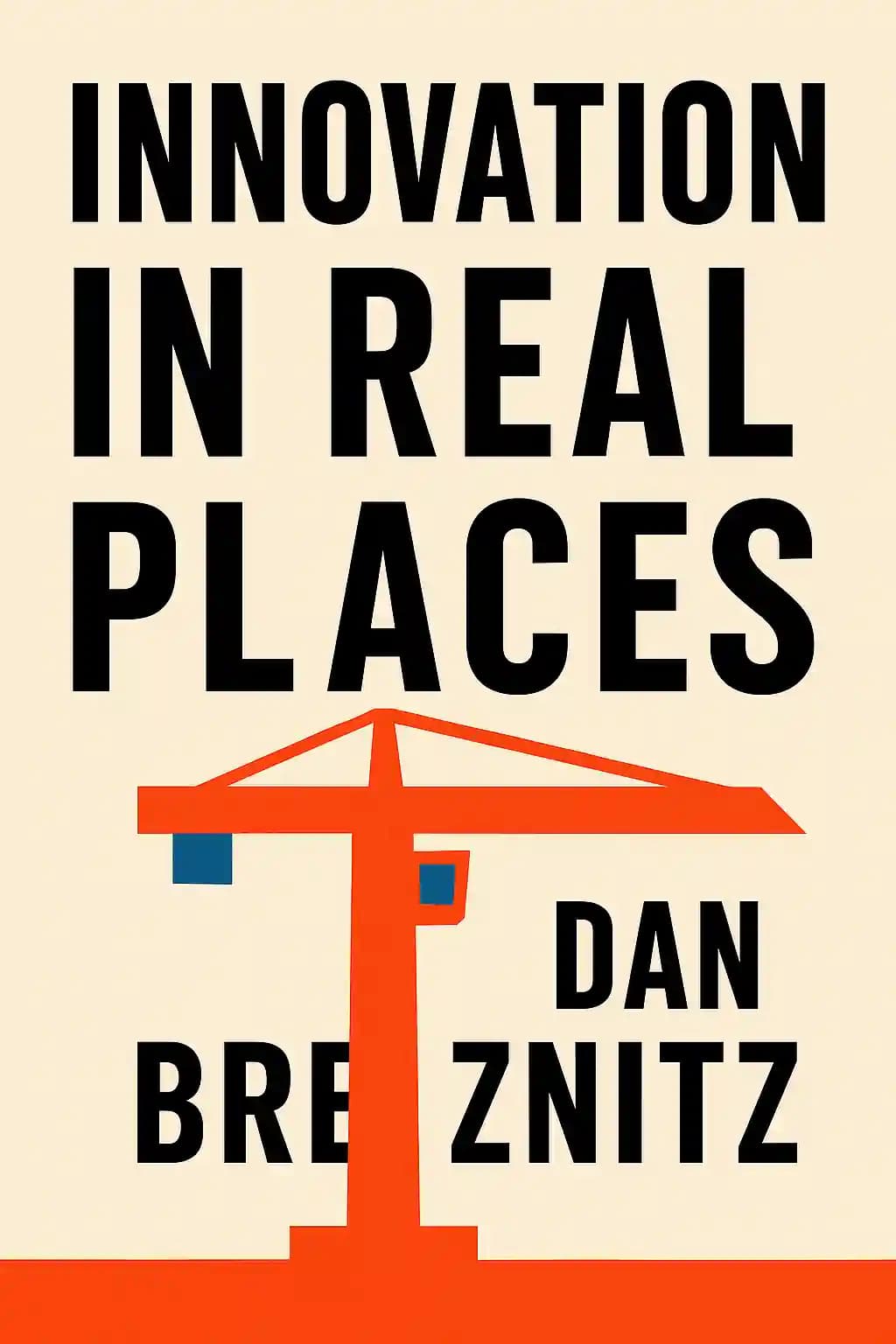
Forget Silicon Valley myths. "Innovation in Real Places" - winner of the $60,000 Balsillie Prize - reveals why copying tech hubs fails. What if your region's unique advantages could drive prosperity? McKinsey's top book of 2021 redefines innovation for an unforgiving world.
Dan Breznitz, author of Innovation in Real Places: Strategies for Prosperity in an Unforgiving World, is an award-winning innovation policy expert and the Munk Chair of Innovation Studies at the University of Toronto. A globally recognized authority on economic growth and equitable technological development, Breznitz combines decades of academic research and real-world advisory experience with governments and organizations like the World Bank and the United Nations.
His work focuses on challenging Silicon Valley-centric myths about innovation, advocating instead for context-specific strategies to foster inclusive prosperity.
Breznitz’s previous books, including Innovation and the State (winner of the Don K. Price Award) and The Run of the Red Queen (featured in The Economist), established his reputation for blending rigorous analysis with actionable policy insights. As Co-Director of the University of Toronto’s Innovation Policy Lab and a CIFAR Fellow, he shapes global debates on technology and equity. Innovation in Real Places—lauded as a Financial Times Best Business Book of 2021 and translated into multiple languages—has been praised for its pragmatic roadmap to revitalizing communities through localized innovation strategies.
Innovation in Real Places challenges the Silicon Valley-centric innovation model, arguing communities should leverage existing strengths in global production chains rather than copying tech hubs. Breznitz presents strategies for localized prosperity through case studies, emphasizing innovation in manufacturing and distribution over high-tech R&D. The 2021 Financial Times bestseller combines economic analysis with actionable policy frameworks for regional development.
Policy makers, urban planners, and business leaders seeking alternatives to generic tech-led growth strategies will benefit most. It’s equally valuable for economists studying regional development and readers interested in equitable prosperity models beyond major innovation hubs. Breznitz’s clear examples make complex concepts accessible to non-specialists.
Yes – it’s been praised for debunking innovation myths while offering practical alternatives. The Financial Times named it a 2021 best book for its fresh perspective on economic resilience. Blinkist users highlight its actionable insights for community revitalization.
Breznitz argues success isn’t about disruptive tech breakthroughs but mastering specific phases of innovation processes. A region might thrive in manufacturing (Taiwan’s chip production) or distribution (Italian textile clusters) without leading in R&D.
Some argue it underestimates the role of digital infrastructure in modern development. Others note its manufacturing-focused examples may need adaptation for service-based economies. However, most praise its evidence-based challenge to conventional wisdom.
Unlike Richard Florida’s "creative class" theory, Breznitz prioritizes leveraging existing industrial ecosystems over attracting high-skilled migrants. He also rejects the assumption that R&D dominance equals economic success.
The book suggests identifying underutilized assets (e.g., skilled workforces, transportation networks) and targeting niche roles in global supply chains. Pennsylvania’s steel towns could transition to specialized metal processing rather than chasing biotech startups.
Breznitz argues innovation policies often widen wealth gaps by favoring high-skilled workers. He advocates for strategies that create quality jobs across education levels, like Germany’s manufacturing apprenticeship systems.
With remote work dispersing talent pools and AI disrupting traditional industries, the book’s emphasis on adaptive regional strategies helps communities navigate economic uncertainty. Its framework assists in evaluating opportunities in automation and green energy transitions.
通过作者的声音感受这本书
将知识转化为引人入胜、富含实例的见解
快速捕捉核心观点,高效学习
以有趣互动的方式享受这本书
Innovation isn't just inventing 'shiny new things' but the complete process.
Silicon-Hyphens become minor leagues.
The benefits rarely flow to local communities.
Atlanta has become a 'feeder cluster' to Silicon Valley.
The most important reframing of innovation policy in years.
将《Innovation in Real Places》的核心观点拆解为易于理解的要点,了解创新团队如何创造、协作和成长。
将《Innovation in Real Places》提炼为快速记忆要点,突出坦诚、团队合作和创造力的关键原则。

通过生动的故事体验《Innovation in Real Places》,将创新经验转化为令人难忘且可应用的精彩时刻。
随心提问,选择声音,共同创造真正与你产生共鸣的见解。

"Instead of endless scrolling, I just hit play on BeFreed. It saves me so much time."
"I never knew where to start with nonfiction—BeFreed’s book lists turned into podcasts gave me a clear path."
"Perfect balance between learning and entertainment. Finished ‘Thinking, Fast and Slow’ on my commute this week."
"Crazy how much I learned while walking the dog. BeFreed = small habits → big gains."
"Reading used to feel like a chore. Now it’s just part of my lifestyle."
"Feels effortless compared to reading. I’ve finished 6 books this month already."
"BeFreed turned my guilty doomscrolling into something that feels productive and inspiring."
"BeFreed turned my commute into learning time. 20-min podcasts are perfect for finishing books I never had time for."
"BeFreed replaced my podcast queue. Imagine Spotify for books — that’s it. 🙌"
"It is great for me to learn something from the book without reading it."
"The themed book list podcasts help me connect ideas across authors—like a guided audio journey."
"Makes me feel smarter every time before going to work"

免费获取《Innovation in Real Places》摘要的 PDF 或 EPUB 版本。可打印或随时离线阅读。
A former silver mining town in northern Ontario holds an unexpected lesson about prosperity. Cobalt boomed spectacularly when silver was discovered, then withered when the mines closed. Meanwhile, Toronto-which had built sophisticated financial networks to fund those distant mines-continued thriving long after the last nugget was extracted. This contrast reveals something profound: sustainable prosperity doesn't come from chasing resources or replicating someone else's success. It comes from building capabilities that endure. Today, as communities worldwide scramble to become "the next Silicon Valley," they're repeating Cobalt's mistake-pursuing someone else's formula rather than developing their own strengths. What if the path to shared prosperity requires abandoning this copycat approach entirely?