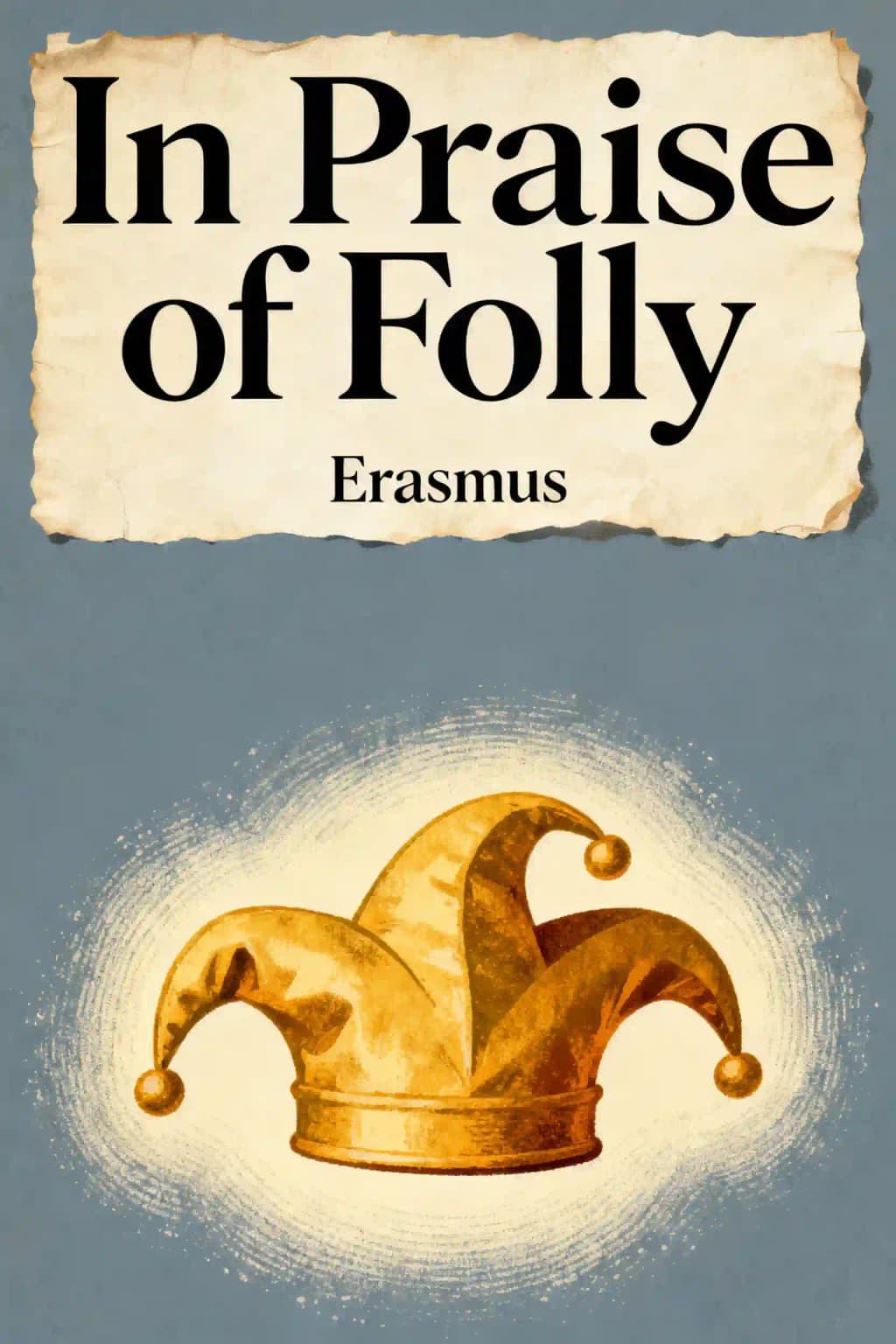
Erasmus's satirical masterpiece, where Folly herself mocks human folly and religious corruption. With 24,000 copies in its first run, this Renaissance bombshell helped spark the Protestant Reformation. What sacred cow would this witty intellectual skewer in today's world?
Desiderius Erasmus Roterodamus (1466–1536) was a Dutch Renaissance humanist and scholar, best known as the author of In Praise of Folly. This groundbreaking satirical work critiques societal hypocrisy, religious dogma, and intellectual pretension.
Born in Rotterdam, Erasmus rose from humble beginnings as an illegitimate child to become Europe’s foremost classical scholar. He leveraged his training as a priest and mastery of Greek and Latin to reform education and theology.
In In Praise of Folly, Erasmus's witty, incisive prose is narrated by the allegorical figure of Folly. The work challenged the corruption of the Church and the folly of human ambition, cementing his reputation as a foundational voice of the Northern Renaissance. Erasmus’s translation of the New Testament into Greek revolutionized biblical scholarship, while his Adagia popularized ancient proverbs.
A moderate critic during the Reformation, he influenced thinkers like Thomas More and Martin Luther. In Praise of Folly remains a literary cornerstone, translated into over 30 languages and studied for its timeless exploration of human delusion and wisdom.
In Praise of Folly is a 1511 satirical essay by Desiderius Erasmus, where the personified goddess Folly humorously argues that human happiness stems from foolishness, not wisdom. Through biting irony, the work critiques societal norms, religious corruption, and scholarly pretensions, suggesting that folly drives human relationships, art, and even faith.
This book appeals to readers interested in Renaissance humanism, religious satire, or classical rhetoric. Scholars of early modern literature, theology, or social critique will find its layered irony and historical context valuable, while general readers enjoy its timeless humor and sharp observations on human nature.
Yes—Erasmus’s masterpiece remains a cornerstone of Western literature for its wit, intellectual depth, and influence on the Protestant Reformation. Though dense with classical allusions, its themes of hypocrisy and human folly resonate in modern discussions of power, culture, and religion.
Key themes include:
Folly personifies humanity’s irrational tendencies, arguing that self-deception and ignorance underpin relationships, ambition, and faith. Her speech blends humor and darkness, revealing Erasmus’s critique of societal and religious excess.
Erasmus satirizes clerical greed, empty rituals, and the sale of indulgences, portraying Church leaders as more focused on wealth than spirituality. Folly sarcastically praises theologians for convoluted debates and monks for performative piety.
Notable lines include:
Erasmus blends classical references (e.g., Greek myths) with Christian theology, emphasizing critical thinking and moral reform. His satire aligns with humanist values by challenging dogma and advocating for intellectual humility.
The book fueled the Protestant Reformation by exposing Church corruption, though Erasmus distanced himself from Luther’s radicalism. It also popularized Renaissance satire, influencing writers like Voltaire and Swift.
Folly’s exaggerated self-praise and paradoxical arguments—like claiming wisdom causes misery—create layered irony. Readers must discern Erasmus’s true critique beneath her seemingly naïve tone.
Some contemporaries accused Erasmus of undermining religious authority, while modern critics note the essay’s ambiguity—its satire sometimes blurs genuine praise for folly. Others argue it oversimplifies human motivation.
Its themes of anti-intellectualism, institutional hypocrisy, and the duality of human nature mirror modern debates on politics, social media, and cultural conformity. The work reminds readers to question dogma and embrace humility.
通过作者的声音感受这本书
将知识转化为引人入胜、富含实例的见解
快速捕捉核心观点,高效学习
以有趣互动的方式享受这本书
Perhaps folly, not wisdom, deserves our praise.
Laughter could open minds where stern argument failed.
Folly becomes an unreliable narrator.
To treat trifles seriously can be more beneficial.
Wisdom comes disguised as foolishness.
将《In Praise of Folly》的核心观点拆解为易于理解的要点,了解创新团队如何创造、协作和成长。
将《In Praise of Folly》提炼为快速记忆要点,突出坦诚、团队合作和创造力的关键原则。

通过生动的故事体验《In Praise of Folly》,将创新经验转化为令人难忘且可应用的精彩时刻。
随心提问,选择声音,共同创造真正与你产生共鸣的见解。

"Instead of endless scrolling, I just hit play on BeFreed. It saves me so much time."
"I never knew where to start with nonfiction—BeFreed’s book lists turned into podcasts gave me a clear path."
"Perfect balance between learning and entertainment. Finished ‘Thinking, Fast and Slow’ on my commute this week."
"Crazy how much I learned while walking the dog. BeFreed = small habits → big gains."
"Reading used to feel like a chore. Now it’s just part of my lifestyle."
"Feels effortless compared to reading. I’ve finished 6 books this month already."
"BeFreed turned my guilty doomscrolling into something that feels productive and inspiring."
"BeFreed turned my commute into learning time. 20-min podcasts are perfect for finishing books I never had time for."
"BeFreed replaced my podcast queue. Imagine Spotify for books — that’s it. 🙌"
"It is great for me to learn something from the book without reading it."
"The themed book list podcasts help me connect ideas across authors—like a guided audio journey."
"Makes me feel smarter every time before going to work"

免费获取《In Praise of Folly》摘要的 PDF 或 EPUB 版本。可打印或随时离线阅读。
Picture a jester stepping onto a stage in 1511, bells jingling, ready to deliver the most dangerous speech of the Renaissance. But this fool isn't just any entertainer-she's Folly herself, come to praise her own virtues before a European audience hungry for change. Within weeks, "In Praise of Folly" sold thousands of copies, an unprecedented success that would help ignite the Protestant Reformation. Written in just seven days while Erasmus recovered from illness at Thomas More's home, this slim volume became so controversial the Catholic Church banned it, yet so beloved that Benjamin Franklin quoted it regularly centuries later. What made a satirical monologue by the personification of foolishness so explosively influential? Because sometimes truth arrives not through solemn philosophy but through laughter-and sometimes the wisest voice in the room belongs to the one wearing the cap and bells.