第 1 章
Democracy's Fragile Foundations: How Free Nations Fall From Within
In November 2016, America faced a question unthinkable to most citizens: Is our democracy in danger? As scholars who've spent decades studying democratic collapse abroad, we never expected to ask this about our own country. Yet here we are, confronting a startling reality-democracy rarely dies through violent coups or military takeovers anymore. Instead, it dies gradually, at the hands of elected leaders who use the very institutions of democracy against itself.
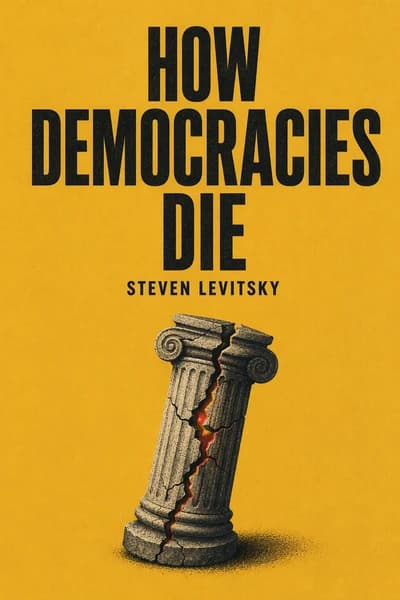
How to Democracies Die has become a cultural touchstone since its publication, praised by figures across the political spectrum from Hillary Clinton to Jeff Flake. The book shot to bestseller status as Americans grappled with unprecedented norm-breaking in politics. What makes this work so powerful is its refusal to treat America as exceptional or immune to the forces that have toppled democracies worldwide. By examining historical patterns from Hitler's Germany to Chavez's Venezuela alongside America's own democratic erosion, the authors reveal how the guardrails protecting our system are far more fragile than we've assumed.
第 2 章
When Establishment Politicians Enable Authoritarians
Throughout history, democracies have fallen not through dramatic coups but through "fateful alliances" where establishment politicians invite populist outsiders into power, believing they can control them. Like the horse in Aesop's fable who allowed itself to be bridled to defeat the stag, these elites soon find themselves under "bit and spur."
Consider the rise of fascism in 1920s Europe. Mussolini didn't seize power through his mythologized "March on Rome" but arrived via invitation from King Victor Emmanuel III, who saw him as a tool to restore order. In Germany, conservative leaders led by Franz von Papen made Hitler chancellor, dismissing concerns with the assurance: "We've engaged him for ourselves...Within two months, we will have pushed him so far into a corner that he'll squeal." Their miscalculation proved catastrophic.
Venezuela's democratic collapse followed a similar pattern. Once South America's oldest democracy, Venezuela unraveled when respected former president Rafael Caldera embraced Hugo Chavez-a failed coup leader-in a bid to revive his own political fortunes. After winning the presidency in 1993, Caldera dropped all treason charges against Chavez rather than allowing him to stand trial. When asked where he was going upon release, Chavez simply replied: "To power."
Five years later, Chavez won the presidency. On inauguration day, Caldera stood glumly aside as the man whose path to power he had unwittingly paved took the oath of office. As Caldera later admitted, "Nobody thought that Mr. Chavez had even the remotest chance of becoming president."
Not all democracies make this fatal mistake. Countries like Belgium, Britain, and Finland have faced demagogues but kept them from power through effective gatekeeping. Political parties serve as democracy's first line of defense by filtering out dangerous candidates. When faced with extremists, successful democracies isolate and defeat them rather than legitimizing their movements.
How can we identify potential authoritarians before they gain power? Four behavioral warning signs serve as a litmus test: rejection of democratic rules, denial of opponents' legitimacy, tolerance of violence, and willingness to curtail civil liberties. A politician exhibiting even one of these traits warrants serious concern.
第 3 章
America's Forgotten Gatekeeping Tradition
Philip Roth's novel "The Plot Against America" imagines an alternative history where Nazi sympathizer Charles Lindbergh becomes president during the Great Depression. What prevented this scenario in reality wasn't Americans' inherent democratic virtue but rather the gatekeeping function of political parties.
America has never lacked extremist demagogues with substantial public support. The 1930s saw Father Charles Coughlin, an anti-Semitic Catholic priest whose nationalist radio program reached forty million listeners weekly. Louisiana Governor Huey Long built what historian Arthur Schlesinger called "the nearest approach to a totalitarian state the American republic has ever seen," with nearly eight million supporters by 1934. Senator Joseph McCarthy maintained 40% approval even after his Senate censure, while Alabama Governor George Wallace gained approximately 40% approval during his third-party presidential run.
Americans have long had an authoritarian streak, with figures like these regularly gaining 30-40% support. The real protection against would-be authoritarians hasn't been Americans' commitment to democracy but rather the gatekeepers-our political parties.
Consider the original "smoke-filled room" at Chicago's Blackstone Hotel in 1920, where Republican leaders selected Warren G. Harding as their nominee despite his trailing in fourth place with only 612 delegates. Though undemocratic, these backroom selections served a crucial function by keeping unfit figures off the ballot.
The founders worried about demagogues who might "pay obsequious court to the people" before becoming tyrants. Their solution-the Electoral College-was designed as a screening device of prominent men who could filter out those with "talents for low intrigue." This system quickly surrendered its authority to political parties, which became democracy's stewards by balancing representation with filtration of dangerous candidates.
Henry Ford exemplifies how party gatekeeping blocked extremists. Despite being one of the world's richest men and immensely popular with the public, Ford's presidential ambitions were thwarted by party leaders who soundly rejected him. As Ford himself admitted, he could only run if the gatekeeping system were somehow removed.
The party system similarly contained other potentially dangerous populists. Huey Long was isolated in the Senate by Democratic Party leaders. George Wallace was forced to run as a third-party candidate despite his blend of populism and white nationalism earning him Trump-like approval levels. Even Charles Lindbergh, extraordinarily popular after his America First speeches, never had his name mentioned at the 1940 Republican convention.
第 4 章
The Great Opening and Its Consequences
The year 1968 shattered America's political system. With 16,592 Americans dying in Vietnam, Martin Luther King Jr. and Robert Kennedy assassinated, and the Democratic Party split between pro-war and anti-war factions, the system cracked under pressure. At the chaotic Chicago convention, Vice President Hubert Humphrey-who hadn't competed in a single primary-secured the nomination through party insiders while police violently clashed with protesters outside.
This catastrophe triggered a complete overhaul of the nomination process. The McGovern-Fraser Commission reforms of 1971 created binding presidential primaries beginning in 1972, where delegates would be elected in state-level contests rather than chosen by party leaders. Democratic National Committee chair Larry O'Brien called these "the greatest goddamn changes since the party system."
Political scientists warned that binding primaries might be too democratic, potentially allowing "extremist candidates and demagogues" to emerge. Initially, these fears seemed overblown. Outsiders like Jesse Jackson, Pat Robertson, and Pat Buchanan all ran but lost. Winning still required navigating what Arthur Hadley called the "invisible primary"-securing support from donors, media, interest groups, and state-level politicians before the actual primaries began.
For a quarter century, this informal vetting process worked. But the system was becoming increasingly vulnerable to wealthy celebrities who could bypass the invisible primary entirely. Between 1996 and 2016, eighteen outsiders competed in presidential primaries-an average of three per election, with thirteen being Republicans.
When Donald Trump descended the escalator in Trump Tower on June 15, 2015, he entered a nomination system fundamentally transformed from earlier eras. Despite competing against sixteen other candidates, many with impressive political resumes like Jeb Bush and Marco Rubio, Trump's candidacy represented something different. The world had changed: party gatekeepers had weakened due to outside money availability and alternative media that allowed celebrities to bypass establishment channels.
第 5 章
The Failure of Republican Gatekeeping
Trump's rise to the presidency represents a profound failure of gatekeeping at three critical junctures. First, he finished dead last in the "invisible primary" of party endorsements, with zero backing from Republican power brokers by the Iowa Caucus. Yet unlike previous outsiders who won early contests but faded, Trump easily won New Hampshire and South Carolina primaries.
The changed media landscape proved crucial-Trump enjoyed support from right-wing personalities like Sean Hannity and Breitbart News, while generating an estimated $2 billion in free mainstream media coverage through controversy. After Trump's Super Tuesday victories, panic set in among Republican leaders. Mitt Romney gave a high-profile speech calling Trump a "fraud," but the #NeverTrump movement proved ineffective.
Trump's candidacy was unprecedented not just for his lack of political experience but because he tested positive on all four measures of the authors' litmus test for autocrats. He showed weak commitment to democratic rules by repeatedly claiming the election was "rigged" and refusing to commit to accepting results. He denied opponents' legitimacy by promoting "birther" theories about Obama and branding Hillary Clinton a "criminal" who should be jailed. He tolerated and encouraged violence at his rallies. Finally, he threatened to curtail civil liberties by promising to "open up libel laws" to sue media outlets.
No major-party presidential candidate in modern history had met all four warning criteria. Yet Republican leaders failed the ultimate test of gatekeeping. Despite clear warning signs, most endorsed Trump rather than backing Clinton to prevent his election. Unlike conservatives in Austria who backed a Green Party candidate over a far-right populist, or French conservative Fillon who endorsed Macron against Le Pen, prominent Republicans like Ryan, McConnell, Rubio, and Cruz fell in line behind Trump.
By normalizing the election as a standard two-party race rather than treating it as a democratic emergency, Republican leaders allowed a close election that Trump ultimately won. Had they broken with Trump and endorsed Clinton, even a small percentage of Republican voters might have followed, potentially changing the outcome.
第 6 章
How Democracies Are Subverted From Within
Peru's Alberto Fujimori exemplifies how democracies can be subverted from within. Initially an unlikely political outsider who ran for president to publicize his senate campaign, Fujimori won Peru's 1990 election amid economic collapse and terrorist insurgency. As president, he faced significant obstacles-opposition parties controlled congress, their appointees dominated the supreme court, and traditional media distrusted him.
Frustrated by legislative gridlock and impatient with democratic processes, Fujimori began attacking congress as "unproductive charlatans" and judges as "jackals." By early 1991, there was talk of impeachment. His authoritarian takeover culminated in April 1992 when he dissolved congress and the constitution.
This pattern repeats across countries where democracy dies gradually. Would-be authoritarians first attack democratic institutions verbally-labeling critics as "enemies," "subversives," or "terrorists." Hugo Chavez called opponents "rancid pigs," Fujimori linked rivals to terrorism, and Silvio Berlusconi denounced judges as "communist." These verbal attacks often escalate to action as society polarizes.
The next step involves "capturing the referees"-taking control of judicial and law enforcement agencies that should serve as neutral arbiters. By installing loyalists in courts, regulatory agencies, and law enforcement, autocrats shield themselves from accountability while gaining weapons to selectively target opponents. Tactics include firing civil servants and replacing them with partisans (as Viktor Orban did in Hungary), bribing officials (as Fujimori's advisor Montesinos did with judges), impeaching independent judges (as Peron did in Argentina), or packing courts (as seen in Hungary and Poland).
After capturing the referees, elected autocrats neutralize key opponents who might challenge their power. Media outlets face devastating legal attacks-Ecuador's Correa won a $40 million libel suit against El Universo; Turkey's Erdogan crippled the Dogan media empire with a $2.5 billion tax fine; Putin forced Vladimir Gusinsky to surrender NTV television in exchange for freedom. These attacks lead other media to self-censor, like Venezuela's Venevision, which replaced political coverage with astrology and soap operas.
Beyond silencing opponents, autocrats change rules to entrench power. In post-Reconstruction Tennessee, Democrats introduced poll taxes, strict registration requirements, and literacy tests that effectively eliminated Black voting. The Memphis Daily Appeal celebrated "Goodbye Republicans" after these measures passed, noting Democratic majorities increased fourfold while Black turnout plummeted to nearly zero by 1896. These "reforms" established white supremacy and single-party rule for nearly a century.
Crises-whether real or manufactured-provide perfect opportunities for democratic backsliding. Ferdinand Marcos used mysterious Manila bombings to declare martial law and extend his rule for fourteen years. Hitler exploited the Reichstag fire to dismantle civil liberties. Erdogan leveraged both ISIS attacks and a coup attempt to purge 100,000 officials, close newspapers, arrest 50,000 people, and ultimately demolish constitutional checks on presidential power.
第 7 章
Democracy's Essential Guardrails
Americans have long placed tremendous faith in their Constitution as the bulwark against tyranny. But constitutional safeguards alone cannot secure democracy. Germany's highly regarded Weimar constitution collapsed rapidly under Hitler. Latin American countries that adopted near-replicas of the U.S. Constitution still succumbed to autocrats like Peron and Marcos.
Democracy's survival depends not just on written constitutions but on unwritten norms that function as guardrails. Two norms stand out as fundamental: mutual toleration and institutional forbearance. Mutual toleration means accepting political rivals as legitimate opponents rather than existential threats-recognizing they have an equal right to compete for power and govern when they win. Institutional forbearance means restraining from actions that, while technically legal, violate democratic spirit.
These norms evolved gradually in America. The early republic exemplified politics without guardrails, as Federalists and Republicans viewed each other as treasonous enemies. This hostility encouraged constitutional hardball: the 1798 Sedition Act criminalized government criticism, targeting Republican newspapers. Only after several decades did this quest for permanent victory subside, as a new generation of politicians normalized the idea that rivals need not be enemies.
America's fragile norms collapsed over slavery in the 1850s. Southern planters viewed Republican abolitionism as an existential threat. Mutual toleration shattered as politicians called each other traitors. Violence pervaded Congress, with 125 incidents of stabbings, canings, and gun-drawing between 1830-1860. The Civil War broke American democracy: one-third of states skipped the 1864 election, Lincoln suspended habeas corpus, and the former Confederacy was placed under military rule.
Tragically, mutual toleration was only restored after racial equality was removed from the political agenda. The Compromise of 1877 ended Reconstruction by withdrawing federal troops from the South, while the failure of the 1890 Federal Elections Bill abandoned protection of black voting rights. With racial equality abandoned and white supremacy preserved in the South, partisan hostility softened.
For most of American history, the Senate treated the filibuster as a "procedural weapon of last resort," with only twenty-three manifest filibusters during the entire nineteenth century. The Senate's power of "advice and consent" over presidential appointments developed into a norm of deference to presidents. Only nine presidential cabinet nominations were blocked between 1800 and 2005, and over 90 percent of Supreme Court nominees were approved between 1880 and 1980.
America's democratic institutions faced three significant challenges in the twentieth century: Roosevelt's unprecedented concentration of executive power, McCarthyism's threat to mutual toleration, and Nixon's authoritarian behavior. Yet in each case, the guardrails held through bipartisan resistance. Roosevelt's court-packing scheme was rejected, McCarthyism was eventually discredited, and Nixon was forced to resign when Republicans joined Democrats in holding him accountable.
第 8 章
The Unraveling of Democratic Norms
The traditions underpinning America's democratic institutions began unraveling in the late 1970s. In 1978, Newt Gingrich won a congressional seat in Georgia, bringing a ruthless vision that would transform American politics. Rejecting the civility of Republican leaders like Bob Michel, Gingrich told young Republicans they were "fighting a war for power."
Through C-SPAN and his PAC GOPAC, he deployed inflammatory rhetoric, instructing Republicans to describe Democrats as "pathetic," "sick," "traitors," and "antifamily." His tactics-comparing opponents to Mussolini and accusing them of trying to "destroy our country"-left Democrats frozen with shock. By becoming Speaker in 1995, Gingrich had transformed American politics from presuming opponents' good will to treating them as immoral, establishing "politics as warfare" as the GOP's dominant strategy.
The Republicans' hardball approach intensified during Clinton's presidency. Senate Minority Leader Dole denied Clinton the traditional presidential honeymoon, blocking his job initiative. Filibuster use reached "epidemic" levels, with cloture motions jumping from historically fewer than seven annually to eighty in 1993-94. The ultimate norm violation came with Clinton's impeachment on a "technicality," politicizing what had been an extraordinary constitutional remedy.
Despite George W. Bush's promise to be a "uniter, not a divider," partisan warfare intensified during his presidency. Congressional Republicans abandoned traditional norms, shredding House conduct rules to implement Bush's agenda while abdicating oversight responsibilities. At the state level, Tom DeLay led Texas Republicans in a brazen 2003 mid-decade redistricting plan-violating the widely shared norm that redistricting occurs only after each census.
The 2008 election marked a watershed in partisan intolerance. Through Fox News and right-wing media, Obama was portrayed as Marxist, anti-American, and Muslim. Republican leaders increasingly adopted this rhetoric, with Congressman Steve King calling Obama "anti-American" and warning of "totalitarian dictatorship."
Despite Obama's election night call for unity, partisan warfare intensified during his presidency. The Tea Party movement fundamentally questioned Obama's legitimacy. Immediately after Obama's election, House "Young Guns" McCarthy, Cantor, and Ryan strategized to make the GOP the "Party of No." Senate Minority Leader McConnell declared his primary goal was making Obama a one-term president.
Senate obstructionism spiked dramatically-385 filibusters between 2007-2012 equaled the total from WWI through Reagan. Democrats responded by eliminating the filibuster for most nominations (the "nuclear option"), while Obama increasingly used executive actions to bypass Congress.
Three events revealed how severely forbearance norms had eroded: the 2011 debt ceiling crisis where Republicans threatened default; forty-seven Republican senators writing directly to Iran's leaders undermining Obama's diplomatic authority; and the unprecedented refusal to consider Merrick Garland's Supreme Court nomination, with some Republicans vowing to block all of Hillary Clinton's potential nominees for four years if she won.
第 9 章
Trump Against the Guardrails
Donald Trump's first year in office followed a familiar authoritarian script, launching blistering rhetorical attacks on opponents, calling media "the enemy of the American people," and questioning judges' legitimacy. Like other elected demagogues, when faced with intense criticism and investigations, Trump doubled down rather than moderating his approach.
President Trump exhibited clear authoritarian tendencies by attempting to capture the referees-law enforcement, intelligence agencies, and courts. He sought personal loyalty from intelligence heads, summoning FBI Director James Comey to a private dinner requesting a loyalty pledge, and pressuring him to drop investigations into Michael Flynn.
When officials maintained independence, Trump tried to punish or purge them. He fired Comey-only the second FBI director dismissal in the bureau's 82-year history-after Comey expanded the Russia investigation. Similarly, he removed Manhattan U.S. Attorney Preet Bharara whose money laundering investigations threatened Trump's inner circle.
Trump also attacked judges who ruled against his policies, referring to one as a "so-called judge" and threatening to break up the Ninth Circuit Court of Appeals. His pardon of Sheriff Joe Arpaio, convicted of violating a federal court order against racial profiling, represented an unprecedented political use of pardon power that undermined judicial authority.
The president employed authoritarian tactics to sideline critics, particularly targeting the media. He repeatedly labeled outlets like the New York Times and CNN as "fake news" and called the media "the enemy of the American people"-rhetoric reminiscent of Stalin and Mao. His administration also considered using government regulatory power against unfriendly media companies.
Trump's efforts to tilt the electoral playing field in his favor proved more concerning than his rhetorical attacks. The most antidemocratic initiative was creating the Presidential Advisory Commission on Election Integrity, run by Kris Kobach, described as America's "premier advocate of vote suppression." The commission built on Republican-led state voter ID laws that disproportionately affect minority voters who tend to vote Democratic.
Despite following much of the electoral authoritarian script during his first year, Trump's most notorious threats weren't realized. His efforts to pack the FBI with loyalists and block Mueller's investigation were derailed by Republican opposition and his own missteps. Democracy's fate under Trump would depend significantly on Republican leaders' willingness to defend democratic institutions against their own party's president.
Trump's unprecedented norm violations have fundamentally corroded democratic standards. Beyond attacking election legitimacy, he abandoned basic political civility and engaged in routine, brazen lying-PolitiFact classified 69 percent of his statements as false or mostly false. His dishonesty has devastated our democracy by jeopardizing citizens' access to credible information and eroding trust in government.
第 10 章
Saving Democracy
American democracy isn't exceptional or immune to breakdown-we've experienced political catastrophe before with the Civil War. Though our system recovered, the stability that followed came at the price of racial exclusion and Southern authoritarianism. Only after 1965 did America fully democratize, paradoxically triggering the partisan realignment that has led to today's norm-breaking polarization.
North Carolina exemplifies politics without guardrails-a purple state with an evenly split electorate that has descended into partisan warfare. After winning control in 2010, Republicans implemented racially gerrymandered districts that allowed them to capture 9 of 13 congressional seats despite Democrats winning more votes statewide. When Democrat Roy Cooper narrowly won the governorship in 2016, Republicans refused to concede for nearly a month, then used a special session to strip powers from the incoming governor.
The most optimistic post-Trump scenario is swift democratic recovery: Trump fails politically through electoral defeat or removal, energizing Democrats to reverse his policies and perhaps even motivate democratic reforms. Yet this hopeful future is unlikely. The assault on democratic norms and underlying polarization began well before Trump.
A darker future involves Republicans continuing to win with white nationalism, using constitutional hardball to manufacture durable white electoral majorities through deportation, immigration restrictions, voter roll purges, and strict ID laws. History shows shrinking ethnic majorities rarely surrender dominance peacefully, as evidenced by Lebanon's civil war, Israel's drift toward apartheid, and America's own post-Reconstruction disenfranchisement of African Americans.
The progressive call to "fight like Republicans" by abandoning norms is misguided. Evidence from other countries shows that opposition scorched-earth tactics often help authoritarians by scaring moderates, unifying government supporters, and providing justification for crackdowns. Even if Democrats succeeded in removing Trump through hardball tactics, they would inherit a democracy stripped of protective guardrails.
Effective democratic defense requires building coalitions not just among like-minded groups but between adversaries with opposing views on many issues. Progressives must forge alliances with business executives, religious leaders, and red-state Republicans. This means temporarily setting aside litmus tests on issues like abortion or healthcare to find common moral ground against authoritarianism.
America's fundamental problem remains extreme partisan division fueled by racial and religious differences. The Republican Party has been the main driver of partisan division, behaving at times like an antisystem party in its obstructionism and extremism. Its rightward march resulted from the hollowing out of its organizational core by well-funded outside groups, wealthy donors like the Koch brothers, and right-wing media who now exert greater influence over elected officials than the party's own leadership.
Reducing polarization requires reforming or refounding the GOP. The party must rebuild its establishment by regaining leadership control over finance, grassroots organization, messaging, and candidate selection. Republicans must marginalize extremists, build a more diverse constituency beyond their shrinking white Christian base, and win without appealing to white nationalism.
Democrats could address partisan division by tackling economic inequality through universalistic rather than means-tested social policies. Programs that benefit everyone-like Social Security and Medicare-could diminish resentment and build bridges across the electorate without fueling racial backlash.
America is not exceptional in its vulnerability to democratic breakdown. Our constitutional system, while older and more robust than any in history, faces the same pathologies that have killed democracy elsewhere. To save our democracy, Americans must restore basic democratic norms and extend them throughout our diverse society.
America's democratic norms have always been sound, but for much of our history, they were sustained by racial exclusion. Now those norms must work in an age of racial equality and unprecedented ethnic diversity. Few societies have managed to be both multiracial and genuinely democratic-that is our challenge and opportunity. If we meet it, America will truly be exceptional.