第 1 章
The Necromancer's Descent: A Cosmic Dance of Death and Resurrection
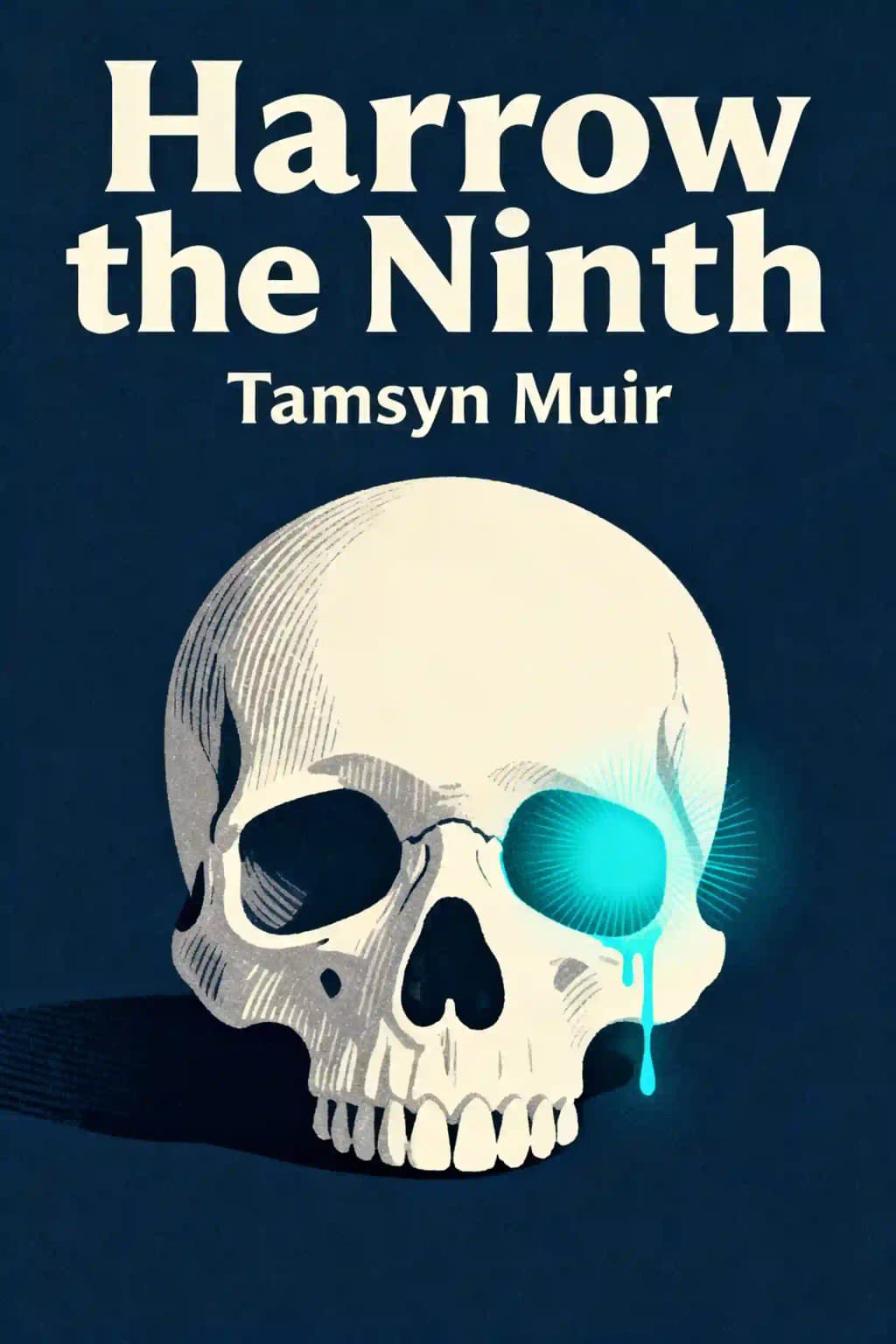
Harrow the Ninth has been hailed as "the most mind-bending space fantasy of the decade" by The New York Times, with Neil Gaiman calling it "a masterpiece of psychological horror disguised as science fiction." Following the breakout success of Gideon the Ninth, Tamsyn Muir's sequel has become a cultural touchstone for readers seeking complex, queer-centered narratives that blend necromancy, space opera, and psychological thriller elements. The novel's intricate puzzle-box structure has spawned countless Reddit theories and analysis videos, with fans obsessively tracking its unreliable narration and timeline shifts. What begins as a seemingly straightforward continuation of a necromancer's journey becomes a disorienting exploration of grief, identity, and the cosmic horrors that lurk beneath reality's surface-all wrapped in Muir's signature blend of gothic aesthetics and irreverent humor.
第 2 章
The Fractured Mind of Harrowhark Nonagesimus
In the darkness of her quarters aboard the Mithraeum, Harrowhark Nonagesimus-the newly minted Lyctor and saint to the Emperor Undying-awaits certain death. Herald creatures slam against the station's hull, minutes from breaching. Despite her title, she knows she's only half a Lyctor, incomplete and fatally vulnerable. When Ianthe the First enters, begging her to "turn around" and reverse whatever she's done to prevent her full power, Harrow rejects her with contempt. As the breach begins, she cocoons herself in bone shields, knowing they'll dissolve when she submerges in the River-the liminal space between life and death. Unlike the other Lyctors, she knows she'll be dead within half an hour.
This opening scene establishes the novel's central tension: Harrow has somehow sabotaged her own Lyctorhood, leaving herself dangerously incomplete. But why would someone sacrifice immortality and power at the moment she needs it most?
The narrative immediately fractures, jumping back fourteen months to show Harrowhark with her cavalier Ortus Nigenad, reviewing a letter summoning them to Canaan House. This scene contains the first clue to Harrow's mental state when she confesses: "I need you to hide my infirmity. You see, I am insane." Yet something is fundamentally wrong with this memory-readers of the first book know that Harrow's cavalier was Gideon Nav, not Ortus.
This disorienting structure mirrors Harrow's own fractured psyche. Her perspective alternates between first and second person, between past and present, between reality and delusion. She exists in a perpetual state of confusion, her supernatural senses detecting 708 hearts aboard the ship while struggling to maintain consciousness. The Emperor himself notes her wasted state as she vomits repeatedly trying to wield a sword that utterly rejects her touch.
What emerges is a portrait of profound psychological trauma. Harrow was born through an unthinkable sacrifice-her parents murdered two hundred children to create a necromantic prodigy. This original sin haunts her, as does her later discovery of the beautiful corpse in the Locked Tomb, with whom she fell "wildly in love at first sight." After her parents' suicide, she began experiencing hallucinations-phantom doors opening, voices beyond hearing, and most significantly, visitations from "the Body," the beautiful corpse from the tomb who now follows her through the Mithraeum.
第 3 章
The Emperor's Saints: Lyctors and Their Terrible Power
The Mithraeum serves as both sanctuary and prison for the Emperor's immortal servants. Here, Harrow meets her fellow Lyctors: Augustine the First (the Saint of Patience), Mercymorn the First (the Saint of Joy, despite her perpetual bitterness), and Ortus the First (the Saint of Duty, who inexplicably tries to kill Harrow fourteen times). Each carries ten thousand years of history, power, and secrets.
The Emperor-whom the Lyctors casually call "John" or "Teacher"-explains the cosmic stakes. When a planet dies suddenly, as during the Resurrection, its collective soul converts violently into a planetary revenant called a "Resurrection Beast." These monsters have hunted him for ten thousand years, feeding on thalergetic planets as they move inexorably through the universe. Of the original nine Beasts, only three remain, including the approaching Number Seven.
"The Resurrection Beasts always know where I am," the Emperor reveals, taking Harrow's hands in his. "And they don't turn to me alone... They hunt whoever has committed the indelible sin"-the sin of becoming a Lyctor.
The process of Lyctorhood itself represents the novel's central ethical question. To achieve this power, a necromancer must consume their cavalier's soul, essentially killing them while preserving their essence. This perfect union grants immortality and tremendous power-the ability to regenerate from any wound, to enter the River at will, and to wield thanergy (death energy) with unprecedented control.
Yet Harrow's Lyctorhood is fundamentally broken. She can't properly wield her cavalier's sword, her healing is painfully slow, and her body becomes defenseless when she enters the River. Augustine dismissively calls her a "diet Lyctor," while Mercymorn considers her barely worth teaching. Most tellingly, when she tries to recall her cavalier's sacrifice, she remembers Ortus Nigenad "giving himself with a numb readiness that still burned her with shame"-another false memory covering something too painful to confront.
The Emperor's other Lyctors reveal the terrible cost of immortality. Augustine and Mercymorn share a complex, bitter relationship spanning millennia. They engage in cryptic conversations using shorthand developed over thousands of years, yet harbor secrets even from each other. When they kiss the Emperor in a shocking scene that sends Harrow fleeing, it reveals not just their complex sexual dynamics but hints at deeper machinations against their master.
第 4 章
The Haunted House of Memory
As Harrow struggles to understand her present, her mind repeatedly retreats into an alternate past - one where she attended Canaan House with Ortus as her cavalier instead of Gideon Nav. These sections, told in third person, present a fundamentally altered version of the events from the first book. The shift in narrative perspective serves to distance readers from Harrow's immediate experience, mirroring her own psychological dissociation from reality.
In this false memory, Harrow investigates a series of increasingly bizarre murders at Canaan House alongside characters who died in the original timeline. Abigail Pent and Magnus Quinn - both killed in the first book - are alive and helping Harrow solve the mystery of the "Sleeper" who's systematically killing the other Houses' heirs. The fabricated reality shows cracks: when Harrow reads a note that appears to contain threatening messages written in blood, Ortus sees only an innocent invitation to dinner. Books change their contents when reread, rooms shift their configurations, and time itself seems to loop and stutter.
These inconsistencies build to a crescendo when Abigail confronts Harrow in the library: "I really think you should consider the idea that you might also be haunted." This pivotal moment reveals that Harrow isn't merely experiencing psychosis - she's created an elaborate false reality, rewriting her own memories to erase someone vital. The haunting Abigail refers to isn't supernatural but psychological, a ghost Harrow herself created through careful mental surgery.
The truth emerges gradually through physical symptoms that become impossible to ignore: Harrow has deliberately excised Gideon Nav from her memories. Every mention of "Gideon" triggers severe physical reactions - blood streaming from her ears or nose, sudden migraines, temporary blindness - all physical manifestations of her mind's desperate defense mechanisms. She's meticulously rewritten her history to replace Gideon with Ortus, but this fabrication is breaking down as reality reasserts itself through these violent symptoms.
In one of the novel's most poignant scenes, set in a crumbling version of Canaan House that reflects her deteriorating mental state, Harrow finally admits to Ortus how Gideon died: "We were pinned down by a Lyctor, our backs to a wall. I was utterly spent... Nav had a fractured kneecap and broken humerus. She pierced her heart on a railing because she thought I would use her to become a Lyctor." When Ortus embraces her, Harrow breaks down, screaming that Gideon died because she let her - because she wasn't fast enough, strong enough, or worthy enough of the sacrifice.
This confession reveals the core of Harrow's trauma - not just grief over Gideon's sacrifice, but overwhelming guilt at her inability to properly consume Gideon's soul, leaving her with an incomplete Lyctorhood that dishonors that sacrifice. The false memories serve as both shield and prison, protecting Harrow from her guilt while simultaneously trapping her in a loop of denial that prevents her from achieving true Lyctorhood or emotional healing.
第 5 章
The Cosmic Chess Game: Betrayal and Ancient Plots
While Harrow struggles with her fractured psyche, a vast and intricate conspiracy unfolds around her like a deadly flower blooming in darkness. The Emperor reveals to her a haunting sight: hundreds of perfectly preserved bodies suspended in time for ten thousand years - her "renewed House," supposedly meant to breathe life back into the dying Ninth. These sleeping forms, frozen between life and death, represent both promise and prison, though this apparent act of generosity conceals layers of calculated manipulation beneath its surface.
The Lyctors, those immortal servants of the Emperor, carry millennia of festering grievances against their master. Their apparent devotion masks a deep-seated resentment that has grown like a cancer over centuries of service. After Harrow witnesses increasingly erratic behavior from Augustine and Mercymorn during a tense dinner - including cryptic exchanges and barely concealed hostility - she follows Ortus the First into the shadows, only to discover him bleeding out from wounds inflicted by an impossible attacker: the supposedly deceased Lyctor Cytherea. This contradiction - a dead Lyctor somehow walking, talking, and dealing death - suggests the existence of powers that even the Emperor, with all his godlike abilities, cannot fully control.
The labyrinthine plot reaches its crescendo thirty minutes before the Emperor's murder, in a scene witnessed by Gideon - now inexplicably inhabiting Harrow's body after a reality-shattering perspective shift. The confrontation between the Emperor and his Lyctors reveals centuries of deception and careful planning. Cytherea, animated by the vengeful spirit of Commander Wake, exposes the true scope of Mercymorn and Augustine's betrayal: they had orchestrated an elaborate scheme to obtain the Emperor's genetic material through sexual means, creating a child specifically engineered to circumvent the blood ward protecting the Locked Tomb. That child was Gideon Nav, carried by Wake herself after multiple "fetal dummies" provided by the conspiring Lyctors had failed to survive. The Emperor's response to seeing Gideon - "Hi, Not Fucking Dead. I'm Dad" - carries both humor and devastating weight.
This revelation transforms our understanding of Gideon's origins and the Ninth House's role in the greater cosmic drama. Wake's original plan had been to use infant Gideon as a living weapon - a "bomb" designed to trigger a catastrophic thanergy cascade at the Tomb's entrance. Something interfered with this plan, though the exact nature of this intervention remains shrouded in mystery. The presence of the Emperor's genetic code explains the golden eyes Harrow now possesses - they carry his divine DNA rather than her cavalier's as the normal Lyctoral process would suggest.
The confrontation reaches its philosophical apex when the Lyctors present their central accusation against their master: his fundamental dishonesty about the true nature of Lyctorhood. Their evidence centers on Alecto, the mysterious occupant of the Locked Tomb, whom they believe achieved perfect Lyctorhood with the Emperor - a process where neither participant had to die. The proof lies in their exchanged eyes - the Emperor bearing Alecto's black eyes, while Alecto possessed his characteristic golden ones - suggesting a level of perfect synthesis that had been denied to all other Lyctors, forcing them to sacrifice their cavaliers unnecessarily for millennia.
第 6 章
The Body in the Tomb: Identity and Sacrifice
Throughout her life, Harrow has been haunted by the Body - the beautiful corpse she discovered in the Locked Tomb as a teenager. This silent companion follows her through the Mithraeum, manifesting as both guardian and ghost, providing comfort during her darkest moments and appearing in her dreams with increasing frequency. The Body's presence is described in exquisite detail: perfect preservation, ice-cold skin, and eyes that seem to hold ancient wisdom despite their lifelessness.
The Body's true identity remains one of the novel's central mysteries, wrapped in layers of religious mythology and political intrigue. When Harrow directly confronts God about who he buried in the Tomb, he responds with characteristic crypticism: "a monster." Yet this supposed monster shows Harrow remarkable tenderness and protection, turning her face away from disturbing sights, cooling her feverish brow with dead fingertips, and appearing at moments when Harrow's grip on reality seems most tenuous.
In her increasingly vivid dreams, the Body finally breaks its eternal silence, telling Harrow: "You are walking down a long passage. You need to turn around." This cryptic message operates on multiple levels - as both literal warning and metaphysical guidance - suggesting Harrow must reverse something fundamental she's done to herself. The passage likely refers to her self-imposed psychic lobotomy, the suppression of Gideon's consciousness within her mind that has left her incomplete and unstable.
The novel's climactic revelations suggest that the Body is almost certainly Alecto - the Emperor's original cavalier whom he "switched off" rather than killed, as she "was not the dying kind." This revelation comes through scattered pieces of evidence: the Lyctors' theories about perfect Lyctorhood, Augustine's fearful recognition, and the Emperor's own careful avoidance of the subject. The Lyctors' theory suggests she and the Emperor achieved a perfect form of Lyctorhood where neither had to die - a holy grail that later Lyctors failed to replicate, explaining why he sealed her in the Locked Tomb rather than destroying her.
This revelation transforms our understanding of the Ninth House's purpose and history. For ten thousand years, they've been guardians not of some holy relic or sacred mystery, but of the Emperor's sleeping cavalier - a being so powerful that Augustine describes her as "a monster in a human suit" that the Emperor's intervention only made more formidable. The Ninth's endless vigil takes on new meaning: they're not preserving a symbol, but containing a threat.
Harrow's obsession with the Body takes on new significance when viewed through the lens of her incomplete Lyctorhood with Gideon. Both relationships represent forms of love that transcend death - Harrow preserving Gideon's soul rather than consuming it, just as the Emperor preserved Alecto rather than destroying her. This parallel suggests alternative paths to power that don't require sacrifice, challenging the fundamental assumptions of the Lyctoral system. The Body thus serves as both warning and promise - a reminder of past failures and a possibility of future redemption.
第 7 章
The River and the Resurrection Beast
The novel's cosmology centers on the River-a liminal space beneath normal reality where distance works differently, allowing instantaneous travel across billions of light years. This supernatural realm contains all souls and serves as both transit system and battlefield for the Lyctors.
When first submerged in the River aboard the Emperor's shuttle, Harrow witnesses its horrors firsthand. Corpses slam against the viewing panel, leaving blooms of blood. Inside, the water fills with floating bits of flesh. Most terrifyingly, she sees the ghosts of the two hundred Ninth House children her parents sacrificed to create her, carpeting the shuttle floor in a vision of guilt made manifest.
The River is also where the Lyctors must battle the Resurrection Beasts-massive entities that can only be truly defeated by being pushed into the stoma, described as "the mouth to Hell" at the bottom of the River. Augustine explains that during battle, Lyctors leave their bodies (protected by their cavaliers) and fight the Beast's true form in the River, where they "ward against it, hack up whatever it points in your direction, wither its false flesh" until they can exorcise it into the abyss.
As the novel reaches its climax, the Heralds of Number Seven arrive at the Mithraeum. These extensions of the Beast create an overwhelming sense of fear-a petroleum smell with sweet undertones, heart-racing panic, and hallucinated sensations of things crawling on the skin. While Ianthe screams over the comm, Harrowhark maintains her composure through sheer force of will, walking "to her death like a lover."
In the novel's final moments, after the Emperor's resurrection and murder of Mercymorn, he plunges the entire Mithraeum into the River. As the station sinks toward the stoma, Augustine wrestles with the Emperor, trying to drag him into this hellish maw. Ianthe betrays Augustine by saving the Emperor instead, while Gideon (in Harrow's body) escapes into the River only to drown.
Meanwhile, Harrow's consciousness finds itself in a cave illuminated by luminescent worms-the shore of the Locked Tomb. She swims to the central island with its black mausoleum of glass and ice, finding broken chains and an empty altar. The Body is gone, but in the coffin rests the two-handed sword from the Sleeper's coffin, along with a crumpled magazine titled "Frontline Titties of the Fifth"-clearly Gideon's possession. Smiling at this reminder of Nav, Harrow falls asleep or dies in the tomb that claimed her heart.
第 8 章
The Fragmented Self: Identity and Resurrection
At its core, Harrow the Ninth explores the fragmentation and reconstruction of identity. Harrow begins the novel having deliberately shattered her own mind, removing all memories of Gideon Nav and replacing them with false ones featuring Ortus. This act of psychological self-mutilation leaves her fundamentally broken-a "diet Lyctor" incapable of wielding her full power.
The novel's structure mirrors this fragmentation, with alternating perspectives, timelines, and narrative styles creating a disorienting reading experience. Just as Harrow can't trust her own memories, readers can't trust the narrative itself. This unreliability serves a thematic purpose-forcing us to piece together the truth just as Harrow must reconstruct her own identity.
The true nature of Harrow's condition is revealed when Abigail Pent explains that Harrow has created a false reality unconsciously-not just removing memories of Gideon, but falsifying them completely. This "play" Harrow is directing with ghost actors represents her mind's attempt to process grief and guilt over Gideon's sacrifice.
The novel's most shocking twist comes when perspective suddenly shifts, and we discover that Gideon Nav's consciousness still exists within Harrow's body. After Harrow is stabbed through the stomach with her own rapier, Gideon awakens in control of Harrow's physically weak form. Looking in the mirror, she sees her own amber eyes staring out from Harrow's face-a bizarre fusion of their identities.
This revelation transforms our understanding of Harrow's condition. She didn't fail to achieve Lyctorhood-she deliberately refused to consume Gideon's soul, preserving it instead within herself. This act of love and sacrifice left her vulnerable but maintained Gideon's separate identity rather than absorbing it completely.
The epilogue hints at yet another transformation. Six months after the Emperor's murder, a young woman lives in hiding with three caretakers, handling bones by day and practicing with a sword in the evenings. When she asks Camilla Hect, "Have you worked out who I am?" Camilla always answers: "Not yet." This suggests a further merging of identities-perhaps Harrow and Gideon becoming something new entirely, or perhaps another consciousness inhabiting their shared body.
第 9 章
The Price of Immortality: Ethics and Power
Throughout the novel, Muir interrogates the ethics of necromancy and immortality. The Lyctoral process itself represents a fundamental moral compromise-achieving eternal life by consuming another's soul. As Mercymorn recalls, Cytherea once responded to her claim that there was "no alternative" with: "We had the choice to stop."
This ethical question becomes explicit when the Lyctors confront the Emperor with their theory that he achieved perfect Lyctorhood with Alecto without requiring her death. Augustine and Mercymorn accuse him of letting them kill their own cavaliers needlessly when a perfect process existed. Their rage at this betrayal culminates in Mercymorn's murder of the Emperor-an act of revenge for Cristabel, her cavalier and apparent lover.
The Emperor's resurrection reveals the true horror of his immortality. Even when completely destroyed, his particles reassemble themselves through some fundamental connection to Dominicus, the system's sun. Augustine's accusation proves correct-the Emperor doesn't draw power from Dominicus; rather, Dominicus draws power from him. His death would cause the star's collapse, dooming all nine Houses.
This revelation places the Emperor's actions in a new light. His seemingly benevolent protection of humanity comes with an unthinkable price-the sacrifice of his Lyctors' cavaliers, the imprisonment of his own cavalier in the Locked Tomb, and the perpetuation of a system built on necromancy and death. Yet without him, everything collapses.
Harrow's choice to preserve Gideon rather than consume her represents a rejection of this system. By refusing to complete the Lyctoral process properly, she chooses love over power, preservation over consumption. Though this leaves her vulnerable, it maintains something the other Lyctors lost millennia ago-a connection to another soul that isn't based on exploitation.
The novel ends with ambiguity about the fate of the Nine Houses following the Emperor's confrontation with his Lyctors. With Mercymorn dead, Augustine dragged into the stoma, and the Emperor rescued by Ianthe, the power dynamics have fundamentally shifted. Meanwhile, Blood of Eden-the anti-necromancy rebels-continue their resistance, having captured Judith Deuteros and converted Coronabeth Tridentarius to their cause.
In this cosmic chess game between immortal players, Harrow and Gideon represent something unique-souls that refuse to consume each other, choosing instead to coexist in one body. Whether this represents a new path forward or merely a temporary respite from inevitable consumption remains to be seen in the trilogy's conclusion, Alecto the Ninth.