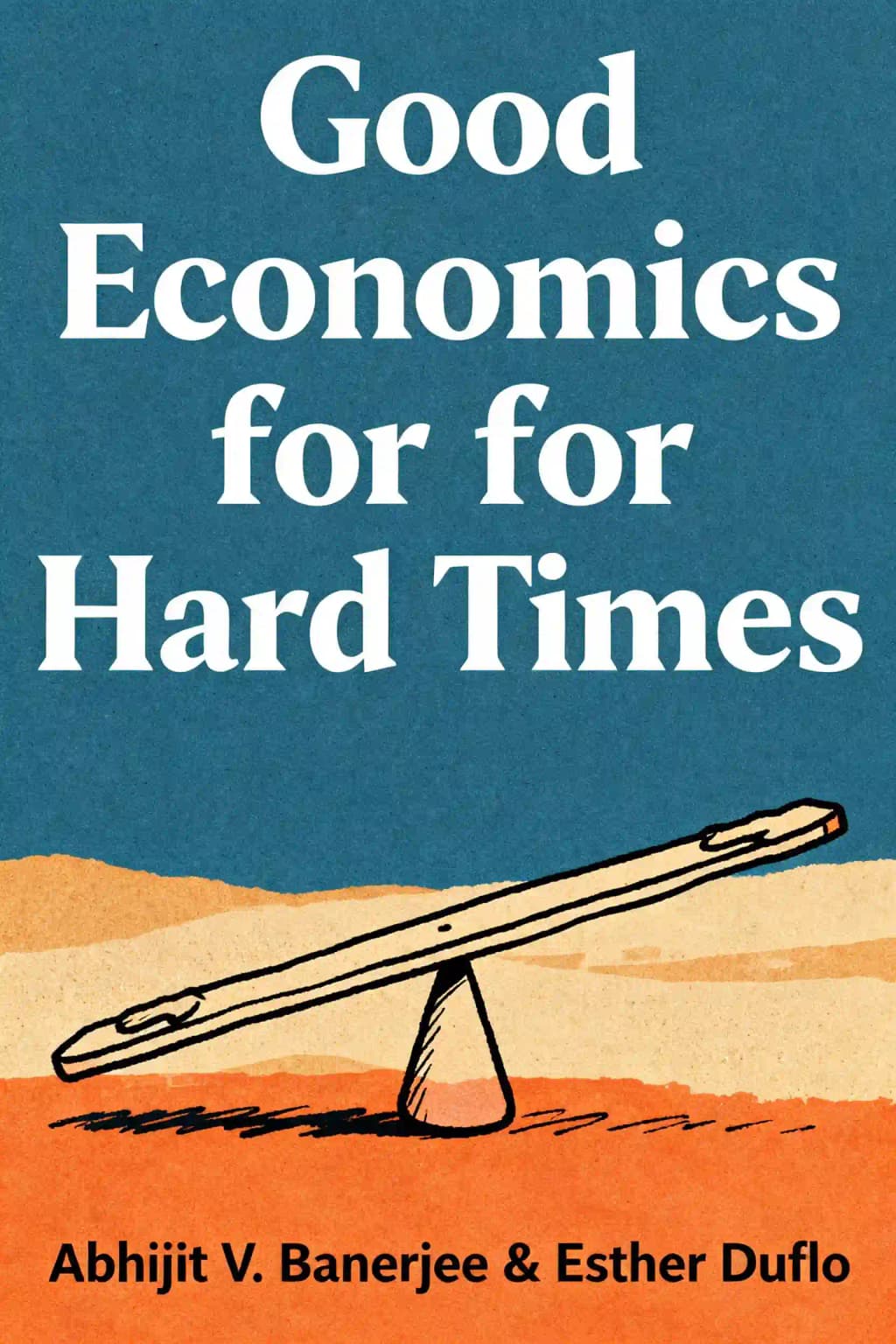
Nobel Prize-winning economists reveal how evidence-based thinking can solve today's toughest challenges. Bill Gates praises their accessible approach to immigration, inequality, and trade. Can rigorous economic methods truly bridge political divides? Discover why this book sparked both acclaim and controversy worldwide.
Abhijit V. Banerjee and Esther Duflo, Nobel Prize-winning economists and co-authors of Good Economics for Hard Times, are renowned for their pioneering work in development economics and evidence-based policy solutions.
Both professors at MIT, they co-founded the Abdul Latif Jameel Poverty Action Lab (J-PAL), which has shaped antipoverty programs impacting over 400 million people worldwide. Their book combines rigorous research with accessible analysis to address pressing issues like inequality, immigration, and climate change, reflecting their decades of fieldwork across five continents.
Banerjee, born in Mumbai and educated at Harvard, and Duflo, a Paris-born MIT faculty member since 1999, previously collaborated on the bestselling Poor Economics, which redefined global poverty alleviation strategies and won the 2011 Financial Times Business Book of the Year Award.
Their work has been featured in The New York Times, TED Talks, and major policy forums, blending data-driven insights with practical compassion. Good Economics for Hard Times has been translated into 20+ languages and praised for challenging ideological divides with empirical clarity.
Good Economics for Hard Times by Nobel laureates Abhijit V. Banerjee and Esther Duflo challenges traditional economic dogmas, advocating for evidence-based policies to address poverty, inequality, and migration. It emphasizes government intervention, critiques market-only solutions, and highlights the economic benefits of reducing inequality and improving social safety nets.
The book targets policymakers, economists, and students but remains accessible to general readers interested in modern economic challenges. Its blend of academic rigor, real-world examples, and clear explanations makes it valuable for anyone seeking actionable insights into global crises like automation, trade disputes, and climate change.
Yes—it provides a fresh, data-driven perspective on polarizing issues like immigration and taxation while dismantling myths about free-market efficiency. Its balanced analysis of trade-offs in policy design makes it essential for understanding 21st-century economic dilemmas.
The authors argue that well-designed government policies are crucial for addressing market failures, reducing inequality, and stabilizing economies. They critique austerity measures and advocate for progressive taxation, social spending, and targeted welfare programs to protect vulnerable populations.
Banerjee and Duflo debunk the myth that immigration harms economies, showing it often boosts growth and innovation. They call for policies that integrate migrants fairly, emphasizing their potential to fill labor gaps and enrich cultural diversity.
Key solutions include expanding tax bases (beyond targeting the ultra-rich), investing in education/healthcare, and strengthening labor protections. The authors stress that reducing inequality isn’t just ethical—it’s economically beneficial, fostering stability and long-term growth.
It challenges reliance on abstract theories like trickle-down economics, arguing they fail real-world stress tests. Instead, the book prioritizes empirical data and behavioral insights to design policies that reflect human complexity.
Absolutely. The 2021 lecture series and book updates address pandemic-related disruptions, emphasizing flexible labor markets, universal basic income, and healthcare reforms. These ideas remain relevant for rebuilding equitable post-COVID economies.
While Poor Economics focuses on developing nations, this book tackles challenges in wealthy countries, like automation and political polarization. Both share a data-driven approach but differ in scope, with Hard Times offering broader policy frameworks.
Some argue it overstates trade’s role in job loss (vs. technology) and underestimates public resistance to tax reforms. Critics also note its optimism about government efficacy may downplay bureaucratic hurdles.
Key concepts:
Its analysis of AI-driven job displacement, climate policy trade-offs, and rising nationalism remains critical. The book’s blueprint for balancing growth with equity offers actionable strategies for current leaders.
通过作者的声音感受这本书
将知识转化为引人入胜、富含实例的见解
快速捕捉核心观点,高效学习
以有趣互动的方式享受这本书
Migration represents a plunge into uncertainty.
Good economics means being willing to change your mind.
Most Democrats view Republicans as bigoted.
We live in an era of unprecedented polarization.
将《Good Economics for Hard Times》的核心观点拆解为易于理解的要点,了解创新团队如何创造、协作和成长。
将《Good Economics for Hard Times》提炼为快速记忆要点,突出坦诚、团队合作和创造力的关键原则。

通过生动的故事体验《Good Economics for Hard Times》,将创新经验转化为令人难忘且可应用的精彩时刻。
随心提问,选择声音,共同创造真正与你产生共鸣的见解。

"Instead of endless scrolling, I just hit play on BeFreed. It saves me so much time."
"I never knew where to start with nonfiction—BeFreed’s book lists turned into podcasts gave me a clear path."
"Perfect balance between learning and entertainment. Finished ‘Thinking, Fast and Slow’ on my commute this week."
"Crazy how much I learned while walking the dog. BeFreed = small habits → big gains."
"Reading used to feel like a chore. Now it’s just part of my lifestyle."
"Feels effortless compared to reading. I’ve finished 6 books this month already."
"BeFreed turned my guilty doomscrolling into something that feels productive and inspiring."
"BeFreed turned my commute into learning time. 20-min podcasts are perfect for finishing books I never had time for."
"BeFreed replaced my podcast queue. Imagine Spotify for books — that’s it. 🙌"
"It is great for me to learn something from the book without reading it."
"The themed book list podcasts help me connect ideas across authors—like a guided audio journey."
"Makes me feel smarter every time before going to work"

免费获取《Good Economics for Hard Times》摘要的 PDF 或 EPUB 版本。可打印或随时离线阅读。
What if the most dangerous economic problems aren't about money at all, but about something far more human? Consider this: nearly half of Republicans would feel genuinely unhappy if their child married a Democrat. In 1960, that number was just 5%. We've reached a point where political identity trumps family bonds, where tribal loyalty overrides rational discourse, and where economic debates have devolved into warfare by other means. This isn't just about politics-it's about how we've lost the ability to talk to each other about the issues that matter most. Immigration, trade, inequality, automation, climate change. These challenges demand nuanced solutions, yet our conversations have shrunk to tweet-length accusations. Meanwhile, economists-who should help navigate these waters-are trusted by only 25% of people, barely more than politicians and far less than weather forecasters. The discipline meant to illuminate our path forward has become part of the fog. What we need urgently is economics that acknowledges complexity, tests ideas against reality, and admits when ideology must yield to evidence.
