第 1 章
When Humans Learned to Soar: A Journey Through the Skies
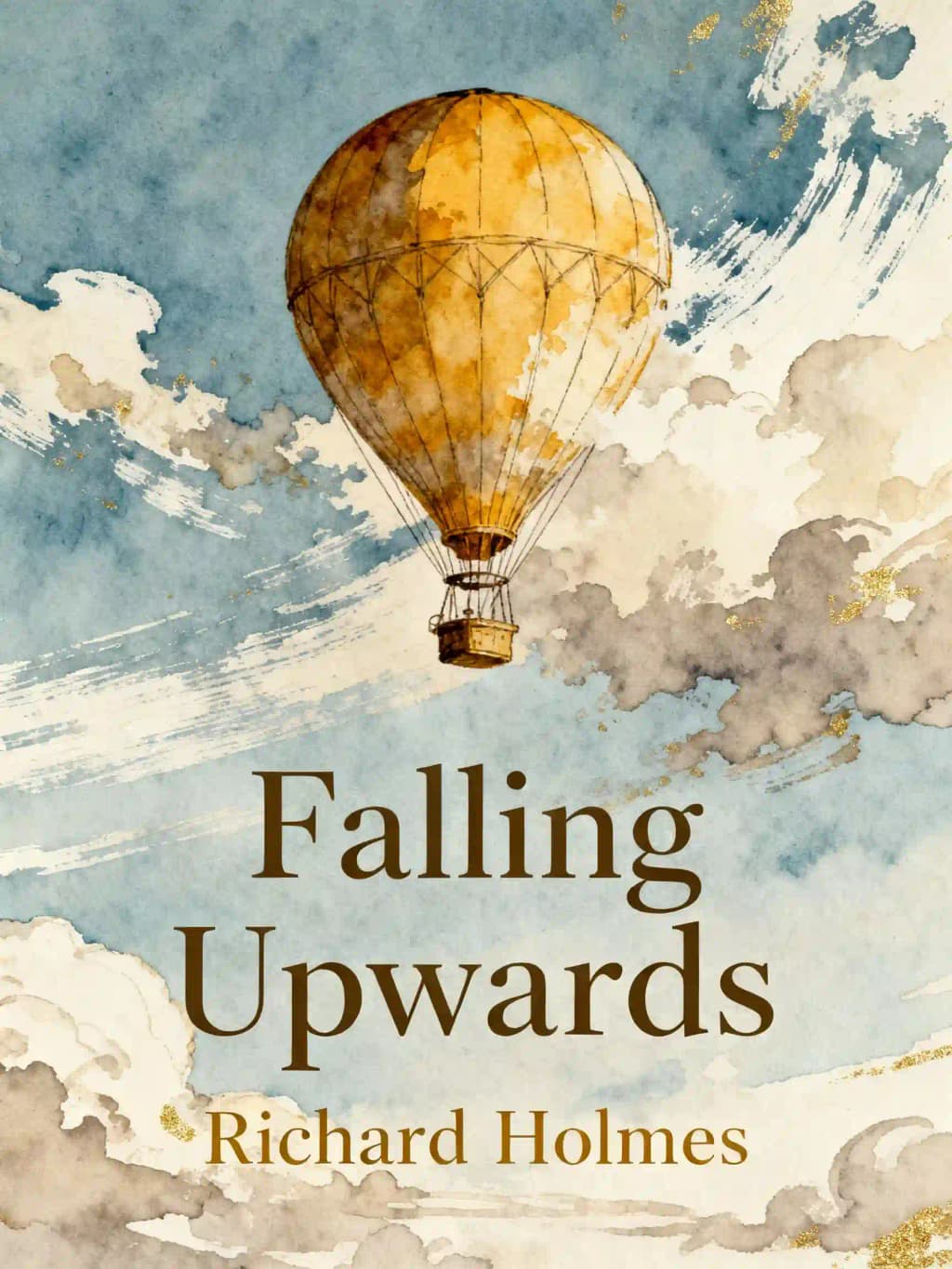
Richard Holmes' "Falling Upwards" has captivated readers worldwide since its publication, becoming a favorite of celebrities like Neil deGrasse Tyson and Stephen Fry, who called it "the most exhilarating book of the year." This mesmerizing history of ballooning does what few science histories accomplish - it transforms technical achievements into deeply human stories of courage, folly, and wonder. As we face modern challenges of climate change and aerial technology, Holmes' exploration of our first ventures into the sky offers timely perspective on humanity's complex relationship with the atmosphere. The book's enduring appeal lies in its ability to make us feel what those first aeronauts experienced: the heart-stopping moment when earth falls away and humans, against all evolutionary logic, find themselves suspended in the heavens.
第 2 章
The Dream of Ascending: Humanity's First Steps into the Sky
The sensation of "falling upwards" first came to Richard Holmes as a four-year-old child when his RAF uncle tied a helium balloon to his shirt at a Norfolk village fete. That strange, vertiginous feeling of being pulled skyward captures the essence of all balloon stories - a mixture of fact, fantasy, and often extraordinary courage in the face of potential disaster.
Balloons naturally attract stories, functioning as inherent three-act dramas: the launch (plans and hopes), the flight (visions and discoveries), and the landing (triumph, disaster, or sometimes farce). They offer remarkable perspectives, revealing natural features and human developments from above in ways that contribute to sciences and arts suggesting we share one living world. Beyond their practical applications, balloons provide an existential "heart-lift" and sense of hilarity that's difficult to describe but profound to experience.
The history of ballooning is filled with mesmerizing characters. In 2008, Father Adelir Antonio de Carli, known as "The Balloon Priest," ascended nineteen thousand feet on a charity flight suspended beneath a thousand multicolored helium balloons. Despite his thermal suit, GPS system, and satellite phone, he was carried out to sea and lost contact with coastguards. Three months later, his partial remains were found floating sixty miles off the Brazilian coast, still attached to his buoyancy chair.
The dash and eccentricity of balloonists since the first Montgolfiers of 1783 comes in every personality type - from meticulous to reckless, with varied motivations from scientific to publicity-seeking. Yet they share an enigmatic, almost unnatural longing to be airborne. The balloons themselves are paradoxical objects - beautiful yet ephemeral, powerful yet fragile - offering a provocative mix of tranquility and peril, control and helplessness.
Major John Money exemplifies this spirit. In July 1785, this half-pay officer took off from Norwich to raise funds for the local hospital. When an "improper current" carried him out over the North Sea, he found himself unable to descend. Twenty miles offshore, his balloon deposited him in treacherous shoals. For five desperate hours, Money clung to the balloon's rigging as it dragged him through the water before being rescued. Rather than being deterred, Money later volunteered to command a French regiment that used military balloons.
Ballooning exists in a curious timeless dimension - simultaneously modern and primitive. Though today's balloons use stainless-steel propane burners and rip-stop nylon, balloons have ancient origins stretching back thousands of years. Chinese dynasties reportedly used smoke balloons for military signaling and carrying love letters, while pre-Inca civilizations may have employed them for shamanic flights. The mysterious Nazca plateau carvings in Peru were likely designed to be viewed from balloons hundreds of feet in the air - suggesting these aerial vessels have long captivated human imagination.
第 3 章
Liberation and Transcendence: The Philosophical Impact of Flight
The theme of escape permeates ballooning history. When Dr. Alexander Charles made the first hydrogen balloon flight in December 1783, he experienced profound metaphysical freedom. Launching from Paris's Tuileries Garden before 500,000 spectators including Benjamin Franklin, Charles traveled twenty miles before continuing alone, rising to 10,000 feet where he witnessed a second sunset. His euphoric account captured the transcendent feeling: "Nothing will ever quite equal that moment of total hilarity that filled my whole body at the moment of take-off. I felt we were flying away from the Earth and all its troubles and persecutions for ever."
Franklin later remarked when asked about balloons' usefulness: "What's the use of a new-born baby?" Thomas Baldwin's 1785 Airopaedia similarly documented the existential dimension of flight, including the first aerial drawings and paintings from a balloon basket, revealing how the earth below appeared "like a coloured map."
Despite numerous successful flights across Europe by 1793, ballooning's true purpose remained enigmatic to scientific bodies. Notable achievements included Jean-Pierre Blanchard and Dr. John Jeffries' Channel crossing (1785), Pilatre de Rozier's fatal attempt in the opposite direction, and Blanchard's American debut in Philadelphia (1793) carrying a passport endorsed by President Washington. Yet these remained primarily public spectacles rather than practical applications.
Early theorists imagined balloons as tethered observation platforms for military reconnaissance, maritime navigation, atmospheric chemistry, or astronomy. More creatively, Erasmus Darwin proposed using tethered balloons to transport heavy loads uphill, while Joseph Banks envisioned them as counterweights to reduce horse requirements for ground transport. Benjamin Franklin suggested military applications along with whimsical ideas like balloon-assisted running footmen, aerial viewing platforms, suspended iceboxes, and even a balloon-powered wheelchair to ease his gout-ridden commute.
Tiberius Cavallo, an Italian physicist and Fellow of the Royal Society, produced the first comprehensive British study of ballooning in 1785. Unlike the romanticized accounts of pioneers like Vincenzo Lunardi, Cavallo demanded rigorous scientific observation. He recognized that ballooning's true essence lay in its vertical dimension - achieving altitude revealed mankind's impact on Earth's surface while exposing vast unexplored territories. Cavallo championed ballooning's relevance to meteorology, arguing that atmospheric phenomena required "attentive examination" only possible through aerial observation.
The most enduring dream of flight has always been metaphysical - to fly as high as possible and look back upon the earth to see mankind for what it truly is. Cyrano de Bergerac, the seventeenth-century French dramatist, wrote of a fictional moon journey using glass cluster balloons filled with dew that evaporated in sunlight. Three centuries later, Apollo 8 astronaut Bill Anders experienced a similar revelation when seeing Earth from lunar orbit: "The most significant thing we're seeing is our own planet." The resulting "Earthrise" photograph became one of history's most famous images, showing our small blue planet hanging against the blackness of space. The dream of flight, ultimately, is to see the world differently.
第 4 章
War in the Skies: Balloons as Military Technology
The military applications of ballooning quickly overshadowed scientific aspirations. Benjamin Franklin had warned of this possibility, as recognized by contemporaries like Sophia Banks, who collected balloon memorabilia including an 1784 cartoon depicting "The Battle of the Balloons" - British and French balloons armed with muskets and cannons maneuvering for aerial combat.
As Franklin predicted, the first military balloon regiment was French. The Corps d'Aerostiers, founded in March 1794, deployed observation balloons at the Battles of Fleurus and Liege just months later. Captain Charles Coutelle's aerial reconnaissance provided vital intelligence that contributed to French victories in both engagements. Coutelle identified key challenges: hydrogen generation in the field, launching in windy conditions, and transmitting observations effectively from basket to ground.
Beyond tactical value, balloons served as psychological weapons - their mere presence created the impression that every enemy soldier was constantly being observed, with "no hiding place, no escape." This demoralized opposing forces, who complained they couldn't fight Republicans who remained "out of reach but see all that passes beneath." Ironically, this visibility made balloons prime targets for enemy fire, making the aeronaut's position both extremely dangerous and glamorous.
Civilian ballooning resurfaced in France during the 1802 Peace of Amiens, championed by Andre-Jacques Garnerin, who had made a spectacular first parachute descent in Paris in 1797. Garnerin's ballooning passion developed during three years imprisoned in Hungary, where he designed imaginary escape balloons and parachutes. His shows drew enormous crowds across European capitals, with Garnerin promoting himself through heroic posters. Napoleon recognized balloons' propaganda value exceeded their military applications.
Sophie Blanchard emerged as the most celebrated French Revolutionary balloonist. Small, fearless and enigmatic, Sophie was abnormally nervous on the ground - terrified of crowds, loud noises, horses and coach travel - yet transformed completely in the air, becoming confident, commanding, and daringly exhibitionistic. She specialized in spectacular night ascents with elaborate fireworks displays, appearing like an unearthly creature suspended in the night sky above cascades of colored smoke and flaming stars.
On July 6, 1819, during a night ascent from the Jardin de Tivoli, Sophie's hydrogen balloon caught fire at five hundred feet. The flaming balloon crashed onto a rooftop, and though not severely burned, Sophie became tangled in the rigging. She hung briefly from a parapet, calmly calling "A moi, a moi!" before falling to her death on the cobblestones below. Her tragic death profoundly changed ballooning's reputation in France.
第 5 章
The Golden Age of Recreational Flight
By the late 1820s, ballooning's pioneering era had ended as dreams of global air transport faded across Europe. The railway network was emerging as the dominant form of revolutionary transport. Victorian railways represented everything balloons could not: iron, steam, noise, power, speed, reliability and mass transport - the physical embodiment of industrialization. Ballooning, by contrast, evolved into something essentially bucolic, silent, decorative, exclusive and refreshingly unreliable - a means to mysterious adventure rather than mundane travel.
As railways boomed, a new era of "recreational" ballooning emerged with increasingly large, sophisticated aerostats designed to carry paying passengers. These commercial yet romantic ventures often incorporated "royal" in their names to honor Queen Victoria. Critical to their commercial success was the discovery that cheap, reliable coal gas from urban mains could replace expensive, unstable hydrogen. Their most memorable flights occurred over urban landscapes, offering passengers unprecedented panoramic views of rapidly industrializing cities.
Charles Green (1785-1870), celebrated for his 526 successful ascents and absolute sang-froid in emergencies, emerged as Britain's preeminent balloonist of this second generation. Though jovial and easy-going on the ground, Green became strangely fierce and commanding in the air. Born into a family of fruit merchants in London's Goswell Street, Green revolutionized commercial ballooning by negotiating with the London Gas Light and Coke Company to purchase coal gas at a third the cost of hydrogen.
By 1835, Green had made over two hundred ascents and invented the trail rope - a simple, self-regulating ballast device allowing gas balloons to adjust their height automatically when flying below five hundred feet. His Royal Vauxhall balloon, constructed in 1836 for 2,000, was a magnificent eighty-foot-high coal-gas balloon adorned with red-and-white vertical candy stripes and a Latin inscription from Ovid's Metamorphoses: "Caelum certe patet, ibimus illi" - "Surely the sky lies open, let us go that way!"
In November 1836, Green orchestrated a spectacular overnight flight from London to the Continent that would become legendary. Accompanied by wealthy MP Robert Hollond and Irish musician Monck Mason, they launched from Vauxhall Gardens with provisions for up to three weeks. Their supplies were extravagant: forty pounds of ham, beef and tongue; forty-five pounds of game and preserves; forty pounds of bread and biscuits; sixteen pints each of sherry, port and brandy; and several dozen bottles of champagne.
As darkness fell, they dined on cold meats and wine, noting that champagne proved "unmanageable" at altitude, revealing its "natural tendency to flying." By midnight, having been airborne for twelve hours, they approached Liege, Belgium, and were transfixed by its industrial landscape. The balloonists, floating silently through the night, witnessed an "unearthly glare of fiery foundries" surrounding the ancient city center - a nightmarish vision of the industrial future that Mason described as a "Cyclopean region."
第 6 章
Literature Takes Flight: Balloons in the Imagination
The year before Green's epic flight, Edgar Allan Poe had written "The Unparalleled Adventure of One Hans Pfaall," published in the New York Sun in June 1835. This technically detailed fantasy describes a successful moon journey in a massive home-made balloon containing forty thousand cubic feet of gas.
During nineteen days aloft, Hans observes Earth's retreating surface, gradually reduced to a curving globe of blue oceans and white polar caps. "The proudest cities of mankind had utterly faded away from the face of the earth," he notes. Eventually reaching lunar orbit, he descends to the moon's surface where he encounters hostile, ugly creatures who dismiss his tales of Earth as lies. Written when Poe was only twenty-six, this pioneering tale combines scientific realism with metaphysical terrors, suggesting the wholly new dimension of science fiction.
Two years after Monck Mason published his serious account of Green's flight in Aeronautica (1838), Green proposed crossing the Atlantic, claiming to have identified a west-to-east wind current in the upper atmosphere. Though Green never found financial backing for the attempt, Edgar Allan Poe created a brilliant fictional account in 1844's "The Atlantic Balloon" hoax, convincingly describing Green and Mason crossing the Atlantic in seventy-three hours.
Throughout the 1840s and 1850s, dramatic ballooning stories gained increasing prominence in popular press across Britain and America. With the founding of illustrated journals like the Illustrated London News in 1847, balloons offered superb opportunities for picture stories. Henry Mayhew's rapturous account, "A Balloon Flight over London," published in September 1852, stands as a masterpiece of aeronautical journalism. After years exploring the city's darkest corners in his famous work London Labour and the London Poor, he sought to see London from above - from "an angel's view." His resulting essay captured the transformative experience of seeing the metropolis miniaturized below, describing how the aerial vantage point conferred "a kind of innocence, a kind of grace."
Charles Dickens, though intrigued by balloons and acquainted with Charles Green, never actually ventured into a balloon basket himself. In "Vauxhall Gardens by Day," he wrote sarcastically about balloon launches, particularly mocking the gullibility of crowds. Dickens's hostility toward ballooning went deeper than mere mockery of scientific pretensions. He despised balloons as mass entertainment that exploited public credulity and aeronauts' courage. In an extraordinary essay on "Nightmares," Dickens made a disturbing comparison between crowds at Vauxhall balloon launches and spectators at public hangings.
第 7 章
American Ambitions: Conquest of the Continental Skies
For American balloonists, the horizon was just opening up. From the 1840s, fairground aeronauts and showmen began dreaming of the ultimate publicity coup: a single non-stop balloon flight three thousand miles across America. Unlike their British counterparts, American balloonists were inspired by their nation's untamed wilderness - the vast prairies, forests, and lakes.
Eugene Godard, a celebrated French aeronaut, brought glamour to American ballooning in 1854 with his touring aerial spectacle. Arriving in New York with five balloons including his flagship 106,000-cubic-foot Transatlantic, Godard toured extensively with his wife and crew who performed aerial trapeze acts and parachute jumps. The Cincinnati Gazette even appointed a "Balloon Editor" to cover his exploits.
By the late 1850s, three serious American aeronauts emerged who would transform ballooning from mere spectacle to scientific pursuit: John Wise, John LaMountain, and Thaddeus S.C. Lowe. Unlike showmen, these "Professors" were educated men who could lecture and write as well as fly. John Wise believed a permanent west-east air current blew across America, ordained by God to open vast lands to balloon travel. In 1850, he published "A System of Aeronautics" promoting this theory, and by 1859 had formed the Trans-Atlantic Balloon Corporation to fund a specially equipped balloon for long-distance flights.
His ambitious plan was to fly the 120-foot-high silk balloon "Atlantic" from St. Louis to New York - nearly a thousand miles - demonstrating that crossing the Atlantic Ocean was feasible. The journey began on July 1, 1859, carrying champagne, provisions, blankets, and critically, a mailbag from the United States Express Company - representing Wise's business vision of establishing America's first rapid air mail service.
Though they'd traveled an impressive 809 miles in twenty hours (a world record that would stand until 1910), the commercial mail venture had failed when they were forced to jettison the mailbag during a storm. The great dream of crossing the Atlantic had eluded them all.
第 8 章
War and Science: Balloons in the American Civil War
The outbreak of the Civil War dramatically changed the course of American ballooning. Between September 1870 and January 1871, sixty-seven manned balloons successfully launched from the encircled city, creating history's first civilian airlift. Though not military balloons, they changed warfare conditions by opening the one unguarded route from Paris: the sky.
Thaddeus Lowe experienced the growing North-South tensions firsthand when he launched his Enterprise balloon from Cincinnati on April 19, 1861. Originally planned as a scientific investigation of easterly air currents, the flight became an attempt to impress the Union government. Instead, rebel winds carried him 650 miles south to Unionville, South Carolina, where suspicious locals arrested him as a spy.
After returning north with his balloon, Lowe consulted Professor Henry at the Smithsonian and developed a revolutionary idea: using a tethered balloon with telegraph equipment to send aerial observations directly to commanders on the ground. On June 16, 1861, Lowe demonstrated this system to President Lincoln himself, ascending 500 feet above Constitution Mall with a telegraph operator and wire running directly to the White House.
Throughout 1862, Lowe's Union Balloon Corps operated exclusively during the Virginia phase of the Civil War. From his aerial vantage point, Lowe observed a new kind of American warfare - rapid, violent and passionate, with swift exchanges of attack and counter-attack across countryside dotted with small townships and strategic junctions. He witnessed the devastating effects of modern weaponry: heavy artillery shells, mines, hand grenades, canister shells, and Springfield rifles capable of blowing off limbs at a thousand yards.
One of Lowe's most brilliant coups was discovering the Confederates' secret evacuation of Yorktown on May 4-5, 1862. While observing the fortress ablaze with bonfires, he noticed a crucial detail: ingoing wagons moved rapidly and lightly while outgoing ones moved slowly and heavily laden. This observation convinced General Heintzelman that the rebels were withdrawing, not reinforcing, allowing Union forces to overtake the Confederate army at Williamsburg.
第 9 章
Scientific Exploration of the Upper Atmosphere
By the late 1820s, ballooning's pioneering era had ended as dreams of global air transport faded across Europe. The railway network was emerging as the dominant form of revolutionary transport. Victorian railways represented everything balloons could not: iron, steam, noise, power, speed, reliability and mass transport - the physical embodiment of industrialization. Ballooning, by contrast, evolved into something essentially bucolic, silent, decorative, exclusive and refreshingly unreliable - a means to mysterious adventure rather than mundane travel.
In 1862, the British Association for the Advancement of Science formed a Scientific Committee to investigate "Hygrometric and other Conditions of the Upper Air" through sponsored balloon ascents. They appointed James Glaisher, a fifty-three-year-old meteorologist, to lead these researches.
Glaisher seemed an unlikely aerial adventurer - a large, taciturn family man with heavy whiskers, a Fellow of the Royal Society, and Secretary to the Royal Meteorological Society who lived comfortably with his ten children in South London. Yet he proved meticulous in his approach, compiling a thirteen-point research program covering the earth's magnetic field, solar spectrum, dew point, atmospheric oxygenation, electricity, barometric pressure, cloud density, and air currents.
Glaisher and Coxwell's most celebrated high-altitude ascent occurred from Wolverhampton on September 5, 1862. Departing at 1 p.m. on a fine autumn afternoon, they reached twenty thousand feet within forty minutes, where breathing becomes difficult and the sky darkens to Prussian blue. At 1:54 p.m., they recorded twenty-nine thousand feet with the balloon still rapidly rising.
Disaster nearly struck when the valve line tangled, forcing Coxwell to climb into the balloon hoop to free it. Both men began suffering severe oxygen deprivation. Glaisher's eyesight blurred, his muscles failed, and he slumped unconscious against the basket. Meanwhile, Coxwell struggled with frozen, blackened hands to free the valve line. Unable to grip with his hands, he ingeniously caught the rope between his teeth and pulled, releasing gas to begin their descent.
Finding Glaisher unconscious, Coxwell roused him by asking scientific questions. "Do try to take temperature and barometer observations," he urged repeatedly until Glaisher regained consciousness. They revived each other with brandy and began their descent.
Glaisher meticulously reconstructed their maximum altitude. His last accurate reading showed 29,000 feet at 1:54 p.m., after which they continued ascending for perhaps six or seven more minutes before Coxwell managed to release the valve. Various instruments suggested they reached between 35,000-37,000 feet (approximately seven miles), though Glaisher modestly claimed 32,000 feet (six miles) in a letter to The Times. This extraordinary record would stand for the remainder of the nineteenth century.
第 10 章
The Final Frontier: Extreme Ballooning and the North Pole
The quintessential extreme record-breaking balloonist was Swedish engineer Salomon Andree, who attempted to reach the North Pole by balloon in 1896-97.
Born in 1854 in provincial Granna, Andree was raised primarily by his mother Wilhelmina after his apothecary father died when he was sixteen. He grew up exceptionally tall, headstrong and adventurous, with a lifelong confidence instilled by his mother. Passionate about natural sciences, especially engineering, meteorology and ornithology, Andree disdained arts and literature, claiming only adventure stories interested him.
Despite taking his first actual balloon flight surprisingly late in 1892, Andree proved a natural aeronaut. Between 1893-95, he made eight solo flights in his balloon Svea, surviving a dramatic Baltic storm that garnered tremendous publicity. With only forty hours' total flying experience, he gained support from leading polar scientist A.E. Nordenskiold and wealthy patrons including Alfred Nobel.
For his crew, Andree recruited Dr. Nils Ekholm and 24-year-old Nils Strindberg, a brilliant physicist and accomplished photographer. In February 1895, Andree presented his "Plan to Reach the North Pole by Balloon" to the Swedish Royal Academy, methodically addressing the four major challenges: sustaining flight for thirty days, surviving extreme cold, navigating northward, and returning home after landing on ice.
Like a character from Jules Verne, Andree proposed technological solutions for every problem, from sailing rigs and guide ropes to ice-repellent fabrics and lightweight cooking equipment. His balloon, confidently christened the North Pole, was a Vernian fantasy machine of immense proportions - 212,000 cubic feet, ninety-seven feet tall, constructed from three layers of expensive double Chinese silk with a special varnished cotton top canopy to prevent icing.
The expedition's fortunes deteriorated rapidly. Within four minutes of launch, the Eagle (renamed from North Pole) dropped from eight hundred to sixty-five feet, never to rise above three hundred feet again. At this low altitude, the seemingly smooth ice revealed its true nature - a treacherous landscape of twenty-foot humps and sharp edges where the pack had compacted under enormous pressure.
By mid-morning on July 13th, the wind reversed again, freeing their trapped rope and sending them eastward. The crew celebrated with a hot meal and several bottles of "the King's Special Ale." Andree released four pigeons with an ominously brief message: "All well on board. This is the third pigeon post. Andree." There were no details of plans, prospects, or signatures from Fraenkel or Strindberg.
As bumping increased, conditions deteriorated. Andree grew withdrawn, Fraenkel accidentally set the cooker on fire, and Nils became seasick. At 8 p.m., they made a desperate attempt to gain altitude by jettisoning six marker buoys, the winch, the night-stool, and most remaining ballast - 550 pounds in total. The Eagle rose only to two hundred feet before sinking again, striking violently against the ice by 10:30 p.m.
Clearly Andree concluded the gamble was too great. At 6:20 the following morning, July 14th, he released more gas and brought the Eagle down on a relatively smooth ice floe. It was a fearful decision - they'd been airborne less than sixty-five hours in a balloon designed for thirty days. The landing was rough, with the basket dragging for over an hour before turning on its side. All three men scrambled out to face the grim reality: their proud balloon now a tattered, frost-covered wreck, and themselves stranded on a featureless frozen plateau, over four hundred miles short of the Pole and 216 miles from the nearest land.
Nils Strindberg's last almanac entries provide a haunting final thread of narrative, proving the Eagle's crew survived until mid-October 1897. His terse notations track their final days: the ice-floe breaking on October 2nd, the "exciting situation" of reaching White Island, moving to land on October 5th, and mysteriously noting "Home 7 o'clock a.m." on October 17th - his final written words.
The expedition's fate remained unknown for over thirty years until 1930, when a Norwegian whaling ship accidentally discovered their campsite. Investigators found Andree and Fraenkel's remains beneath the rock shelf Nils had called "home." Most touching was the discovery of Nils Strindberg's carefully constructed grave thirty yards away, revealing he had died first. Their companions had lovingly buried him and preserved his personal effects - including letters to his fiancee Anna and her gold locket - before they too perished.
第 11 章
The Legacy of Ballooning: From Pioneers to Modern Flight
Though Andree's expedition ended tragically, it represented not failure but a revolutionary achievement in humanity's long quest for flight. Between 1780 and 1900, through extraordinary courage and recklessness, the concept of manned flight itself was established after a hundred thousand years of human evolution. As Felix Nadar put it, "Le Droit au vol" - "The Right to Fly" - had been claimed.
While mechanical flight soon passed to heavier-than-air machines and eventually rockets and spacecraft, ballooning itself followed a different path. After dwindling during the interwar years, it experienced a renaissance since the 1960s with the popularity of hot-air ballooning as both tourist attraction and international sport. Balloon fiestas have become global phenomena, democratically transcending borders as Victor Hugo once claimed they would.
Modern balloons continue serving science through weather monitoring, archaeological surveying, military applications, and environmental studies. The quest for balloon records persists - from Auguste Piccard's 1932 ascent to 53,149 feet to Felix Baumgartner's 2012 stratospheric jump, from Atlantic crossings to Breitling Orbiter 3's round-the-world flight in 1999.
But this history isn't merely about balloons - it's about the spirit of discovery itself and the extraordinary human drama it produces. It explores how a single counter-intuitive scientific discovery - that hydrogen can be weighed against atmospheric air - created such enormous social and imaginative impact, representing the powerful intersection of chemistry, physics, engineering and human imagination.
Perhaps what continues to captivate us about ballooning is not the technology itself but the idea - the upward possibility. Our hearts still leap when we behold these dragons in the sky, these silent witnesses to humanity's eternal dream of transcending our earthbound existence, if only for a few precious hours.