第 1 章
The Winged Wanderers: A Journey Through Britain's Avian Treasures
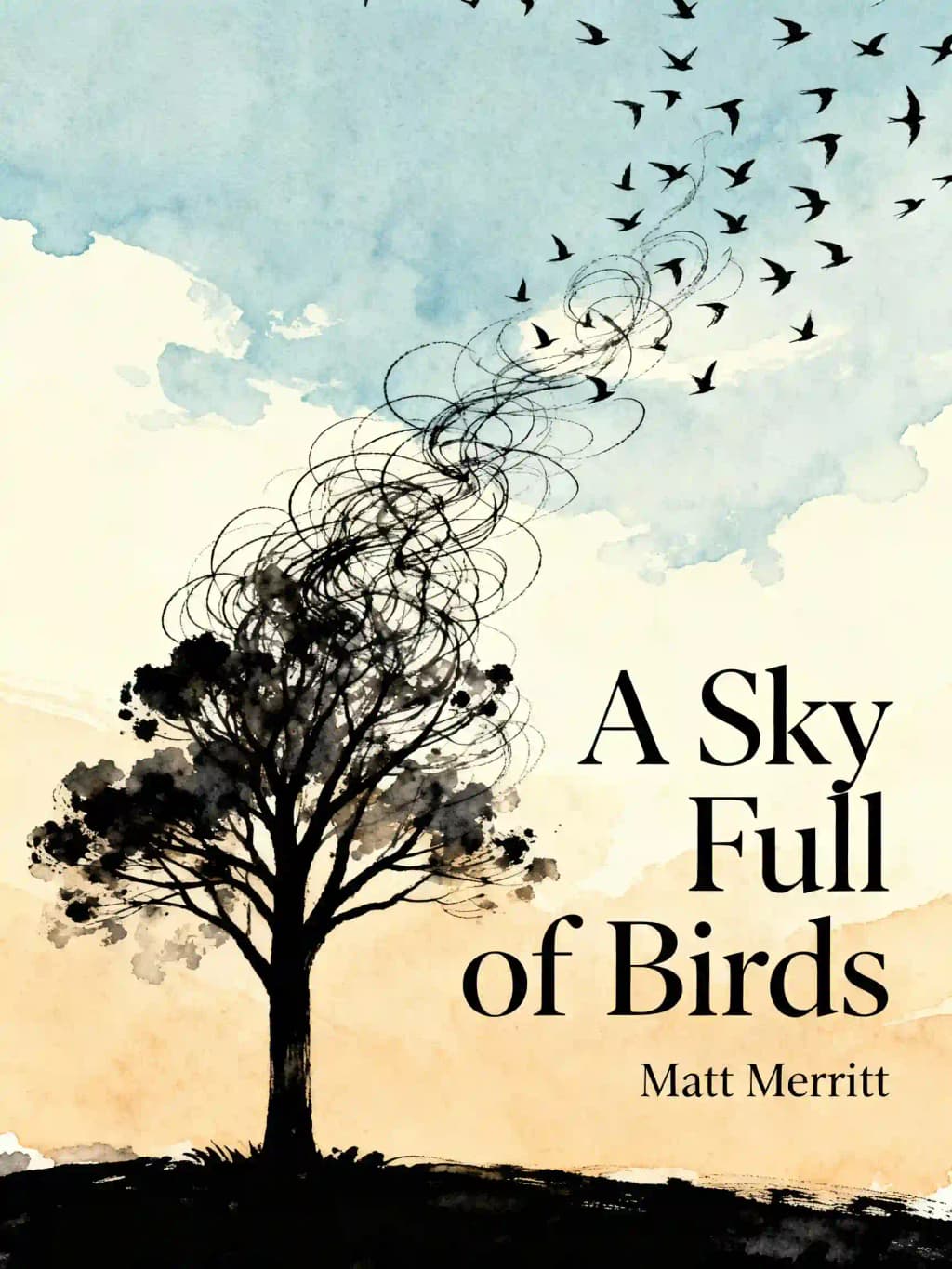
In a world where exotic wildlife documentaries dominate our screens, we often overlook the extraordinary avian drama unfolding daily in our own backyards. From city raptors hunting between skyscrapers to Arctic visitors in supermarket parking lots, remarkable bird spectacles await discovery across Britain. Matt Merritt's "A Sky Full of Birds" has become something of a cult classic among nature enthusiasts, with celebrities from Emma Thompson to Benedict Cumberbatch citing it as a favorite. The book's cultural impact extends beyond birdwatchers-it has inspired art exhibitions, poetry collections, and even a BBC radio adaptation. What makes this work so compelling is Merritt's unique dual perspective as both an award-winning poet and the editor of Bird Watching Magazine, allowing him to capture the wonder of Britain's birds with both scientific precision and lyrical beauty. As climate change and habitat loss increasingly threaten bird populations worldwide, this intimate portrait of Britain's avian treasures serves as both celebration and warning-a reminder of what surrounds us, if only we know where to look.
第 2 章
The Rhythms of Avian Romance
I'm driving down the M5 toward Cornwall during the wettest January in memory when the skies suddenly clear near Taunton. Birds materialize everywhere-winter thrushes speckle sheep pastures, woodpigeons arrow across lanes, and buzzards transform into scaled-down eagles in the afternoon thermals. Near East Lyng, I find the A361 transformed into a causeway with submerged fields stretching to the horizon. Though devastating for locals, as a visitor I'm captivated by this strange grandeur-a landscape that likely resembles what King Alfred saw when hiding from Danish invaders.
The moment I start walking, birds command my attention: fieldfares and redwings from Scandinavia flock densely on remaining dry ground, marsh harriers glide low over their reflections, and lapwings bicker along field boundaries. Most spectacular are the golden plovers-about two hundred flash and spangle overhead, performing their strange alchemy with every turn, transforming from dark dots to white-hot ingots to falling gold pieces. For ten entrancing minutes, I forget I'm in Somerset; this feels like one of the world's great wetlands.
To be a birdwatcher is to live by a different calendar, one marked by small disappointments and unexpected melancholies. By June, the first wading birds at reservoirs signal failed breeding attempts in the north. These adults, unable to pair or whose nesting failed, have moved south early to claim prime winter feeding spots. With summer solstice still days away, autumn migration has already begun-birds always several wingbeats ahead of our perception of seasons.
Yet this altered timescale brings consolations. By early March, the first summer visitors battle through blustery winds to reach Britain. Even in January's depths, birds prepare for spring-robins intensify their silvered songs, blue tits inspect nest holes, herons build nests in bare trees, and ravens return to ancient nesting sites.
Black grouse begin returning to their traditional leks as early as November, months before females arrive in March. At a Welsh moorland hide before dawn, what first appeared as undergrowth gradually resolves into eight male black grouse-blackcocks. Their purple-black bodies with white wing flashes, lyre-shaped tails, and shocking red wattles become visible as daylight strengthens. Triggered by a nearby red grouse call, they begin their ritual, strutting back and forth uttering low, liquid display calls while assessing rivals. Their spread white tails create snow-like patches across the plateau, wattles flaring brighter as they occasionally leap onto fence posts to survey their domain.
Great crested grebes represent one of British conservation's greatest triumphs. Nearly exterminated by the Victorian plumage trade, they became the focus of a successful campaign that birthed the Royal Society for the Protection of Birds-now with 1.1 million members. Their courtship ritual unfolds with remarkable symmetry. The pair swims face-to-face, shaking heads and sweeping their bills through their plumage, ruffs puffed out. Then comes the more rarely witnessed display-one bird disappears beneath the surface only to emerge upright like a penguin, pirouetting before its potential mate. Swimming rapidly toward each other, they rise vertically breast-to-breast, presenting vegetation like hopeful lovers.
Birdwatching teaches us that Britain, despite its modest size, contains remarkably diverse habitats that create distinct avian populations. Birds common in one region may be rarities just fifty miles away. This diversity became apparent during a winter trip to Scotland's Moray coast where a single great crested grebe-unremarkable to my Midlands eyes-was considered a genuine prize. This moment revealed how Britain's seemingly unified landscape is actually a complex mosaic of distinct ecosystems.
第 3 章
The Symphony at Dawn
I dream of birds-sometimes so vividly that I wake excited by strange new species only to face disappointment when realizing they were merely imagination. But another type of bird dream visits me too, beginning in February and intensifying in April when open windows welcome the dawn. It starts as the eastern sky barely lightens, when a thin silvery voice speaks of forests, rivers, heath and hedgerow. Before I can locate it, another voice joins, then another-similar yet distinct, as if speaking related languages. Soon a fifth, sixth, and seventeenth song-language join the babel, washing over me until I realize this dream has become part of my waking self, announcing spring's arrival.
Most people recognize a few bird songs-the cuckoo's disyllabic announcement, the blackbird's rhapsodic performance, the robin's silvery strands, the chaffinch's suburban jangle. But Britain's dawn chorus surpasses most worldwide thanks to our distinct seasons that compress breeding into a short period. Unlike warmer climates where breeding extends year-round, British songbirds must attract mates within a few weeks from late winter through spring. The chorus builds gradually from winter's single voices to spring's full orchestra, enhanced by migrant warblers from the southern hemisphere.
British birdwatching is friendly yet solitary, serving as socially acceptable cover for spending time alone with one's thoughts. Five years ago, I decided to do all my birdwatching on foot for a year. This pedestrian routine saved petrol, helped me lose three stone, and transformed my birding experience. Walking between sites revealed new behaviors in familiar species and heightened my attention to marginal habitats. Most importantly, I realized how much of birdwatching is actually bird-listening-a lesson that immeasurably enriches the experience.
On an early April morning in Gracedieu Woods, I prepare for my monthly woodland bird survey by "getting my ear in." As darkness thins, a robin begins the dawn performance, followed by blackbirds with their sweet, fluty tones. Song thrushes join with their jazz-like improvisations, repeating distinctive phrases as Browning noted: "That's the wise thrush; he sings each song twice over."
The early singers-robins, blackbirds, thrushes-feed mainly on forest floor creatures, establishing territories at dawn before a day of competition. As sunlight filters through the trees, more layers join: chiffchaffs with their insistent two-note calls, great tits, and various finches-bullfinches' quiet warbling, goldfinches' metallic tinkling, greenfinches' wheezing, and chaffinches' descending jangle. Finally, warblers complete the chorus-blackcaps chortle, garden warblers babble, willow warblers offer their affecting songs, and whitethroats add scratchy jibber-jabber.
While dawn offers the most intense birdsong, dusk provides a worthy encore as birds make their final territorial announcements before nightfall. The nightingale-whose name means "night songstress" though males do the singing-requires specific habitats: coppiced woodland of particular age and scrubby thicket structure. Their decline in Britain-down to an estimated 6,500 males from significantly more in the mid-1990s-stems largely from habitat loss, though climate change might eventually extend their range northward.
Standing in the darkness at Knepp, the nightingales' songs are thrown into sharper relief by the surrounding stillness. Like all great musicians, they know what to leave out is as important as what to include. Though perhaps not my favorite British songster (the blackbird wins that accolade), hearing even one nightingale connects you momentarily to nature's poetry.
第 4 章
Travelers on Ancient Flyways
On a bitter March Sunday, I visit Swithland Reservoir in Leicestershire to see a rare lesser scaup duck blown across the Atlantic. Today the parking lot is packed with twitchers. I quickly spot the scaup, but my attention is suddenly drawn to something more remarkable: a freshly-arrived wheatear perched on the Victorian pumping-house, looking bedraggled and exhausted after its journey from south of the Sahara. This tiny bird, no bigger than a robin, hasn't even reached its final destination-it might continue to the Peak District, Scotland, Iceland, or incredibly, even Canada.
Migration plays a crucial role in British bird life, yet remains surprisingly misunderstood. While we're familiar with summer visitors like swallows and swifts, Britain hosts many other migratory patterns including warblers, redstarts, pied flycatchers, Arctic terns and hobbies-all making long journeys from south of the Mediterranean or Sahara. Species often fit multiple categories. Black-tailed godwits breed here in small numbers but also include substantial wintering populations from Iceland and passage birds moving between northern breeding sites and Iberian wintering grounds.
Migration defines what many birds are: creatures of perpetual motion bound to invisible global flyways, in thrall to seasons and weather. It's both curse and blessing, making them fascinating to us who are hopelessly bound by family, work, place and culture.
Wheatears are among spring migration's pioneers, appearing as early as March's first week. Their northward movement continues into May, accommodating both British upland breeders and those bound for Scandinavia, Greenland and eastern Canada. By mid-April, migration reaches its peak. At Pagham Harbour, I immediately spot a gorgeous male redstart with its rusty-red breast, ash-grey back and head, black throat, white forehead, and namesake red tail. This bird, wintering south of the Sahara before returning to our deciduous woodlands, seems almost designed for African savannah rather than British sea-fret.
At Pagham Harbour, I witness something extraordinary. What I initially mistake for wind in the leaves is actually a tree shivering with at least fifty excited, restless willow warblers-tiny birds no bigger than blue tits that have just made landfall after flying from France. Each tree along the lagoon teems with these green-brown and pale yellow songsters, newly arrived from tropical Africa. Despite such massive arrivals-willow warblers establish over 2 million breeding territories in the UK-they barely register with non-birdwatchers.
Spring brings massive "falls" of migrants along Britain's south coast when south and southwest winds prevail. Headlands like Beachy Head, Selsey Bill and Berry Head become natural landing spots. At prominent headlands like Dungeness and Portland Bill, birdwatchers conduct ongoing citizen science by trapping and ringing incoming birds.
Recent technological advances have revolutionized tracking. Electronic geo-locators, initially used on large birds like ospreys but now miniaturized for smaller species, transmit exact locations multiple times daily. The British Trust for Ornithology's Cuckoo Project revealed surprising migration routes-some birds travel through Italy and Malta while others pass through France and Spain before crossing the Sahara. This is particularly remarkable since young cuckoos, raised by foster parents that don't migrate sub-Saharan, must navigate alone without parental guidance.
As April ends, I squeeze in a quick visit to my favorite local reserve, Kelham Bridge. On a small grassy hill, I immediately spot a wheatear-plumper, neater and more pristine than the March waif at Swithland. Wheatears inspire admiration beyond their globetrotting feats. They project energy, purpose and quiet confidence-watchful without being too quick to flee from humans. As I turn to leave, wondering about this bird's final destination, the most instantly recognizable birdsong in the western world rings out along the valley: the resonant, querulous call of the cuckoo. It has only one meaning. Spring.
第 5 章
Predators and Prey in Dynamic Balance
Standing at the edge of a rain-slicked road fronting an unremarkable expanse of windswept saltmarsh, I watch a hen harrier glide in a shallow V, hugging the contours of the ground with millimeter precision. Its flat disc face remains fixed toward the waterlogged earth as it banks near us, flashing its bright white rump. Though lacking the striking pale grey plumage of males, the female's streaky dark brown loses nothing in grace and elegance. Every sighting of these increasingly rare birds brings to mind their persecution on grouse moors, despite their preference for rodents and small birds over game.
As the harrier glides away, other shapes materialize over the marsh: heart-faced barn owls ghosting toward us, yellow-eyed short-eared owls with flashing orange wing patches, a fence-perched merlin that suddenly bounces low above the ground, and a peregrine hunting by ambush rather than its famous dive. The mammals too are fleeing the advancing tide. A slick-coated stoat weaves through the grass, and two foxes emerge from behind tussocks, picking their way through pools and rivulets.
Parkgate on the Wirral coast of the Dee estuary doesn't initially appear extraordinary among Britain's saltmarsh birdwatching spots. What makes Parkgate special are its tides. Britain has some of the highest tidal ranges worldwide, and a few times yearly, especially during spring tides, Parkgate stages an extraordinary wildlife spectacle. As the tide advances, birds move in waves: first waders lift like smoke from the marsh edges, then come starlings, reed buntings and finches dashing low toward the promenade. A merlin follows, snatching a meadow pipit in mid-air.
As the tide advances further, mammals appear. First rabbits, then the usually hidden stratum of the ecosystem-voles, shrews, mice and rats that normally inhabit the upper saltmarsh. With nowhere to retreat, they flee toward the road, running a gauntlet of assembled predators and birdwatchers. The scale of predation becomes genuinely distressing. Despite a lifetime of birdwatching teaching the truth of Tennyson's "Nature, red in tooth and claw," watching this relentless hunting feels different from witnessing a kestrel take a vole or a sparrowhawk ambush a garden robin.
Birdwatchers tend to favor raptors, perhaps especially in Britain where their numbers were historically suppressed by gamekeepers. The appeal of these birds is best described by the original meaning of "glamour"-not modern glittering celebrity, but an enchantment that makes one see things differently. When confronted with a bird of prey, most react with awed reverence, a natural response to the spectacle of an eagle's imposing size and talons, or a peregrine's unmatched speed.
Even smaller raptors like kestrels and barn owls inspire similar awe through seemingly supernatural abilities-kestrels hovering with perfectly motionless heads using ultraviolet vision to detect prey, or barn owls triangulating sounds with offset ears while floating effortlessly. This reverence may paradoxically explain their persecution. Though raptors do occasionally take game birds, lambs, or fish, the scale of depredations attributed to them as justification for culling is vastly exaggerated.
第 6 章
Urban Adaptations and Island Colonies
The pristine whiteness of kittiwakes cuts through the overcast morning like erasers across a heavily penciled sketch. Though nesting in the middle of urban regeneration, they behave exactly as they would on some wind-lashed North Atlantic rock stack, completely oblivious to the city around them.
Kittiwakes are the one British gull species that truly deserves the name "seagull." Unlike other gulls that frequent farmland, landfills, sewage works, and urban centers, kittiwakes remain strictly maritime. Their buoyant flying style, serene facial expression, and preference for genuinely marine habitats distinguish them from their opportunistic relatives. At all times, kittiwakes seem not shy but completely oblivious to humans, giving them an air of genuine wildness.
My fascination with kittiwakes began in Newcastle during my university years. Without binoculars, I appreciated their quiet beauty as they moved between the Baltic Flour Mills and the Tyne. This monolithic building had become a vast kittiwake apartment block, hosting the largest inland kittiwake colony in the world with hundreds of pairs-remarkable since they rarely nest away from the coast. Years later, returning to Newcastle, I found the Baltic transformed into an arts center, but the kittiwakes had simply relocated to the Quayside buildings and Tyne Bridge.
There's nothing quite so disorienting yet exhilarating as losing all sense of scale and place in the universe. Just hours after waking disoriented in my hotel, I'm facing something even more dizzying-what appears at first glance to be insects orbiting bleached bones of some sea beast. The fishy, ammoniac smell and the buzzing shapes sharpen into focus as gannets-white crosses glittering in thin sunshine, expanding and contracting as they twist and turn.
This is the Bass Rock in the Firth of Forth, hosting one of the world's largest gannetries with up to 150,000 birds yearly. The species' scientific name, Morus bassanus, references this location. The raucous, grating noise of thousands of voices swells and fades like waves-the song of rush hour in this seabird city, with birds constantly flowing to and from the guano-whitewashed rock, catching fish for their young.
Walking through the gannet colonies, I marvel at their remarkable tolerance of humans. From the summit, the entire seabird metropolis unfolds below-a city with distinct neighborhoods where the oldest, most experienced birds occupy prime central real estate while younger birds inhabit the windier, more dangerous suburbs. Most spectacular are their hunting dives-gaining height, spotting silver flashes below, then folding into sleek harpoons plunging at nearly 60 mph.
One of Britain's greatest pleasures is visiting its seabird islands-the Bass Rock, Ailsa Craig, Papa Westray, Skokholm, Skomer, Ramsey, and the remote St Kilda. These islands offer perfect habitats for different species: broader ledges low on cliffs for razorbills and black guillemots; narrower bare ledges for common guillemots with their tapered eggs designed not to roll off; grassier ledges higher up for gannets, kittiwakes and fulmars; and burrows in clifftop turf for the beloved puffins.
Seventh-century Northumbria seems an unlikely birthplace for wildlife protection, but as our boat approaches the Farne Islands off the Northumberland coast, I recall St Cuthbert's remarkable legacy. After becoming prior of Lindisfarne, this humble evangelist retired to Inner Farne as a hermit, where his relationship with the natural world flourished. In 676, he passed special laws protecting the seabirds nesting on the island-particularly eider ducks, still known locally as "cuddy ducks" after the saint's nickname.
Today I've come for the Arctic tern-over a thousand pairs breed on the Farnes, notorious for their fierce defense of nests by dive-bombing visitors. Away from this gauntlet, they transform into angelic creatures, hovering with translucent primary feathers backlit by the sun. These remarkable birds travel an average of 56,000 miles annually between their Arctic breeding grounds and Antarctic wintering waters.
第 7 章
The Return of the Peregrine
On a sunny day along London's South Bank, feral pigeons feast on the crumbs and leavings of tourists and office workers. These birds-often dismissed as "sky-rats"-dodge nimbly between hurrying feet, joined occasionally by house sparrows and black-headed gulls. Unlike their wild rock dove ancestors that still nest on remote sea cliffs and mountain crags, these urban descendants have grown complacent on a fast-food diet. And now, their most deadly ancestral enemy has also embraced the urban landscape of high-rise blocks and man-made canyons.
Three pigeons circle near the Tate Modern's towers when a different shape appears above them-pigeon-chested but with pointed wings slightly flexed at the carpal joint. The peregrine's wingbeats quicken before it folds into itself and drops as though shot dead, striking a plump brown-and-white mottled pigeon at 200 mph. Powerful talons break the bird's neck instantly, and the killer circles back to claim its prize, carrying it to a high ledge.
It's easy to forget what a resurrection this bird has undergone. Though always persecuted by gamekeepers and pigeon-fanciers, peregrines faced a double catastrophe: first, deliberate wartime culling to protect messenger pigeons carrying vital intelligence from occupied Europe; then, the devastating effects of DDT and other pesticides that thinned their eggshells to breaking point. By the early 1960s, the peregrine was desperately threatened in Britain, inspiring J.A. Baker's extraordinary book The Peregrine-a virtuoso prose poem that acts as both elegy for a vanishing species and supreme evocation of the English winter.
My own introduction to peregrines came through Ewan Clarkson's novel In the Shadow of the Falcon, which I devoured with the same enthusiasm I'd reserved for The Hobbit. Spotting a peregrine seemed only slightly more likely than stumbling into a hobbit. While the kestrel I regularly watched hovering over the hill behind our house was thrilling enough, its larger, more glamorous relative seemed impossibly unattainable.
Peregrines steadily rebuilt their numbers in traditional strongholds until young birds began seeking new territories. The bird's very name, meaning 'wanderer', hints at its peripatetic tendencies, and pairs prefer maintaining large territories. Soon they began exploring distinctly untypical breeding sites.
Red kites, meanwhile, received human assistance. With the Welsh population so small that UK extinction loomed, reintroduction programs began in 1986 at various locations including the Black Isle, the Chilterns, and several other sites. Despite some persecution in Scotland, the scheme has been spectacularly successful, especially in intensively farmed southern England.
Driving along the M40 near Stokenchurch, I witness the emotional punch of this recovery firsthand. As drizzly clouds clear and late afternoon sunshine bathes the Chilterns, red kites appear above the motorway-first a dozen, then three times as many, their distinctive silhouettes unmistakable with long wings crooked at the "elbow" and forked tails serving as rudders. Seeing this bird, recently emblematic of rarity and remoteness, thriving visibly just miles from London brings tears to my eyes.
Peregrines followed a similar path. Years after I'd read about them nesting in New York City, where skyscraper canyons mimicked their natural habitat, reports emerged of birds colonizing British cities, often favoring cathedrals as nest sites. In York, I meet friend and Bird Watching contributor Paul Brook to look for the pair residing on the famous Minster. Despite a strong, cold wind, we quickly spot our target-a peregrine perched like some heraldic beast on a carved stone pinnacle, unmoving as any gargoyle, seemingly intent on reminding the public of its former status as a bird of kings.
Eventually peregrines found their way to my local landscape. Charnwood Forest, with its ancient granite and scattered quarries between my house and Leicester, provided perfect habitat. The quarries' sharp, sheer walls were exactly what the falcons sought as they wandered in search of new nest sites, and high security around working quarries protected them from disturbance. The thrill never diminished; every encounter felt like a brief journey into a parallel existence-a world like our own in almost every respect, but infinitely more thrilling.
第 8 章
Conservation Success Stories and Spectacular Gatherings
I notice them first on my way from the bus-individuals and pairs walking purposefully in the same direction as me, speaking in a babel of tongues. By the railway station, they've formed larger, noisier groups with pent-up energy. At Oakham station, some 200 people spill out, all wearing branded outdoor gear and carrying cameras and equipment. This migration's scale becomes clear as taxis and minibuses collect passengers against the backdrop of this quintessentially English town.
I have a confession: despite living within thirty miles of Rutland Water for most of my life, it took me thirty years to appreciate it. As a seven-year-old, I first saw the reservoir when it was newly created-a dismal scene of murky water with leafless trees and old buildings poking through, resembling post-industrial desolation rather than natural beauty. Though not entirely unspoiled-car parks, visitor centers, sailing clubs and fishing spots developed around the horseshoe-shaped lake-Anglian Water balanced recreation with conservation. Two peaceful spots were designated as Rutland Water Nature Reserve, with centers at Egleton and Lyndon, which have since developed into locations of international importance for wildfowl conservation.
Tim Appleton has shaped Rutland Water Nature Reserve for forty years. "No one had done anything on this scale before," Tim explains, pointing to the landscape visible from his Egleton visitor center office. Nearly every tree and bush we see was planted as part of the reserve's creation, along with the lagoons and reed beds that distinguish this from a typical reservoir. "I planted 100,000 trees in the first two years," he notes, and dug twenty-five reed bed channels by hand, using rhizomes from Burley Fish Ponds. Now fourteen hectares of reed bed support booming bitterns.
Birdfair was conceived in the Finch's Arms pub at Hambleton when Tim Appleton met with Martin Davies of the RSPB. Building on successful "wildfowl bonanza" events from the mid-1980s, they recognized there was nothing like the Game Fair for birdwatchers, despite the hobby's growing popularity. The fair's success-14 million raised for conservation when match-funding is included-has inspired similar events worldwide, from Spain and Portugal to Colombia, South Africa, Uganda and the United States.
Birdfair is genuinely fun-discovering birds and destinations you never knew existed, learning intimate details about species from celebrated ornithologists, and hearing passionate speakers from across the globe who leave you convinced that conservation isn't merely a hopeless rearguard action. Above all, it's about people-those you see only annually who've nurtured your love of birds, those you've met on Scottish islands or Andean volcanoes, people who might change your life by inspiring you to volunteer or travel, and those who simply want to share a drink and chat about the one thing all 25,000-plus attendees have in common: birds.
The osprey, a bird literally in a class of its own, appears at Manton Bay as I watch from the wigeon hide. Unmistakable with its short tail, long wings with four "fingers," and distinctive hovering, it suddenly plunges into the water, emerging seconds later with a trout carried torpedo-style. Once extinct in Britain between 1916 and 1954, ospreys recolonized Scotland naturally, but their introduction to Rutland was initially controversial. The scheme has proven remarkably successful, with six breeding pairs by 2014 and birds spreading to Wales.
第 9 章
The Collective Intelligence of Flocks
British poets have long been fascinated with birds. From anonymous Anglo-Saxon bards cataloging seabirds of northern firths, through Chaucer's Parliament of Fowls, to the Romantics with their nightingales and skylarks, birds have served as metaphors and symbols throughout English literary history. This poetic preoccupation continues unabated into modern times, with even contemporary small-press poetry magazines revealing a fixation on "seagulls"-a term that would make any serious birder wince.
I stand on the Somerset Levels as dusk approaches, surrounded by similarly equipped birdwatchers and curious tourists awaiting nature's spectacle. The conditions are perfect-clear sky, little wind. The starling murmuration begins with just twenty birds, quickly swelling to hundreds, then thousands, as if every starling in Somerset were drawn to an invisible magnet. The flock takes fantastical shapes against the sunset-flying saucer, whale, double-helix-while we watchers murmur our observations aloud. When the birds swoop closer, the rush of massed wings creates the impression of a single living entity, like a Nordic dragon passing overhead.
Murmurations have made starlings beloved by newspaper editors and designers. On slow news days with empty pages to fill, these spectacular bird formations provide eye-catching space-fillers. This media attention has elevated starlings in public consciousness-everyone recognizes those dense, amorphous clouds of birds and knows their poetic collective noun: "murmuration."
We understand why starlings gather in large roosting flocks-safety in numbers against predators, shared body heat during cold nights, and information exchange about feeding spots. What remains mysterious is why they perform such elaborate pre-roost aerobatics. These displays seem counterproductive-advertising presence to predators and wasting energy before nightfall. Recent computer modeling reveals that each starling bases its movements on just its nearest neighbors rather than tracking every bird within range-each bird only needs to monitor about six others to maintain the flock's cohesion and flexibility.
Murmurations have captivated humans for centuries. The tenth-century Anglo-Saxon Exeter Book contains a riddle describing "small creatures... feathery as grain, fine as smoke" that clearly refers to starlings. Samuel Taylor Coleridge marveled at a murmuration in 1799, describing how it "expands & condenses, some moments glimmering & shivering, dim & shadowy, now thickening, deepening, blackening!"
Starlings have suffered a worrying decline of around 50 percent since 1995, with renovation of older buildings eliminating nesting sites and summer insect shortages affecting breeding success. Still, an estimated 800,000 breeding territories remain in the UK, supplemented by millions of winter migrants from continental Europe and Scandinavia.
At Heathrow Central Bus Station, freshly returned from South Africa where I'd observed exotic violet-backed starlings, I notice our common starlings parading importantly across the forecourt. These urban survivors are remarkable mimics, related to mynahs, collecting and recycling the sounds of their environment-mobile ringtones, electric doors, reversing beeps. Though they lack elegance in flight and walk with an ungainly gait, their plumage offers surprising beauty for those who take the time to look closely. Their coal-black appearance at distance dissolves into a glorious swirl of blues, greens and purples up close, with a constellation of stars radiating from below the bill.
第 10 章
Witnesses to the Wild
The chapter opens with the author observing two pristine white birds flying in from the north-not the familiar mute swans of city parks, but whooper swans with yellow and black bills and distinctive "kloo-kloo-kloo" trumpeting calls. These first arrivals herald a "snowstorm" of more birds emerging from the mist, their whiteness striking against the bleak fenlands.
Most whooper swans wintering in Britain arrive from Iceland, with three-quarters of the Icelandic population-about 15,000 birds-making the 600-mile journey in a single flight between September and November. The Ouse Washes form part of a flood management system that transformed wilderness into agricultural land. Whooper swans only began arriving in large numbers in the 1980s, drawn by the combination of nearby arable fields providing winter wheat and sugar beet, safe roosting areas in the reserves, and supplementary feeding provided by the Wildfowl & Wetlands Trust.
Son of polar explorer Captain Robert Scott, Sir Peter Scott became Britain's most influential 20th century conservationist. Following his father's dying wish to "make the boy interested in natural history," Peter founded the Severn Wildfowl Trust after WWII, which later became the Wildfowl & Wetlands Trust with nine reserves across the UK. His achievements included saving the Hawaiian goose from extinction through captive breeding and discovering that each Bewick's swan has a unique bill pattern, enabling individual identification.
The hide at Welney defies typical birdwatching accommodations-it's a heated observatory with comfortable seating and a panoramic glass front overlooking the flooded fields. As darkness falls, floodlights illuminate the waters, creating a theatrical setting where swans gather in a 180-degree arc. Their pristine whiteness gives them sharper outlines than the surrounding ducks and waders. Though the feeding scene appears domesticated, the flash of yellow and black on bills reminds observers these birds spend half their year in the remote Arctic-a duality that captures the essence of birdwatching, blending the exotic with the familiar.
Swans have occupied a prominent place in British culture since pre-Norman times. As royal birds owned by the Crown, they were strictly protected by swan laws formalized in 1482, with harsh penalties for interfering with them. Valued as prestigious banquet centerpieces until the seventeenth century, swans were eventually supplanted by turkeys from the New World. Traditions like "swan-upping" on the Thames and the 700-year-old swan colony at Abbotsbury preserve this heritage. Britain hosts about half of Europe's 45,000 mute swans, thriving in our cool climate.
Ten days after Welney, I encounter another extraordinary swan spectacle at Berwick-upon-Tweed. Driving across the high bridge over the Tweed estuary, I'm ambushed by a breathtaking sight-hundreds of mute swans clustered below like ice floes on the water. These normally territorial birds gather here in late summer and autumn to molt in safety, replacing their flight feathers when most vulnerable. The estuary provides perfect conditions-some 200 non-breeders and juveniles remain year-round, joined by up to 600 more from breeding sites across Northumberland and the Borders.
Standing at the edge of a rain-slicked road fronting an unremarkable expanse of windswept saltmarsh, I watch a hen harrier glide in a shallow V, hugging the contours of the ground with millimeter precision. Its flat disc face remains fixed toward the waterlogged earth as it banks near us, flashing its bright white rump. Though lacking the striking pale grey plumage of males, the female's streaky dark brown loses nothing in grace and elegance. Every sighting of these increasingly rare birds brings to mind their persecution on grouse moors, despite their preference for rodents and small birds over game.